How a 3,000-year-old practice gave me the one thing no app, no drug, and no meditation technique ever could:
a focused mind.
Here is my story
For as long as I can remember, I couldn't direct my own mind.
The energy was there.
A relentless engine of thought, running nonstop from the moment I woke up.
Ideas, worries, daydreams, ruminations, plans and hopes...
Spinning all at once, all the time.
The problem was never a lack of energy.
The problem was that I couldn't AIM it.
It destroyed my work.
I studied physics in college.
I'd sit in a lecture and instead of following the derivation on the board, I'd be constructing elaborate scenarios in my head: conversations that would never happen, futures that would never arrive, lives I would never live.
It felt like thinking... living, almost.
It wasn't.
It was my mind fleeing from the one thing I was asking it to do.
Later, as a programmer, I'd stare at a problem for hours while my mind was somewhere else entirely. Fill the day with easy tasks, avoid the hard ones. Panic at the deadline.
When I started my business, the procrastination became an existential threat that made my hair gray in my twenties.
It hollowed out my relationships.
I'd be sitting across from a friend, physically present, mentally gone.
Nodding at their words while running a parallel monologue about some unresolved worry.
The people I cared about got a fraction of me, and I could feel it happening.
I'd watch myself do it and not be able to stop.
It took away the world.
My senses had gone dull.
I'd eat a meal and not taste it.
Walk through a park and not hear a single bird.
Sit on a balcony at sunset and spend the entire time scrolling my phone.
The world was vivid and rich and I was experiencing it through a thick fog.
Not because anything was wrong with my senses.
Because I was never actually THERE.
I tried everything.
Productivity apps. Pomodoro timers. Lo-fi playlists. Nootropic stacks.
Each hack gave me a few good days, then faded, and left me more dependent on the next one.
Then I saw something that made me sit up.
A Harvard psychiatrist demonstrated a 3,000-year-old focusing practice to 3 million people. I happened to be watching.
Dr. Alok Kanojia, a Harvard-trained psychiatrist with over 3 million YouTube subscribers, was teaching something I had never encountered: trataka.
Fixed-gaze meditation.
You almost certainly haven't heard of it either.
It has no app. No brand. No influencer ecosystem.
It is an ancient practice from India's tantric tradition, a tradition older than yoga itself, that has been quietly training human attention for over 3,000 years.
In Sanskrit, the word means "to gaze steadily." The practitioners who developed it understood something about attention that modern neuroscience is only now confirming:
Your eyes and your mind
are locked together.
When your gaze is scattered
Your thoughts scatter with it. Notice how your eyes dart around the room when you're anxious.
When your gaze is steady
Your mind steadies. Notice how still your eyes are when you're calm.
The eyes don't just reflect your mental state. They drive it.
This is what makes trataka different from breath meditation.
You fix your gaze on a single point.
You hold it there.
Your eyes will try to dart away, make tiny involuntary jumps called saccades.
You bring them back.
Every time your gaze slips, you know instantly.
And that's the beauty:
The feedback is immediate and unmistakable.
There is no drifting off for five minutes without noticing.
One round takes as little as thirty seconds. A deep session lasts thirty minutes.
You're training attention through the very mechanism that controls it.
Not thinking about focus.
Not wishing for focus.
Building the neural pathways that produce it.
Scientists have found that sustained gaze fixation activates the brain's top-down attentional control networks and quiets the default mode network, the part of the brain responsible for mind-wandering and rumination.
The research: peer-reviewed evidence
Improvement on the Stroop test after a single session. Quiet sitting improved it by 10.7%. Eye exercises had zero effect.
Raghavendra & Singh, 2014
Daily practice over two weeks significantly improved working memory and spatial attention. Eye exercises alone produced no change.
Swathi, Bhat & Saoji, 2021
A randomized controlled trial with 106 participants. Two weeks of practice reduced mind-wandering and visual fatigue from screen use.
Swathi, Saoji & Bhat, 2022
Practice improved executive function in elderly adults. The gains persisted at one-month follow-up, even after stopping.
Talwadkar et al., 2014
A single session increased critical flicker fusion frequency, an objective physiological measure that cannot be explained by placebo.
Mallick & Kulkarni, 2010
A systematic review proposed the underlying mechanism: sustained gaze fixation enhances thalamic filtering of irrelevant stimuli and quiets the default mode network.
Roj et al., 2025
All cited papers are real, peer-reviewed, and publicly accessible through PubMed.
The science was convincing.
But trataka needs something to gaze at.
And what you choose to look at changes everything.
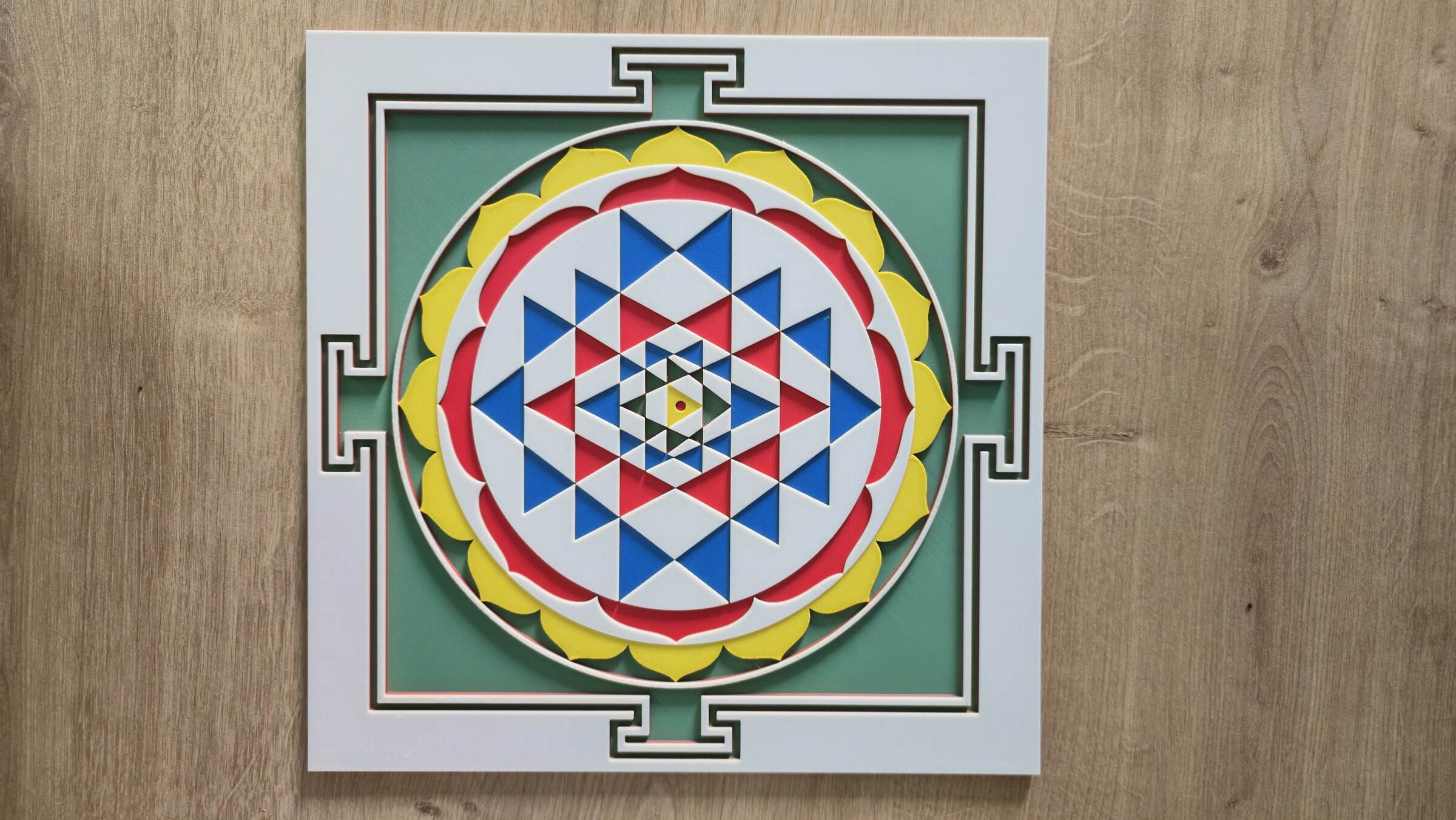
For over a thousand years, the masters of this practice have used this specific focal object.
You can practice trataka with anything.
A dot on the wall. A candle flame.
But the tantric practitioners didn't use dots or candles for their deepest work.
They used the Sri Yantra.
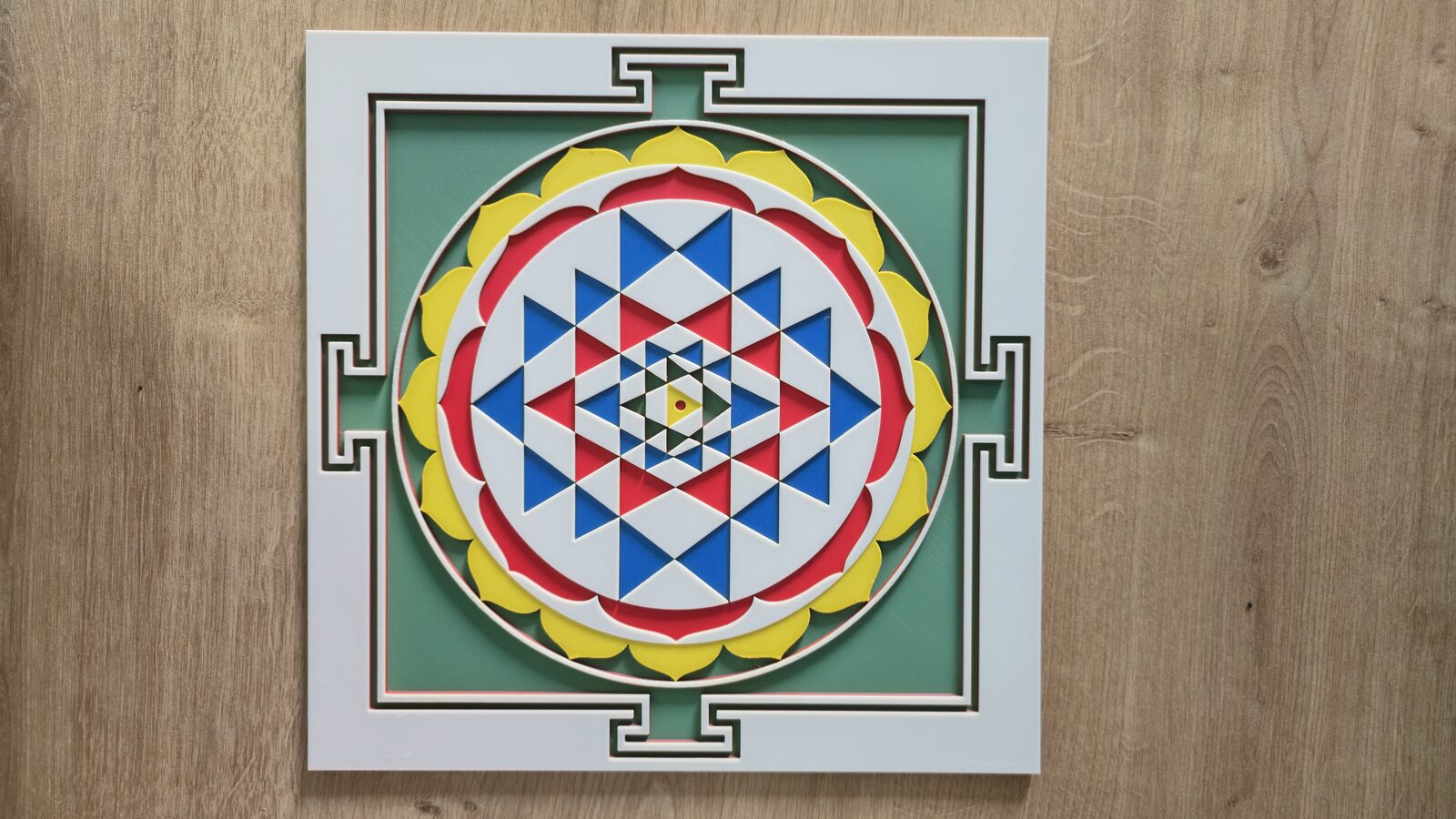
Nine interlocking triangles, four pointing upward (the masculine energy) and five pointing downward (the feminine energy), radiating from a single central point called the bindu.
Their intersection generates 43 smaller triangles across five concentric levels.
Sacred geometry representing the creation of the universe.
But set aside the symbolism.
For trataka, what matters is what this geometry does to your eyes.
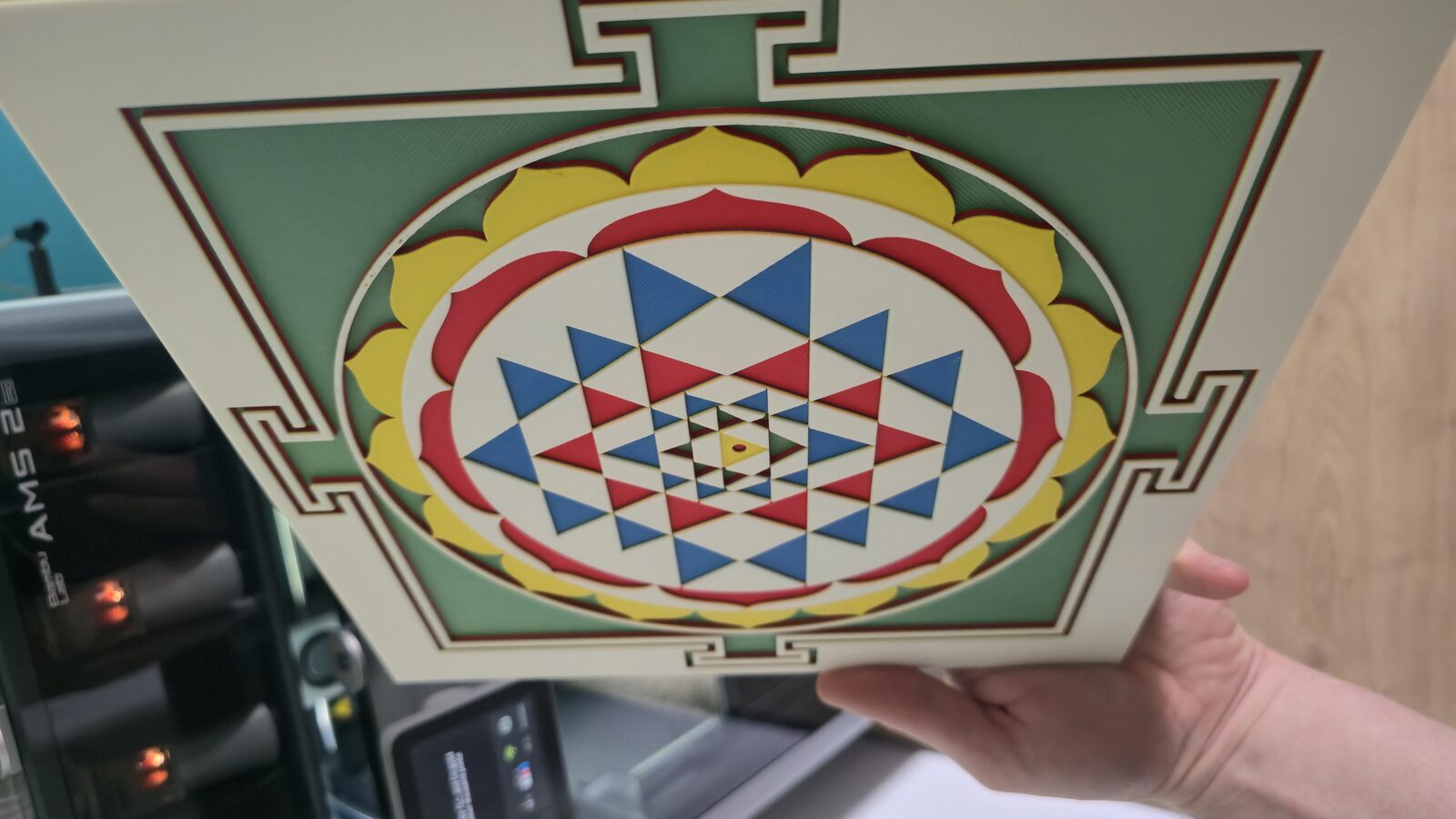
Gaze locks to the center, awareness opens to the whole.
Only after I started practicing trataka with the Sri Yantra did I realize why breath meditation never worked for me.
The breath is invisible.
Monotonous.
Internal.
There is nothing for a restless mind to grab.
The Sri Yantra gives you something extraordinary to look at: high-contrast colors, intricate interlocking geometry, and when you close your eyes, a vivid, glowing afterimage of the entire pattern floating in the dark behind your eyelids.
Almost magical the first time you see it.
That is the difference between FIGHTING to stay focused and being DRAWN into focus.
Nothing else does this as well as the Sri Yantra.
I had found the practice.
I had found the geometry.
Now I needed the physical tool.
What your focus does with each target
A dot on the wall
A candle flame
The Sri Yantra
The Sri Yantra I needed didn't exist. Everything available was built for decoration, not for practice.
I searched for a physical Sri Yantra I could use daily for trataka.
What I found was discouraging.
- Paper prints, flimsy and weightless, curling at the edges
- Large wooden carvings, beautiful but too heavy and impractical
- Small metal pendants, designed for ritual worship not steady gazing
I could use my phone or tablet, but that defeats the entire purpose.
A screen is a distraction machine with glary, artificial light.
The whole point was to step away from devices that scattered my mind in the first place.
What I wanted was simple.
Nothing like that existed.
So I built it.
I applied modern manufacturing to 3,000-year-old sacred geometry, and spent weeks getting it right.
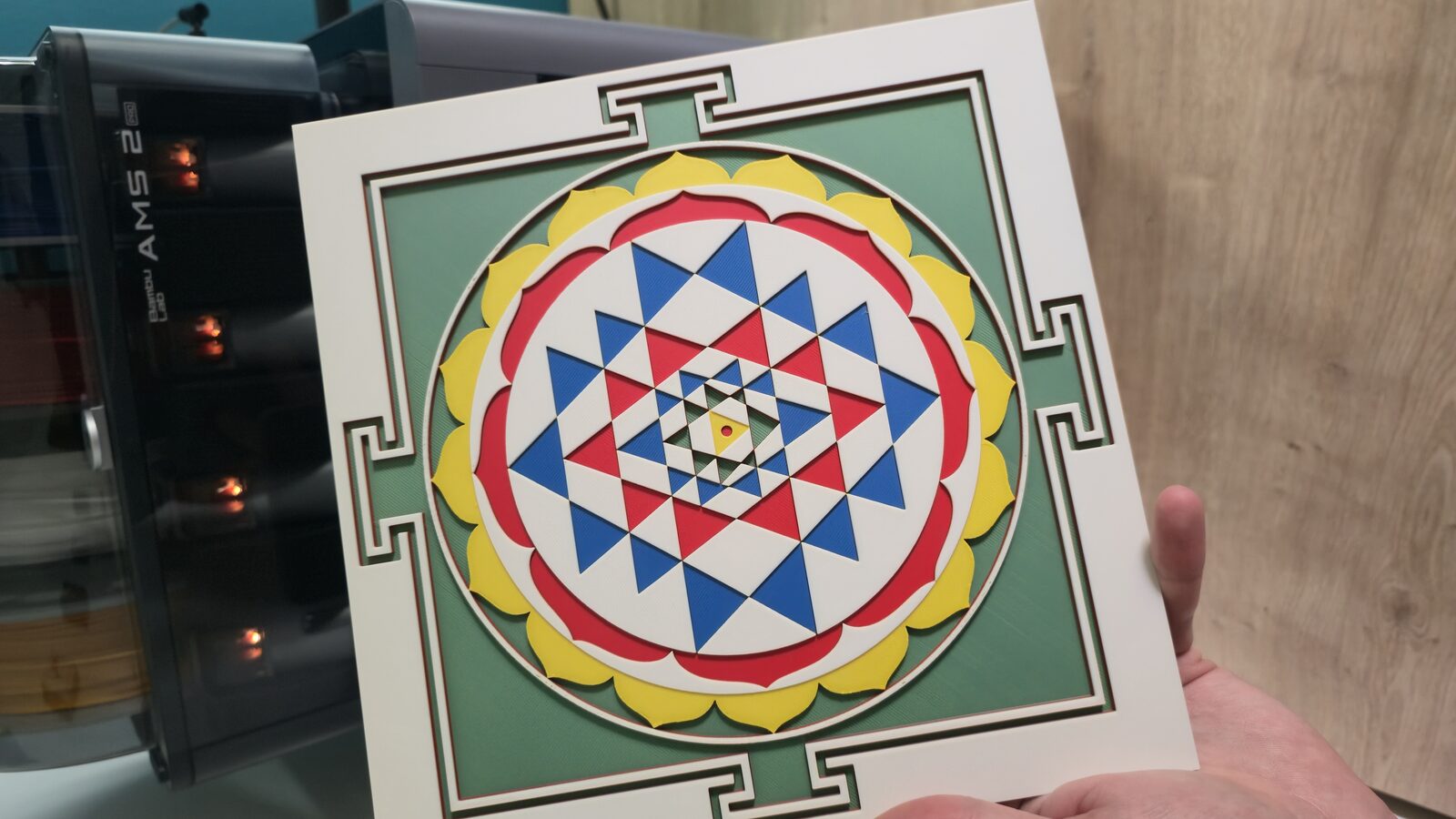
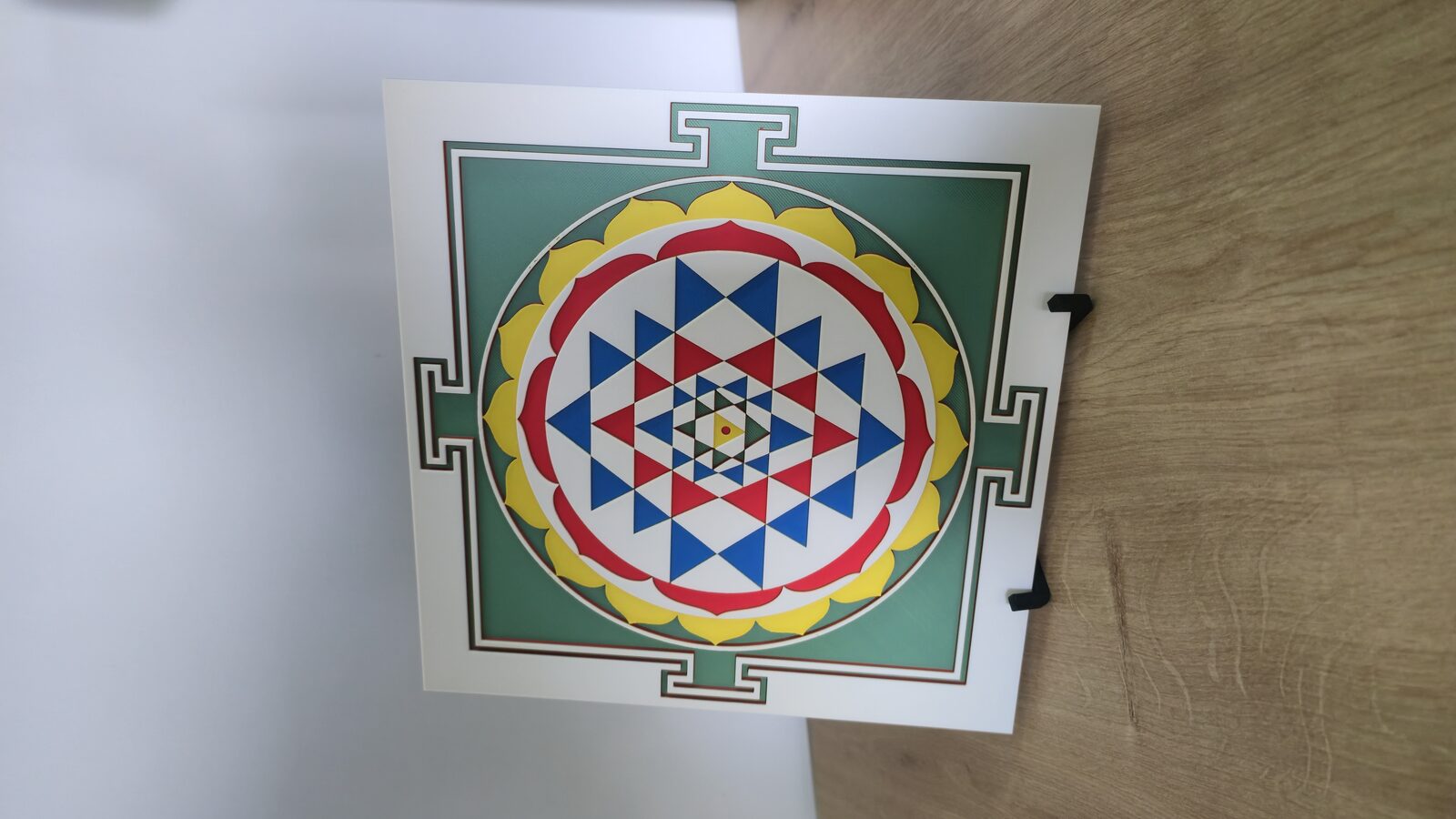
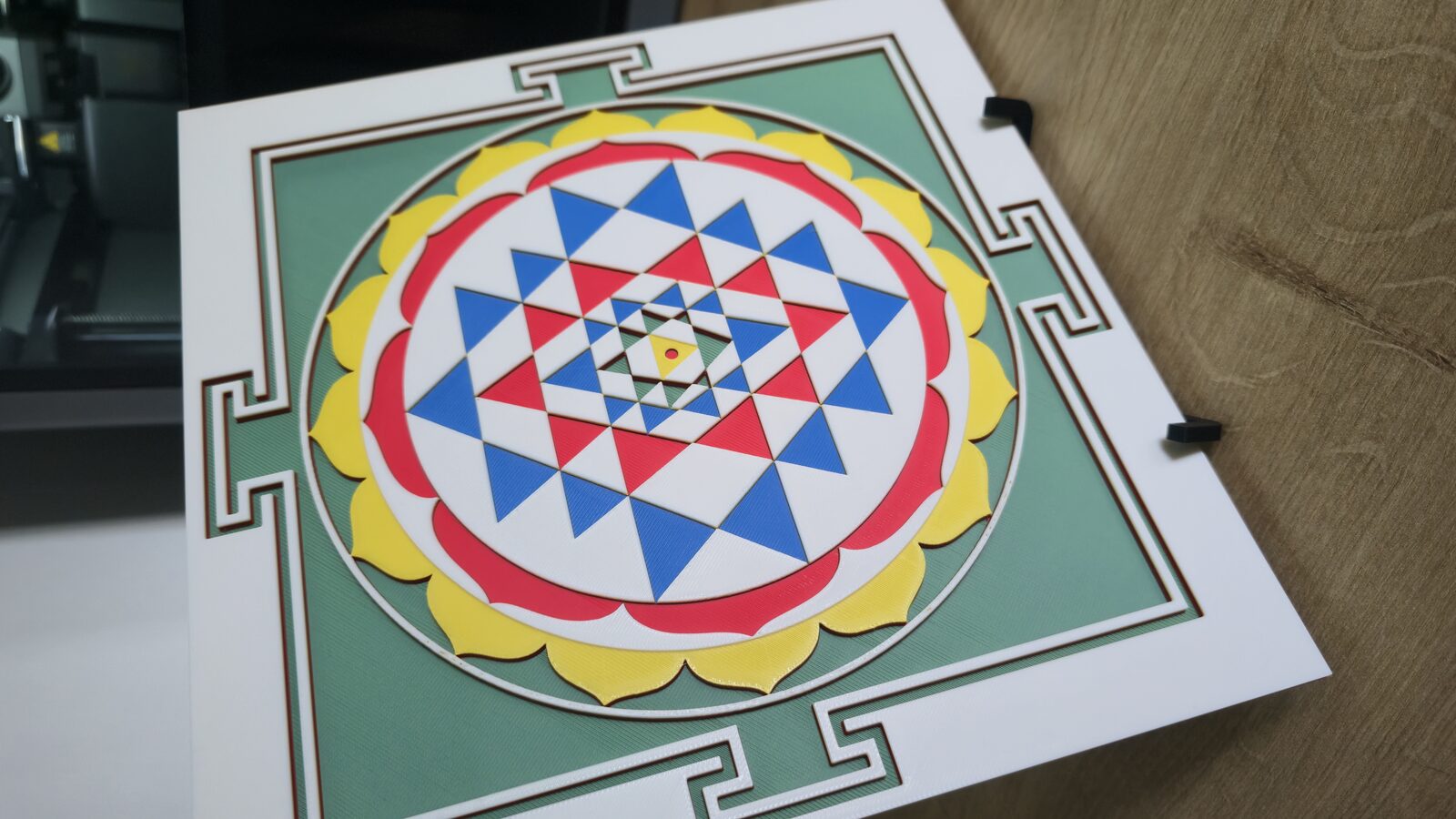
I built my first Sri Yantra using a special 3D printing technique that creates images by layering colored plastic, one thin sheet at a time.
The colors aren't painted on a surface. They are the material.
After dozens of iterations, I arrived at the perfect piece.
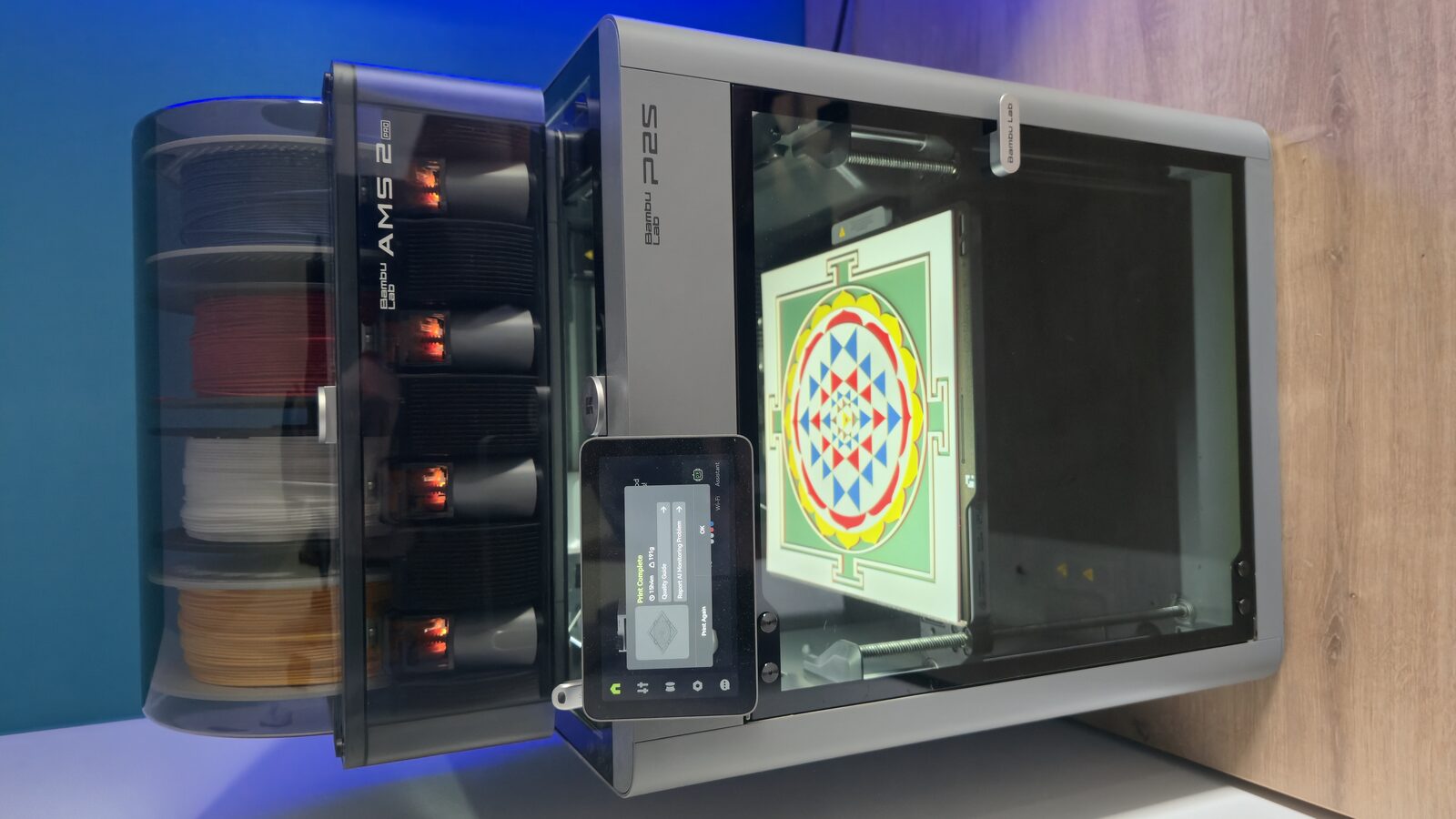
Five colors of cornstarch plastic
Fills your central vision at arm's length. Small enough for a backpack, large enough for a desk display.
Each colored layer is 0.24mm. Doesn't bend, but has a solid, springy feel. Durable and responsive. A tool, not a slab.
Can hold it comfortably in one hand, heavy enough to feel real. On the stand, it stays put. Doesn't give way to the wind.
This is not a mass-produced item. Each piece is printed to order in my home in Slovenia. I inspect every piece before it ships.
The original high-contrast tantric palette: green, white, red, blue, yellow. Printed with "matte" microscopic particles that scatter light, eliminating glare even on a sunny day.
Made from polylactide: a safe, biodegradable thermoplastic derived from renewable, plant-based sources like corn starch or sugarcane. Stable indoors for 10+ years. May have a faint sugary odor.
With daily practice
My mind learned to stay.
Not at once.
Not in the first session, or the fifth.
But slowly, rep by rep, my mind began to listen.
At some point the mind I sat down with was not the same mind that used to scatter and whine the moment anything got hard.
- I now sit with a hard task until it's done.
- I read my book for hours without checking my phone.
- I catch every word and expression in the conversations I am in.
The distractions still come. They always will.
But they fade into the background. They don't control my days anymore.
My days are driven by what I choose to do, not what distracts me in the moment.
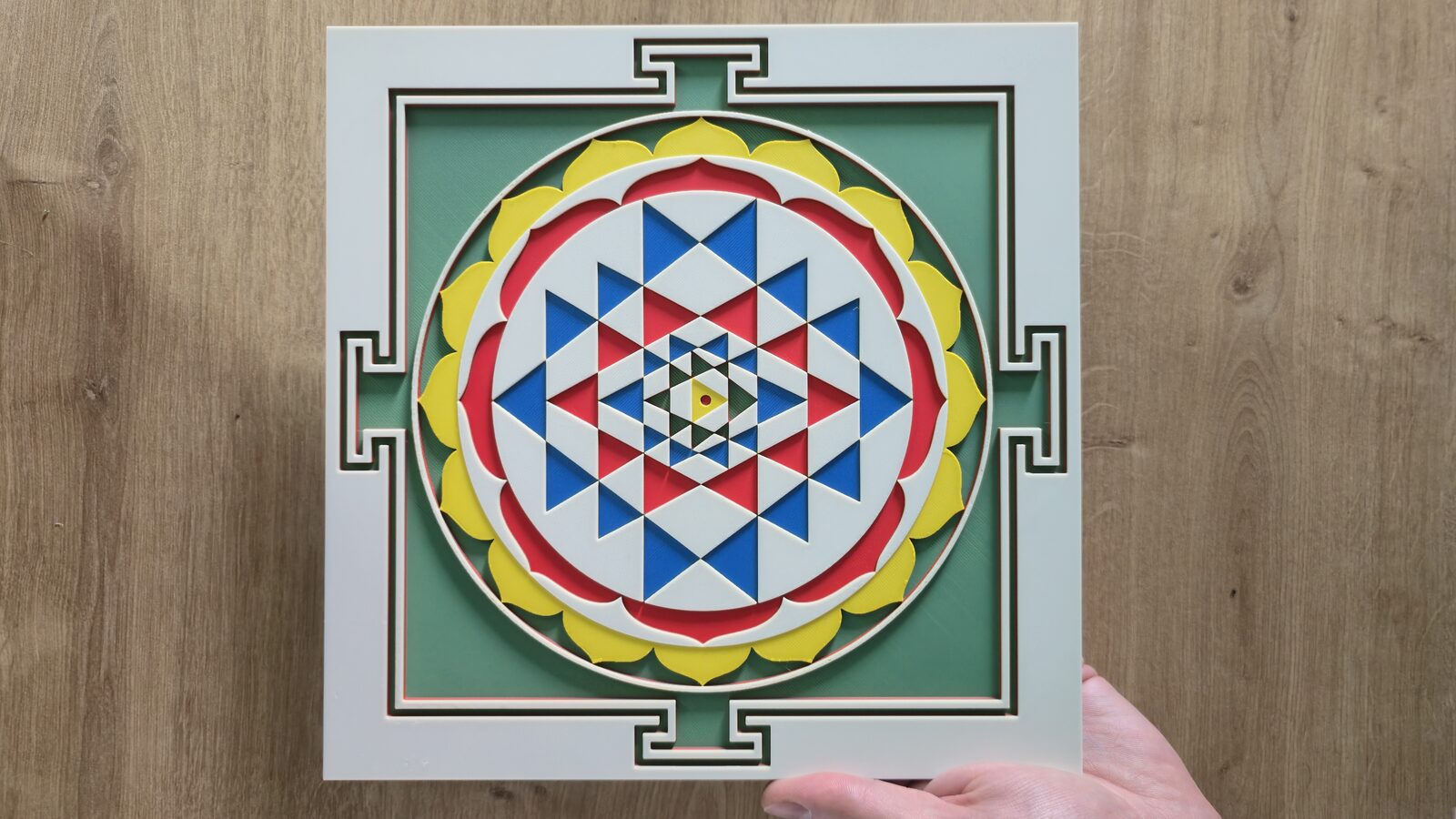
I practice trataka with my Sri Yantra multiple times a day.
One-minute sprints between tasks and ten-minute sessions in the evening.
This is not a product I designed from yoga trends.
This is the tool I built for my own practice and refined over weeks of daily use.
Hope it helps you as much as it helped me.
— Miha
Start training your focus today.
Every focusing technique you tried demanded you to fight your own mind. This one works with it.
No app subscription. No monthly fee.
One physical tool, yours forever.
The day you order, I begin the printing process. Eight hours of calibrated layering, one sheet at a time. When it's done, I inspect the piece and send it to you. Fresh off the press.
In the parcel, I'll also include a complimentary desk stand and a practice guide, and ship it at no additional cost, doesn't matter where you are in the EU.
One price. No VAT surprises, no shipping cost, no hidden fees.
Payment through Stripe: cards, Apple Pay, Google Pay, PayPal, Klarna, Revolut Pay.
Tracked delivery: 1-3 days in Slovenia, 3-8 days elsewhere in the EU.
14-day returns, full refund, no questions asked.
Write to miha.cacic@gmail.com for more info.
I currently only ship within the European Union.