How Long Should a Trataka Session Be
Miha Cacic · April 7, 2026 · 6 min read
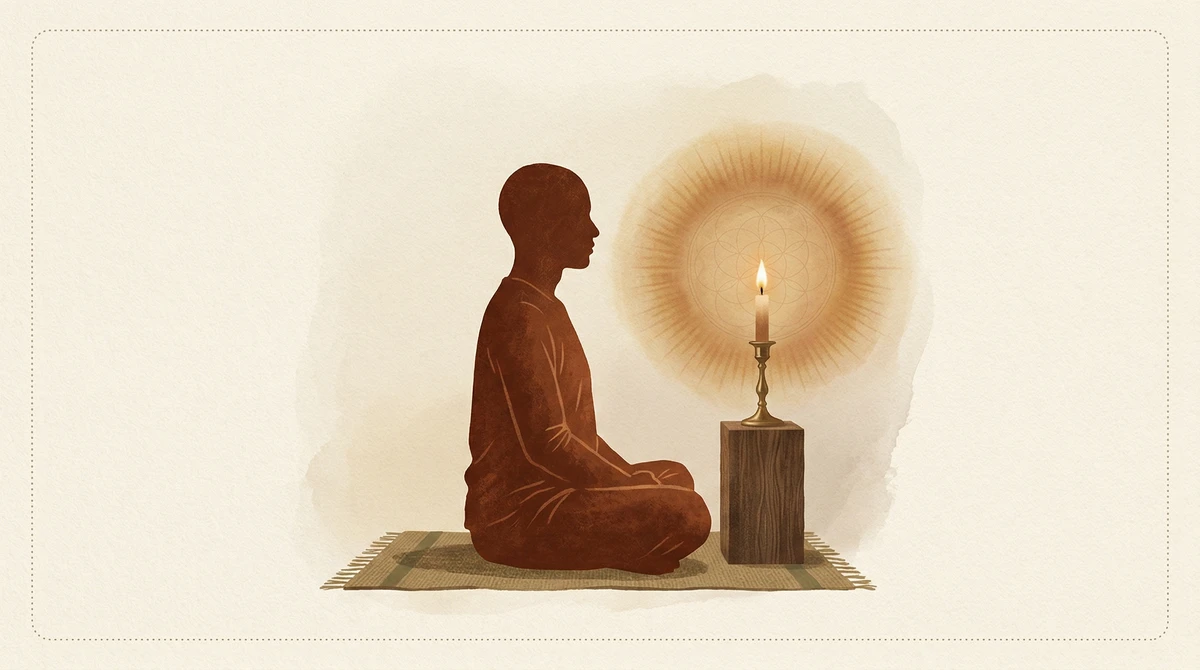
A complete trataka session runs 10 to 20 minutes. But the eyes-open gazing portion is much shorter: 10 seconds to 3 minutes per round, depending on your experience. The reason advice online seems contradictory (“start with 2 minutes” vs. “sessions last 30 minutes”) is that different sources are measuring different things. Some mean just the staring phase; others mean the entire session including preparation, gazing, eyes-closed visualization, and rest.
A trataka session has three phases, not one
Most articles treat trataka as a single activity: sit down and stare at something. That’s like describing swimming as “get wet.”
Phase 1: Preparation (2 to 5 minutes). Sit comfortably, close your eyes, and let the body settle. Follow your natural breath without controlling it. This isn’t optional padding — rushing into the gaze with a scattered mind makes the practice harder and less effective. The published research protocols all include a structured warm-up before gazing begins.
Phase 2: External gazing, or bahiranga trataka (10 seconds to 5 minutes per round). This is the eyes-open, fixed-gaze portion. You look steadily at a candle flame, dot, or yantra without blinking. The round ends when your eyes water, you feel strain, or your attention breaks, whichever comes first. For most practitioners on most days, this lasts between 30 seconds and 3 minutes.
Phase 3: Internal visualization, or antaranga trataka (1 to 5 minutes per round). Eyes closed, you hold the after-image of the object at the point between your eyebrows. This is not a bonus step. In traditional practice, the internal phase is the main event. Swami Satyananda Saraswati described one advanced round as 3 minutes of gazing followed by 27 minutes of internal visualization (Satyananda, 1976). For most people, the after-image fades within 2 to 8 seconds at first, and the internal phase becomes an exercise in gently re-summoning it.
A typical session cycles through phases 2 and 3 for 3 to 5 rounds, with brief palming between rounds. When a source says “a trataka session lasts 20 minutes,” most of that time is preparation, internal visualization, and rest — not continuous staring.
How long the gazing phase should last at each level
These numbers come from traditional teaching and the protocols used in published research.
First 2 to 4 weeks: 10 to 30 seconds per round, 2 to 3 rounds. Even if your eyes feel fine, don’t extend. In the SVYASA study on elderly participants, researchers started at just 10 seconds of gazing and still observed significant improvements in working memory and executive function after 26 days (Talwadkar, Jagannathan & Raghuram, 2014). Short works.
Months 1 to 3: 30 to 90 seconds per round, 3 to 4 rounds. Your eyes will water near the end of each round. The Hatha Yoga Pradipika (verse 2:31) defines trataka as gazing “until tears are shed.” Tears mark the natural end of the gazing phase.
Months 3 to 6: 1 to 3 minutes per round, 3 to 4 rounds. The Corsi-Block study at SVYASA used 2 to 3 minute rounds for 3 rounds and found significant improvements in visuospatial working memory and spatial attention (Swathi, Bhat & Saoji, 2021). This is also the range where internal visualization starts to deepen and become more absorbing than the external gaze.
6+ months: 3 to 5 minutes per round. The practice often shifts toward predominantly internal trataka. The external gaze becomes a brief ignition, and the internal visualization carries the session.
One principle: longer gazing is not more advanced. Swami Satyananda warned that gazing well beyond 3 minutes tends to become “Shunya Trataka” — blank, unfocused gazing rather than concentrated observation (Satyananda, 1976). A relaxed 30-second gaze with full attention beats a strained 5-minute stare.
Why the numbers differ between sources
If you’ve searched this question, you’ve noticed the chaos: one site says 2 minutes, another says 20, and a third says build to one minute over a year. They’re describing different approaches to the same practice.
Trataka as purification (shatkarma). In the Hatha Yoga Pradipika tradition, trataka is one of six cleansing practices. The goal is to gaze until tears flow freely, flushing and cleansing the eyes. Duration is dictated by the body, not a timer. Sessions may be shorter because the tear reflex comes faster with practice.
Trataka as concentration training (dharana). In the Bihar School approach, the goal is one-pointed focus. You gaze until attention breaks or eyes fatigue, then switch to internal visualization. The emphasis is on the quality of attention, not whether tears appear. Satyananda stated that in this approach, “tears should not roll down. No strain at all” (Satyananda, 1976) — a deliberate departure from the Hatha Yoga instruction, reflecting a different goal.
Trataka as meditation preparation. In some Tantric and extended Bihar School sessions, trataka is step one in a longer sequence that includes pranayama and deeper meditation. The gazing portion stays deliberately short to preserve energy for what follows.
Candle vs. non-candle objects. The strongest cautions about duration apply specifically to candle gazing, because you’re staring at a bright point-source of light. For a non-luminous object (a yantra, a black dot, a symbol), the constraint is attention and eye muscle fatigue, not retinal exposure. Longer gazing may be appropriate with non-flame objects.
How long to practice based on your goal
Concentration and focus (the most common goal). 10 to 15 minute sessions, 2 to 3 minutes of gazing per round, 2 to 3 rounds. Daily practice. This is the protocol closest to what the Stroop study used when it found a 26% improvement in cognitive interference scores after a single 25-minute session (Raghavendra & Singh, 2016). Of that 25 minutes, about 4 to 9 minutes was actual gazing.
Stress relief and relaxation. 15 to 20 minute sessions with a longer preparation phase and extended palming at the end. 3 to 5 times per week is sufficient. The relaxation comes as much from the preparation and palming phases as from the gaze itself.
Eye comfort (kriya approach). Shorter gazing rounds (1 to 2 minutes), pushed to tears, with palming and eye washing afterward. Daily for defined periods. This is trataka in its original role as a shatkarma (purification practice).
Meditation and contemplative practice. 20 to 30 minute sessions where the gazing portion stays modest (3 to 5 minutes total across rounds) and the internal visualization and stillness phases extend. The gaze is the doorway; the stillness behind it is the destination.
The 10-minute rule and retinal safety
You’ll find the claim “never gaze at a candle for more than 10 minutes” repeated across many trataka guides. Here’s where it comes from and how much weight it carries.
The original traditional source appears to be the Bihar School lineage. Swami Satyananda warned in 1976 that “any light, if it makes a permanent impression on the retina… that particular point becomes dead” and advised against continuing candle gazing “for a very long time” or “for many months” (Satyananda, 1976). He capped the external gaze at 3 minutes per round by pointing out that gazing beyond that becomes Shunya (blank) rather than focused.
The “10-minute maximum” that circulates online is harder to trace to a single source. It likely comes from conflating total session time with gazing time, or from roughly calculating 3 rounds of 3 minutes each.
What does ophthalmology say? A candle flame has low luminance compared to sunlight and does not approach the brightness levels associated with acute phototoxic retinal damage in clinical literature. No peer-reviewed study has documented retinal injury from candle gazing at trataka durations. The SVYASA safety letter confirmed that their trataka protocol was “feasible, safe, and can be practiced by the elderly without worsening their eyesight problems” (Talwadkar, Jagannathan & Nagarathna, 2015). Even in a glaucoma RCT at AIIMS New Delhi, a modified trataka protocol produced no adverse effects (Sankalp et al., 2022).
The honest conclusion: the 10-minute cap for candle gazing is a reasonable precaution worth following, even though no study has documented harm at these exposure levels. For non-luminous objects like a dot or yantra, the constraint is attention and eye muscle fatigue, not retinal risk. None of this matters if your gazing rounds stay in the 1 to 3 minute range, which they should for the vast majority of practitioners.
Signs your session length is right (and when it’s not)
Numbers are useful starting points, but your body gives better feedback than any timer.
Signs you’re going too long: Persistent redness that doesn’t resolve with palming. Headache at the brow center. Increased agitation rather than calm after practice. Blurry vision lasting more than a few minutes. If any of these happen, shorten your gazing rounds next session.
Signs you’re cutting it too short: You never reach a quiet-mind moment. You never see the after-image. The session feels rushed and incomplete before you’ve had a chance to settle.
Signs you’ve found the right length: Gentle tearing (not painful). The after-image appears clearly and you can hold it for a few seconds. Your mind reaches a quiet interval, even briefly. You feel refreshed rather than drained afterward.
In the Hatha Yoga Pradipika’s approach, the onset of tears marks the natural end of the gazing phase (HYP, verse 2:31). You don’t push through tears — you close your eyes and begin the internal visualization. If you’re wondering whether blinking during the gaze is okay, the answer is that a relaxed, steady gaze is the goal, not an endurance contest.
How to build duration over time
Here’s a progression based on the protocols used in research and the Bihar School’s traditional teaching.
Weeks 1 to 2: Learn the form. 10-second gazes, 2 to 3 rounds, 10-minute total sessions. Focus on learning the cycle: gaze, close eyes, visualize, palm, repeat. Don’t worry about duration yet.
Months 1 to 2: Build stamina. 30 to 60 second gazes, 3 rounds, 12 to 15 minute sessions. You’ll start to notice the after-image becoming more vivid and lasting longer. The internal visualization phase becomes more interesting than the external gaze.
Months 3 to 6: Deepen. 1 to 3 minute gazes, 3 to 4 rounds, 15 to 20 minute sessions. Internal visualization becomes the main event. Some practitioners find they can summon the after-image almost immediately after closing their eyes.
Month 6 and beyond: Mature practice. 3 to 5 minute gazes (if using candle, keep total gazing under 10 minutes), extended internal trataka, 20 to 30 minute sessions. Some practitioners transition to primarily internal or void-gazing practice.
The only wrong approach is forcing duration at the expense of relaxation. Add time gradually and stay consistent.
Sources
- Satyananda Saraswati, Swami. (1976). “Tratak.” Yoga Magazine, May 1976. Bihar School of Yoga.
- Svatmarama. Hatha Yoga Pradipika, Ch. 2, verses 31-32. (15th century CE). Bihar School of Yoga edition: Muktibodhananda S, Saraswati SS. Munger: Yoga Publications Trust; 2000.
- Gheranda. Gheranda Samhita, Ch. 1, verses 53-54. (17th century CE). Commentary: Niranjanananda SS. Munger: Yoga Publications Trust; 2012.
- Talwadkar S, Jagannathan A, Raghuram N. (2014). “Effect of trataka on cognitive functions in the elderly.” International Journal of Yoga, 7(2), 96-103. PMC4097909.
- Talwadkar S, Jagannathan A, Nagarathna R. (2015). “Response to ‘trataka and cognitive function.‘” International Journal of Yoga, 8(1), 83. PMC4278143.
- Swathi PS, Bhat R, Saoji AA. (2021). “Effect of Trataka (Yogic Visual Concentration) on the Performance in the Corsi-Block Tapping Task: A Repeated Measures Study.” Frontiers in Psychology, 12, 773049. PMC8718544.
- Raghavendra BR, Singh P. (2016). “Immediate effect of yogic visual concentration on cognitive performance.” Journal of Traditional and Complementary Medicine, 6(1), 34-36. PMC4738033.
- Sankalp, Dada T, Yadav RK, Sharma HB, Netam RK, Kochhar KP. (2022). “Effect of Tratak (Yogic Ocular Exercises) on Intraocular Pressure in Glaucoma: An RCT.” International Journal of Yoga, 15(1), 59-69. PMC9015087.
- Gopinathan G, Dhiman KS, Manjusha R. (2012). “A clinical study to evaluate the efficacy of Trataka Yoga Kriya and eye exercises in the management of Timira.” Ayu, 33(4), 543-546. PMC3665208.
- The Yoga Institute. (2022). “Trataka Meditation — Yogic Eye Care.” theyogainstitute.org.