What Is Trataka Meditation? Yogic Gazing Explained
Miha Cacic · April 7, 2026 · 5 min read
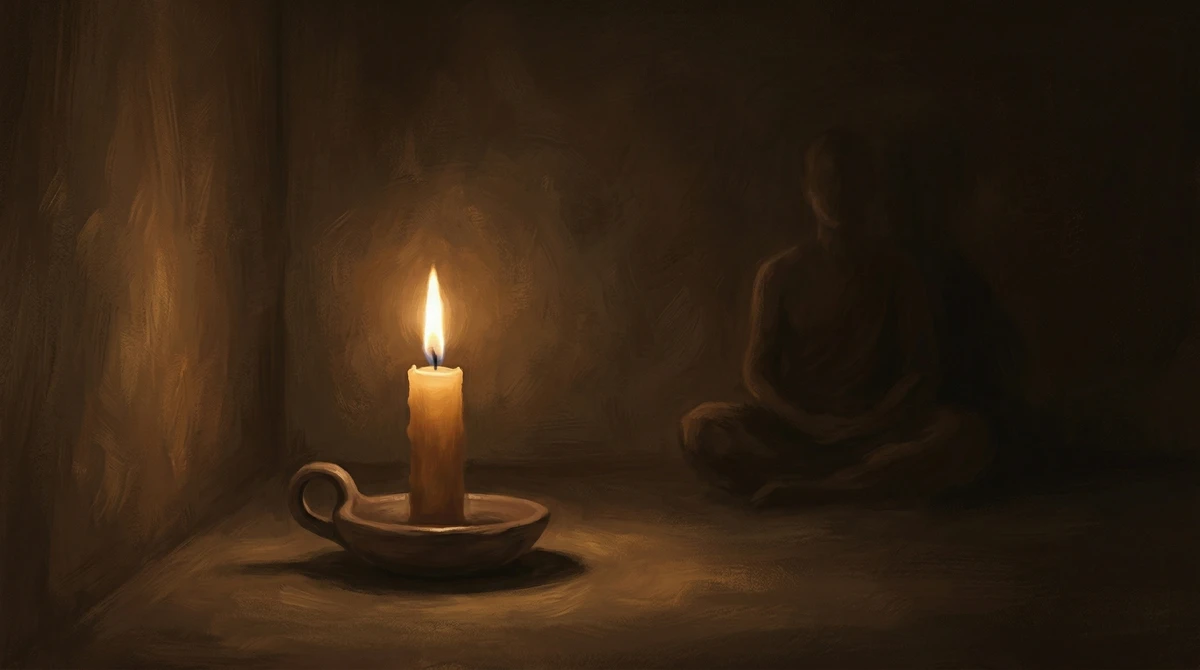
Trataka is a yogic gazing practice where you fix your eyes on a single point (usually a candle flame) until the mind follows the gaze into stillness. It is one of the oldest focus-training methods in existence, codified in the 15th-century Hatha Yoga Pradipika as one of six bodily purification techniques. Technically, it is not meditation. It is a concentration exercise that leads to meditation, which is why it works so well for people who struggle with eyes-closed practices.
Most people today know it as “candle gazing meditation” or simply “gazing meditation.”
What trataka means
“Trataka” (also spelled “tratak”) comes from the Sanskrit root meaning “to look” or “to gaze steadily.” The Hatha Yoga Pradipika defines it precisely: “Being calm, one should gaze steadily at a small mark, till eyes are filled with tears. This is called Trataka by the acharyas” (HYP 2:31, Pancham Sinh translation).
Trataka belongs to the shatkarmas, a set of six cleansing techniques in hatha yoga. The other five (dhauti, basti, neti, nauli, and kapalabhati) are purely physical: nasal irrigation, stomach cleansing, abdominal churning. Trataka is the outlier. It is the only shatkarma that works on the mind directly.
The slightly later Gheranda Samhita (late 17th century) repeats the same instruction and adds a bolder claim: that trataka produces “divyadrishti” (divine sight) and “destroys all diseases of the eye” (GS 1:53-54). Whether you take the esoteric claims literally or read them as metaphors for sharpened perception, the practical instruction is identical across both texts: gaze at a small point, don’t blink, continue until tears come.
Why gazing quiets the mind
You can observe the gaze-mind link right now. Notice how your eyes dart when you’re anxious and how still they become when you’re calm. This is not just correlation. Research on eye movements and cognition shows that eye movements both reflect and influence higher mental functions like memory and decision-making.
The anatomy explains why. The retina is not a peripheral sense organ like the skin or ear. It develops from the diencephalon (forebrain) and is technically central nervous system tissue. Roughly half of the cortex is involved in processing visual information, directly or indirectly. When your eyes move (scanning, saccading, tracking), they generate constant input that keeps your brain’s arousal systems active. When the gaze is fixed, that input drops.
A 2023 study by Krause and Poth in iScience tested this directly. They found that maintaining eye fixation reduced cognitive conflict on a spatial Stroop task with a medium effect size (d = 0.49), without slowing reaction time or reducing accuracy. Fixation was cognitively “free.” Their proposed mechanism: fixed gaze locks spatial attention via topographic priority maps in the brain, reducing processing of irrelevant spatial information. They call it “attentional disinhibition.”
The autonomic nervous system responds too. Raghavendra and Ramamurthy (2014) measured heart rate variability in 30 volunteers before and after a single trataka session. They found increased vagal tone (higher HF component of HRV) and reduced sympathetic arousal (lower LF component), along with decreased heart rate and breath rate. The researchers concluded that trataka could induce a calm state comparable to what meditation produces.
A 2025 systematic review by Roj et al. ties these findings together into a proposed chain: sustained gaze fixation enhances thalamic filtering of irrelevant stimuli, quiets the default mode network (the brain’s mind-wandering circuit), and improves cognitive performance. The mechanism is not mystical. Your visual system is a gateway to your attention system, and trataka uses that gateway deliberately.
Trataka is not meditation (but it leads there)
This distinction matters for how you practice. In Patanjali’s Yoga Sutras, the path from ordinary distraction to absorbed stillness passes through three stages: dharana, dhyana, and samadhi. Dharana is concentration, the effortful fixing of attention on one point. Dhyana is meditation, the moment that effort dissolves into an unbroken flow. Samadhi is absorption, where the boundary between observer and object disappears.
Trataka is a dharana practice. You are actively working to hold your gaze and attention on the flame. If you sit down expecting passive relaxation (the way many people think of “meditation”), you will get frustrated. The effort is the point. You are training the attention to stay, the way you would train a muscle by holding a weight.
Meditation happens after the gazing phase, when you close your eyes and sit with the concentrated mind. This is why traditional trataka instructions always include a second phase: after gazing, close your eyes and observe whatever remains (the afterimage, the stillness, or the space itself). The gazing builds the concentration. The eyes-closed phase is where that concentration can deepen into meditation.
In the yoga tradition, trataka is classified as a shatkarma (cleansing practice) because it “cleanses” the mind of restlessness, preparing it for the subtler work of concentration meditation.
The two stages: external and internal trataka
The full trataka practice has two distinct stages, and most people only know about the first one.
Bahir trataka (external) is the gazing phase: eyes open, fixed on a physical object. This is the part everyone describes. It trains concentration by giving untrained attention something concrete and visible to grip.
Antar trataka (internal) is what follows: you close your eyes and hold the afterimage of the object at the center of your visual field. If you’ve been gazing at a candle flame, you’ll see a vivid imprint, often shifting colors (blue, green, purple). The work is to hold your attention on this internal image steadily, without chasing it as it moves or fades. This is a subtler and more demanding form of concentration.
The internal stage is the actual destination. External trataka is scaffolding. When the afterimage fades and your attention remains steady in the space where it was, you have crossed into meditation territory. Swami Satyananda Saraswati describes this transition as the gateway to pratyahara (sensory withdrawal), the step that precedes deep meditation in the yogic framework. 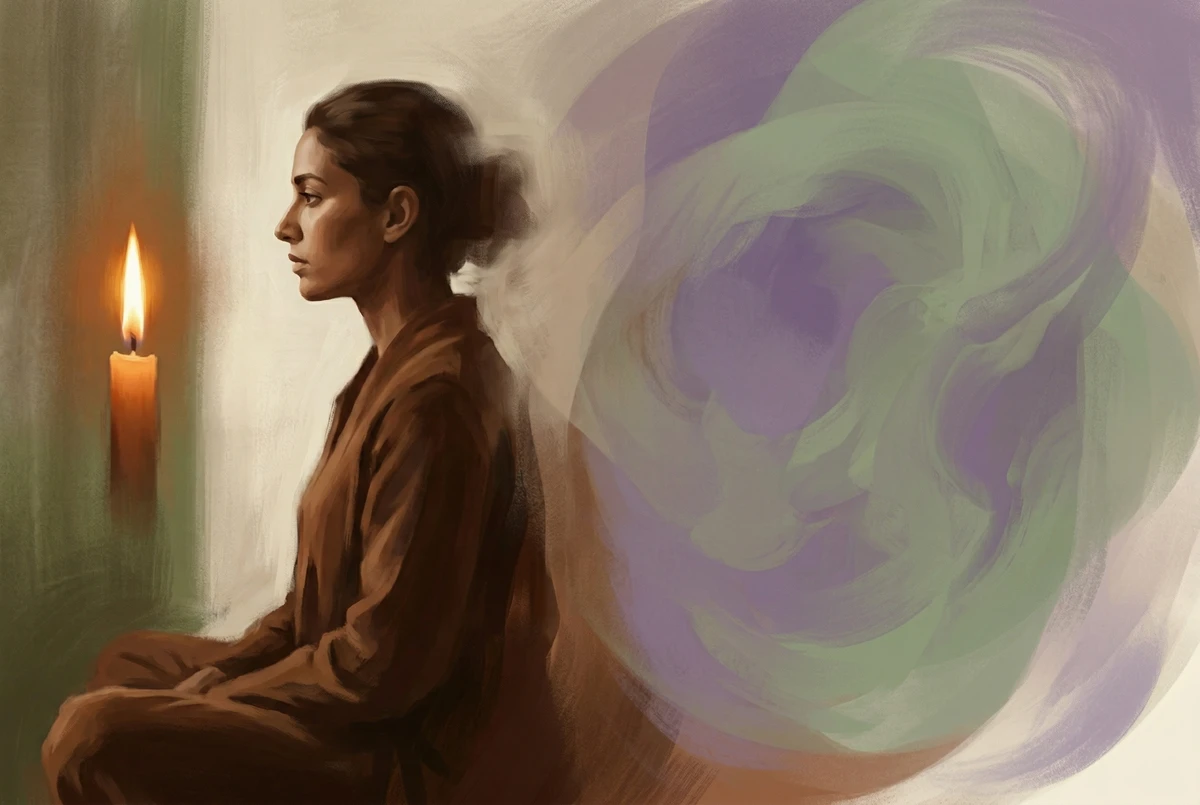
Advanced texts mention a third stage: shunya trataka (void gazing), where the practitioner gazes into empty space with no object at all. This corresponds to the final progression from form to formlessness, but it is far beyond where most practitioners need to start.
What you can gaze at (and why the candle flame dominates)
You can practice trataka with many objects: a black dot on white paper, a yantra, a deity image, the tip of the nose, the rising sun (only when orange, near the horizon, never when bright), the moon, or a star.
But the candle flame is the most widely used, and for practical reasons that matter:
The flame is luminous and naturally draws the eyes, making sustained attention easier than staring at a static dot. It produces a strong, clear afterimage when you close your eyes, which is essential for the internal (antar) phase. The gentle flicker provides just enough variation to maintain visual interest without becoming a distraction. And practicing in a dark room eliminates competing visual input, creating a natural sensory reduction that supports concentration.
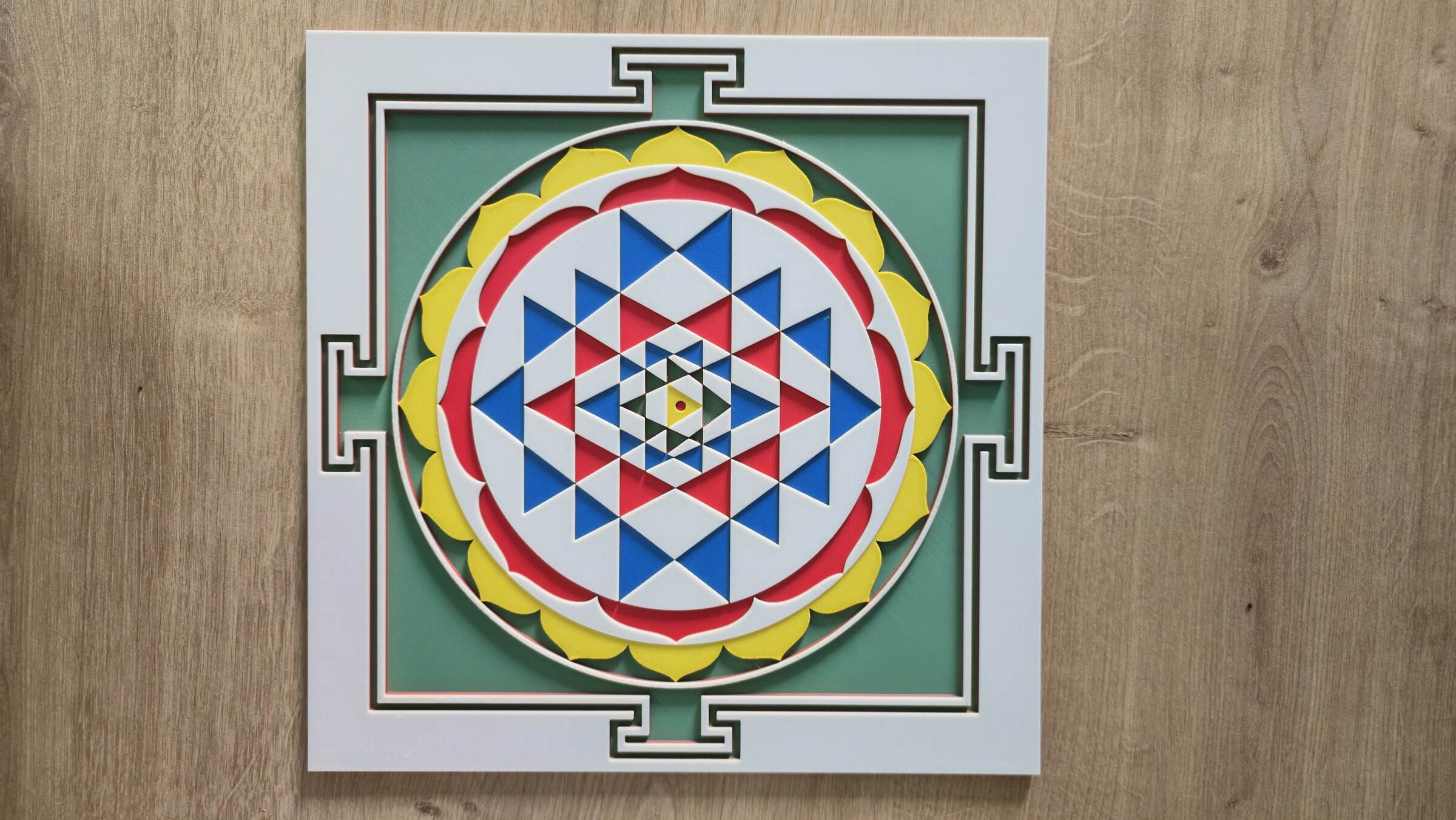
The Sri Yantra, a complex geometric diagram from the tantric tradition, is another traditional trataka object. Its nested triangles and central point (bindu) provide a structured focal path that some practitioners prefer to the simplicity of a flame. Yantra-based trataka works differently from candle trataka: the complexity of the geometry engages spatial processing, and the afterimage tends to be more structured.
For people concerned about eye strain from candle gazing, a non-luminous object (dot, symbol, or yantra) avoids the brightness contrast entirely while preserving the core mechanism of fixed-point concentration. You can practice trataka without a candle entirely.
What happens when you practice
The most common question from new practitioners is “Am I doing it right?” Here is what to expect, based on the classical progression and what practitioners consistently report:
First 30 seconds. Eyes feel normal. Mind wanders. You notice thoughts, sounds, itches. This is ordinary distraction, and it is where you start.
30 seconds to 2 minutes. The urge to blink builds. Minor watering begins. You may notice your attention starting to narrow as the effort to hold the gaze occupies more of your mental bandwidth.
2 to 5 minutes. Eyes water more freely. Vision may sharpen or blur at the edges. Peripheral vision dims (this is the Troxler effect, a well-documented psychophysical phenomenon where the brain stops processing unchanging peripheral stimuli). The flame may appear to grow larger or develop a halo. The mind quiets, not because you forced it to, but because sustained visual effort crowds out the usual chatter.
The tears. The Hatha Yoga Pradipika names tears as the endpoint of the external phase (“ashru-sampata-paryantam,” until tears fall). They are both a physiological reflex (your cornea drying slightly triggers your lacrimal glands) and a signal: sustained attention has overridden the blink reflex, indicating a shift in autonomic nervous system state.
Eyes close: the afterimage. When you close your eyes, a vivid imprint of the flame appears at the center of your visual field. It shifts colors, drifts, and eventually fades. Your work during antar trataka is to hold your attention on it. When it disappears, you sit in the residual stillness. This is where meditation begins.
Should you blink? The non-blinking instruction is a goal to work toward, not a rigid rule for day one. Gentle blinking is fine, especially for beginners. The classical instruction describes the endpoint of a developed practice, not the starting requirement.
What about the research? A 2016 study by Raghavendra and Singh found that a single 25-minute trataka session improved selective attention by 26% on a Stroop color-word test compared to a control session of eye exercises and quiet sitting. Talwadkar et al. (2014) found that 26 days of daily trataka improved working memory, selective attention, and executive function in elderly participants, with effects persisting at a one-month follow-up. Kumari et al. (2022) demonstrated that trataka improved spatial working memory (Corsi-block tapping task) where eye exercises alone had no effect, suggesting the gazing component itself, not just eye movement, drives the cognitive change.
The evidence base is still young (a 2024 PRISMA review identified only 16 trataka-specific studies published between 2000 and 2024), and most studies come from Indian yoga universities with small sample sizes. But the results converge across different cognitive tests and populations, and the mechanistic explanations from neuroscience (attentional disinhibition, DMN quieting, vagal tone increase) are consistent with what practitioners have described for centuries.
Trataka does not require belief in any tradition. It requires a point to look at, a willingness to sit still, and about ten minutes. The gaze-mind link it exploits is not cultural. It is anatomical. And the simplicity of the practice (look at a thing, don’t look away) is precisely what makes it effective as a first step toward deeper meditation practice.
Sources
- Svatmarama. (15th c.). Hatha Yoga Pradipika, 2:31-32. Pancham Sinh translation (1914). sacred-texts.com.
- Gheranda. (17th c.). Gheranda Samhita, 1:53-54.
- Patanjali. Yoga Sutras, 3.1-3.3. Swami Satchidananda translation.
- Raghavendra, B.R. & Singh, P. (2016). “Immediate effect of yogic visual concentration on cognitive performance.” Journal of Traditional and Complementary Medicine, 6(1), 34-36. PMC4738033.
- Raghavendra, B.R. & Ramamurthy, V. (2014). “Changes in heart rate variability following yogic visual concentration (Trataka).” Heart India, 2(1), 15-18.
- Talwadkar, S., Jagannathan, A. & Raghuram, N. (2014). “Effect of trataka on cognitive functions in the elderly.” International Journal of Yoga, 7(2), 96-103. PMC4097909.
- Kumari, S., Feldhaus, H.G., Gomes, C.M. et al. (2022). “Effect of Trataka on the Performance in the Corsi-Block Tapping Task.” Frontiers in Psychology. PMC8718544.
- Krause, A. & Poth, C.H. (2023). “Maintaining eye fixation relieves pressure of cognitive action control.” iScience. PMC10457444.
- Roj et al. (2025). “Trataka and cognition: A systematic review with a proposed neurophysiological mechanism.” Journal of Neurosciences in Rural Practice.
- “The Retina.” Neuroscience, 2nd ed. NCBI Bookshelf, NBK10885.
- MIT News. (1996). “In the blink of an eye.” news.mit.edu.