Why You See Colors During Trataka (And What They Mean)
Miha Cacic · April 7, 2026 · 6 min read
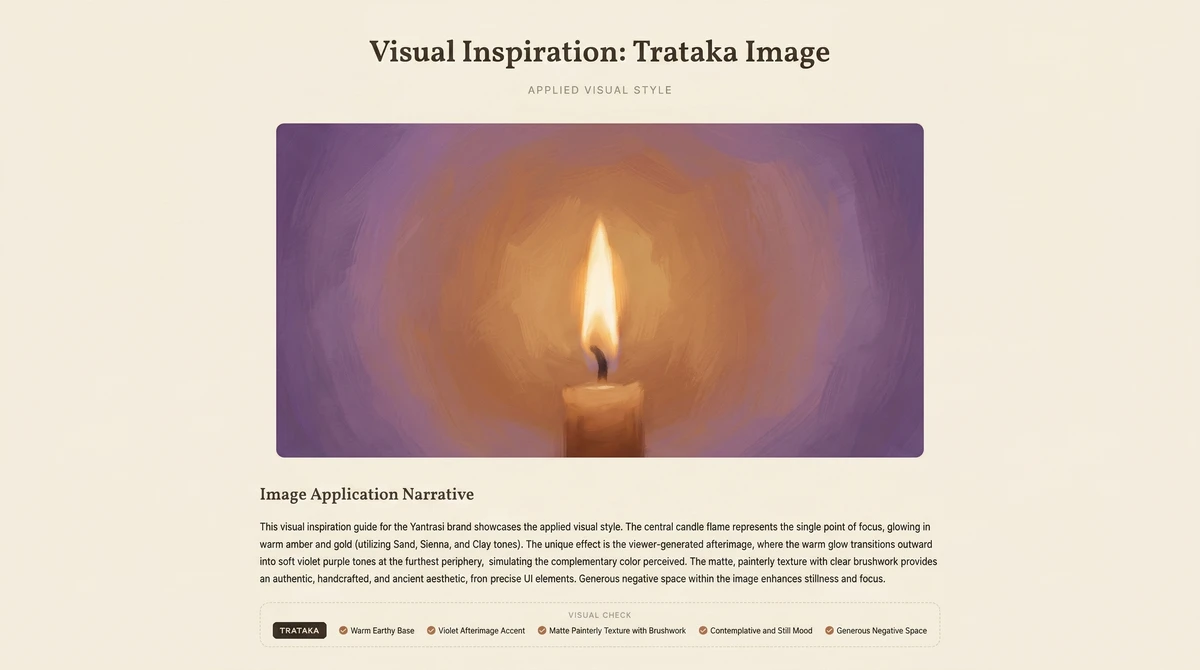
The colors you see during trataka have precise biological explanations, and different colors at different moments come from entirely different mechanisms. The blue or violet that appears when you close your eyes is the mathematically predictable complement of the candle’s yellow-orange light. The swirling patterns and independent colors that show up later come from somewhere else entirely: your visual cortex generating its own activity.
Most articles either wave at “afterimages” without explaining why they’re always purple, or jump to chakra associations with no mechanism. There are at least three distinct color phenomena happening during a single trataka session, each with its own biology.
The three phases of color in trataka
Practitioners tend to blend several different visual events into one account. Separating them clarifies what’s happening and why.
Phase 1: During the gaze. Your eyes are open, fixed on the flame. You’re seeing actual photons. The candle flame contains multiple colors: a blue base (incomplete combustion, around 450nm wavelength), a bright yellow-white middle zone where soot particles incandesce (the hottest part, around 570-590nm), and a cooler orange-red tip. You might also notice the area around the flame beginning to fade or dissolve. That’s Troxler’s fading, identified by Ignaz Paul Vital Troxler in 1804: when you fix your gaze and suppress the tiny eye movements (microsaccades) that normally refresh your visual field, unchanging stimuli in your peripheral vision disappear from awareness.
Phase 2: Immediately after closing your eyes. First, a brief positive afterimage: the flame appears in its original colors for a fraction of a second as residual retinal activity persists. Then the negative afterimage takes over. The colors invert. The yellow-orange flame becomes blue-violet. This lasts anywhere from 5 to 30 seconds, depending on how long you gazed, the brightness of the flame, and how dark the room is. This is the phase most people mean when they say “I see colors.”
Phase 3: After the afterimage fades. Colors and patterns that have nothing to do with the flame. Pulsing lights, geometric shapes, spirals, colored halos. These are phosphenes and cortical activity, generated internally. This phase can be subtle or vivid, and it’s where the experience of long-session practitioners diverges most from beginners.
The timing tells you which phenomenon you’re experiencing. If it appears in the first 30 seconds after closing your eyes and matches the shape of the flame, it’s an afterimage. If it appears later and looks nothing like a flame, it’s your visual cortex.
Why the afterimage is blue or violet when the flame is yellow
Your visual system works in opponent pairs. The opponent-process theory, proposed by Ewald Hering in 1878, describes how color perception operates through three antagonistic channels: red-green, blue-yellow, and black-white. When you stare at a yellow-orange flame for several minutes, the neural pathways processing that color adapt. When the stimulus disappears, the opposing channel rebounds, and you see the complement: blue-violet.
For decades, textbooks attributed this to photoreceptor “bleaching” in the cones. That explanation doesn’t hold at normal light levels. Zaidi, Ennis, Cao, and Lee (2012) showed that afterimage signals are generated by post-receptor rebound responses in retinal ganglion cells, not by photoreceptor fatigue. The adaptation happens downstream from the cones, with time constants of 5-12 seconds, which matches how long your afterimage takes to develop and fade.
Here’s what makes the “always purple” phenomenon precise. Koenderink, van Doorn, and Albertazzi (2020) measured afterimage hues for 24 inducer colors across 17 participants. Their key finding: almost the entire warm half of the color wheel (orange through yellow to chartreuse) produces afterimages that cluster in a narrow range of purples. Not blue, not random. Purple. Since a candle flame sits squarely in that orange-to-yellow range, purple is the single most predicted afterimage color for candle trataka.
Practitioners across centuries have independently reported the same color because the visual system’s response to yellow-orange light is that consistent.
If your afterimage has multiple colors (green in one area, purple in another), you’re seeing the complement of different flame zones. The color wheel predicts each region of the afterimage from the corresponding region of the flame.
Colors that have nothing to do with the flame
After the afterimage fades (usually within 30 seconds), many practitioners continue seeing colors, lights, and patterns. These have a different source.
Phosphenes are light sensations generated by the visual system itself, without external photons. They can be triggered by sustained retinal activation (which just happened during the gazing phase), mild mechanical pressure from holding your eyes still, prolonged darkness, or spontaneous neural firing. The German researcher Max Knoll studied phosphenes in over a thousand volunteers in the 1950s and identified 15 categories of shapes, including triangles, stars, spirals, spots, and amorphous blobs. By stimulating different areas of the visual cortex, he consistently induced the same specific patterns.
Form constants go further. Heinrich Kluver, studying mescaline-induced visual phenomena in the 1920s, identified four universal geometric patterns the visual cortex generates under certain conditions: gratings and lattices, cobwebs, tunnels and funnels, and spirals. Bressloff, Cowan, Golubitsky, Thomas, and Wiener (2002) built a mathematical model proving these patterns arise from spontaneous pattern formation in the primary visual cortex (V1). They are not random; they reflect the architecture of the visual cortex itself. When V1’s normal resting state becomes unstable (through deep concentration, sensory deprivation, or sustained visual stimulation), these patterns emerge. 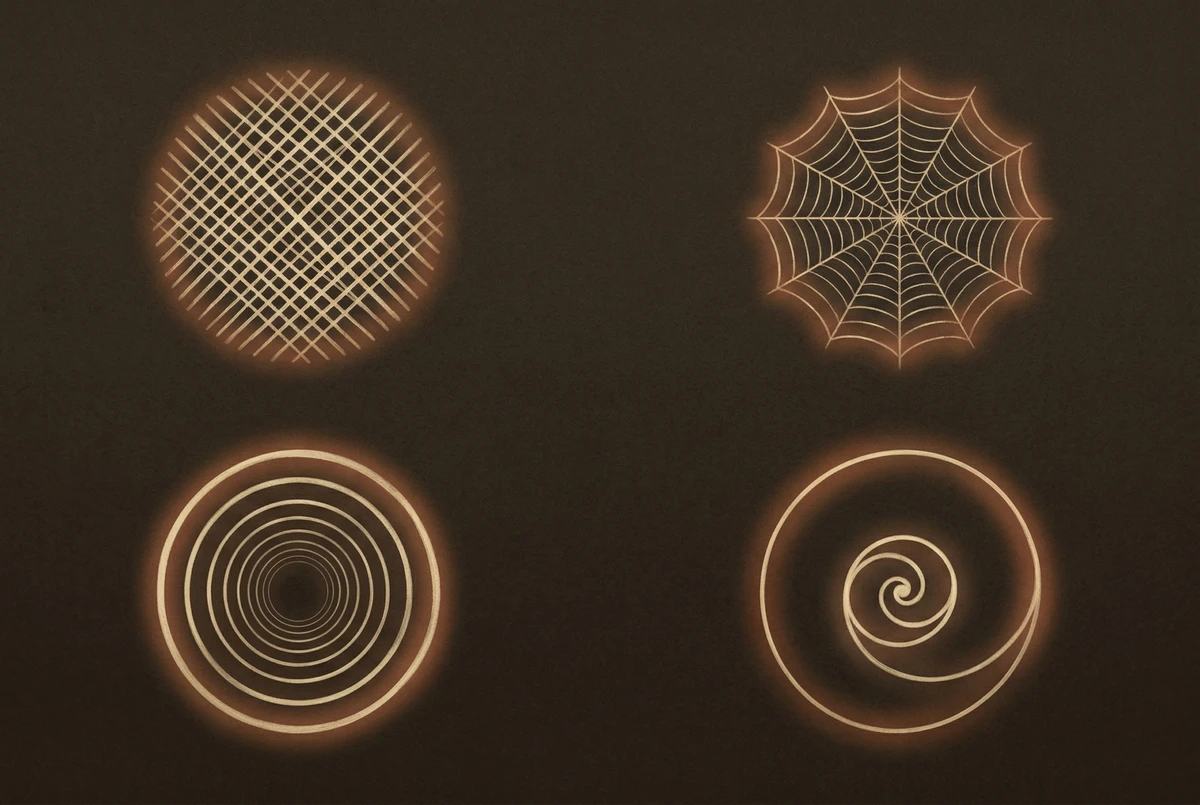
This explains why trataka practitioners report geometric grids, tunnel vision, and spiraling patterns during longer sessions. The bright stimulus primes the visual cortex. The transition to darkness amplifies contrast. And sustained focused attention lowers your threshold for noticing internal visual activity the brain normally filters out.
There’s also a more speculative explanation. István Bókkon proposed in a 2008 paper in BioSystems that retinal cells emit biophotons (biologically produced light particles) as part of normal cellular function. If true, some of the faint lights visible with eyes closed would be actual photons produced inside the eye. This hypothesis appears in peer-reviewed journals but remains debated; a 2019 paper in the Journal of General Physiology argued against it.
What practitioners commonly report at this stage:
- White or gold pulsing light
- Geometric grids and lattice patterns
- Swirling spirals or tunnel-like structures
- Colored halos expanding and contracting
- A steady “ball of light” (what the Buddhist tradition calls a nimitta)
Prisoners held in total darkness report the same lights and patterns, a phenomenon called “prisoner’s cinema.” Same mechanism, different context.
Why different people see different colors
“My friend sees green, I always see purple. What does that mean?”
Mostly it means you’re focused on different parts of the flame, in different conditions.
Where you focus on the flame matters most. A candle flame has three distinct color zones. The blue base (incomplete combustion) produces a yellow-orange afterimage. The bright yellow-white middle (the zone most people naturally focus on, because it’s brightest) produces a purple afterimage. The orange-red tip produces a cyan or green afterimage. If your friend focuses on the top of the flame and you focus on the middle, you’ll see different complementary colors.
Duration of gaze. Longer gazing deepens retinal adaptation, producing a more saturated, vivid afterimage. Short sessions produce faint, ambiguous colors.
Room conditions. Total darkness produces stronger afterimage contrast than a dimly lit room.
The object itself. Wax color, flame temperature, wick type, and air currents all affect the spectrum of light entering your eyes. A beeswax candle and a paraffin candle produce slightly different flames. A yantra or other non-flame object produces entirely different afterimage colors.
Individual variation. People differ in cone sensitivity ratios. Some have relatively stronger L-cone (red) responses, others stronger S-cone (blue) responses. People with visual snow syndrome experience enhanced and prolonged afterimages (Schankin et al., 2014, found that palinopsia is present in roughly 86% of visual snow patients).
Prior visual state. If you’ve been staring at a blue-light screen before practice, your cones arrive pre-fatigued. This can shift or mute the afterimage colors.
None of this means one color is “better” or indicates more advanced practice. The colors are a predictable output of conditions, not a spiritual report card.
The chakra interpretation: a different lens on the same experience
Many practitioners expect a spiritual explanation for the colors, and there’s a reason the traditional framework lines up so neatly with the biology.
In the chakra system, purple or indigo corresponds to the Ajna (third eye) chakra, the exact point where trataka practitioners are instructed to focus the afterimage during the eyes-closed phase. Blue maps to Vishuddha (throat), green to Anahata (heart). These are the most commonly reported colors in meditation.
This alignment is not a coincidence in the way people sometimes mean (“the ancient texts predicted neuroscience!”). It’s more straightforward. Meditators across centuries consistently saw purple when they closed their eyes after candle gazing. The traditional system mapped that consistent observation and assigned it meaning within its framework. What we now know is the mechanism that produces the consistency: the opponent-process response to yellow-orange light.
The Gheranda Samhita (17th century) says trataka cultivates “divya drishti” (divine sight) and “inner vision.” Taken literally, that’s what happens in Phases 2 and 3: the visual cortex begins generating its own input, and you see light that originates from within rather than from outside. The text describes the phenomenology accurately; modern neuroscience describes the mechanism.
The retinal mechanism and the meditative experience operate at different levels of description. Both frameworks agree on what matters practically: the colors indicate correct practice and provide a useful anchor for concentration.
What the colors tell you about your practice
The colors are feedback. Here’s how to read them.
A clear, vivid afterimage that holds in one spot means your gaze was steady, your concentration strong, and your fixation consistent. The afterimage is a direct print of how still your eyes were.
An afterimage that jumps around or fades quickly suggests your eyes moved during the gazing phase (microsaccades) or your concentration wavered. This isn’t failure — it’s data. Try a shorter gazing period with stronger focus.
No afterimage at all usually means the room is too bright, the flame too far away, or the session too short. Darken the room, bring the flame to arm’s length, and gaze for at least 3 minutes before closing your eyes.
Rich patterns after the afterimage fades (geometric shapes, pulsing lights, colored fields) indicate extended practice and deepening relaxation. Your visual cortex is becoming more active in the absence of external input. In the Buddhist Fire Kasina tradition (the closest equivalent to candle trataka), practitioners describe a progression: from an initial afterimage blob, through color changes and patterns, to vivid internal imagery.
Colors during the eyes-open phase (halos or color shifts around the flame while you’re still gazing) are usually Troxler’s fading at the periphery, or complementary-color halos from local retinal adaptation around the fixation point.
Don’t chase the colors. The Bihar School of Yoga’s two-phase structure moves from bahiranga trataka (external gazing) to antaranga trataka (internal gazing on the afterimage). The aim is holding the afterimage steady until it dissolves, then sustaining attention in the space that follows. The Hatha Yoga Pradipika (2.31-32) puts it simply: ”Gaze steadily without blinking at a small point until tears flow.”
The colors are a tool, not a destination. Use them as a concentration anchor. Notice what you see, let it inform your technique, and return attention to the practice.
One practical note: phosphenes and afterimages are normal and harmless. But if you see persistent flashes, new floaters, or lights accompanied by pain after practice, that’s not meditation, that’s your retina asking for an ophthalmologist.
Sources
- Zaidi Q, Ennis R, Cao D, Lee B. (2012). “Neural Locus of Color Afterimages.” Current Biology, 22(3):220-224. PMID: 22264612. PMC3562597.
- Koenderink J, van Doorn A, Albertazzi L. (2020). “Hues of Color Afterimages.” i-Perception, 11(1). PMID: 32180934. PMC7058369.
- Bressloff PC, Cowan JD, Golubitsky M, Thomas PJ, Wiener MC. (2002). “What Geometric Visual Hallucinations Tell Us about the Visual Cortex.” Neural Computation, 14(3):473-491. PMID: 11860679.
- Bókkon I. (2008). “Phosphene phenomenon: A new concept.” BioSystems, 92(2):168-174.
- Hering E. (1878). Zur Lehre vom Lichtsinne. Vienna: Carl Gerold’s Sohn.
- Kluver H. (1966). Mescal and Mechanisms of Hallucinations. University of Chicago Press.
- Schankin CJ, Maniyar FH, Digre KB, Goadsby PJ. (2014). “‘Visual Snow’: a disorder distinct from persistent migraine aura.” Brain, 137(5):1419-1428.
- Svatmarama. Hatha Yoga Pradipika, Chapter 2, Verses 31-32. Sacred Texts.
- Gheranda Samhita, Chapter 1, Shlokas 53-54.
- Swami Satyananda Saraswati. (2008). Asana Pranayama Mudra Bandha. Bihar School of Yoga.