Should I Blink During Trataka?
Miha Cacic · April 7, 2026 · 4 min read
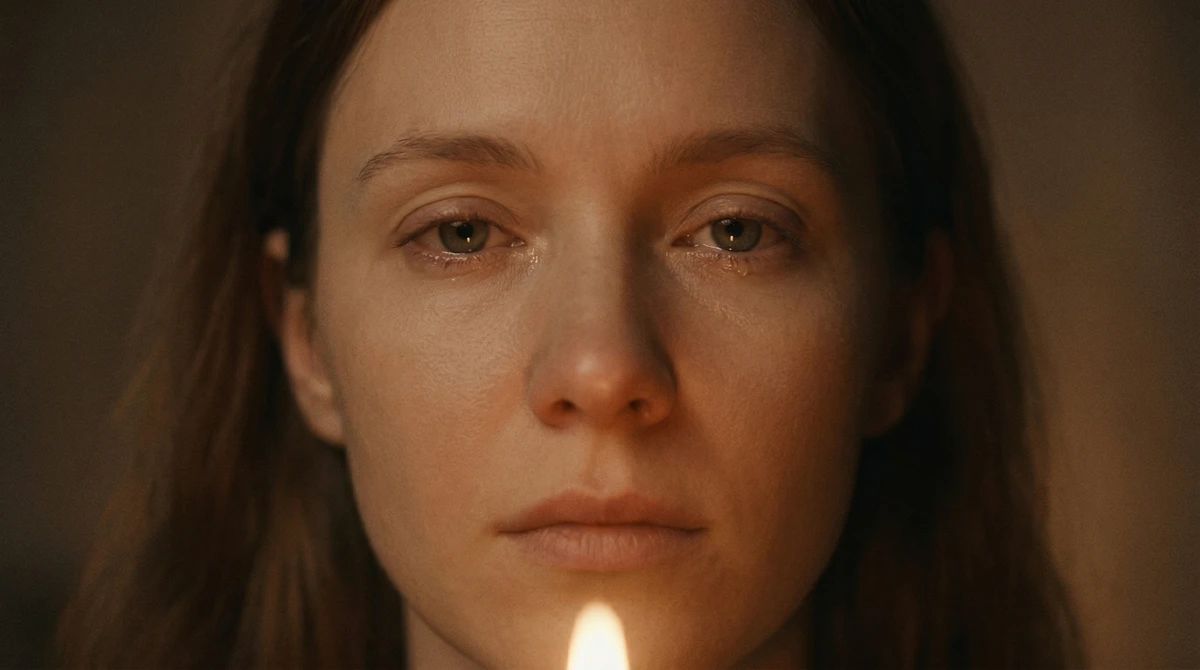
The traditional goal is a steady, unblinking gaze, but you should not force your eyes to stay open. Non-blinking in trataka is what happens because of deep concentration, not something you do in order to concentrate. If you’re a beginner, blink when you need to and return your attention to the object. As your focus deepens over weeks of practice, blinking will naturally slow on its own.
What the Traditional Texts Actually Say About Blinking
The Hatha Yoga Pradipika (verse 2.31) defines trataka as: “Being calm, one should gaze steadily at a small mark, till eyes are filled with tears.” The Sanskrit term nimesha-unmesha-varjitam translates literally to “without closing and opening the eyes,” an explicit instruction not to blink (Muktibodhananda, 1999).
The Gheranda Samhita (1.53-54) gives a nearly identical instruction: “By stopping nimesha-unmesha, staring at a subtle target until the tears start falling is called Trataka by the wise” (Saraswati, 2012). Bön Buddhist practitioners describe the same instruction in the A-khrid and Zhang Zhung traditions: “stare unblinkingly and let tears and saliva flow.”
Notice what these texts describe. Tears are the defined endpoint, not a sign that something went wrong. In the Hatha Yoga tradition, trataka is classified as one of the six shatkarmas (purification practices). The tears that come from sustained gazing are the purification mechanism itself.
But these texts describe what accomplished practice looks like. They are not prescriptions for day one. Swami Satyananda Saraswati’s Bihar School teaching acknowledges that beginners will experience watering eyes and drooping eyelids as natural difficulties, and instructs that “the practice should be increased gradually.” The goal of 15-20 minutes of continuous gaze is understood to take months of progressive work.
Why Non-Blinking Is a Symptom of Concentration, Not a Technique for It
Swami Satyananda Saraswati wrote: “When an individual does any intellectual work, listens carefully or thinks about something, the eyes remain steady without a flicker — thus a natural state of trataka is attained.”
You already know this from experience. When you’re absorbed in a book, a conversation, or a problem, you blink less. You don’t decide to blink less. It just happens.
Research confirms it. Under normal conditions, humans blink roughly 15-17 times per minute. During tasks requiring sustained attention, blink rate drops significantly. Nakano et al. (2009) showed that blinks are timed to cognitive breakpoints, occurring at moments of minimal information loss rather than at random. The brain actively suppresses blinking when it needs continuous input.
Nakano et al. (2013) found that each spontaneous blink triggers a momentary activation of the default mode network, the brain network responsible for mind-wandering. When you blink, your attentional networks briefly decrease in activity while the mind-wandering network fires up.
Blinking doesn’t just interrupt your gaze. It interrupts your concentration at a neural level. The reverse is also true: when concentration deepens, blinking naturally decreases because the brain suppresses blinks to maintain continuous focus.
Trataka works with this natural relationship, not against it. The practice gives your eyes a single, fixed point. As your mind settles onto that point, blink rate drops on its own. The non-blinking described in the classical texts is the result of deep practice, not the method for getting there.
The Difference Between Forcing and Allowing Non-Blinking
Two different experiences both look like “not blinking.” Confusing them is the most common mistake in trataka practice.
Forcing means holding the eyes open through muscular effort. You’ll feel tension in your forehead, brow, and around the eye sockets. The cornea dries out, causing stinging and involuntary flickering as the eyes fight back. Your attention splits between the object and the discomfort, which is the opposite of what trataka is meant to produce.
As the Live and Dare trataka guide puts it: “The trick in mastering trataka lies in relaxing the eyes as much as possible — otherwise your vision will soon blur and the eyes will flicker.”
Allowing means placing your concentration on the object and letting the gaze soften. The eyes stay open because your attention is absorbed, not because your muscles are straining. When tears come, the eyes feel wet and relaxed, not dry and gritty. The gaze feels effortless.
Here’s a practical test: while gazing, consciously relax the muscles of your forehead and around your eye sockets. If the gaze holds, your concentration is doing the work. If it collapses as soon as you relax, you were holding it with muscular effort. That’s a signal to work on deepening your focus rather than strengthening your stare.
What to Do When You Feel the Urge to Blink
If you’re in your first weeks of practice: blink when you need to, then return your attention to the object. Don’t count blinks. Don’t treat them as failures. A blink is a moment, not a reset. Return to the object and continue.
As practice develops: the urge to blink starts feeling different. Instead of a physical reflex triggered by dryness, it becomes more of a mental impulse, a brief tug that you can observe without acting on. When you can feel that impulse clearly, you can choose to let it pass. This is where the attentional training deepens. You’re not suppressing a reflex through willpower. You’re observing an impulse and choosing not to follow it.
When you should always blink or stop: if you feel actual pain or burning dryness (not the pleasant watering that precedes tears). If a fan or air conditioning is blowing toward your face, your eyes will dry out faster than normal and you’ll need to blink more often. If you wear contact lenses, be aware that contacts depend on the tear film refreshed by blinking. Within 1-2 minutes of not blinking, soft contacts begin to dehydrate and adhere to the cornea, causing a gritty, stinging sensation that has nothing to do with meditation.
A distinction most guides skip: blinking mid-session is not the same as the rest phase. When you’re ready to rest (after tears come or fatigue sets in), you close your eyes fully and hold the afterimage at the point between your eyebrows. This transition from external gazing to internal trataka is a different act with a different purpose, and it’s the natural progression of each round.
When Tears Come, You’re Doing It Correctly
Many practitioners worry when their eyes water. They shouldn’t. The Hatha Yoga Pradipika’s instruction, “until tears are shed,” is not a warning. It’s the intended outcome of a full round of external trataka.
When you hold your gaze without blinking, your tear film breaks up (the normal tear break-up time is about 10-15 seconds). Your lacrimal glands respond by producing reflex tears, the same kind triggered when wind hits your face or when you chop an onion. These are different from emotional tears. Reflex tears contain high concentrations of lysozyme, an antimicrobial enzyme that breaks down bacterial cell walls. Tears contain more lysozyme than any other bodily fluid.
This is the physiological basis for trataka’s classification as a purification practice. The “cleansing” isn’t metaphorical. Reflex tears flush debris and microbes from the surface of the eye.
When tears come during practice: continue gazing through them if the gaze remains soft and focused. Don’t wipe them, let them fall. When you can no longer sustain the gaze, close your eyes fully and observe the afterimage. This transition from external to internal gazing is the natural end of a round, not a failure.
How Blinking Frequency Naturally Reduces Over Time
Practice doesn’t improve your ability to force the blink reflex into submission. It improves your capacity for sustained concentration, and reduced blinking follows as a consequence.
A rough progression that most practitioners experience:
- First weeks: blinks every 10-30 seconds. Normal and expected.
- After consistent daily practice: 1-3 minutes of steady gazing becomes natural, not forced.
- Advanced practice (Bihar School benchmark): 15-20 continuous minutes without fatigue, with tears flowing, and a clear afterimage when closing the eyes.
A practical approach for building your practice: start with 1-2 minute rounds of external gazing. When tears come or fatigue sets in, close your eyes and hold the afterimage for as long as it remains visible. Repeat 3-5 rounds. Extend the gazing duration only when the current duration feels effortless rather than effortful.
The measure of progress is not time. A relaxed, absorbed 30-second gaze where blinking simply didn’t occur is more valuable than a strained 3-minute stare where you fought the reflex the entire time.
Sources
- Muktibodhananda, S. (1999). Hatha Yoga Pradipika. Yoga Publications Trust, Munger.
- Saraswati, S.N. (2012). Gheranda Samhita: Commentary on the Yoga Teachings of Maharshi Gheranda. Yoga Publications Trust, Munger.
- Nakano, T., Yamamoto, Y., Kitajo, K., Takahashi, T., & Kitazawa, S. (2009). “Synchronization of spontaneous eyeblinks while viewing video stories.” Proceedings of the Royal Society B, 276(1673), 3635-44. PMID: 19640888.
- Nakano, T., Kato, M., Morito, Y., Itoi, S., & Kitazawa, S. (2013). “Blink-related momentary activation of the default mode network while viewing videos.” PNAS, 110(2), 702-6. doi: 10.1073/pnas.1214804110.