How to Practice Trataka Without a Candle
Miha Cacic · April 7, 2026 · 7 min read
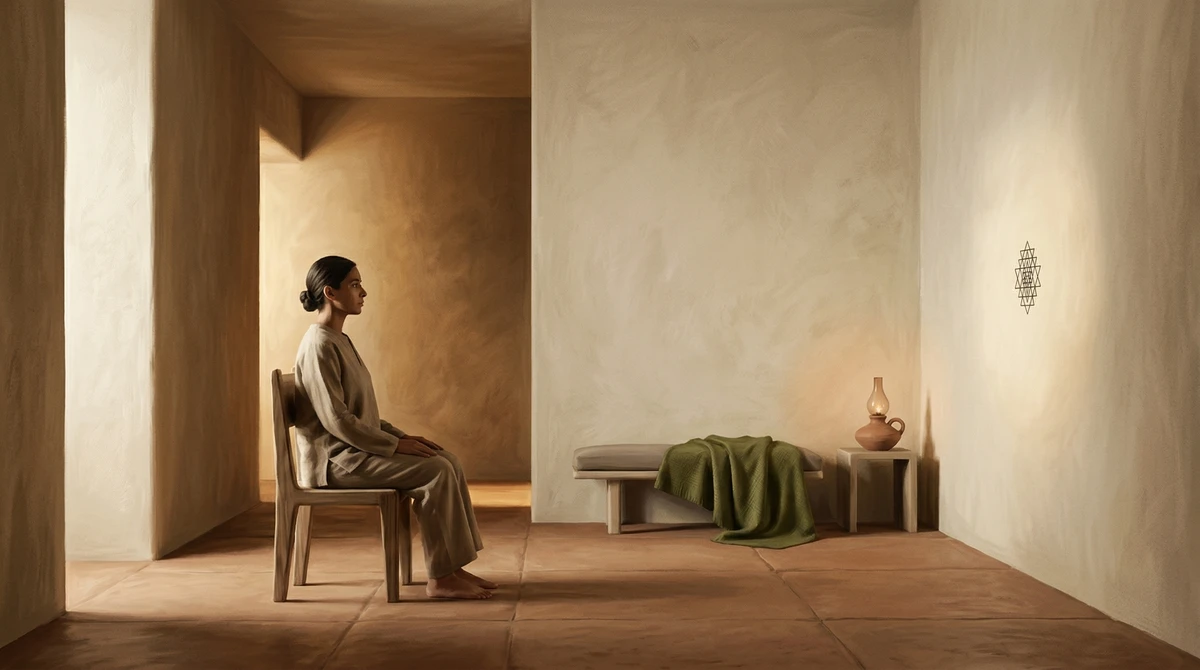
You can practice trataka without a candle. The original texts never required one. Both the Hatha Yoga Pradipika (15th century) and the Gheranda Samhita describe trataka as gazing at “a small mark” or “any small object.” The candle became the default later, through teaching traditions like the Bihar School of Yoga, not because the texts demand it.
What most guides leave out: the alternatives are not interchangeable. The object you choose determines which stages of trataka you can practice effectively, and some objects make the hardest stage significantly harder.
Why the candle is the default (and what you lose without it)
Trataka has three stages, as described in the Bihar School tradition (Swami Satyananda Saraswati’s Asana Pranayama Mudra Bandha):
- Bahiranga trataka (external gazing): You fix your gaze on an object without blinking until tears flow.
- Antaranga trataka (internal gazing): You close your eyes and concentrate on the afterimage or a mental reconstruction of the object.
- Shunya trataka (void gazing): Gazing into empty space with no object at all.
The candle dominates because of what happens between stages one and two. A candle flame is a direct light source. When you stare at it for 30 or more seconds, your retinal photoreceptors become fatigued. Close your eyes, and a vivid afterimage (a phosphene) appears automatically in complementary colors. Research published in Neuroscience of Consciousness (2024) measured a mean afterimage duration of 5.35 seconds, with significant individual variation.
That afterimage is the bridge. It gives beginners a concrete internal focal point without any visualization skill required. You don’t have to imagine anything; the image is just there.
A black dot on a wall, a printed yantra, or a photograph are reflected-light objects. They produce afterimages through the same photoreceptor adaptation mechanism, but weaker and shorter-lived ones, because reflected light is less intense than emitted light. No comparative study has measured this difference in a trataka context specifically, but the physics is straightforward: a luminous source drives harder photoreceptor fatigue than a reflective surface.
What you lose: The “freebie” internal focal point. Without a strong afterimage, the antaranga stage becomes an active visualization exercise rather than a passive observation of what your retina gives you.
What you gain: No fire hazard. No flickering (a candle dances with air currents, which means your eyes chase movement instead of training stillness). No smoke. No need for a dark room. No retinal safety concerns from staring at a bright light source. Longer-term, a stronger visualization skill, since you build that capacity yourself rather than relying on a physiological shortcut.
The best non-candle objects for trataka (ranked)
Here they are, ranked by how well they support the full three-stage progression.
1. Black dot on a white wall (Bindu Trataka)
The simplest and most commonly recommended alternative. Draw a black circle (roughly coin-sized) on white paper and fix it to a wall at eye level. Swami Niranjanananda Saraswati lists Bindu Trataka as a named variation in Dharana Darshan, the Bihar School’s most comprehensive text on concentration practices.
The black dot does produce a visible afterimage. When you stare at a dark stimulus against a bright background, the surrounding white area causes greater photoreceptor fatigue than the dark area. Close your eyes, and you’ll see a bright dot against a dark field (an inverted negative afterimage). It’s weaker and shorter-lived than the candle’s phosphene, but it exists, and it gives you something to work with during the internal stage.
Best for: Beginners who want a zero-equipment starting point. Travelers. Anyone who wants the most traditional candle-free option.
Limitation: After a few seconds of gazing, there’s nothing left to discover. One dot is the entire visual field. This can actually make sustained external gazing harder, because the mind gets bored quickly.
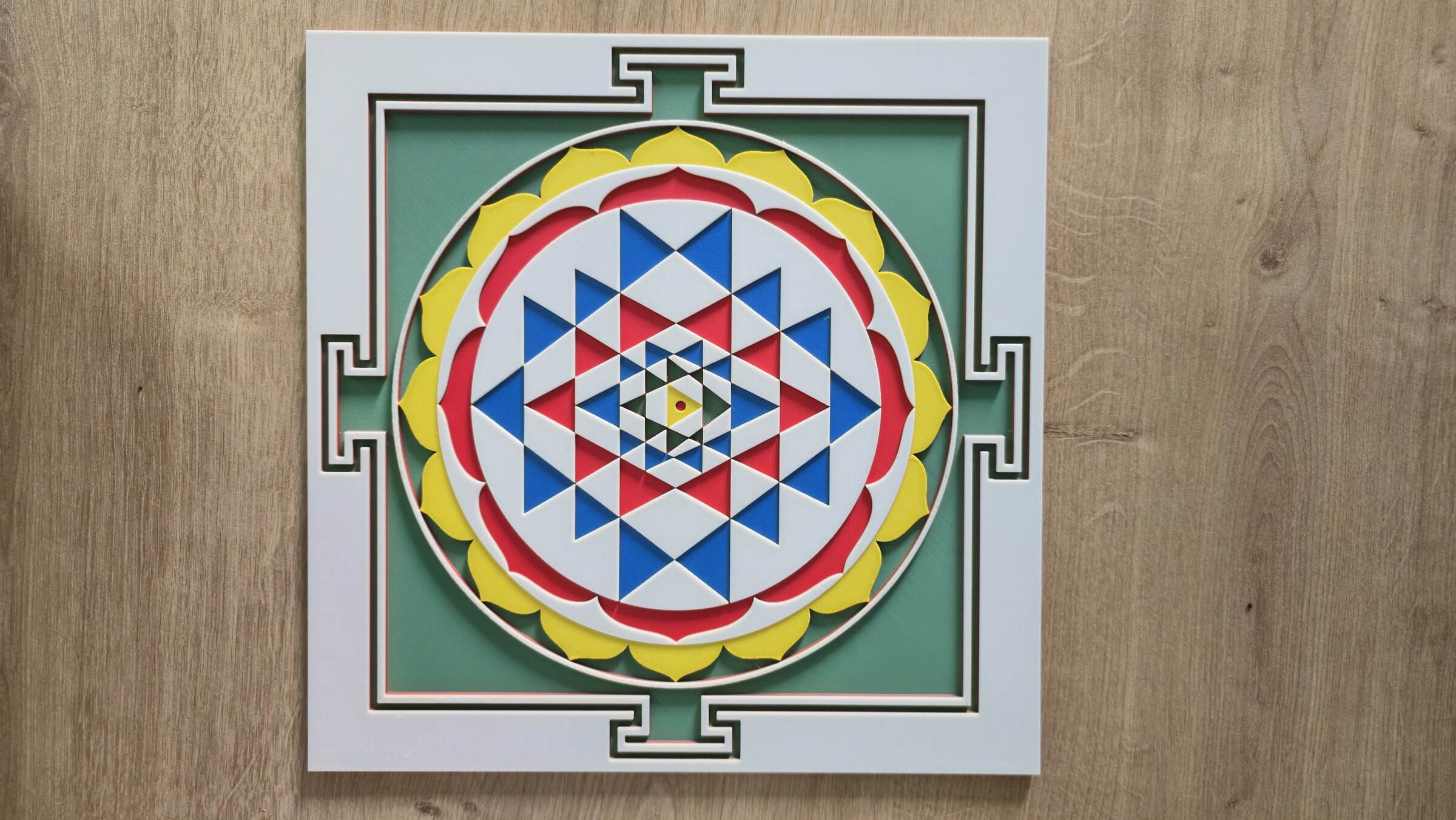
2. Sri Yantra (Yantra Sadhana)
The strongest alternative for progressing to internal trataka. Yantra Sadhana (yantra gazing) is another named practice in Dharana Darshan, and the Sri Yantra has a long tradition as a meditation object.
Where the dot gives you one point, the Sri Yantra gives you an architecture: nine interlocking triangles, concentric circles, lotus petals, and a central bindu. You fix your gaze on the bindu, then, without moving your eyes, let your peripheral awareness take in the surrounding geometry. Sri Swami Satchidananda described this approach in Integral Yoga Magazine: “Gently gaze at it, holding the main part of the attention on the central dot.”
The geometric complexity matters for the internal stage. When you close your eyes and try to reconstruct the image mentally, the yantra’s layers of triangles and circles give your mind multiple “hooks” to hold onto. A dot gives you one anchor; a yantra gives you a scaffolding. Shri Vidya practitioners report that with regular practice, the yantra’s afterimage grows progressively clearer and more detailed with eyes closed, eventually imprinting the full geometry.
A high-contrast printed yantra (dark lines on white, or colored) also produces a stronger afterimage than a plain dot, because the multiple color boundaries create more areas of differential photoreceptor adaptation.
Best for: Anyone serious about developing the internal gazing stage. Practitioners who find the dot too simple to sustain attention.
Limitation: Requires a physical yantra (printed or three-dimensional). More visually complex, which may feel overwhelming for total beginners. Start with the bindu only, and let the surrounding geometry come into peripheral awareness gradually.
3. Mirror gazing
Gaze at your own right eye in a mirror. Traditional texts reference this as a form of bahiranga trataka. It produces a powerful focusing effect: the self-referential gaze recruits the brain’s social processing networks.
Research by Giovanni Caputo (2010), published in Perception, found that prolonged mirror gazing (10+ minutes in dim lighting) induces perceptual distortions: deformations of one’s own face, unfamiliar faces appearing, even archetypal or animal-like features. A 2022 review in Frontiers in Human Neuroscience confirmed that mirror gazing activates regions of the social brain and noted that negative self-feelings can create a “vicious cycle” during the practice.
Best for: Experienced practitioners looking for a psychologically challenging variation.
Not recommended for: Beginners, anyone with a history of dissociation or trauma, or anyone looking for a relaxing practice. Mirror gazing produces no useful afterimage for the internal stage, so the antaranga phase requires pure visualization.
4. Natural objects (moon, rising sun, flower)
Surya trataka (sun gazing) and Chandra trataka (moon gazing) are traditional named practices. The moon produces a gentle afterimage. The rising or setting sun, when the disc is on the horizon and the atmosphere filters intensity, produces a strong one.
Sun gazing carries real risk. Never gaze at the sun outside the first or last few minutes of the day, when it sits directly on the horizon. If you have to squint, it’s too bright. Even brief mid-day sun gazing can cause solar retinopathy (permanent retinal damage).
Flowers and other natural elements work well for relaxed external gazing and general calm, but provide no afterimage for the internal stage. They’re better understood as a concentration exercise than as full trataka practice.
5. Digital screens
A white dot on a black screen, or a yantra image on a tablet. This is a modern adaptation that works in a pinch (hotels, travel, offices). The backlit display does produce a mild afterimage, since it’s an emitted-light source like a candle.
The downsides are practical: blue light exposure works against the relaxation response, the device is associated with stimulation and notifications, and even a dimmed screen in a dark room is harsh on the eyes. If you use a screen, enable night mode, reduce brightness to minimum, and set the device to Do Not Disturb.
Useful as a fallback. Not a primary practice tool.
How to practice: step-by-step without a candle
These instructions work for both bindu trataka and yantra trataka. 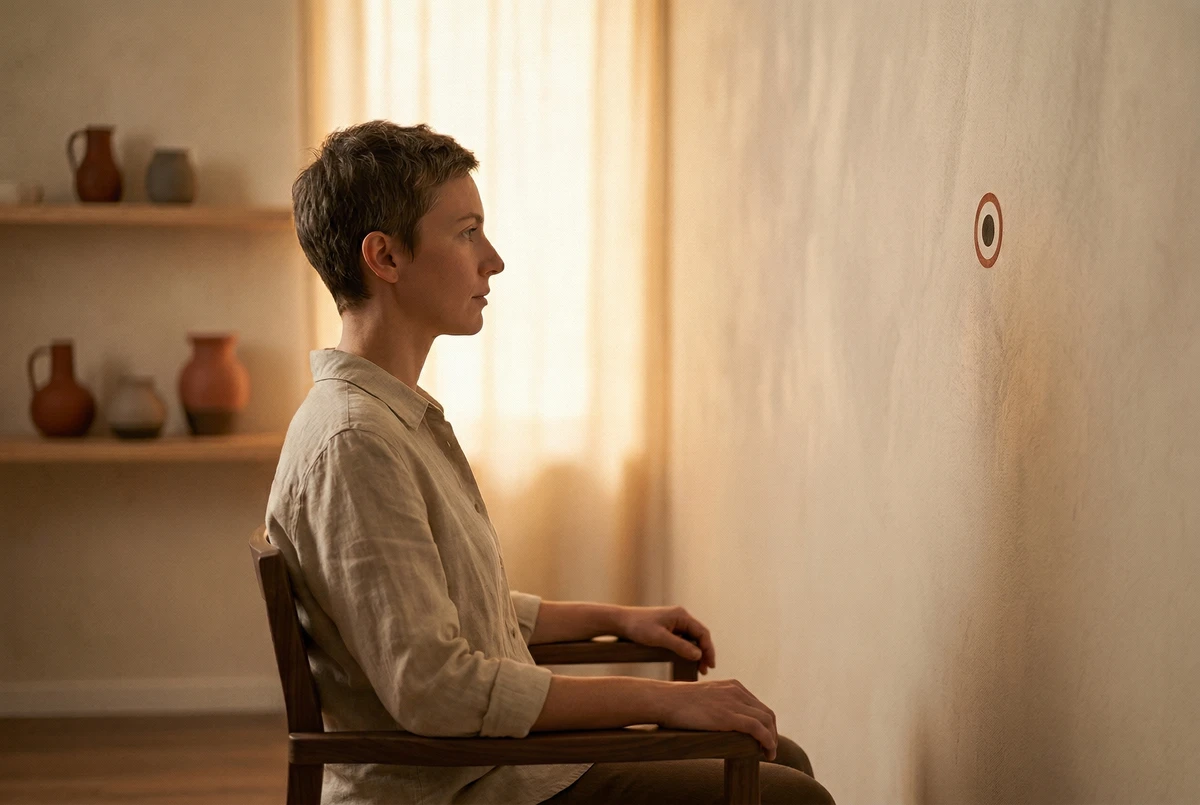
Setup:
- Place your object at eye level, at arm’s length (roughly 50-70 cm).
- Sit in any stable position where your spine is upright and your shoulders can relax. A chair works fine.
- Dim the room. Not dark, just soft. You want reduced visual noise around the object, not a sensory deprivation chamber.
- No harsh light source behind the object. Light should fall on the object or come from behind you.
External gazing phase (bahiranga):
- Fix your gaze on the center point (the bindu, or the center of the dot). Keep your eyes soft, not strained.
- Try not to blink, but don’t force it. The traditional instruction from the Hatha Yoga Pradipika uses the Sanskrit nimesha-unmesha-varjitam (“without closing and opening the eyes”), but modern teachers treat this as progressive. Blinking is fine, especially when starting out.
- Your eyes will water. This is the built-in signal that the external phase is complete. Tears are a normal reflex, not a sign of damage.
- Begin with 1-2 minutes. Over weeks, extend gradually toward 5-10 minutes.
Transition:
- When tears come (or when your chosen time is up), close your eyes gently.
- Cup your palms lightly over your closed eyes (palming). This blocks residual light and helps the afterimage or mental impression become visible.
Internal gazing phase (antaranga):
- Look for any residual image behind your closed lids. With a dot, you may see a bright spot on a dark field. With a yantra, you may see fragments of the geometry.
- If no afterimage appears, hold the memory of the shape. Start with the center point and rebuild outward. Don’t strain to “see” something vivid. Even a vague sense of the shape counts.
- When the image fades completely and you can’t hold the memory, open your eyes and return to external gazing. Repeat the cycle.
After practice:
- Blink several times. Palm your eyes again for 30 seconds.
- Splashing cool water on your closed eyes feels good and helps the eyes recover, though it’s a traditional recommendation rather than a medical necessity.
Building the internal image without an afterimage
The candle hands you the internal image for free. Without it, you build the skill yourself. This takes longer, but the skill you develop (active visualization) is more transferable and more durable than passively watching a phosphene fade.
Here’s a realistic progression:
Weeks 1-2: External gazing only. Don’t worry about the internal stage yet. Your only goal is building a steady, relaxed gaze. If you can hold 2 minutes of soft focus without strain, you’re on track. This phase trains what Krause and Poth (2023) describe as attentional disinhibition: fixed gaze locks spatial attention and reduces cognitive conflict, quieting the mind without requiring willpower.
Weeks 3-4: Begin the internal phase. After each external session, close your eyes and notice whatever you see. It might be a vague colored patch. A dim outline. A sense of where the shape was. Don’t judge it. Whatever appears is enough for now. Hold your attention on it for as long as it lasts, then open your eyes and resume external gazing.
Month 2 onward: The internal image becomes clearer and more stable with daily practice. This is gradual. There’s no shortcut, but there is a yantra advantage: the geometric complexity provides more reference points for your memory to reconstruct. Practitioners report that the yantra’s layers rebuild themselves over time, with the bindu appearing first and the surrounding geometry filling in through repeated practice.
Complementary exercise: Before sleep, close your eyes and picture your trataka object from memory. No gazing, just recall. This trains the same visualization pathway you’ll use during antaranga trataka, and it costs nothing except a few minutes of your evening.
Managing expectations: Internal trataka without a candle develops more slowly. The studies that found cognitive improvements from trataka used candle-based protocols (Raghavendra & Singh, 2016; Talwadkar et al., 2014), so we can’t directly cite timelines for non-candle practice. What we can say: the attentional mechanism behind trataka is sustained voluntary fixation, and it operates regardless of the object. A 2025 systematic review (Roj et al.) confirmed that this mechanism enhances thalamic filtering and reduces default-mode network activity. The object is the anchor. The fixation is the practice.
Safety and contraindications
Do not practice trataka if you have: Glaucoma, cataracts, high myopia, recent eye surgery, retinal disease, or epilepsy. Photosensitizing medications (some antibiotics, psychiatric medications, and acne treatments) can also make any gaze-fixation practice inadvisable. If in doubt, check with your ophthalmologist.
Sun gazing: Only the first or last few minutes of the day, when the solar disc sits on the horizon. If you have to squint, it’s too bright. Mid-day sun gazing causes permanent retinal damage. This is not a “be careful” suggestion; it’s a hard rule.
Eyes burning or aching: Stop and palm. Watering is normal (it’s the point). Pain is not. If you experience persistent discomfort after practice, shorten your sessions and see an eye care professional.
Mirror gazing: Can surface suppressed emotions and produce disturbing visual distortions (Caputo, 2010). Approach with awareness, and skip this variation entirely if you have a history of dissociation, depersonalization, or trauma.
Screen-based practice: Use night/warm mode, reduce brightness to the lowest comfortable setting, and take breaks. Your eyes are already adapted to associating screens with stimulation. Working against that association requires deliberate environmental setup.
Session length: Begin with 1-2 minutes of external gazing, working up to 10 minutes over several weeks. Talwadkar et al. (2014) used 30-minute sessions with elderly participants (including eye exercises, breathing, and chanting alongside the gazing), but these were supervised. For solo practice, 5-10 minutes total (external plus internal) is a reasonable daily target.
Frequently asked questions
Can I use any object for trataka? Technically, yes. The Gheranda Samhita says “any small object.” But not all objects support all three stages equally. Objects that produce an afterimage (candle, dot, high-contrast yantra) make the internal stage accessible sooner. Objects that don’t (flowers, photographs, natural landscapes) work for external concentration but leave you to build the internal stage entirely through visualization.
Is trataka without a candle less effective? For the internal stage, initially yes. You lose the automatic afterimage that serves as a bridge. But you build a stronger visualization capacity over time, because you’re not relying on a retinal artifact. For the external stage and its cognitive benefits (improved selective attention, reduced mind-wandering), the mechanism is the same regardless of object: sustained voluntary fixation. Raghavendra and Singh (2016) found a 26% improvement in Stroop color-word test performance after trataka. The key variable was the sustained gaze, not the flame.
How long should I practice each day? 5-10 minutes total, including both external and internal phases. Start with 1-2 minutes of external gazing. Add time gradually as your eyes and attention adapt. For guidance on frequency, see how often you should practice trataka.
Can I practice trataka with glasses or contacts? Yes. You need to see the object clearly. If your prescription achieves that, wear your correction.
Is it safe to practice without a teacher? Yes, with the precautions above. The main risks are eye strain from overdoing duration, sun gazing without proper timing, and (for mirror gazing) psychological disturbance without preparation. If you follow reasonable session lengths and avoid the sun, self-guided trataka is a low-risk practice. A modified trataka protocol was found to be “feasible, safe and can be practiced by the elderly” in a controlled study (Talwadkar et al., 2014).
What’s the best time to practice? Early morning or evening, when natural light is gentle. A dimmer environment helps with afterimage visibility and settling the mind. But the best time is the time you’ll actually do it consistently.
Sources
- Raghavendra, B.R. & Singh, P. (2016). “Immediate effect of yogic visual concentration on cognitive performance.” Journal of Traditional and Complementary Medicine, 6(1), 34-36. doi:10.1016/j.jtcme.2014.11.030. PMC4738033.
- Talwadkar, S., Jagannathan, A. & Raghuram, N. (2014). “Effect of trataka on cognitive functions in the elderly.” International Journal of Yoga, 7(2), 96-103. doi:10.4103/0973-6131.133872. PMC4097909.
- Krause, F. & Poth, C.H. (2023). “Attentional disinhibition of visual information by fixation.” iScience, 26(9). PMC10457444.
- Caputo, G.B. (2010). “Strange-face-in-the-mirror illusion.” Perception, 39(7), 1007-1008.
- Caputo, G.B. (2022). “Face yourself: The social neuroscience of mirror gazing.” Frontiers in Human Neuroscience. PMC9691426.
- Roj, S. et al. (2025). “Neurophysiological mechanisms of trataka.” Journal of Neurosciences in Rural Practice (systematic review).
- Svatmarama. Hatha Yoga Pradipika, Chapter 2, Verses 31-32. Pancham Sinh translation.
- Gheranda Samhita, Chapter 1, Verses 53-54. Rai Bahadur Srisa Chandra Vasu translation.
- Swami Satyananda Saraswati. Asana Pranayama Mudra Bandha. Bihar School of Yoga.
- Swami Niranjanananda Saraswati. Dharana Darshan. Bihar School of Yoga.