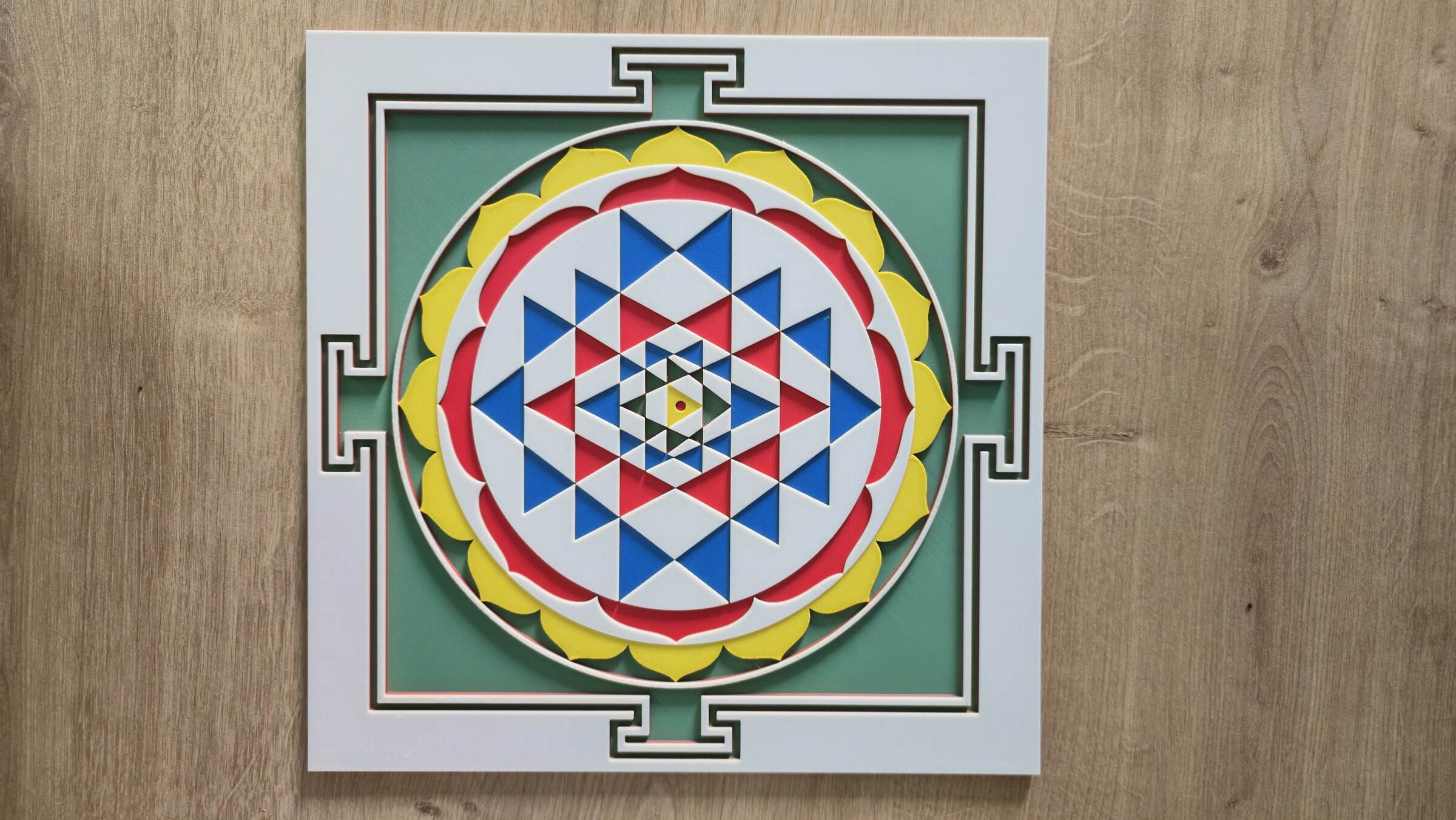
How Often Should You Practice Trataka? A Frequency Guide
Miha Cacic · April 7, 2026 · 5 min read
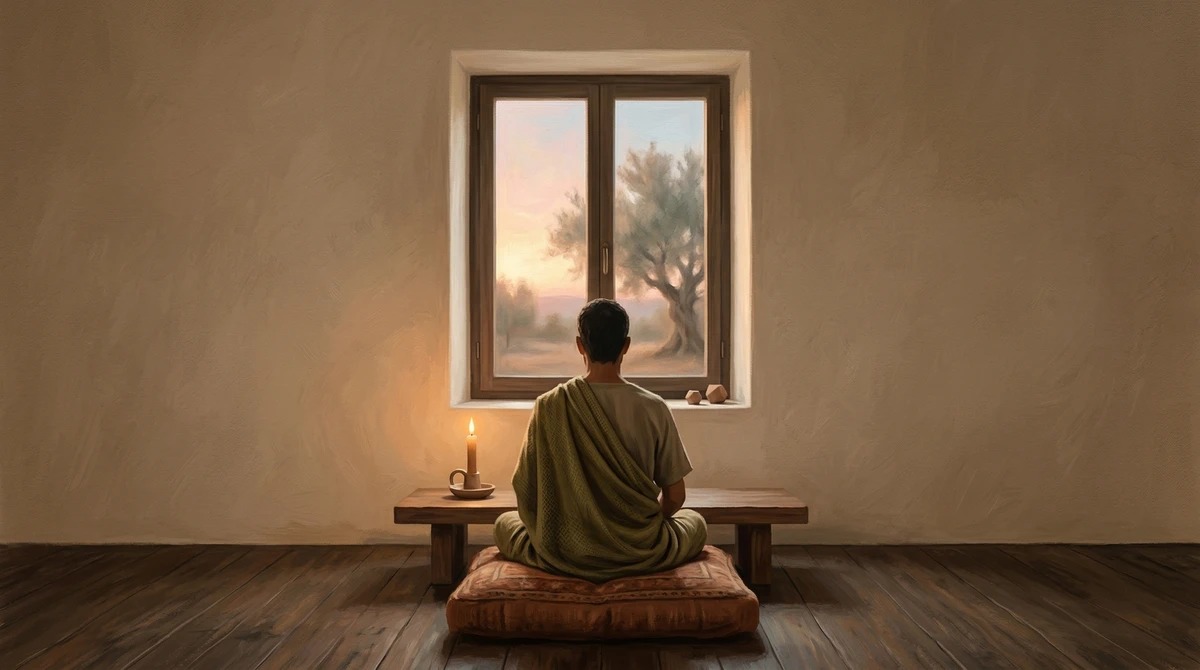
Once a day for 5 to 10 minutes is the frequency that works for most people. Both clinical research and traditional yoga sources converge on daily practice as the effective dose. But that answer comes with a caveat most guides skip: it depends on what you’re gazing at. Candle flame trataka and non-flame trataka (a yantra, a black dot, a symbol) follow different frequency rules because they place different demands on your eyes.
If you’re using a candle, once a day is the practical ceiling. If you’re using a non-flame object, you can safely practice multiple times a day, and there are good reasons to do so.
Once daily is the baseline, and here’s why
The oldest texts on trataka don’t specify how often to practice. The Hatha Yoga Pradipika (15th century) simply says to “gaze steadily at a small mark, till eyes are filled with tears.” The Gheranda Samhita gives nearly identical instructions. Neither mentions a schedule.
The daily recommendation comes from practice lineages, particularly the Bihar School of Yoga, whose Asana Pranayama Mudha Bandha treats trataka as a bridge between physical and mental practices. Serious practitioners in this tradition practice morning and evening. For everyone else, once daily is the standard starting point.
Research protocols support this baseline. Swathi, Bhat, and Saoji (2022) studied 20 minutes per day, 6 days per week for two weeks and found significant improvements in working memory and spatial attention (Cohen’s d = 0.74). Talwadkar, Jagannathan, and Raghuram (2014) used 30 minutes per day, 6 days per week for 26 days with elderly participants and found improvements in selective attention, working memory, and executive function that persisted at a one-month follow-up.
Consistency matters more than exact duration. Patanjali’s Yoga Sutras (1:14) put it plainly: practice becomes firmly grounded when performed “for a long time, without interruption, and with devotion.”
Why the object you gaze at changes the frequency rules
This is the distinction most trataka guides miss.
When you gaze at a candle flame, your pupils constrict to handle the brightness, and your retina sustains repeated photostimulation. After a session, your visual system needs recovery time. Doing a second candle session later the same day means your eyes start from a fatigued baseline. Eye watering, redness, or afterimages that persist longer than a few minutes are all signs you’ve hit your threshold.
When you gaze at a non-flame object (a black dot, a yantra, a symbol), the same concentration mechanism activates without the photostimulation stress. Your eyes still fatigue from sustained fixation, but the limiting factor is muscular, not retinal. The recovery is faster and the ceiling is much higher.
The widely repeated “take a two-week break from trataka every two months” comes from the Bihar School tradition, relayed by teachers like Giovanni Dienstmann. But the concern is specifically about prolonged candle-flame exposure, not trataka in general. If you’re practicing with a non-flame object, this rule doesn’t apply to you. No traditional source or published study imposes a rest period for non-flame gazing.
Can you practice trataka multiple times a day?
Yes, especially with a non-flame object.
Short sessions of 2 to 3 minutes on a yantra or dot at the start of a work block function as a focus primer. The neuroscience supports this: Krause and Poth (2023) found that sustained eye fixation produces “attentional disinhibition,” reducing the brain’s processing of irrelevant information (d = 0.49, a medium effect). And Raghavendra and Singh (2016) found a 26% improvement in Stroop test performance after a single trataka session compared to 10% from a control activity. The benefit is immediate, which makes short repeated sessions throughout the day a practical strategy.
The strongest twice-daily protocol combines different objects for different purposes: a non-flame object in the morning for concentration, candle gazing in the evening to wind down. The Sri Vidya tantric tradition actually prescribes a three-times-daily framework for Sri Yantra meditation, with morning, afternoon, and evening sessions each carrying a different intention. For most people, two sessions is more realistic: morning for focus, evening for calm.
If you do practice candle trataka twice in one day, keep the total gazing time under 10 minutes across both sessions, and watch for persistent afterimages or eye irritation.
Matching your frequency to your goal
As a warm-up before other meditation
Two to five minutes, daily, before your main practice. The duration is short enough that eye strain is negligible, and even a single session sharpens concentration measurably. Giovanni Dienstmann recommends trataka this way, as a brief warm-up before deeper meditation.
As your primary meditation practice
Ten to twenty minutes total (including the closed-eye afterimage phase), daily. This is the dose range used in research. At this intensity with a candle, the two-month break guideline becomes relevant. With a non-flame object, daily practice at this duration has no known upper limit.
For insomnia
Ten to fifteen minutes before bed, nightly. Shathirapathiy et al. (2022) found that daily trataka for 10 days significantly reduced insomnia severity and improved sleep quality across all measured subscales. Their clinical protocol used 45 minutes per day (including warm-up and relaxation stages), but practitioners report that 10 to 15 minutes of gazing before sleep is enough. A separate morning session with a non-flame object works well alongside this.
As a yogic cleansing kriya
The Hatha Yoga Pradipika classifies trataka as one of the six shatkarmas (purification practices). In this context, the emphasis is on gazing until tears flow rather than on duration or frequency. Two to three times per week may be sufficient: the purification effect doesn’t require the same daily momentum as concentration training.
The beginner schedule: weeks 1 through 8
Most trataka guides only cover how to increase duration. Frequency progression matters too.
Weeks 1 to 2: Once daily, 2 to 3 minutes. The goal is habit formation, not depth. Don’t skip days. If you miss one, just resume the next day — a few missed days won’t undo your progress.
Weeks 3 to 6: Once daily, 5 to 10 minutes. Add the internal visualization phase: after gazing, close your eyes and hold the afterimage at the point between your eyebrows. This is antaranga trataka, and Swami Satyananda describes it as the gateway to pratyahara (sense withdrawal).
Week 7 onward: Consider adding a second session if the first leaves you feeling clear rather than drained. Morning non-flame, evening candle is the natural split.
Signs you’re ready to increase: the afterimage holds steady for 30 seconds or more, your mind settles within the first minute, and you feel no eye strain after sessions.
Signs to pull back: persistent eye irritation between sessions, headaches, or visual disturbances outside of practice. These are signals to reduce duration or frequency, not to push through.
How long before you see results
The most honest answer: something happens immediately, and deeper changes build over weeks.
First session: Increased calm, narrowed attention, a vivid afterimage. Raghavendra and Singh’s single-session study (2016) measured a 26% improvement in selective attention immediately after trataka. You’ll feel the shift in your first sitting.
Two to four weeks of daily practice: Noticeable improvement in concentration during other activities. Swathi et al. (2022) measured significant gains in working memory and spatial attention after just two weeks of daily practice. Acute focus benefits from a single session last an estimated 15 to 45 minutes, but regular practice converts these temporary state changes into stable traits.
One to three months: Deeper concentration, stable afterimage retention, improved visualization ability. Talwadkar et al. (2014) showed that 26 days of practice produced cognitive improvements that persisted a full month after the study ended, even without continued practice.
The practical takeaway: if you’ve been practicing daily for two weeks and feel nothing, something about your technique may need adjusting. If you’ve been practicing for three days and wonder why your life hasn’t changed, give it time.
The two-month break rule: what it actually means
You’ll encounter this advice everywhere: “take a two-week break from trataka every two months.” It’s repeated across dozens of websites, almost always without a source.
The advice traces to the Bihar School of Yoga tradition, where the concern is specifically about prolonged, daily candle-flame gazing. The worry is that months of unbroken bright-light exposure could create a persistent retinal impression. No published ophthalmological research confirms this risk (a PubMed search for “retinal phototoxicity candlelight” returns zero results), but the precaution is physiologically reasonable: any sustained bright-light stimulus taxes photoreceptor adaptation.
Here’s what the rule means in practice:
If you use a candle as your primary trataka object and practice daily for 10 or more minutes per session, switching to a non-flame object for two weeks every couple of months is sensible. You don’t stop trataka. You stop the flame.
If your sessions are under 3 minutes, or if you already use a non-flame object, the rule doesn’t apply to you. No traditional source or study recommends periodic breaks from dot or yantra gazing.
Sources
- P S Swathi, R Bhat, A Saoji. (2022). “Effect of Trataka (Yogic Visual Concentration) on the Performance in the Corsi-Block Tapping Task: A Repeated Measures Study.” Frontiers in Psychology, 12. PMC8718544.
- S Talwadkar, B Jagannathan, N Raghuram. (2014). “Effect of trataka on cognitive functions in the elderly.” International Journal of Yoga, 7(2):96-103. PMC4097909.
- B R Raghavendra, P Singh. (2016). “Immediate effect of yogic visual concentration on cognitive performance.” Journal of Traditional and Complementary Medicine, 6(1):34-36. PMC4738033.
- G Shathirapathiy, A Mooventhan, N Mangaiarkarasi, et al. (2022). “Effect of trataka (yogic gazing) on insomnia severity and quality of sleep in people with insomnia.” Explore (NY), 18(1):100-103. PMID: 33036930.
- M R Krause, C H Poth. (2023). “Fixation-related attentional disinhibition.” iScience. PMC10457444.
- Svatmarama. Hatha Yoga Pradipika. Chapter II, verses 31-32. Translation: Pancham Sinh (1914).
- Swami Satyananda Saraswati. Asana Pranayama Mudha Bandha. 4th ed. Bihar School of Yoga.