What to Do When Your Mind Wanders During Trataka
Miha Cacic · April 7, 2026 · 5 min read

Bring your gaze back to the flame. That’s the whole instruction. But trataka gives you something no other meditation practice does: a built-in distraction detector. When your mind drifts, your gaze drifts, and you feel it immediately. In breath meditation, you can lose five minutes before you notice. In trataka, the feedback is almost instant. Once you learn to read that signal, you catch distraction before it fully forms.
Why your mind wanders during trataka (and why that’s the point)
Your brain’s default state is narration. Planning, replaying, evaluating, worrying. Neuroscientists call this the Default Mode Network, and it doesn’t switch off because you lit a candle. If your mind wanders during trataka, that’s not a sign the practice isn’t working. It’s the practice revealing what your mind does when left to its own devices.
The classical Hatha Yoga texts classify trataka as one of the six shatkarmas, the purification practices described in the Hatha Yoga Pradipika (Ch. 2, v. 31-32) and the Gheranda Samhita (Ch. 1, v. 53-54). The “impurity” it targets is vikshepa: the restless tossing of the mind. Swami Sivananda called trataka “the alphabet of concentration.” It’s the first exercise, not the final achievement. If your mind wanders, you’re doing the alphabet.
The training is the returning. Kumari et al. (2022) found that just two weeks of trataka practice improved working memory and spatial attention, measured by the Corsi Block Tapping Task (Kumari et al., 2022). Those gains came from the repeated cycle of focus, drift, and return, not from unbroken concentration. Nobody in the study sat motionless in perfect focus for two weeks. They wandered, they returned, and their brains got better at both.
The feedback loop: how trataka shows you when your mind wanders
Your eyes and your mind are wired together, and the connection runs both ways. Mental states produce specific eye movement patterns, and changing how you move your eyes changes your mental state. During visual fixation, your eyes make constant involuntary micro-movements called microsaccades. Laubrock, Engbert, and Kliegl (2005) demonstrated that these microsaccade patterns shift directly with changes in attention.
In trataka, this creates a feedback loop. You fix your gaze on the flame. Your attention steadies. Your eyes still. When a thought arises, the micro-movements return, your gaze softens or shifts, and you feel the change physically. The sensation of your gaze drifting is the alarm bell.
Krause and Poth (2023) showed why. Maintaining eye fixation didn’t consume cognitive resources. It freed them through what they called “attentional disinhibition”: fixation locks spatial attention in place, reducing the processing of irrelevant spatial information (Krause & Poth, 2023). The gaze isn’t just reflecting your concentration. It’s supporting it. When the gaze breaks, both the signal and the support break at once.
Compare this to breath meditation. Breath practice gives no external signal when the mind wanders. You discover the drift after the fact, often minutes later. Trataka collapses that delay to seconds or less. This is why trataka is recommended for people who struggle with other forms of meditation: the visual anchor makes distraction detectable, not just endurable.
Three types of distraction (and what to do about each one)
Most meditation guides treat “mind wandering” as one thing and give one instruction: gently bring your attention back. But three distinct experiences all feel like “my mind wandered,” and each needs a different response.
Type 1: Gaze drift
What’s happening: Your eyes have physically moved off the flame. You’re looking at the candle body, the wall, or into soft unfocused space. You notice because the flame is no longer sharp in your vision.
What to do: Redirect your eyes back to the brightest point of the flame, just above the wick tip. No inner commentary needed. This is the simplest catch: you notice it, you correct it, you continue. Over weeks, both the drift distance and the catch time shrink. That shrinkage is progress.
Type 2: Autopilot gaze
What’s happening: Your eyes are aimed at the flame, but you’re thinking about something else entirely. The flame has become wallpaper. You can “stare” for minutes without seeing anything. This is the most common type and the most frustrating, because it feels like you’ve been practicing when you haven’t.
Krause and Poth’s (2023) research explains why this matters: fixation without attentional engagement doesn’t produce the cognitive benefit. The eyes may be still, but without active focused attention, the brain’s fixation support system isn’t engaged. You’re physically fixed but mentally absent.
What to do: The fix isn’t harder staring. It’s re-engaging with seeing. Look at the flame as if for the first time. Notice the color gradient: blue at the base, yellow in the body, white at the tip. Notice the edge where flame meets air. Some teachers recommend briefly closing your eyes, observing whatever afterimage appears, then reopening. This breaks the autopilot pattern. A common trataka instruction is to refocus on the point just above the wick where the flame begins, since that point is more stable than the flickering tip.
Type 3: Dullness
What’s happening: Your gaze has gone heavy and half-closed. Attention hasn’t wandered to thoughts; it’s sunk into fog. This state is often confused with relaxation or “going deep,” but it’s the opposite of alert concentration. You’re not focused. You’re drowsy.
What to do: This needs physical intervention, not just mental redirection. Straighten your spine. Take two or three deliberate deep breaths. Briefly widen your eyes. If dullness keeps returning session after session, the real fix is practical: shorter sessions, earlier practice time, or more sleep. The Bön Dzogchen tradition captures the right quality of alertness in its gazing instruction: “stare unblinkingly and let tears and saliva flow.” The gaze should be alive and released, not heavy and collapsed.
How to use the afterimage as a concentration check
When you close your eyes after the gazing phase, you’ll see a residual image of the flame. Every trataka guide mentions this. What they rarely explain is that this afterimage is a live readout of your concentration quality during the gazing phase. 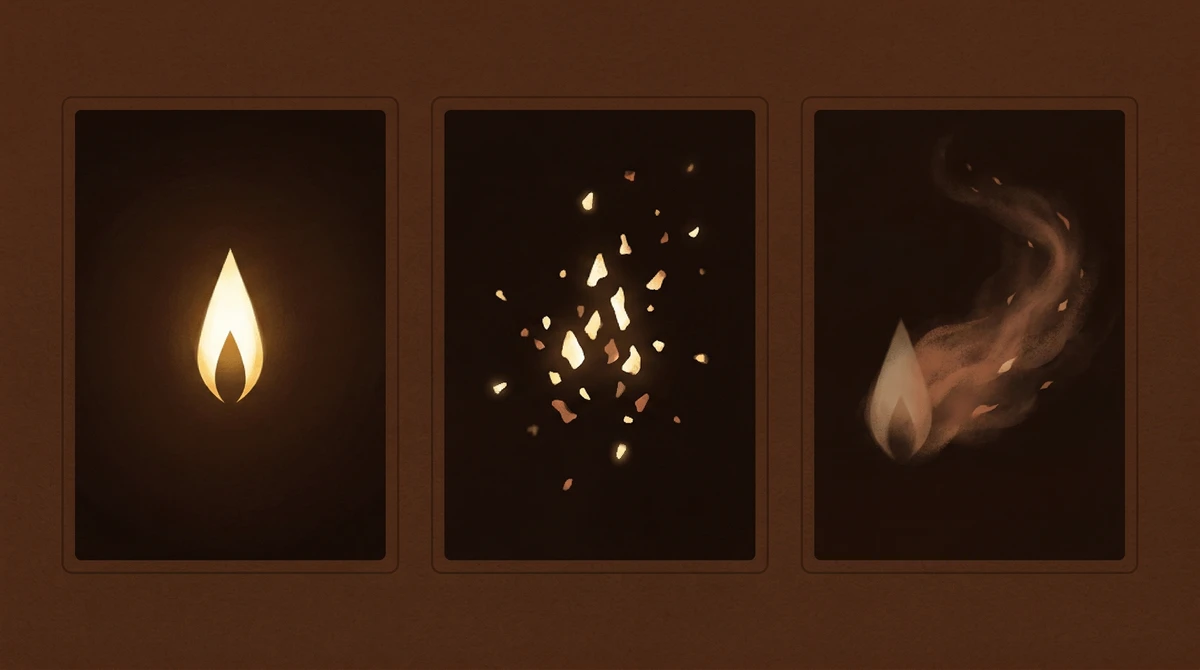
A stable, bright, centered afterimage means your focus was strong. Your mind carried its object cleanly inward.
A rapidly fading or fragmenting afterimage means concentration was weaker than it felt. You were likely in autopilot gaze during the external phase, visually fixed but mentally elsewhere.
A drifting afterimage means the mind is restless. As Christian Möllenhoff instructs: don’t chase the image. Hold your attention at the eyebrow center and let it drift back on its own. Following a moving afterimage is the internal-phase version of letting your eyes wander the room.
A 2024 study in Neuroscience of Consciousness found that afterimages last an average of 5.35 seconds (SD = 1.60), with wide individual variation. People with more vivid mental imagery perceived brighter afterimages (r = 0.34, p = 0.007). The researchers confirmed that afterimages are not purely retinal; the brain actively shapes them through top-down cortical processes (Sörensen et al., 2024). Concentration genuinely shapes what you see with your eyes closed. The afterimage isn’t just a visual echo. It’s a signal you can learn to read.
Over weeks of practice, the afterimage becomes your most reliable progress marker. You don’t need anyone to tell you whether your sessions are improving. The image tells you directly.
Five mistakes that make distraction worse
Trying not to think
Suppressing thoughts amplifies them. Psychologist Daniel Wegner documented this as ironic process theory: the mental process that monitors whether you’ve successfully suppressed a thought keeps the thought active. The instruction in trataka is not “stop thinking.” It’s “keep your gaze on the flame and let thoughts exist in the periphery.” They’re there. You don’t follow them.
Straining the eyes
Tension in the eyes creates tension in the mind. If you’re squinting, getting headaches, or forcing tears through willpower, soften. Sivananda’s instruction was explicit: “Do not strain the eyes. Do it gently with ease and comfort.” The Hatha Yoga Pradipika’s instruction uses the phrase “nimesha-unmesha-varjitam” (without closing and opening the eyes), but the unblinking quality should come from relaxed attention, not muscular effort.
Sessions too long, too soon
Traditional instructions agree: start with one to two minutes and increase gradually. Multiple sources recommend beginners cap at three to five minutes. A focused three-minute session trains attention better than a distracted fifteen-minute one. Raghavendra and Singh (2015) found that a single session of focused trataka improved Stroop performance by 26%, compared to 11% from quiet sitting alone (Raghavendra & Singh, 2015). Duration matters less than quality.
Self-judgment after catching distraction
The moment you notice your mind wandered is the moment of success. That’s the attention muscle contracting. Adding self-criticism (“I drifted again, I’m terrible at this”) is just another thought to follow, another layer of distraction. Notice, return, continue. No editorial.
Poor setup
A flickering flame, a candle too high or too low, an uncomfortable seat: these create physical distractions before the mental work begins. Dark or dim room, flame at eye level, arm’s length away, no wind. Solve the solvable problems so your attention can meet the unsolvable one.
What progress looks like
Progress in trataka is not fewer thoughts. It’s three things: catching distraction faster, returning with less inner drama, and sustaining focus for longer stretches between catches.
Early practice (first weeks): Many distractions per minute. Slow to notice. Sometimes self-critical on the return. This is normal and unavoidable. Talwadkar et al. (2014) showed that 26 days of daily trataka improved selective attention, working memory, and executive function in elderly participants, with gains that persisted at one-month follow-up (Talwadkar et al., 2014). The practice works through accumulation, not individual perfect sessions.
Intermediate practice (weeks to months): You notice the drift within a second or two. The return is smooth, almost reflexive. You can sustain thirty to sixty seconds of unbroken attention. Practitioners describe a qualitative shift here: returning becomes effortless, and the practice seems to carry itself. The Yoga Sutras call this the transition from dharana to dhyana: from effortful binding of mind to one point (Sutra 3.1) to continuous, unbroken flow of awareness toward the object (Sutra 3.2).
The afterimage test: Close your eyes after the gazing phase and observe. Can you hold the afterimage steadily at the eyebrow center? How long does it stay clear? A stable image that lasts well beyond a few seconds reflects concentrated gazing. A scattered one that vanishes almost immediately reflects distraction. Track this across sessions.
The off-cushion test: The real measure of trataka progress is whether you notice mind-wandering faster in daily life: during conversations, reading, work. Trataka trains a general faculty of attention, not just flame-staring ability. As Sivananda put it, trataka is the alphabet. You’re not learning to read candle flames. You’re learning to read your own mind.
Sources
- Kumari, S. et al. (2022). “Effect of Trataka on the Performance in the Corsi-Block Tapping Task.” Frontiers in Psychology, 12. PMCID: PMC8718544.
- Krause, A. & Poth, C.H. (2023). “Maintaining eye fixation relieves pressure of cognitive action control.” iScience. PMCID: PMC10457444.
- Laubrock, J., Engbert, R. & Kliegl, R. (2005). “Microsaccade dynamics during covert attention.” Vision Research, 45(6), 721-730. PMID: 15639499.
- Raghavendra, B.R. & Singh, P. (2015). “Immediate effect of yogic visual concentration on cognitive performance.” Journal of Traditional and Complementary Medicine, 6(1), 34-36. PMCID: PMC4738033.
- Talwadkar, S., Jagannathan, A. & Raghuram, N. (2014). “Effect of trataka on cognitive functions in the elderly.” International Journal of Yoga, 7(2), 96-103. PMCID: PMC4097909.
- Sörensen, L.K.A. et al. (2024). “Afterimage individual differences.” Neuroscience of Consciousness. PMCID: PMC10760211.
- Wegner, D.M. (1994). “Ironic processes of mental control.” Psychological Review, 101(1), 34-52.