Candle Gazing vs Object Gazing: Which Trataka Method to Use
Miha Cacic · April 7, 2026 · 6 min read

Both are forms of trataka, the yogic fixed-gaze meditation. The question isn’t which is “better” — it’s which one matches what you’re trying to build right now. That comes down to a mechanical difference almost every guide skips: a candle emits light, while a dot, symbol, or yantra merely reflects it. That single distinction changes what happens in your eyes, your attention, and your practice.
What Actually Separates a Candle Flame from a Gazing Object
Both candle gazing and object gazing are external trataka (bahir trataka). Same practice, different focal points. But two physical differences produce distinct training effects.
First: luminous vs. reflective. A candle flame generates its own light. A black dot on white paper, a printed yantra, an Om symbol, a moon reflection: these only bounce ambient light back at your eyes. This matters because of what happens in your retina when you gaze long enough (more on that in the next section).
Second: moving vs. still. Even in a draft-free room, a candle flame shifts. Micro-fluctuations in brightness, color, and shape keep refreshing your visual field. A dot on a wall does nothing. Your visual system has to do all the work.
Common trataka objects include: a candle flame, a black dot (bindu), a yantra, the Om symbol, a mirror, a moon, or a star. The Hatha Yoga Pradipika (verse 2.31) doesn’t prescribe a candle. It says “looking intently with an unwavering gaze at a small point until tears are shed.” The candle dominates modern practice for practical reasons, not because any classical text ranks it above other objects.
Why Beginners Are Told to Start With Candle Gazing
The short answer: because it produces the strongest afterimage.
When you stare at a bright light source for 30 or more seconds, your cone cells (the photoreceptors in your retina that handle color and detail) gradually fatigue. They reduce their response to the ongoing stimulus. When you close your eyes, the fatigued cones respond weakly while the unfatigued ones keep firing, producing a complementary-color afterimage: the bright flame becomes a dark shape, the yellow glow shifts toward blue-violet.
This afterimage is the bridge to the second stage of trataka, antaranga (internal gazing). You close your eyes and hold the image at the point between your eyebrows. As the afterimage stabilizes over weeks of practice, it becomes the object of meditation itself.
A luminous source like a candle flame causes rapid, intense photoreceptor fatigue. The afterimage arrives within 30 to 60 seconds of gazing and typically lasts 5 to 30 seconds, depending on the individual. A reflective source like a black dot on white paper causes slower, weaker fatigue. The afterimage is fainter, takes longer to appear, and may be too subtle for beginners to perceive at all. That’s the core reason candle gazing is the standard entry point.
Fire may also be easier to attend to because it’s visually compelling. A 2014 study by Christopher Dana Lynn found that fire’s relaxation effect depends on sound (crackling, not just the visual), so the “evolutionary fire-gazing instinct” explanation has limits. Still, beginners report less effort staying focused on a candle compared to a static mark.
The safety question nobody explains clearly. Some teachers in the Bihar School of Yoga tradition recommend a two-week break from candle trataka every two months. This guideline is precautionary. No published clinical study has documented retinal damage from trataka at standard practice durations (2 to 10 minutes per session). A study of 26 days of daily candle gazing (Talwadkar et al., 2014) reported no adverse eye effects. Still, if you practice daily for months, the traditional guidance to take periodic breaks is reasonable and costs nothing to follow.
What Static Object Gazing Actually Trains (And Does Better)
With a static dot or symbol, nothing draws your eye. No flicker, no brightness pulling attention back. The eye must be held still by pure intention.
This makes static object gazing harder early in practice but trains a different cognitive capacity: saccadic suppression without external aid. Your frontal eye fields and superior colliculus must actively inhibit the urge to shift gaze, and there’s no visual reward for staying put. The concentration is entirely self-generated.
Something else happens with static objects that the candle avoids: Troxler’s fading. Discovered in 1804 by Swiss physician Ignaz Troxler: an unchanging stimulus in your visual field begins to disappear. Your neurons adapt to the unvarying input and stop responding, the same way you stop feeling a watch on your wrist after a few minutes. With a static dot, peripheral elements fade. The mind must remain actively engaged to counteract this perceptual disappearance. Martinez-Conde, Macknik, and Hubel (2004) established that tiny involuntary eye movements called microsaccades exist precisely to prevent this fading.
A candle flame’s constant micro-variations refresh the retinal image automatically, largely preventing Troxler fading. The flame keeps itself visible. The dot doesn’t.
For practitioners who have built a basic concentration foundation with the candle, switching to a static object removes the training wheels.
Practical advantages: A dot requires no fire, no darkness, no smoke, and no draft management. A dot or printed symbol is usable anywhere: at a desk, while traveling, in daylight.
The epilepsy consideration. Photosensitive epilepsy is triggered by flickering light at frequencies between 3 and 30 Hz. A candle flame in a drafty room can flicker within this range. While candle flames are not listed among the most common triggers by the Epilepsy Foundation, the precautionary recommendation across all yoga sources is clear: people with epilepsy or photosensitivity should use a static object, not a flame. A dot or yantra poses zero photosensitive seizure risk.
The Traditional Progression: From Simple to Symbolic
Across teaching traditions (particularly the Bihar School of Yoga lineage), a logical progression of trataka objects emerges: simple point, then flame, then meaningful image, then yantra, then deity image, then internal visualization with no external object at all.
This isn’t a strict prescription from any single classical text. The Hatha Yoga Pradipika says “a small point.” The Gheranda Samhita says the same. Swami Satyananda Saraswati lists multiple valid objects (candle flame, black dot, needle point, Om symbol, yantra, moon, star, crystal ball) without insisting on one fixed order. Swami Satchidananda wrote that “the particular form can differ according to the individual’s temperament and taste.”
But the progression makes pedagogical sense. Each step increases cognitive demand:
- A simple dot requires only sustained attention. Nothing to interpret.
- A candle flame adds the afterimage training component, building the internal visualization capacity needed for antaranga trataka.
- A meaningful symbol (Om, cross, religious image) adds recognition and association. Attention now coexists with meaning.
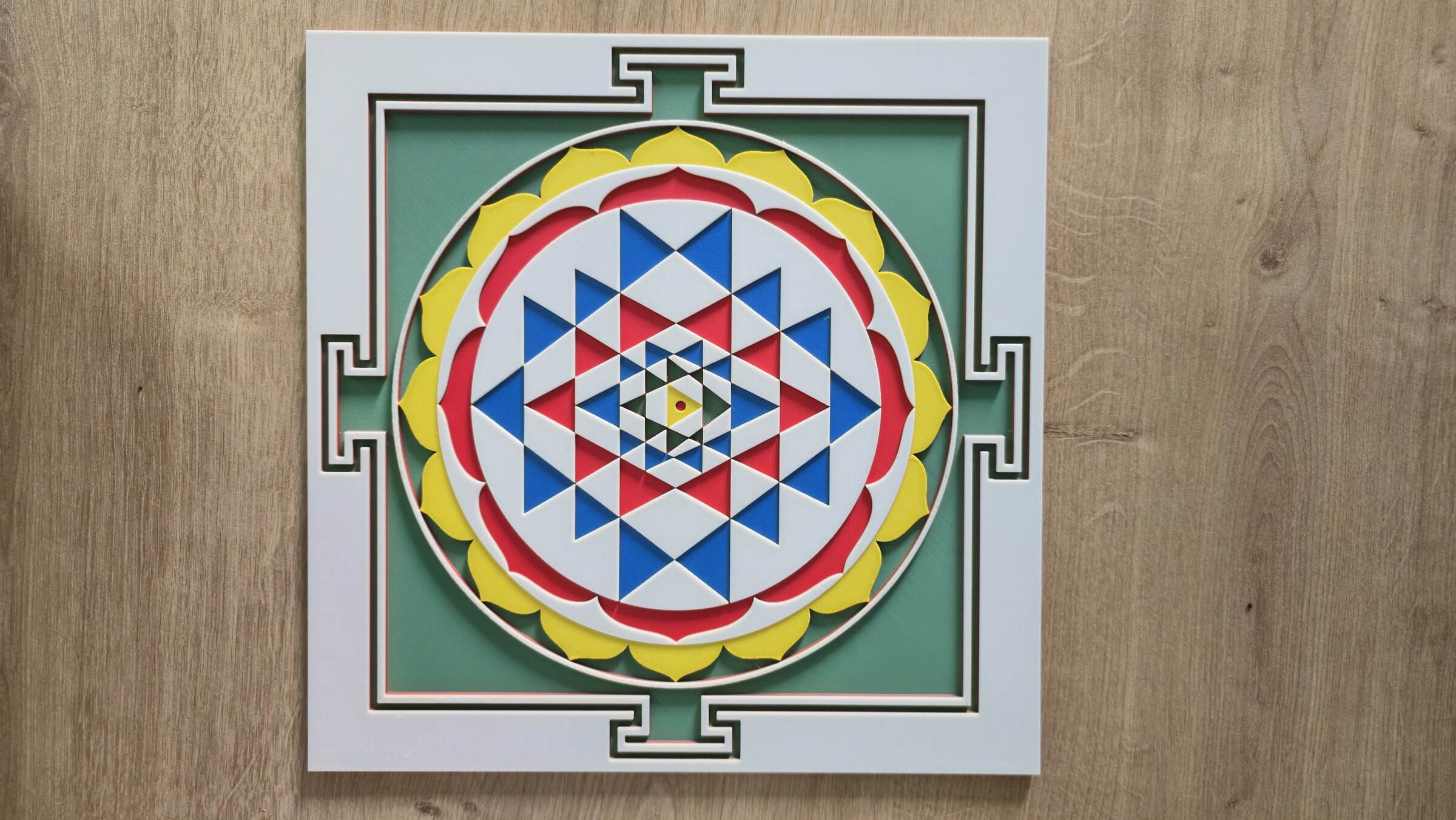
- A yantra adds geometric complexity. Multiple layers, concentric structures, and a central focal point that invites peripheral awareness without losing the center.
- Internal visualization requires no external object at all. The practitioner generates and holds the image entirely from within.
The critical transition is from candle or dot to yantra. That’s where trataka stops being purely a concentration exercise and becomes something closer to meditation.
Yantra Gazing: When the Object Becomes the Meditation
A candle flame gives your mind a point of light. After you’ve steadied your gaze on it, there’s nothing more to discover. The flame is the flame. A yantra gives your mind a point of light (the central bindu) surrounded by layers of geometric structure that can be explored without ever moving your eyes from the center.
Swami Satchidananda described yantras as expressions of what meditators experienced at the deepest levels of practice: “Upon returning to normal consciousness, they expressed what they had experienced in the form of mantras, or mystic sounds, and yantras.” A yantra isn’t decoration placed on top of a meditation practice. It’s a map of what the practice is moving toward.
In Sri Yantra trataka, the gaze rests on the central bindu (the same type of precise focal point as a candle tip or a dot). But the nine interlocking triangles forming 43 smaller triangles in five concentric levels create a natural progression for awareness. Without moving your eyes, you let peripheral awareness expand outward through the layers. You’re training the exact perceptual state the practice aims for: a sharp focal point held steady while soft awareness fills the periphery.
A meditation teacher on the IndiaDivine forum reported that during Sri Yantra trataka, beginners in her class saw the yantra “morph into a variety of geometrical figures and deities.” This kind of perceptual phenomenon doesn’t happen with a dot or a candle. The yantra’s geometric complexity engages visual processing that simpler objects can’t.
The shift from candle gazing to yantra gazing is developmental. The practitioner has built enough concentration stability to hold the gaze steady and begin engaging the object’s symbolic content. That combination, stable attention plus structured meaning, is what distinguishes concentration from meditation.
Which One Should You Use (and When to Switch)
This isn’t a personality quiz. Match the object to what you need to build:
No prior concentration practice: Start with a candle. It’s the easiest entry point. The strong afterimage builds the internal visualization habit faster than any other object.
Some practice, want to deepen stillness: Switch to a black dot (bindu). This removes the luminous crutch and forces you to generate concentration from internal effort alone.
Photosensitive epilepsy or light sensitivity: Always use a static object. Never a flame.
No access to fire (travel, smoke-free housing, daytime practice): A dot or printed symbol works anywhere. Tape a small black circle to the wall at eye level.
Ready to move beyond concentration into meditation: A yantra. The geometric structure gives your stabilized attention somewhere to deepen into.
When to switch: The clearest signal is the afterimage. When you close your eyes after candle gazing and the afterimage appears reliably and holds for several seconds, you’ve built the internal visualization capacity the candle is designed to teach. At that point, the candle’s main advantage (strong afterimage production) is no longer the bottleneck. You can move to a static object or a yantra.
How long to stay with one object: Commit to a single object for weeks or months before switching. Traditional sources are consistent on this point. The mind builds a specific internal image from repeated exposure to one object. Switching frequently resets that image before it stabilizes.
Room setup differs by object. Candle trataka works best in a darkened room where the flame is the brightest point in your visual field. Dot or yantra trataka works best in a well-lit room where contrast is clear and the eyes aren’t straining against dimness.
Common Questions Answered Directly
“Does the flame need to be completely still?”
Yes. A flickering flame forces continuous micro-tracking impulses: your eyes involuntarily chase the movement, undermining the stillness the practice builds. Close windows, turn off fans, and shield the candle before starting. If you can’t eliminate drafts, a dot or yantra will serve you better than a struggling flame.
“I can’t see the afterimage. Am I doing it wrong?”
No. The afterimage develops over weeks of consistent practice, not immediately. You need at least 30 to 60 seconds of unbroken gazing for the first faint afterimage to appear, and even then, some people initially see colors or shifting patterns rather than a clear shape. If you “imagine” the flame when you close your eyes, that’s the right starting point. The distinction between imagined image and true retinal afterimage becomes clearer with practice.
“Can I switch between objects in the same session?”
Traditionally, no. One object, one session, session after session. The internal image stabilizes through repetition. Switching mid-session or across sessions resets the visualization before it has a chance to consolidate.
“Is the candle more spiritual than a dot?”
No. The spiritual depth of trataka comes from the quality of attention, not the object. Swami Satyananda noted that candles in churches function as a form of trataka, whether or not the worshippers realize it. The candle is an effective training tool, but it carries no inherent spiritual advantage over a dot, symbol, or yantra.
“How long should I gaze before closing my eyes?”
Gaze until the eyes begin to water naturally. That reflex is the body’s signal. Beginners typically sustain 10 to 30 seconds of steady external gaze; experienced practitioners maintain 3 to 5 minutes. Don’t force the duration. It increases on its own as the eye muscles and concentration develop.
A research gap that matters here. Every published trataka study (Raghavendra & Singh, 2016; Talwadkar et al., 2014; Kumari et al., 2021; Mallick & Kulkarni, 2010) used a candle flame. No study has compared candle trataka against dot trataka or yantra trataka in a head-to-head design. The practical distinctions in this article are based on retinal physiology, perceptual science, and the accumulated teaching tradition, not on direct experimental comparison of objects.
Sources
- Raghavendra BR, Singh P. (2016). “Immediate effect of yogic visual concentration on cognitive performance.” Journal of Traditional and Complementary Medicine, 6(1):34-36. PMC4738033.
- Talwadkar S, Jagannathan A, Raghuram N. (2014). “Effect of trataka on cognitive functions in the elderly.” International Journal of Yoga, 7(2):96-103. PMC4097909.
- Kumari S, Bhat KM, Saoji AA. (2021). “Effect of trataka on working memory and spatial attention.” Frontiers in Psychology, 12:773049. PMC8718544.
- Mallick T, Kulkarni R. (2010). “The effect of trataka, a yogic visual concentration practice, on critical flicker fusion.” Journal of Alternative and Complementary Medicine, 16(12):1265-1267. PubMed 21091294.
- Lynn CD. (2014). “Hearth and Campfire Influences on Arterial Blood Pressure: Defraying the Costs of the Social Brain through Fireside Relaxation.” Evolutionary Psychology, 12(5):983-1003. PMC10429110.
- Martinez-Conde S, Macknik SL, Hubel DH. (2004). “The role of fixational eye movements in visual perception.” Nature Reviews Neuroscience, 5(3):229-240.
- Svatmarama. (15th century CE). Hatha Yoga Pradipika, verses 2.31-2.32. Sacred Texts Archive.
- Gheranda Samhita. (17th century CE). Verses 1.53-1.54.
- Sri Swami Satchidananda. Meditation. Excerpted in Integral Yoga Magazine.
- Swami Satyananda Saraswati. A Systematic Course in the Ancient Tantric Techniques of Yoga and Kriya. Bihar School of Yoga.