Yantra vs Mandala — What Is the Difference?
Miha Cacic · April 7, 2026 · 4 min read
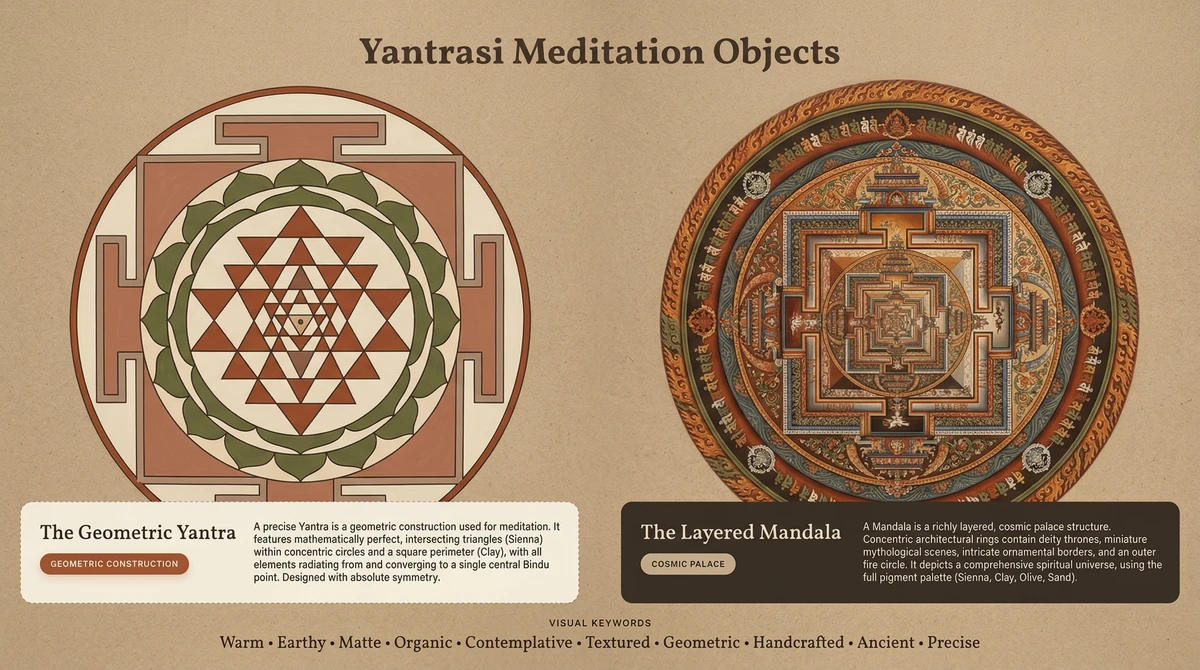
A yantra is a precise geometric diagram you fix your gaze on. It works like a lens, pulling your attention inward to a single point. A mandala is a symbolic map of the cosmos you mentally enter and explore. It works like a door into a visualized world. Both are meditation tools, but they train your attention in fundamentally different ways.
The popular framing (“yantra = Hindu, mandala = Buddhist”) gets it roughly right at the surface, but it misses what matters: these are different meditation mechanics. And the word “mandala” is broader than most people realize.
A yantra is a type of mandala (but not all mandalas are yantras)
The word “mandala” means “circle” in Sanskrit. It appears as early as the Rigveda, where it names the ten sections of the text, long before anyone used it for meditation diagrams. In Hindu ritual, mandalas are everywhere: the Vastu Purusha mandala in architecture, the Navagraha mandala in planetary rites, and dozens of others in Smarta and Pancaratra worship traditions.
A yantra is a specific subset of mandala. The Bihar School of Yoga states it directly: “A yantra is a specific form of mandala consisting of geometrical shapes and figures, and often diagrams of deities.”
So asking “yantra vs mandala” is a bit like asking “square vs shape.” One is a subset of the other, with distinct properties that matter for how you use it. What is a yantra covers this in more depth.
How they look different
The visual difference is stark once you know what to look for.
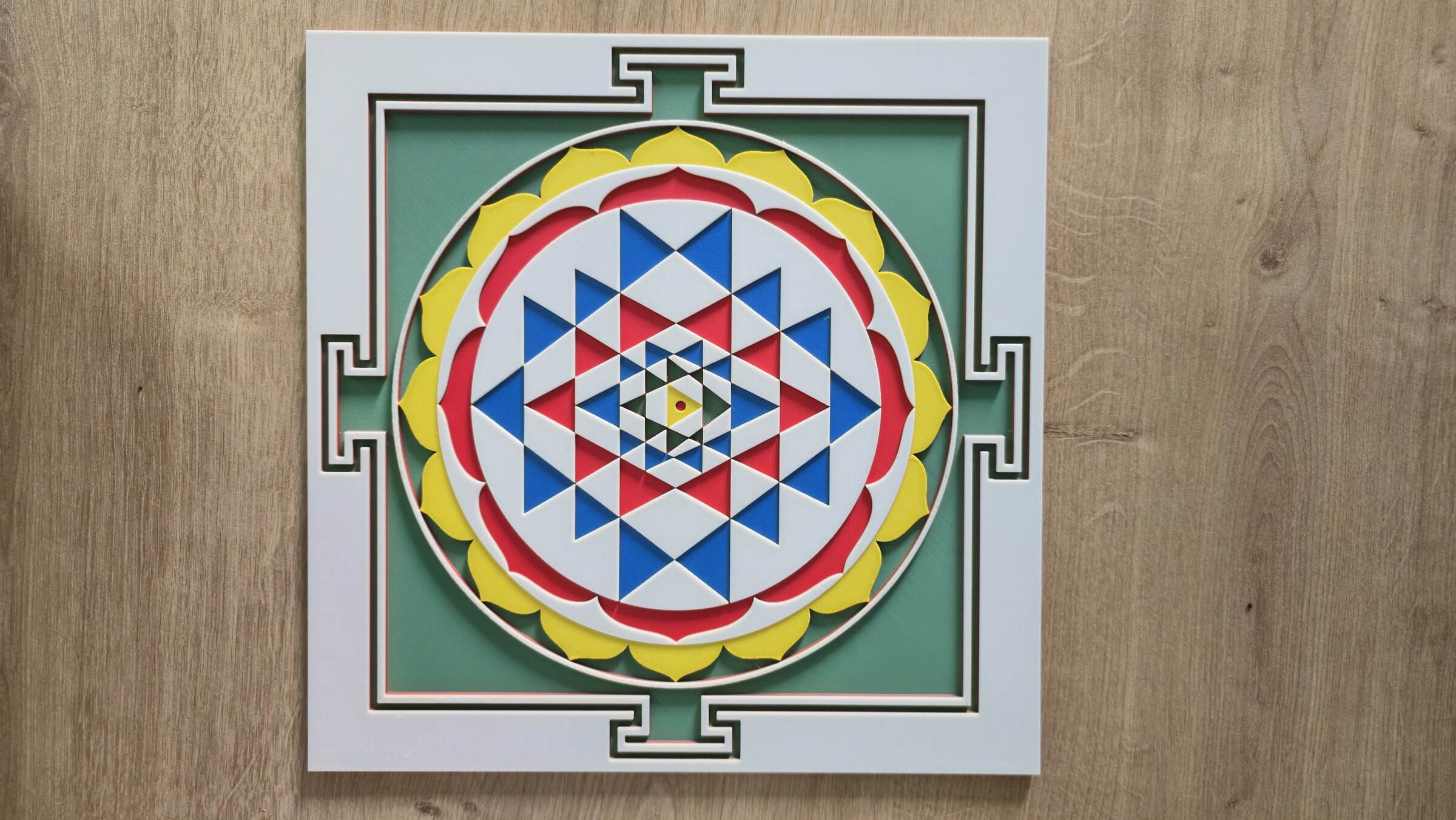
A yantra is built from a small set of geometric elements: a central point (the bindu), interlocking triangles, concentric circles, lotus petals, and a square frame (the bhupura) with four gates. The proportions are mathematically defined. The Sri Yantra consists of nine interlocking triangles (four pointing up, five pointing down) radiating from a single bindu. You could describe it with coordinates. Yantras use fewer colors than mandalas, with each color carrying symbolic meaning rather than decorative function.
A mandala, particularly in the Vajrayana Buddhist tradition, is an elaborate scene. The Kalachakra mandala depicts a multi-layered palace with deities, mythological figures, architectural details, and rich narrative iconography across dozens of colors. You don’t describe a mandala with geometry. You describe it with story.
The key distinction: a yantra is reducible to mathematical precision. A mandala is irreducible to anything less than its full narrative content.
Gazing vs visualization: how the meditation differs
Yantra meditation is trataka (fixed-gaze concentration). You sit in front of the yantra, fix your open eyes on the central bindu, and hold your gaze without blinking. The interlocking geometry funnels your attention inward along its converging lines toward the center point. After a few minutes, your eyes water. You close them.
What happens next is the distinctive feature: the yantra’s geometry persists as an afterimage (called pratika) in complementary colors, glowing behind your closed eyelids. Warm reds and golds become blues and cyans. You hold this afterimage as your meditation object, training ekagrata (single-pointed concentration). The Hatha Yoga Pradipika (2.31-32) describes this: “Gaze steadily without blinking at a small point until tears flow.”
This is a centripetal practice. Everything moves inward, toward one point.
Mandala meditation is visualization. You study the mandala in detail, learning its iconography, deities, and architectural layers. Then you close your eyes and mentally reconstruct the entire thing from memory. You imagine entering through one of its four gates, moving through successive rings (fire, vajra, lotus), approaching the central deity through the palace architecture, and ultimately merging with that deity.
This is what Tibetan Buddhist practitioners call deity yoga. The mandala is, as Wikipedia describes it, “a support for the meditating person, something to be repeatedly contemplated to the point of saturation, such that the image of the mandala becomes fully internalised.”
This is an immersive practice. You don’t focus on a point. You enter a world.
The practical difference:
| Yantra (trataka) | Mandala (visualization) | |
|---|---|---|
| Eyes | Open, then closed | Primarily closed |
| Method | Fixed gazing | Mental reconstruction |
| Attention | Centripetal (inward to a point) | Immersive (entering and exploring) |
| Feedback | Afterimage appears within minutes | Visualization clarity develops over months |
| Mantra | Always paired | Optional |
| Teacher needed | No, for basic practice | Typically requires initiation |
These are not different wallpapers. Switching between yantra gazing and mandala visualization means switching between different skills, producing different perceptual states.
The mantra connection
Every yantra is paired with a mantra. This isn’t decorative. The Bihar School of Yoga puts it plainly: “The mantra is the vehicle of consciousness, while yantra is the form of consciousness.” Sound and sight lock together.
The Kularnava Tantra (a Kaula School text, traditionally dated 1000-1400 CE) frames the relationship more starkly: “The yantra is the body of the deity; the mantra is the breath; tantra is the technique.”
In practice, you chant or mentally repeat the mantra while gazing at the yantra. The two are treated as expressions of the same energy in different sensory modes. A Sri Yantra without its associated mantra is structurally incomplete, like a song with the melody removed.
Mandalas can be used with mantras, but the pairing is not structural in the same way. A Tibetan practitioner working with the Kalachakra mandala uses mantras as part of a larger ritual framework, but the mandala’s function (as a visualized palace to be entered) doesn’t depend on them the way a yantra’s function depends on its mantra.
Where they come from (and why “Hindu vs Buddhist” is too simple)
Both yantras and mandalas emerge from Indian Tantric traditions. The divergence is real, but it’s about emphasis and development, not rigid ownership.
Yantras are most developed in Shakta Hindu Tantra, particularly the Sri Vidya tradition and Kashmir Shaivism. The word “yantra” derives from the Sanskrit root yam (to sustain, to restrain) plus the suffix -tra (instrument), giving “instrument for sustaining” or “instrument for restraining,” per Monier-Williams’ Sanskrit dictionary.
Elaborate figurative mandalas reached their fullest development in Vajrayana (Tibetan) Buddhism, where they serve as the basis for deity yoga and tantric initiation.
But the split is not clean. Buddhist Tantra uses geometric yantras. Hindu traditions use the word “mandala” extensively. Gudrun Buhnemann’s Mandalas and Yantras in the Hindu Traditions (Brill, 2003) devotes entire chapters to mandalas in Smarta ritual, Pancaratra worship, and Kashmir Shaivism, showing that usage varies across Hindu lineages, let alone between Hindu and Buddhist traditions.
The useful frame is not “Hindu vs Buddhist.” It’s “geometric concentration tool vs symbolic visualization map,” with each tradition developing the approach that suited its practice framework.
What about mandala coloring books?
Mandala coloring is what most Westerners think of when they hear “mandala.”
Coloring circular symmetrical patterns can be relaxing. A 2021 meta-analysis in the Art Therapy journal found that structured mandala coloring reduces state anxiety, likely through the fine repetitive movements that promote present-moment focus.
But mandala coloring is not traditional mandala practice (no deity visualization, no mantra, no initiatory context, no mental reconstruction from memory). And it’s not yantra meditation (no trataka, no afterimage work, no fixed geometric proportions, no open-eyed gazing).
Calling a coloring book pattern a “mandala” is like calling a sketch of a church floor plan a “cathedral.” The word is technically defensible, but it misses the function entirely. If you’ve been coloring “mandalas” and want to go deeper, trataka with a yantra is the most accessible bridge. It requires no teacher or initiation, just a geometric object and a few minutes of steady gazing.
Which one should you try?
Start with a yantra if you want a concentration practice using open-eyed gazing. Trataka with the Sri Yantra is self-contained: you can begin today with no teacher and no background knowledge. The afterimage gives you immediate, tangible feedback that your attention is working. This is where most beginners get the most from the least.
Explore mandala practice if you’re drawn to Tibetan Buddhist visualization and have access to a qualified teacher. Traditional mandala meditation requires initiation and extensive study of the specific mandala’s iconography. The depth is extraordinary, but the entry barrier is real.
If you’ve been coloring mandalas and want to move toward actual meditation, trataka is the natural next step. It bridges the gap between casual relaxation and structured practice, and it uses the same channel (visual focus) that made coloring appealing in the first place.
You don’t have to pick a tradition permanently. But switching between yantra gazing and mandala visualization means switching between different skills. One trains stillness at a single point. The other trains navigation through a complex inner world. Both are valuable. They’re not the same thing.
Sources
- “Mantra, Yantra and Mandala: The Three Tools of Tantra.” Yoga Magazine (Bihar School of Yoga), March 1991. yogamag.net
- “Mandala.” Wikipedia. en.wikipedia.org/wiki/Mandala
- “Yantra.” Wikipedia. en.wikipedia.org/wiki/Yantra
- Monier-Williams, Monier. (1899). A Sanskrit-English Dictionary. Oxford University Press.
- Buhnemann, Gudrun. (2003). Mandalas and Yantras in the Hindu Traditions. Brill’s Indological Library, Vol. 18. Leiden: Brill. archive.org
- Khanna, Madhu. (1979/2003). Yantra: The Tantric Symbol of Cosmic Unity. Inner Traditions.
- Kularnava Tantra (c. 1000-1400 CE). Kaula School text.
- Hatha Yoga Pradipika (c. 15th century). Svatmarama. Chapter 2, verses 31-32.
- Sandmire, D. A. et al. (2021). “The Effect of Mandala Coloring on State Anxiety: A Meta-Analysis.” Art Therapy, 39(3). tandfonline.com