Why Meditation Apps Stop Working (And What to Do Instead)
Miha Cacic · April 7, 2026 · 6 min read

Meditation apps don’t stop working because you lost motivation. They stop working because they were never designed to build the skill meditation actually requires: the ability to sustain attention on your own. After a month of guided sessions, you haven’t developed concentration. You’ve developed a dependency on external scaffolding. When the app stops feeling useful, it’s because the scaffolding was always doing the work your attention needed to learn.
What 300 million downloads actually tells us
The top 10 meditation apps have collectively reached over 300 million downloads (Creswell & Goldberg, 2025). Only 4.7% of those users are still opening the app after 30 days (Baumel et al., 2019). The average lifetime use of a meditation app is between one and four sessions (Lam et al., 2023).
These numbers don’t describe a motivation problem. If the issue were individual willpower, you’d expect wide variation: some users sticking around, others dropping off early. Instead, 95% of users hit the same wall at roughly the same time. That’s a design ceiling, not a character flaw.
The pattern holds even among people with explicit motivation to continue. In clinical trials where participants signed up specifically to meditate, dropout rates still range from 21% to 54% (Huberty, Chung & Stecher, 2023). Daily use among paying subscribers across health apps sits below 4%.
The users who stick around longest don’t rate the experience well. As of April 2026, Calm holds a 1.4 out of 5 on Trustpilot across 425 reviews. Headspace sits at 1.5 out of 5 across 757. The dominant complaints: repetitive content, poor personalization, and the sense that sessions stopped doing anything months ago. That’s the inverse of what you’d expect from a product that works.
The real job of a meditation app (and why it conflicts with the job of meditation)
A meditation app is a content delivery system. Its job is to keep you opening it, completing sessions, and renewing your subscription. Engagement equals revenue.
Meditation is a training process. Its job is to build your capacity to sustain attention without external support. Progress means needing the tool less, not more.
These two goals are structurally incompatible. Every feature that makes an app engaging (a guiding voice, fresh content, gamified rewards) substitutes for the attentional work you were supposed to be doing. Think of it like a personal trainer who carries you on their back during your run. You feel like you exercised. You didn’t build the muscle.
The voice is the clearest example. A 2018 review of 16 popular mindfulness apps by Daudén Roquet and Sas at Lancaster University found that 13 of 16 relied on guided audio. Only three (Insight Timer, Meditation Timer, Tide) emphasized self-directed, silent practice. Harvard Health, reporting on the same study, noted that “the self-directed, silent form of mindfulness practice is more effective than externally guided exercises.”
The reason is mechanical. When someone is narrating your meditation, the narration gives your wandering mind somewhere to go. Zindel Segal, co-creator of Mindfulness-Based Cognitive Therapy, put it directly: “The practice of mindfulness is about observing and experiencing states that arise in the mind as we find it. Elements such as music and waterfalls are designed to induce a state of relaxation, calm, or soothing that may or may not be in the mind of the practitioner. It might make it more difficult, rather than easier, to connect with what’s happening in the present moment.”
At the beginner stage, a guiding voice is a useful guardrail. It redirects wandering attention and prevents the frustration of sitting in silence with no idea what to do. At the intermediate stage, that guardrail becomes a cage. You can’t develop sustained internal focus because the voice keeps breaking the thread every few seconds. If guided meditation has stopped working for you, the format itself may be the limiting factor.
How gamification turns meditation into its own opposite
When Headspace launched, it was built around co-founder Andy Puddicombe’s genuine meditation instruction. The Queensland University of Technology rated it highest on their mindfulness app quality scale in 2015 (Mani et al., 2015). In the years following its 2021 merger with Ginger, the product shifted toward Duolingo-style gamification: streaks, badges, progress counters. Jake Crump, a meditator with over 10 years of experience who spent two years on Headspace, described the change on Product Hunt: “They did a fairly big change a few years ago and have kind of gone the way of Duolingo in terms of being more about gamification and streaks and not so much about actually learning.” He added: “I don’t recommend them anymore.”
Each gamification feature introduces a specific contradiction:
Notifications designed to remind you to “be present” are themselves demands for reactive attention, the exact mental pattern meditation trains you to interrupt.
Streaks attach a performance metric to a practice whose premise is non-attachment to outcomes. Miss a day and the guilt arrives. “I missed one day, felt guilty, and never opened the app again,” wrote one user. Decades of psychology research on the overjustification effect show that tangible external rewards undermine intrinsic motivation for the very activity they’re meant to encourage.
Social sharing introduces competitive comparison into a non-judgmental practice. Shivendra Misra, a former app user who wrote about his experience in detail, described it: “Post-meditation, they push you to share your progress with your friends and be proud of being better than others. You’re leading with competition instead of compassion. So much for mindfulness!”
Gamification solves the engagement problem (more daily opens, longer subscription retention) while worsening the effectiveness problem. That trade-off is invisible to product teams measuring DAUs, but obvious to the meditator whose practice feels increasingly hollow.
Why you plateau (and why the app can’t help you through it)
Most explanations for why people quit meditation focus on beginners: wrong expectations, poor habit formation, novelty wearing off. They miss a distinct failure mode. Some users did establish a habit. They did experience early benefit. They meditated daily for months. And then, gradually, the practice stopped delivering anything.
This plateau is built into the product, not the practice.
App content is designed for perpetual beginners: simple, accessible, repeatable. That’s correct for onboarding. It becomes a trap after the first few months. The Lancaster review found that none of the 16 apps evaluated offered any way of tracking how well users were learning mindfulness or whether it was affecting their lives (Daudén Roquet & Sas, 2018). No curriculum, no progression, no skill ladder. You can’t distinguish a 30th session from a 300th.
The business model makes this inevitable. “Never will they tell you: ‘So you’ve come this far, now we recommend you unsubscribe and meditate on your own,’” Misra wrote. Apps are financially incentivized to prevent the outcome they claim to enable: an independent meditator who no longer needs the product.
Creswell and Goldberg (2025) confirm the dosage gap: in-person MBSR participants practice roughly 30 minutes a day, 6 days a week. Active app users average 10 to 21 minutes, 3 days a week, roughly one-third the dose. Yet the apps rarely encourage users to increase their practice beyond what keeps completion rates high.
There’s a deeper problem at the plateau. When meditation starts to work at a certain depth, it surfaces difficult emotions. The GeekWire journalist Monica Nickelsburg described this as the “hugging the cactus” threshold (borrowing Robert Downey Jr.’s recovery metaphor): experienced meditators eventually uncover “the ugly, hairy emotions and thoughts we all have.” Tuere Sala, lead teacher at Seattle Insight Meditation Society with over 25 years of experience, and other teachers in the piece agreed: at this depth, practitioners need coaching from a real person to continue.
Segal raised a more urgent version of this concern for people with depression or anxiety: “It’s especially hard for people with depression to dis-identify from their own thinking. These practices need to be customized in a way that allows them to build skills gradually and sequentially while also providing them with information about how the disorder might camouflage itself in terms of thinking patterns.” A pre-recorded audio track can’t do that. Generic guided instructions, Segal warned, can do this population “a disservice.”
What actually predicts whether a practice lasts
The single strongest predictor of not abandoning a meditation app is also the one apps barely support: anchoring meditation to an existing daily routine.
Huberty, Chung, and Stecher (2023) studied abandonment patterns among Calm subscribers and found that users who meditated as part of an existing routine showed 39 to 57% lower abandonment risk compared to those who meditated whenever they could find time (hazard ratios of 0.607 for pre-pandemic subscribers and 0.434 for pandemic-era subscribers, both statistically significant). “Every time I make coffee” beats a push notification because it leverages an existing behavioral cue rather than competing with everything else on your phone for a moment of attention.
Apps push notifications (weak contextual cues) when piggybacking on existing habits (strong contextual cues) would work far better. This isn’t a technical limitation. It’s a design choice: notifications re-engage lapsed users and generate visible metrics, while habit-stacking is invisible to product analytics.
Session length matters more than apps suggest. Apps normalize 5 to 10 minutes because short sessions have higher completion rates, which looks good in dashboards. But the research base for meditation’s clinical benefits (MBSR, MBCT) was built on 30-minute daily sessions. Ovidiu Donciu, a practitioner who commented on Product Hunt, described the experience directly: “My brain needs between 30-45 min to actually get into those brainwaves that are actually transformative. At least for people that are very much in their head and mental.”
The type of meditation matters too. Emily Fletcher, founder of Ziva Meditation, argues that “the most common reason for someone quitting their meditation practice is they are practicing a type of meditation that wasn’t built for them.” The mindfulness observation technique that dominates app libraries works well for some minds. For people who are highly verbal and analytical, passive observation of thought may be the wrong entry point entirely.
A different approach: object-based meditation and what it solves
If the core problem is that apps outsource the attentional work to a voice, the structural fix is a practice where the attention cannot be outsourced.
Trataka, a fixed-gaze meditation on a single visible object, inverts the scaffolding model. The object doesn’t narrate or direct. It just exists. Your job is to look. When attention wanders, you notice immediately because the object is still there, unchanged. This is the attentional feedback loop that builds concentration, the one guided audio replaces.
The structural differences map directly to the failure modes above:
The voice problem dissolves. Because trataka gives you nothing to listen to, the attentional work cannot be outsourced. The wandering mind has no pre-approved destination to flee to, only the object or the awareness of having left it.
The platform problem dissolves. Trataka requires a physical focal point, not a screen. Meditating on the device that delivers every other distraction in your life contaminates the practice context. A separate, stable object creates a clean boundary between meditation and everything else.
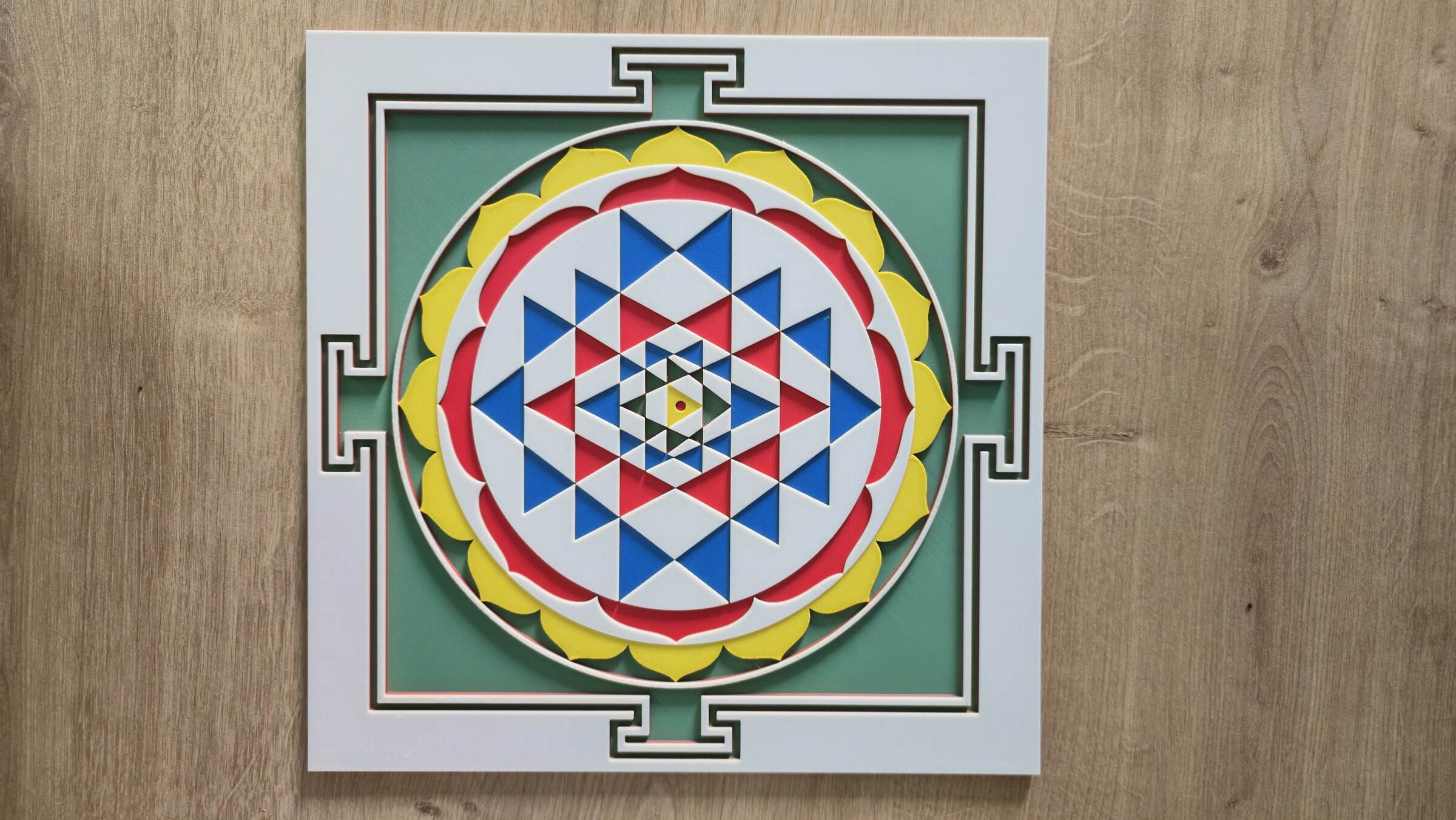
The progression problem has a built-in answer. With a geometric object like the Sri Yantra, whose structure moves from complex interlocking triangles at the periphery to a single point (the bindu) at the center, progress is directly perceivable: the stability of your gaze, the clarity of the afterimage, the depth of absorption. These develop over months without requiring a content library or a streak counter.
This isn’t a practice for absolute beginners (who may genuinely benefit from guided audio to establish initial familiarity). It’s for the person this article is written for: someone who learned the basics through an app, hit the ceiling, and needs the next step.
Sources
- Baumel A, Muench F, Edan S, Kane JM. (2019). “Objective User Engagement With Mental Health Apps: Systematic Search and Panel-Based Usage Analysis.” Journal of Medical Internet Research, 21(9):e14567. DOI: 10.2196/14567.
- Creswell JD, Goldberg SB. (2025). “The Meditation App Revolution.” American Psychologist. DOI: 10.1037/amp0001576. PMC12333550.
- Huberty J, Chung Y, Stecher C. (2023). “Mindfulness Meditation App Abandonment During the COVID-19 Pandemic: An Observational Study.” Mindfulness, 14:1052-1064. DOI: 10.1007/s12671-023-02124-z. PMC10158687.
- Daudén Roquet C, Sas C. (2018). “Evaluating Mindfulness Meditation Apps.” Extended Abstracts of the 2018 CHI Conference on Human Factors in Computing Systems, Paper LBW050. ACM. DOI: 10.1145/3170427.3188616.
- Lam SU, Xie Q, Goldberg SB. (2023). “Situating Meditation Apps Within the Ecosystem of Meditation Practice: Population-Based Survey Study.” JMIR Mental Health, 10:e43565. PMC10182467.
- Mani M, Kavanagh DJ, Hides L, Stoyanov SR. (2015). “Review and Evaluation of Mindfulness-Based iPhone Apps.” JMIR mHealth and uHealth, 3(3):e82. DOI: 10.2196/mhealth.4328. PMC4705029.
- Segal Z. Quoted in Tlalka S. (2016). “The Trouble with Mindfulness Apps.” Greater Good Science Center, August 24.
- Nickelsburg M. (2019). “What that meditation app you downloaded (and don’t use) can really do for you — and what it can’t.” GeekWire, February 13.
- Misra S. (2021). “Why You Should Not Use Meditation Apps.” blog.shivendramisra.com.