How Much Meditation Do You Need to See Benefits?
Miha Cacic · April 11, 2026 · 5 min read

As few as thirteen minutes a day produces measurable cognitive benefits within eight weeks. But that single number hides something important: different benefits emerge at different thresholds. Immediate calm after a single session, sharper attention after two months of daily practice, and structural brain changes after sustained effort are three separate outcomes with three separate minimums. The real answer depends on what you’re hoping meditation will do for you.
The short answer: ten minutes a day changes your brain, but one minute changes your state
The research converges on a surprisingly specific range. In a 2019 study by Basso et al., people with no meditation experience practiced for just 13 minutes a day. After eight weeks, they showed significant improvements in attention, working memory, recognition memory, mood, and emotional regulation. A control group that listened to podcasts for the same duration showed none of these changes.
Dr. Amishi Jha’s research on Marines during an intense predeployment period found a similar threshold. Those who practiced mindfulness for an average of roughly 12 minutes daily maintained or improved their working memory, while Marines who practiced less showed cognitive degradation (Jha et al., 2015).
But those are trait effects (lasting changes built over weeks). A single conscious breath also does something real. Slow, controlled breathing activates your vagus nerve, which triggers your parasympathetic nervous system and lowers your heart rate. That happens in seconds. The calm you feel after three deep breaths isn’t imaginary, and it isn’t a “benefit of meditation” in the way most people mean when they ask this question. It’s a temporary state shift, not a lasting change.
This distinction matters for everything that follows.
State effects vs. trait effects: two different questions
Most people asking “what’s the minimum amount of meditation to see benefits?” are really asking about trait effects. They want to know: will this change me? Will I become calmer, more focused, less reactive?
State effects are temporary changes during and shortly after meditation. Lower heart rate, calmer breathing, a feeling of presence. These happen within the first minute or two of practice and fade within hours. They’re useful (especially for managing acute stress), but they don’t accumulate into lasting change on their own. 
Trait effects are lasting changes to brain structure and function. Increased gray matter density in regions involved in learning and memory. Measurable improvements in attention, working memory, and emotional regulation that persist between sessions. These require weeks to months of accumulated practice.
The confusion between these two categories is where most bad advice about meditation originates. When someone says “even five minutes helps,” they’re usually talking about state effects. When a clinical program prescribes 45 minutes daily for eight weeks, they’re targeting trait effects. Both claims are true, but they’re answering different questions.
The minimum for each type of benefit
Immediate stress relief: one to five minutes
Even a brief meditation session produces measurable state changes. In a randomized controlled trial by Strohmaier et al. (2020), novice meditators who did a single five-minute mindfulness session showed significant improvements in state mindfulness (effect size d = 2.17) and reduced stress. These five-minute sessions outperformed 20-minute sessions for beginners, possibly because novices lose focus and become frustrated in longer sits.
A separate Stanford study (Balban et al., 2023) compared four daily five-minute practices over 28 days: cyclic sighing, box breathing, cyclic hyperventilation, and mindfulness meditation. All four reduced anxiety and negative mood. Cyclic sighing (a structured breathing technique where you inhale twice through the nose and exhale slowly through the mouth) produced the largest gains in positive mood, but mindfulness meditation still showed improvements across all measures.
If you need to calm down right now, three to five minutes of focused breathing works. You don’t need to “meditate properly” for it to count.
Cognitive improvements: ten to thirteen minutes daily for eight weeks
This is where the research is most specific. Basso et al. (2019) tested non-meditators at two checkpoints: four weeks and eight weeks. At four weeks of 13-minute daily meditation, there were no significant improvements in any measure. At eight weeks, improvements appeared across attention, working memory, recognition memory, mood, and emotional regulation.
That four-week null result is one of the most useful findings in meditation research. It means you shouldn’t evaluate whether meditation is “working” after a month. The cognitive rewiring takes longer than most people expect.
Jha’s military research tells a complementary story. In a high-stress predeployment environment (where cognitive performance normally degrades), about 12 minutes of daily practice was enough to protect and even improve working memory. For a population under extreme pressure, that’s a meaningful finding.
A brief training study by Zeidan et al. (2010) found that four days of 20-minute meditation sessions (80 minutes total) improved working memory and executive function in novices by 5 to 16 percent. Even at this low total dose, cognitive performance shifted, though mood and anxiety didn’t change.
Measurable brain changes: twenty or more minutes daily for eight or more weeks
Structural changes to the brain require a higher investment. Hölzel et al. (2011) put participants through an eight-week Mindfulness-Based Stress Reduction (MBSR) program where they practiced an average of 27 minutes daily. MRI scans afterward showed increased gray matter density in the left hippocampus (involved in learning and memory), the posterior cingulate cortex, the temporoparietal junction, and the cerebellum. A waitlist control group showed no such changes. 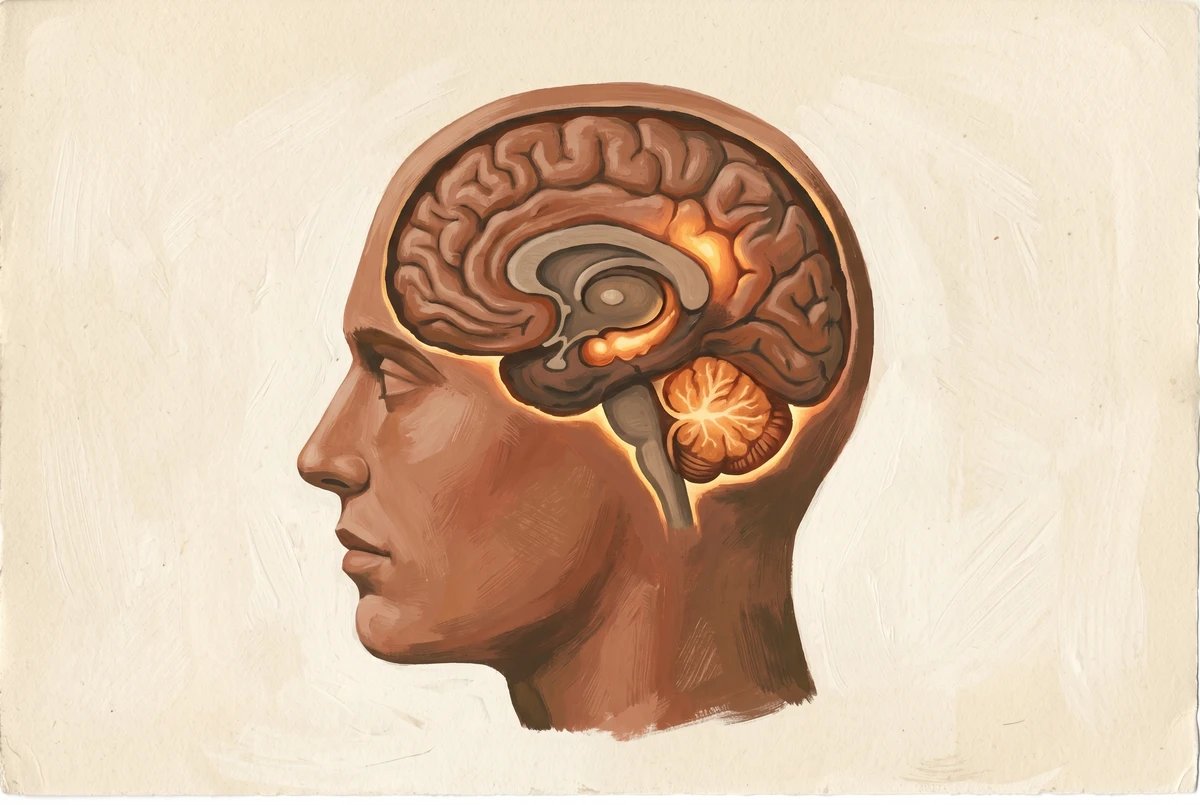
This is the tier that clinical programs target. MBSR and Mindfulness-Based Cognitive Therapy (MBCT) typically prescribe 40 to 45 minutes of daily practice over eight weeks. That dosage isn’t arbitrary; it reflects what the neuroimaging research supports for structural change.
These results come from different studies with different designs, so they don’t form a clean dose-response curve. But the pattern is consistent: cognitive benefits appear at 12 to 13 minutes daily, while detectable structural brain changes require roughly twice that. You can get sharper attention with less effort, but reshaping the physical structure of your brain takes more.
Deep transformation: a thousand or more accumulated hours
The highest tier of meditation research looks at long-term practitioners with thousands of hours of practice. Daniel Goleman and Richard Davidson document this in their book Altered Traits (2017), describing meditators with 10,000 or more hours showing fundamentally different brain activity patterns, including altered default mode network function and unusual gamma wave activity.
At 20 minutes a day, 1,000 hours takes about eight years. At 40 minutes a day, roughly four years. This is aspirational context, not a practical recommendation. If you’re reading this article wondering whether five minutes is worth it, the thousand-hour milestone is not your concern right now.
Why frequency beats duration
A meta-analysis of 203 randomized controlled trials (Strohmaier, 2020) found no relationship between session duration and the size of psychological benefits. Meditating for longer didn’t produce larger effects on depression, anxiety, stress, or well-being. What did predict outcomes was frequency: more sessions per week correlated with larger improvements. 
Other studies point in the same direction. Fincham et al. (2023) randomly assigned participants to either 10-minute or 30-minute daily sessions for two weeks. Both groups improved, and there was no significant difference between them on well-being, mindfulness, or psychological distress.
A longitudinal study by the meditation app Insight Timer (10,000+ participants across 103 countries over one year, though not peer-reviewed) reinforced this pattern: consistency of four to seven days per week mattered more than minutes per session. For beginners in their first 20 sessions, five to 20 minute sessions produced the highest mood improvements. Only after roughly 20 sessions did longer sessions begin to outperform shorter ones.
Ten minutes every day beats 30 minutes three times a week. The analogy to physical exercise holds: a short daily run builds more cardiovascular fitness than a long run once a month.
How to know if your practice is working
The most common frustration beginners report is: “I’m meditating, but I don’t notice anything different.” This is expected, especially in the first four weeks (recall the Basso et al. null result at that checkpoint).
Early signs of trait change are subtle and easy to miss if you’re looking for dramatic shifts. Practitioners commonly describe noticing them outside the meditation session itself: catching a reactive thought before acting on it, noticing tension in the shoulders during a stressful meeting and releasing it, falling asleep faster, responding to an irritating email with less heat.
These are small changes in the gap between stimulus and response. They accumulate gradually, which makes them hard to attribute to meditation unless you’re paying attention.
Don’t use the meditation session itself as the measuring stick. The session might feel like a battle with distraction every single day. That doesn’t mean it isn’t working. Noticing that your mind wandered and returning your attention to the breath is the practice. Distraction is not failure; it’s the repetition that builds the skill.
Give it eight weeks of daily practice before evaluating. Some people report changes within two to four weeks, but the strongest evidence points to eight weeks as the threshold where multiple measurable benefits emerge.
The best starting point for beginners
Based on the research, start with ten minutes a day.
This is close to the cognitive benefit threshold identified in multiple studies (Basso at 13 minutes, Jha at 12), and short enough that most people can sustain it. The Strohmaier RCT found that novices perform better with shorter sessions, so if ten minutes feels like a struggle, starting at five and building up over a few weeks is a better strategy than forcing 20 minutes and quitting after a week. 
A simple protocol: set a timer, sit comfortably, and focus on your breath. When your attention wanders (it will, constantly), notice that it wandered and bring it back. That’s the entire practice. Repeat daily for eight weeks before deciding whether it’s working.
One detail from the Insight Timer study worth noting: people who meditated in the morning were twice as likely to maintain their practice compared to evening meditators. If you’re building a new habit, mornings appear to be the path of least resistance. 
Sources
- Balban, M.Y., Neri, E., Kogon, M.M., Weed, L., Nouriani, B., Jo, B., Holl, G., Zeitzer, J.M., Spiegel, D., & Huberman, A.D. (2023). “Brief structured respiration practices enhance mood and reduce physiological arousal.” Cell Reports Medicine, 4(1), 100895. PMC9873947.
- Basso, J.C., McHale, A., Ende, V., Oberlin, D.J., & Suzuki, W.A. (2019). “Brief, daily meditation enhances attention, memory, mood, and emotional regulation in non-experienced meditators.” Behavioural Brain Research, 356, 208–220. DOI: 10.1016/j.bbr.2018.08.023.
- Fincham, G.W., Strauss, C., Cavanagh, K., & Leaviss, J. (2023). “Effects of Mindfulness Meditation Duration and Type on Well-being: A Dose-response Meta-analysis.” Mindfulness. PMC10090715.
- Goleman, D. & Davidson, R.J. (2017). Altered Traits: Science Reveals How Meditation Changes Your Mind, Brain, and Body. Avery.
- Hölzel, B.K., Carmody, J., Vangel, M., Congleton, C., Yerramsetti, S.M., Gard, T., & Lazar, S.W. (2011). “Mindfulness practice leads to increases in regional brain gray matter density.” Psychiatry Research: Neuroimaging, 191(1), 36–43. PMID: 21071182.
- Jha, A.P., Morrison, A.B., Dainer-Best, J., Parker, S., Rostrup, N., & Stanley, E.A. (2015). “Minds ‘At Attention’: Mindfulness Training Curbs Attentional Lapses in Military Cohorts.” PLOS ONE, 10(2): e0116889. DOI: 10.1371/journal.pone.0116889.
- Strohmaier, S. (2020). “The Relationship Between Dose of Mindfulness Meditation and Psychological Outcomes: a Meta-Analysis.” Mindfulness, 11, 1397–1410. DOI: 10.1007/s12671-020-01319-4.
- Strohmaier, S., Jones, F.W., & Cane, J.E. (2020). “Effects of Length of Mindfulness Practice on Mindfulness, Depression, Anxiety, and Stress: A Randomized Controlled Experiment.” Mindfulness, 12, 198–214. DOI: 10.1007/s12671-020-01512-5.
- Zeidan, F., Johnson, S.K., Diamond, B.J., David, Z., & Goolkasian, P. (2010). “Mindfulness meditation improves cognition: evidence of brief mental training.” Consciousness and Cognition, 19(2), 597–605. DOI: 10.1016/j.concog.2010.03.014.