Active Meditation vs Sitting Meditation: How to Choose
Miha Cacic · April 9, 2026 · 7 min read
Active meditation uses movement to anchor your attention. Sitting meditation strips movement away so your mind has fewer things to process. The real difference isn’t what your body does; it’s how much sensory input you’re giving your attention to work with. The right choice depends on where you are in your practice and what you’re trying to train.
What “active meditation” actually means (because three traditions define it differently)
The term “active meditation” means three different things depending on who’s using it.
In Western wellness circles (Calm, PsychCentral, most English-language articles), active meditation means moving your body while being mindful. Walking meditation, mindful yoga, tai chi, ecstatic dance, gardening, washing dishes. The body moves; awareness rides along.
In the yogic tradition (particularly the Satyananda lineage), active meditation means the opposite: maintaining a meditative state during all daily activity. This is the culmination of practice, not the entry point. You train with seated techniques first. Then you carry that awareness into everything else. What the West calls “active meditation” is what yogis call the final exam.
In Osho’s framework, active meditation means cathartic techniques (Dynamic Meditation, Kundalini Meditation) designed to discharge restless energy before you sit. Osho’s reasoning: “If you begin with sitting, you will feel much disturbance inside. The more you try to just sit, the more disturbance will be felt; you will become aware only of your insane mind and nothing else.” His solution wasn’t to skip sitting but to clear the ground first through intense physical release.
All three definitions are legitimate. This article uses the Western one (movement-based) throughout, but if you encounter “active meditation” elsewhere and it sounds contradictory, this is why.
The movement-based landscape itself is broad. Walking meditation ranges from Thich Nhat Hanh’s mindful stepping to the formal kinhin of Zen monasteries. Tai chi and qigong use slow, choreographed sequences. Ecstatic dance (like 5 Rhythms) uses spontaneous movement. Osho’s Dynamic Meditation has distinct stages of chaotic breathing, emotional release, stillness, and dance. At the low-structure end: bringing attention to mundane activity like cooking, cleaning, or gardening. Each uses a different ratio of structure to spontaneity, but all share the same core: movement as an anchor for awareness.
Why sitting became the default (and what it actually does to your brain)
Virtually every contemplative tradition converged on sitting as the primary meditation posture. Buddhist, Hindu, Christian contemplative, Sufi, Daoist. This isn’t arbitrary tradition. There’s a functional reason.
When the body moves, the brain must process motor planning, balance, proprioception, and environmental navigation. This processing competes with attention for the same limited pool of cognitive resources. Daniel Kahneman formalized this in his capacity model of attention (1973): when a motor task consumes attentional resources, less remains for cognitive tasks. The more complex the movement, the steeper the cost.
Sitting eliminates this competition. The body stays upright with minimal effort, freeing the brain’s attentional bandwidth for internal observation.
The Buddhist tradition made this gradient explicit. The Vitakkasanthana Sutta (MN 20) uses a simile of a person progressively stilling their body: walking quickly, then slowly, then standing, then sitting, then lying down. Each transition replaces a coarser posture with a more subtle one. The Buddha uses this as a metaphor for the progressive stilling of thought, but the fact that the body-stilling gradient was treated as self-evident tells us something: the connection between physical stillness and mental stillness was intuitive to practitioners 2,500 years ago.
Why not lie down, then? Lying down minimizes sensory-motor load even more than sitting. But it introduces the opposite problem: drowsiness. As one experienced practitioner on the SuttaCentral forum put it: “Walking tends to be more conducive to thinking and lying down tends to be more conducive to dozing off… so sitting seems to be the perfect median.” Sitting is the sweet spot between restlessness and torpor, where the body is alert and the mind is free.
The practical takeaway: sitting isn’t the default because it’s morally or spiritually superior. It’s the default because it’s the most efficient posture for training sustained attention. Movement meditation is real meditation. It just allocates more bandwidth to the body and less to internal focus.
When movement meditation is the right choice
Movement meditation isn’t a consolation prize for people who “can’t sit properly.” There are specific conditions where it’s the better tool.
When your body carries accumulated tension. If you’ve spent all day at a desk, or you’re buzzing from stress and caffeine, forcing yourself to sit often produces a session dominated by body discomfort and restlessness. The body holds tension that needs discharge before the mind can settle. Walking, yoga, or cathartic movement releases that excess energy so the nervous system can calm down. Trying to sit through it isn’t discipline; it’s fighting your body instead of training your mind.
When you have a trauma history. David Treleaven’s Trauma-Sensitive Mindfulness (2018) documents how sustained inward attention in stillness can trigger flashbacks, dysregulation, or dissociation in trauma survivors. Bessel van der Kolk’s research on body-based trauma recovery similarly advocates movement practices (yoga, tai chi, dance) as safer entry points. Movement provides a sense of agency and embodiment that stillness removes. This is a safety consideration, not a preference.
When you have ADHD. The restlessness is neurological, not a failure of willpower. Mitchell et al. (2015) found that adults with ADHD are measurably lower in trait mindfulness, and their clinical meditation protocol specifically adapts practice for ADHD, noting that “greater emphasis on walking meditations is based on clinical features of ADHD, including restlessness and frequent urges to move.” Jonathan Kaplan, PhD, writing in Psychology Today, echoes this: people who struggle with seated meditation often have anxiety or ADHD, and walking meditation is a legitimate clinical alternative.
As a warmup before sitting. The walk-then-sit sequence appears across Buddhist, yogic, and secular practices. In the Thai Forest tradition, monks alternate walking and sitting meditation throughout long practice periods, sometimes for ten or fifteen hours a day. Walking meditation paths (cankama) are a defining architectural feature of Thai Forest monasteries. Experienced meditators across traditions and online communities report the same pattern independently: walking before sitting produces noticeably better concentration. Walking settles the coarse layer of distraction so sitting can address the subtle layer.
As integration practice. Once someone has developed concentration in sitting, carrying that awareness into movement (walking, daily tasks) is how meditation becomes a life skill rather than a 20-minute exercise. This is what the yogic tradition means by “active meditation”: the final stage, not the first.
When sitting meditation is the right choice
A still body creates conditions that a moving body doesn’t. These conditions enable specific skills that movement can’t train.
Building concentration depth. Sustained single-pointed focus develops faster when there are fewer sensory inputs to manage. The Cankama Sutta (AN 5.29) lists five benefits of walking meditation: fitness for travel, fitness for striving in meditation, health, proper digestion, and that “immersion gained while walking lasts long.” Four of the five benefits are physical or practical. The fifth refers to the durability of concentration gained while walking, not its depth. The sutta subtly acknowledges that walking and sitting serve different functions.
Observing the mind directly. When the body is still and the environment is controlled, the content of the mind (thoughts, emotions, impulses) becomes the most prominent experience. This is the precondition for insight practices like vipassana and self-inquiry. Movement keeps the body as the primary object of attention. Sitting lets the mind become the primary object.
Working with discomfort. The mild discomfort of sitting still is a low-stakes training ground for non-reactivity. Learning to notice knee pain or restlessness without immediately adjusting builds a capacity that transfers to emotional challenges in daily life. If you only meditate when the body is comfortable and moving, you never develop this specific skill.
Accessing deep meditative states. The states contemplative traditions describe (jhana in Buddhism, dharana and dhyana in yoga, hesychasm in Christianity) uniformly require physical stillness. No major tradition describes reaching these states through movement. This isn’t gatekeeping; it’s consistent observational reporting across thousands of years and millions of practitioners.
The option nobody talks about: still body, active eyes
The active-versus-sitting debate frames meditation as a choice between two poles: move your body and give your mind something obvious to anchor to, or sit still and anchor to something subtle like the breath. But there’s a third option that collapses this binary.
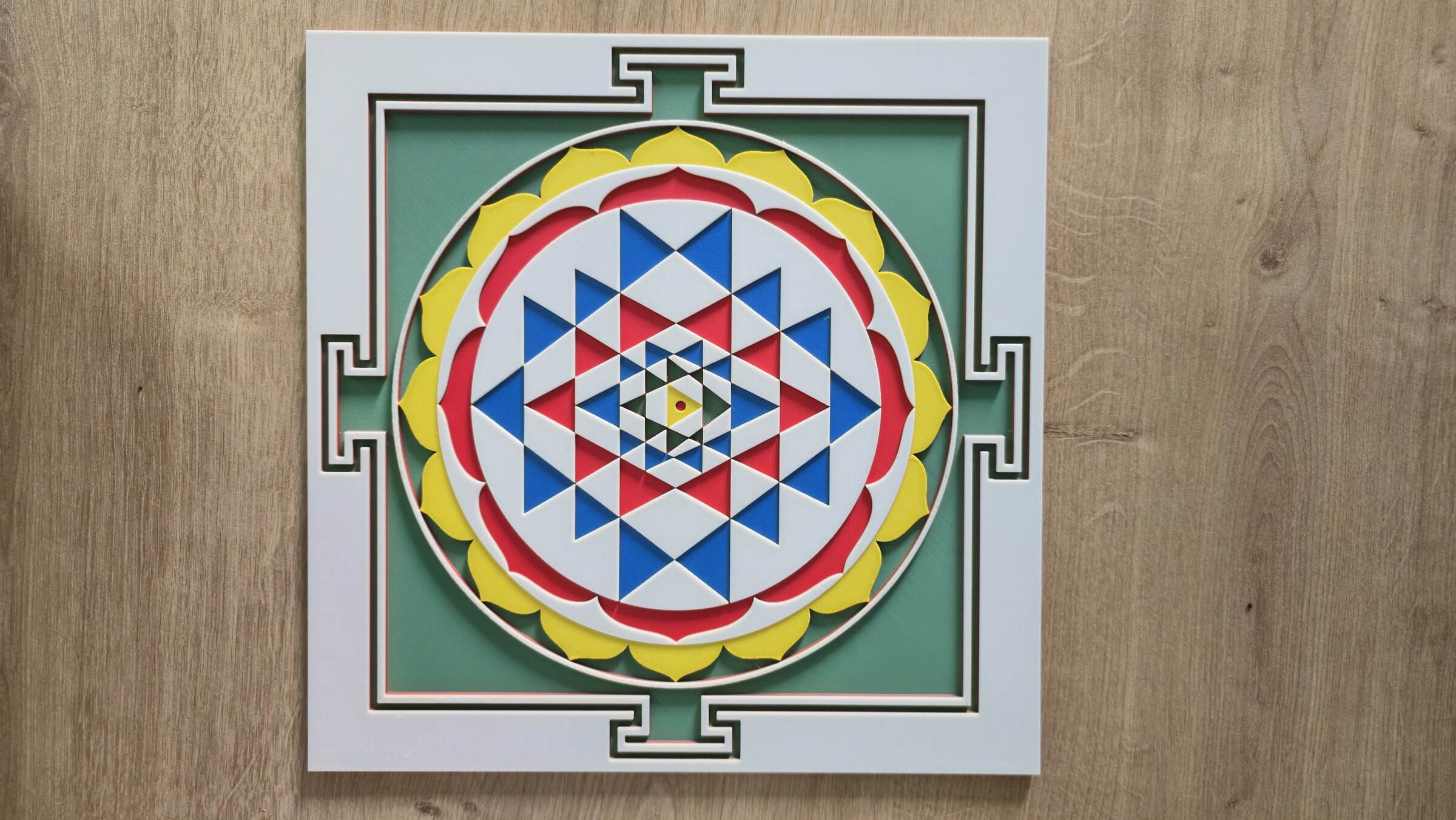
Trataka is fixed-gaze meditation. You sit still and focus your eyes on a single object: a candle flame, a black dot, or a geometric form. The body is completely still (you get the attentional bandwidth benefits of sitting), but the mind has active, compelling work to do through the visual channel.
Why vision? Roughly 30% of the cortex is devoted to visual processing (Felleman & Van Essen, 1991), more than any other sense. When you anchor attention through the eyes, you’re engaging the brain’s most powerful sensory channel. This makes trataka a stronger anchor than the breath (which is subtle and easily lost) without the sensory-motor complexity that movement introduces.
The classical description comes from the Hatha Yoga Pradipika (15th century): “Being calm, one should gaze steadily at a small mark, till eyes are filled with tears. This is called Trataka by the acharyas.” The Gheranda Samhita (17th century) gives nearly identical instructions and adds that the practice “manifests inward light.”
What makes trataka practically useful is its built-in feedback loop. When your attention wanders during breath meditation, you might not notice for minutes. When your attention wanders during trataka, your gaze drifts and you know immediately. Few meditation techniques provide such direct, real-time feedback on the state of your attention.
The research, while small-scale, is encouraging. Raghavendra and Singh (2016) tested 30 yoga-experienced male volunteers in a within-subject design: each participant completed both a 25-minute trataka session and a control session (sitting with eyes closed) on separate days. The trataka session produced a 26% improvement in selective attention on the Stroop color-word test, compared to 11% in the control condition. Swathi, Bhat, and Saoji (2021) found that after a two-week training period, trataka significantly improved working memory and spatial attention on the Corsi-Block task, and that eye exercises alone did not produce the same effect. The concentration component, not just the eye movement, was the active ingredient. Both studies used small, healthy samples, so the findings are promising rather than definitive.
Trataka also has a natural progression built in. You begin with external gazing (bahiranga trataka, eyes open on the object), then close your eyes and hold the afterimage internally (antaranga trataka). This internal phase is identical to the visualization practices found in advanced sitting meditation, but you arrive there through a concrete gateway rather than trying to conjure an image from nothing. The object does half the work.
This doesn’t make trataka universally superior. It won’t help you discharge physical tension the way walking or yoga will. It’s not as internalized as breath meditation for practitioners who’ve moved past needing an external anchor. But for people who find breath meditation too subtle and movement meditation too shallow, trataka fills a gap that most meditation guides don’t acknowledge exists.
How to choose: a practical framework
Rather than “try both and see what you prefer,” here’s a decision framework based on your current state and your goals.
Choose by your current state:
- High physical energy, restlessness, or tension: Start with movement. Walk, do yoga, or try cathartic movement (Osho-style). Then transition to sitting. Fighting your body’s need to move wastes the session.
- Moderate energy, scattered mind: Try trataka or another fixed-gaze practice. Your body doesn’t need to move, but your mind needs something more engaging than the breath.
- Calm but unfocused: Sitting with breath awareness or a mantra. You’re in the right zone for classical seated practice.
- Already calm and concentrated: Sitting with minimal anchor. Open awareness, choiceless awareness. Let attention rest without directing it.
Choose by your goal:
- Stress relief and relaxation: Movement meditation is sufficient and often preferable. Edwards and Loprinzi (2018) found that both walking and seated meditation reduced fatigue, but seated meditation improved overall mood more broadly. If deep relaxation is the goal, a walk-then-sit sequence may cover both needs.
- Building concentration: Sitting or trataka will progress faster than movement. Fewer sensory inputs means more bandwidth for the specific skill you’re training.
- Emotional processing: Practitioners commonly report that high-activation emotions (anger, agitation) benefit from movement first, while low-activation emotions (grief, sadness) respond better to sitting with the feeling directly. No controlled studies confirm this mapping, but the pattern aligns with the coarse-to-subtle gradient discussed above.
- Integration into daily life: Movement meditation (mindful walking, attention during daily tasks) is the endgame. But it works best after you’ve built concentration through sitting or focused practice first.
The combination principle: The most effective approach for most people isn’t choosing one or the other but sequencing them. Walk, then sit. Or: trataka for focus, then close your eyes for internal stillness. The traditions that have been doing this longest (Thai Forest Buddhism, Ashtanga yoga, Osho’s framework) all prescribe combined sequences. The Qigong tradition summarizes it well, as Payne and Crane-Godreau (2013) noted in their review of meditative movement: “Small movement is better than large movement; no movement is better than small movement.” Start where you are, and let the practice move toward stillness on its own.
Sources
- Raghavendra BR, Singh P. (2016). “Immediate effect of yogic visual concentration on cognitive performance.” Journal of Traditional and Complementary Medicine, 6(1):34-36. PMC4738033.
- Swathi PS, Bhat R, Saoji AA. (2021). “Effect of Trataka (Yogic Visual Concentration) on the Performance in the Corsi-Block Tapping Task: A Repeated Measures Study.” Frontiers in Psychology, 12:773049. PMC8718544.
- Edwards MK, Loprinzi PD. (2018). “Experimental effects of brief, single bouts of walking and meditation on mood profile in young adults.” Health Promotion Perspectives, 8(3):171-178. PMC6064756.
- Payne P, Crane-Godreau MA. (2013). “Meditative Movement for Depression and Anxiety.” Frontiers in Psychiatry, 4:71. PMC3721087.
- Kahneman D. (1973). Attention and Effort. Englewood Cliffs, NJ: Prentice-Hall.
- Mitchell JT, Zylowska L, Kollins SH. (2015). “Mindfulness Meditation Training for Attention-Deficit/Hyperactivity Disorder in Adulthood.” Cognitive and Behavioral Practice, 22(2):172-191. PMC4403871.
- Treleaven DA. (2018). Trauma-Sensitive Mindfulness: Practices for Safe and Transformative Healing. New York: W.W. Norton.
- Van der Kolk B. (2014). The Body Keeps the Score: Brain, Mind, and Body in the Healing of Trauma. New York: Viking.
- Felleman DJ, Van Essen DC. (1991). “Distributed hierarchical processing in the primate cerebral cortex.” Cerebral Cortex, 1(1):1-47. PMID: 1822724.
- Svatmarama. (~15th century). Hatha Yoga Pradipika. Trans. Pancham Sinh (1914). Ch. 2, v. 31-32.
- Gheranda. (~17th century). Gheranda Samhita. Ch. 1, v. 53-54.
- Cankama Sutta (AN 5.29). Trans. Bhikkhu Sujato. SuttaCentral.
- Vitakkasanthana Sutta (MN 20). Trans. Bhikkhu Sujato. SuttaCentral.
- Kaplan JS. (2012). “Why You Can’t Sit in Meditation and What to Do About It.” Psychology Today.
- Osho. “Is it good to start with a sitting meditation or an active meditation?” Meditation: The Art of Ecstasy, Talk #5.
- Thich Nhat Hanh. (1996). The Long Road Turns to Joy: A Guide to Walking Meditation. Berkeley: Parallax Press.