Meditation for Restless Minds: Why Trataka Works
Miha Cacic · April 9, 2026 · 7 min read

If you’ve tried meditation and your mind refused to cooperate, racing through to-do lists, replaying old conversations, physically itching to move, you weren’t doing it wrong. You were doing the wrong type of meditation for your brain. There is a category of practice specifically built for restless minds, and it works by giving your attention something to grip instead of asking it to float in darkness.
Why your mind goes haywire the moment you close your eyes
Standard meditation advice says to close your eyes, focus on your breath, and let thoughts drift past like clouds. For some brains, this is like pouring gasoline on a fire.
Here’s why. When you close your eyes and reduce sensory input, your brain’s default mode network (DMN) becomes more active, not less. The DMN is the system responsible for mind-wandering, self-referential thought, and mental time travel. It’s the part of your brain that rehearses tomorrow’s meeting while you’re trying to count breaths. Neuroscientist Marcus Raichle’s team at Washington University identified this network in 2001, showing that the brain is already highly active at rest, with the DMN driving the chatter (Raichle et al., 2001).
Closing your eyes makes it worse. A 2020 fMRI study of 168 participants found that the primary visual cortex correlates positively with the DMN during eyes-closed rest but anticorrelates with the DMN when eyes are open (Adrián-Ventura et al., 2020). The researchers described two distinct brain states: an “interoceptive” mode (eyes closed, imagination and mind-wandering amplified) and an “exteroceptive” mode (eyes open, attention directed outward). You’re not failing at meditation. Your brain is doing exactly what it’s designed to do when you remove visual input.
And the visual input matters enormously. Roughly 80% of our sensory processing is visual; nearly half of the brain’s cortical area is dedicated to vision, more than all other senses combined. The retina itself develops as a direct outgrowth of the brain during fetal development, sharing its neural structure. The eye isn’t just connected to the brain; part of it is the brain. When you close your eyes, you’ve removed the strongest anchor your brain has, leaving the remaining 20% of input (mostly body sensation and sound) to compete with an unleashed DMN.
There’s one more piece. Your eyes make thousands of tiny involuntary movements called microsaccades. Neuroscientists Susana Martinez-Conde and Stephen Macknik have shown that microsaccade patterns directly reflect attentional states: scattered eyes, scattered mind (Martinez-Conde et al., 2004, 2013). The ancient yogis figured this out empirically, millennia before brain scanners. Their insight was simple: still the eyes, and the mind follows.
The eye-brain connection has clinical applications beyond meditation. EMDR (Eye Movement Desensitization and Reprocessing), the trauma therapy devised by Francine Shapiro in 1987, uses directed eye movements to process traumatic memories and is now a first-line PTSD treatment recommended by the World Health Organization, the UK’s NICE guidelines, and the US Department of Veterans Affairs (Shapiro, 1989). EMDR and trataka work through different mechanisms (bilateral movement vs. fixed gaze), but both depend on the same underlying principle: what the eyes do shapes what the brain does.
So when a meditation teacher says “just observe your thoughts like clouds,” they’re assuming you already have a baseline of calm awareness. For a restless mind, that’s like telling someone who can’t float to relax in the water. You need something to hold onto first.
Trataka: the practice designed for restless minds
That something already exists. It’s called trataka, first codified in the 15th-century Hatha Yoga Pradipika, though the underlying principles are centuries older.
Trataka is steady, relaxed gazing at a fixed point: a candle flame, a dot on a wall, or a geometric symbol. It is one of the six shatkarmas (purification practices) described in the Hatha Yoga Pradipika. Verse 2:31 reads: “Being calm, one should gaze steadily at a small mark, till eyes are filled with tears. This is called trataka by the teachers.” Verse 2:32 adds: “Trataka destroys the eye diseases and removes sloth.”
The Gheranda Samhita, another classical text, describes multiple forms: bahiranga (external gazing at a physical object) and antaranga (internal visualization of an image behind closed eyes). Both texts position trataka as a foundational practice, something you do before deeper meditation, not after.
Why does it work for restless minds? Because keeping the eyes open and focused on a single point gives the brain its strongest sensory channel something specific to do. Instead of removing vision and leaving the DMN to run wild, trataka occupies the attention system with visual input. That 2020 fMRI study from Adrián-Ventura’s team showed that eyes-open rest shifts the brain into its “exteroceptive” configuration, where the visual cortex connects with the salience network (responsible for detecting what’s important) rather than the DMN. Trataka takes this further by adding a focal point: you’re not just eyes-open, you’re eyes-focused.
The research backs this up. Raghavendra and Singh (2015) tested 30 male volunteers on the Stroop color-word test before and after a trataka session versus quiet sitting. After trataka, the color-word interference score (the hardest measure, requiring you to override a habitual response) improved by 26%, compared to 10.7% in the control group. It’s a small study, but the effect size was large, and the researchers concluded that trataka increased selective attention, cognitive flexibility, and response inhibition.
A randomized controlled trial of 60 elderly participants found similar results: 30 minutes of daily trataka over 26 days significantly improved digit span, letter cancellation, and trail-making scores, with benefits appearing after the first session and persisting at the one-month follow-up (Talwadkar, Jagannathan, & Raghuram, 2014).
And it’s not just cognition. A study of 30 adolescents found that trataka produced a marked decrease in anxiety alongside cognitive improvements, and noted that the practice lessened erratic eye movements (Raghavendra et al., 2020). The microsaccades quieted down, and so did the mind.
These are small studies, and the field needs larger trials. But the consistency across populations (young men, adolescents, elderly adults) and outcome measures (Stroop tests, digit span, anxiety scales, eye movement patterns) tells a coherent story: fixing the gaze occupies the attention system in ways that closing the eyes does not.
Trataka has a built-in feedback mechanism that breath meditation lacks. When you’re gazing at a candle flame or dot, you get immediate physical feedback: when the mind wanders, the eyes move first. You’ll notice the gaze drifting before you notice the thought. This makes the return to focus faster and more concrete than trying to catch a wandering thought after it’s already carried you three tangents deep.
The practice also has a distinct structure. After external gazing, you close your eyes and look for the afterimage (a bright spot or shape on your inner visual field). Holding attention on this afterimage is the second phase (antaranga trataka), a bridge between focused visual attention and the kind of internal stillness that breath meditation aims for. Practitioners report that the afterimage gets clearer with practice, and many use its vividness as an informal gauge of concentration depth. That concrete feedback loop is what makes trataka feel productive to restless minds, not like you’re sitting there hoping something happens.
And keeping the eyes open during meditation isn’t some modern hack. It’s the standard approach in Zen Buddhism, where zazen is always practiced with eyes half-open, gaze resting on the floor a few feet ahead. Tibetan Dzogchen tradition uses sky gazing. As the Zen saying goes: we keep our eyes open because we don’t want to escape from the world.
How to practice: a 10-minute trataka session for beginners
You need a candle or a printed black dot (about the size of a coin) taped to a wall at eye level. A dim room. That’s it.
Minutes 1-2: Settle in. Close your eyes. Take five or six slow breaths. This isn’t the meditation; it’s the warm-up. Let your body arrive.
Minutes 3-7: External gazing. Open your eyes. Fix your gaze softly on the candle flame or the dot. Don’t stare it down; look at it the way you’d look at something you find beautiful. Blink when you need to (forced non-blinking is a different practice, a purification kriya, not what we’re doing here). When you notice your mind has wandered, check your eyes first. They probably moved. Bring them back to the point. The gaze is the anchor.
Minutes 8-10: Internal gazing. Close your eyes. Look for the afterimage: a bright spot or shape on the dark screen of your closed eyelids. Hold your attention on it gently. Don’t chase it. When it fades, sit with whatever remains for a few breaths.
After: Splash cool water over your closed eyes. This is the traditional recommendation, and it soothes any dryness from the focused gazing.
What to expect: The first session, you’ll blink constantly and the afterimage will be faint or gone entirely. That’s normal. By week two, you’ll notice longer stretches of steady gaze and a clearer afterimage. By month one, the mental quiet during the internal phase becomes unmistakable. This progression is the feedback loop that makes people stick with the practice.
One safety note: If you have glaucoma, cataracts, epilepsy (particularly photosensitive epilepsy with flame), or a serious psychiatric condition, consult a professional before practicing candle trataka. A black dot on a wall is a gentler alternative for anyone with eye conditions. Don’t practice external trataka for more than 10 minutes per session.
Why restlessness is the qualification, not the disqualification
Here’s the belief that does the most damage: “I’m bad at meditation because my mind won’t stop.”
The Buddhist teacher Pema Chodron has reportedly described her mind as still restless after decades of practice. As one commenter on Quora put it with admirable bluntness: “This IS the nature of mind. As long as your brain remains alive, it will spew out unending streams of thoughts and emotions. This will not stop until you are dead.”
You’ve probably heard that we have 60,000 thoughts per day. That number is made up: researchers traced it through a chain of citations that ended at a plumbing contractor’s marketing blog referencing a nonexistent National Science Foundation study. The real count, from fMRI research at Queen’s University, is closer to 6,200. But even 6,200 unmanaged thoughts feels like a lot when you’re sitting with your eyes closed.
The problem was never the restlessness. It was the match between the restlessness and the technique. Research on meditation persistence shows that nearly a third of people who try meditation aren’t practicing a year later, and those who start through apps are less likely to persist than those who learn from a teacher or at a retreat (Lam et al., 2023). The modality matters.
This isn’t a modern problem, either. In the Bhagavad Gita (composed roughly 2,000 years ago), the warrior Arjuna tells Krishna: “The mind is very restless, turbulent, strong and obstinate. It appears to me that it is more difficult to control than the wind.” Krishna doesn’t dismiss him. He doesn’t say try harder. His answer is methodological: through practice (abhyasa) and detachment (vairagya). The right technique, applied consistently.
A mind that generates constant activity has high processing bandwidth. That’s not a deficiency; it’s raw material. Trataka gives that raw material somewhere to go. When Patanjali defined dharana (concentration) in the Yoga Sutras as “the binding of the mind to one place,” he was describing what trataka does in practice: it gives a restless mind a single point to bind to, through the one sensory channel powerful enough to hold its attention.
The Sri Yantra: a visual anchor built for complexity
A candle flame is a good starting point, but it’s visually simple. Some minds find it boring after a week (the same minds that got bored with breath counting). If your brain craves complexity to stay engaged, there’s a trataka object designed for exactly that.
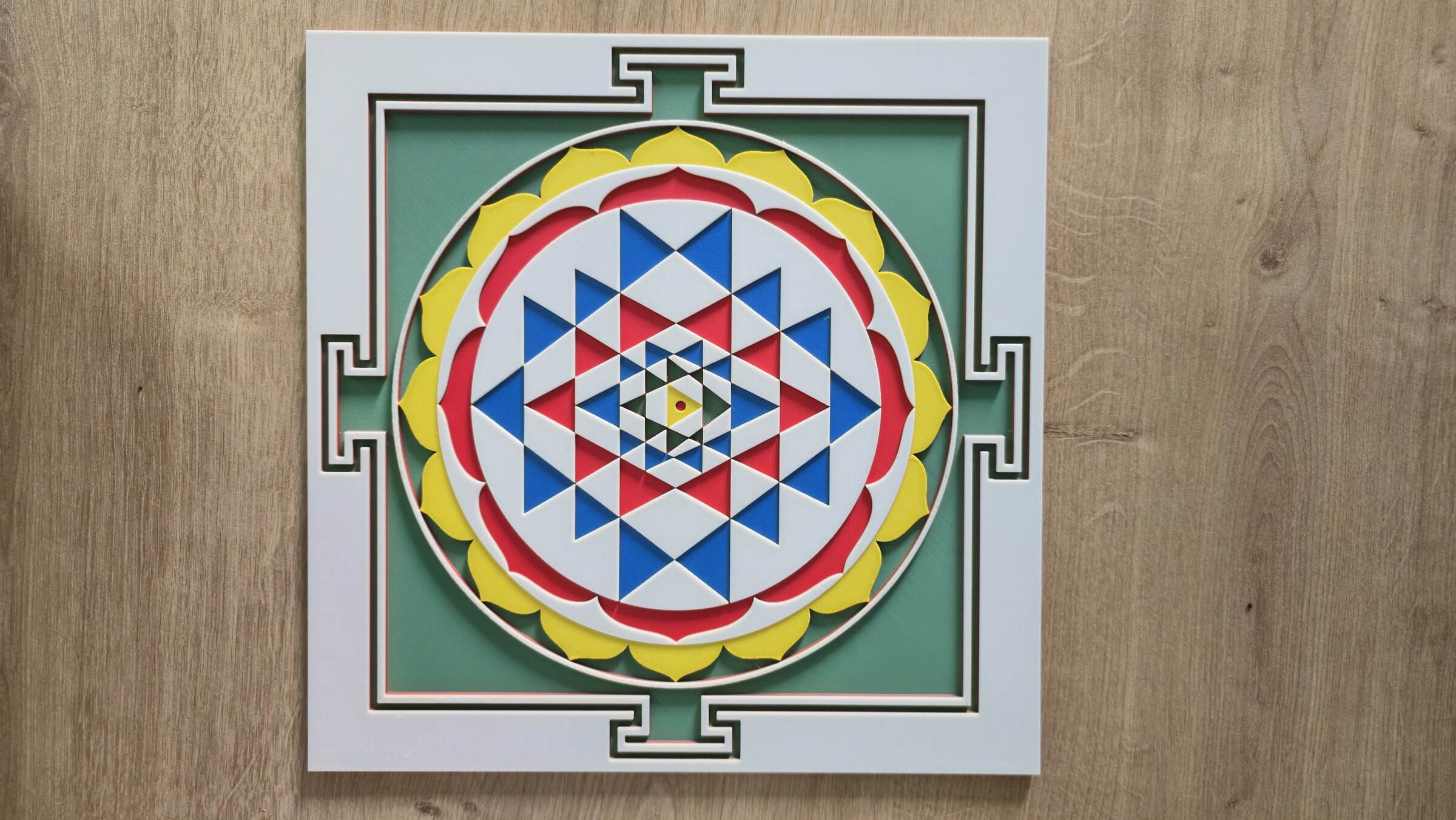
The Sri Yantra is a geometric diagram from the Hindu tantric tradition: nine interlocking triangles radiating from a central point called the bindu. Four triangles point upward, five downward, and their intersections create exactly 43 smaller triangles organized in five concentric levels. The whole structure is enclosed in lotus petals and a square gate.
As a trataka object, the Sri Yantra works differently from a candle or dot. Your eye enters at the outer gate, moves through the petals, navigates the triangular layers, and eventually comes to rest at the bindu. Practitioners describe the geometry as giving the attention system enough complexity to stay engaged without overwhelming it, a visual equivalent of a mantra: repeating, structured, and progressively absorbing.
For a restless mind, this matters. A dot asks you to hold attention on one thing. The Sri Yantra gives you a structured path from complexity to simplicity, from the outer edges inward to the single point at the center. Each time you practice, you notice new relationships between the triangles, new ways the geometry nests. This rewards sustained attention rather than punishing wandering.
Common mistakes (and what to do instead)
“I can’t stop blinking.” You don’t need to. Forced non-blinking is trataka kriya, a purification technique with a different goal. For meditation, blink naturally and focus on keeping the gaze direction steady.
“My eyes water and it hurts.” You’re straining. Soften the gaze. The instruction is “intent but relaxed gazing,” like looking at something you find beautiful, not staring down a threat. If pain persists, reduce session length and move the object further away.
“The afterimage disappears immediately.” Normal for beginners. The afterimage strengthens with practice; its clarity tends to reflect how focused the gazing phase was. Don’t chase it. Let it appear and observe passively.
“My mind still wanders even with eyes open.” Expected. The difference is that with trataka, you get physical feedback: the eyes drift before the thought forms fully. You catch the wandering earlier and return faster. That shorter feedback loop is the advantage.
“Should I do this instead of breath meditation?” Not necessarily instead. Some practitioners use five to ten minutes of trataka as a warm-up before their main practice. Trataka builds the concentration that makes breath meditation productive. If breath meditation feels impossible right now, start with trataka alone and add other practices later.
Sources
- Raichle, M. E., MacLeod, A. M., Snyder, A. Z., Powers, W. J., Gusnard, D. A., & Shulman, G. L. (2001). “A default mode of brain function.” Proceedings of the National Academy of Sciences, 98(2), 676-682. DOI: 10.1073/pnas.98.2.676
- Adrián-Ventura, J., Costumero, V., Parcet, M. A., & Ávila, C. (2020). “Opening or closing eyes at rest modulates the functional connectivity of V1 with default and salience networks.” Scientific Reports, 10, 9137. DOI: 10.1038/s41598-020-66100-y
- Raghavendra, B. R., & Singh, P. (2015). “Immediate effect of yogic visual concentration on cognitive performance.” Journal of Traditional and Complementary Medicine, 6(1), 34-36. PMID: 26870677
- Talwadkar, S., Jagannathan, A., & Raghuram, N. (2014). “Effect of trataka on cognitive functions in the elderly.” International Journal of Yoga, 7(2), 96-103. PMID: 25035618
- Raghavendra, B. R., et al. (2020). “Effectiveness of yogic visual concentration (Trataka) on cognitive performance and anxiety among adolescents.” Journal of Complementary and Integrative Medicine, 17(3). PMID: 32415824
- Martinez-Conde, S., Macknik, S. L., & Hubel, D. H. (2004). “The role of fixational eye movements in visual perception.” Nature Reviews Neuroscience, 5(3), 229-240
- Martinez-Conde, S., Otero-Millan, J., & Macknik, S. L. (2013). “The impact of microsaccades on vision: towards a unified theory of saccadic function.” Nature Reviews Neuroscience, 14(2), 83-96
- Shapiro, F. (1989). “Eye Movement Desensitization: A new treatment for post-traumatic stress disorder.” Journal of Behavior Therapy and Experimental Psychiatry, 20(3), 211-217
- Lam, S. U., et al. (2023). “Who Sticks with Meditation? Rates and Predictors of Persistence in a Population-based Sample in the USA.” Mindfulness, 14, 588-599. PMID: 36777474
- Swami Muktibodhananda (2000). Hatha Yoga Pradipika (commentary). Bihar School of Yoga
- Vyasa (trans. various). Bhagavad Gita, Chapter 6, Verses 34-35
- Sage Gheranda. Gheranda Samhita
- Patanjali. Yoga Sutras, III.1 (Dharana)