Meditation for People Who Hate Meditation
Miha Cacic · April 9, 2026 · 6 min read

You probably don’t hate meditation. You hate the specific kind of meditation that someone told you was the only kind. Breath-focused, eyes-closed, sit-still-and-clear-your-mind meditation is one practice among dozens, and it happens to be the worst possible starting point for the exact type of person who searches “meditation for people who hate meditation.”
Why you actually hate it (it’s not what you think)
Most articles about meditation-hatred treat it like a personality quirk to route around. “Can’t sit still? Try mindful dishwashing!” That skips the diagnosis. If you understand why meditation felt awful, you can find a practice that doesn’t.
You were told the goal is to stop thinking. This is the most widespread and damaging misconception in popular meditation. The goal has never been to empty your mind. Thinking during meditation isn’t failure; it’s the raw material. The actual exercise is noticing that your attention wandered and bringing it back. That moment of noticing IS the rep. Even experienced practitioners spend most of their sessions doing exactly this: noticing distraction, returning to focus, over and over. If monks who’ve sat for decades still contend with wandering minds, the expectation that you should achieve silence on day one isn’t ambitious; it’s a setup.
And about how much thinking is “normal”: you may have seen the claim that we have 50,000 to 70,000 thoughts per day. That number is apocryphal. No study has ever produced it. Neuroscientists at Queen’s University used fMRI to measure thought transitions and estimated roughly 6,200 per day (Tseng & Poppenk, 2020). That’s still a lot of thoughts, but it’s a manageable number, not an avalanche you need to suppress.
There’s no feedback loop. In every other skill you’ve learned (an instrument, a sport, a language), there are tangible progress markers. You play a chord cleanly. You shave seconds off your time. Breath meditation gives you nothing external to track. You sit, you breathe, you wonder if you’re improving, and you have no way to tell. For progress-oriented people, this feels like running on a treadmill in the dark. It’s not that you lack discipline. The practice itself is giving you nothing to work with.
Closing your eyes makes it worse. This is the one nobody talks about. For many people, closing their eyes doesn’t create calm; it removes the last anchor. Neuroscience backs this up. A 2020 study in Scientific Reports found that closing your eyes increases connectivity between the visual cortex and the default mode network, the brain’s self-referential thinking system (Wei et al., 2020). The default mode network is what generates the internal monologue, the worry loops, the replaying of old conversations. Experienced meditators show reduced activity in this network (Brewer et al., 2011), but for a beginner, closing your eyes can intensify the exact mental chatter you’re trying to quiet. Open eyes keep the visual system engaged, which partially counteracts that shift toward rumination.
Sitting still is the wrong starting instruction for a restless person. “Sit still and relax” asks an anxious or restless person to suppress their dominant state rather than channel it. There’s a structural reason this fails: the instruction assumes you can sustain attention without an anchor. Focused attention meditation, where the mind has a concrete object to return to, works differently from open monitoring, where the instruction is to passively observe whatever arises. A restless mind needs something to grip. When you’re told to sit still with nothing to focus on and you can’t do it, the problem isn’t your discipline. It’s a modality mismatch.
What nobody tells you: there are fundamentally different types of meditation
If you’ve “tried meditation and hated it,” you almost certainly tried one thing: a guided breath meditation on an app. That’s not trying meditation. That’s trying one format.
Meditation is a family of distinct practices. Breath-focused meditation (anapanasati) is one. Mantra-based practice (japa, Transcendental Meditation) is another. There’s movement-based meditation (walking meditation, tai chi), visualization practices (common in Tibetan Buddhism), and object-focused gaze practices (trataka). These aren’t interchangeable variations on a theme. They engage different cognitive systems and suit different types of minds.
Why does everyone teach the same one? Partly because the app economy made it so. Calm and Headspace (the two dominant meditation apps) are audio-first subscription platforms. Their business model requires content that translates to guided audio sessions. Breath-focused meditation fits that model perfectly. Object-focused practices like trataka, where you stare at a candle flame in silence, can’t be sold as an audio subscription. The dominance of breath meditation in popular culture is at least partly a distribution artifact, not a ranking of effectiveness. When 95% of people stop using meditation apps within 30 days (Creswell, 2025), it’s worth asking whether the problem is meditation itself or one format delivered through one channel.
The traditional order is backwards from what you were taught. In classical yoga, breath meditation is not treated as a beginner practice. The Hatha Yoga Pradipika, a 15th-century yoga text, lists trataka (steady gazing) as one of six foundational purification practices called shatkarmas (Chapter 2, Verse 22). These purification practices appear in the text before pranayama and seated meditation. The Gheranda Samhita, another classical text from the 17th century, places shatkarmas in its very first chapter (Verses 53-54). In both texts, trataka is categorized as something you do to prepare for meditation, not a consolation prize for those who can’t sit still. The modern default (start with breath meditation, struggle, give up) ignores a progression that classical texts took seriously.
The case for keeping your eyes open
If the problems with closed-eye breath meditation are a missing feedback loop, a racing default mode network, and nothing concrete to anchor your attention, then the fix is a practice that provides all three. That practice exists. It’s called trataka.
Trataka is straightforward: you gaze at a fixed point (traditionally a candle flame) without blinking for as long as comfortable, then close your eyes and observe the after-image. A session can be as short as a few minutes. There’s nothing to download, no one narrating instructions in your ear, no subscription.
The visual anchor changes everything. With your eyes open and fixed on a flame, your mind has something concrete to return to. When attention wanders, you know it immediately, because the flame is still right there. This creates the feedback loop that breath meditation lacks. The instruction is binary: are you looking at the flame, or not? There’s no ambiguity about whether you’re “doing it right.”
Your brain behaves differently with eyes open. Kim et al. (2022) found that open eyes produce more organized neural oscillation patterns in the default mode network compared to eyes closed. The visual anchor doesn’t shut down internal processing; it structures it. For beginners, this suggests less of the chaotic mind-wandering that makes closed-eye practice unbearable and more of the focused attention that makes meditation productive.
Progress is measurable. In trataka, improvement is directly perceptible. Over weeks, the gaze stabilizes. The after-image you see when you close your eyes (called antaranga trataka in the yoga tradition) becomes clearer and lasts longer. Your eyes water less frequently. These are concrete signals that your concentration is developing.
The cognitive effects show up in research too. Raghavendra and Singh (2016) trained 30 volunteers in trataka for 15 days, then compared their Stroop color-word test performance (a standard measure of selective attention and cognitive flexibility) after a trataka session versus sitting quietly with eyes closed. The trataka group improved 26% on color-word scores compared to 11% for the control group. A separate study by Swathi and Bhat (2021) found that two weeks of trataka practice significantly improved working memory and spatial attention. A systematic review of trataka research has proposed a neurophysiological framework linking sustained gaze fixation to enhanced executive function and attentional stability.
This isn’t a gentler, easier version of “real” meditation. In Patanjali’s framework, trataka cultivates at least three of the eight limbs of yoga: pratyahara (withdrawal from distractions), dharana (concentration), and dhyana (meditative absorption). It’s a rigorous concentration training technique with measurable cognitive outcomes. It just happens to work better as a starting point for active, visual, restless minds.
What about people who legitimately can’t meditate?
Some people face genuine barriers to meditation that aren’t about modality mismatch. Being honest about this matters more than being encouraging.
Lindahl et al. (2017), in the most systematic study of meditation-related difficulties to date, interviewed over 60 Buddhist meditation practitioners and 32 meditation experts. They identified 59 types of meditation-related challenges across seven domains. In broader epidemiological samples, 6 to 14% of meditators reported lasting negative effects, a rate that closely mirrors the adverse effects of psychotherapy (5 to 13%). Willoughby Britton, the Brown University psychologist who led the research, has built an entire program around supporting people who experience meditation-related difficulties.
Clinical social worker Sean Grover (2022) identifies five conditions where traditional meditation may worsen symptoms: intense anxiety (turning attention inward can spike dread), PTSD (can cause dissociation and panic attacks), ongoing depression (can fuel withdrawal), psychotic episodes (can magnify breaks from reality), and active addiction.
For people with trauma, the issue runs deeper than discomfort. As Cassie Winter, who lives with PTSD and Complex PTSD, writes: “Most days it was awful. It was a trudge. It was like pulling teeth!” She describes four reasons meditation fails for trauma survivors: the practice itself triggers flashbacks, becoming present feels unsafe to the nervous system, chronic illness makes physical stillness painful, and neurodivergence makes the executive function demands too high. Her core insight is simple: safety is a prerequisite for meditation. If sitting still with eyes closed doesn’t feel safe, no technique will fix that.
Trataka’s external visual focus may be less triggering than closed-eye practices for some of these populations, since attention stays anchored to an object outside the body rather than turning inward. But this is a structural observation, not a clinical recommendation. If meditation consistently makes you feel genuinely distressed (not just bored or restless, but panicked, dissociated, or worse), talk to a therapist before continuing. Meditation is powerful precisely because it works, and things that work can also cause harm when applied wrong.
This is where “mindful dishwashing” actually belongs. Not as a permanent alternative to meditation, but as a genuine bridge practice. Walking, cooking, gardening, and other activities that direct attention to physical sensation can build the capacity for present-moment awareness without the intensity of formal practice. They’re legitimate stepping stones, not consolation prizes. For people who aren’t ready for any form of seated meditation, Grover specifically recommends tactile and sensory activities as a path toward mindfulness.
How to start (for people who’ve already quit once)
You’ve tried meditation before and it didn’t work. Here’s something you can do tonight, in two minutes, with no app.
The two-minute candle test. Light a candle. Sit in front of it. Look at the flame. Don’t try to think or not think. Just look. When your eyes water, blink. When your mind wanders, notice that you’re no longer looking at the flame, and look again. Do this for two minutes. That’s it. That’s a complete meditation session.
This works for people who’ve already quit because it’s too short to dread, too simple to get wrong, and too concrete to get lost in.
The progression. Two minutes becomes five. Five becomes ten. The after-image practice develops naturally: after gazing, close your eyes and see how long the flame’s image persists. With practice, the image becomes clearer and lasts longer. You’re training concentration, and you can feel it working. Research suggests that meaningful benefits from meditation practice appear at around 10 to 21 minutes, three times per week (Creswell, 2025). Two minutes is the starting point, not the destination.
One thing that helps with consistency: Huberty et al. (2023) studied why people abandon meditation apps and found that linking meditation to an existing daily routine reduced the abandonment risk by 39%. If you already have a wind-down ritual (making tea, brushing your teeth), put the candle next to it.
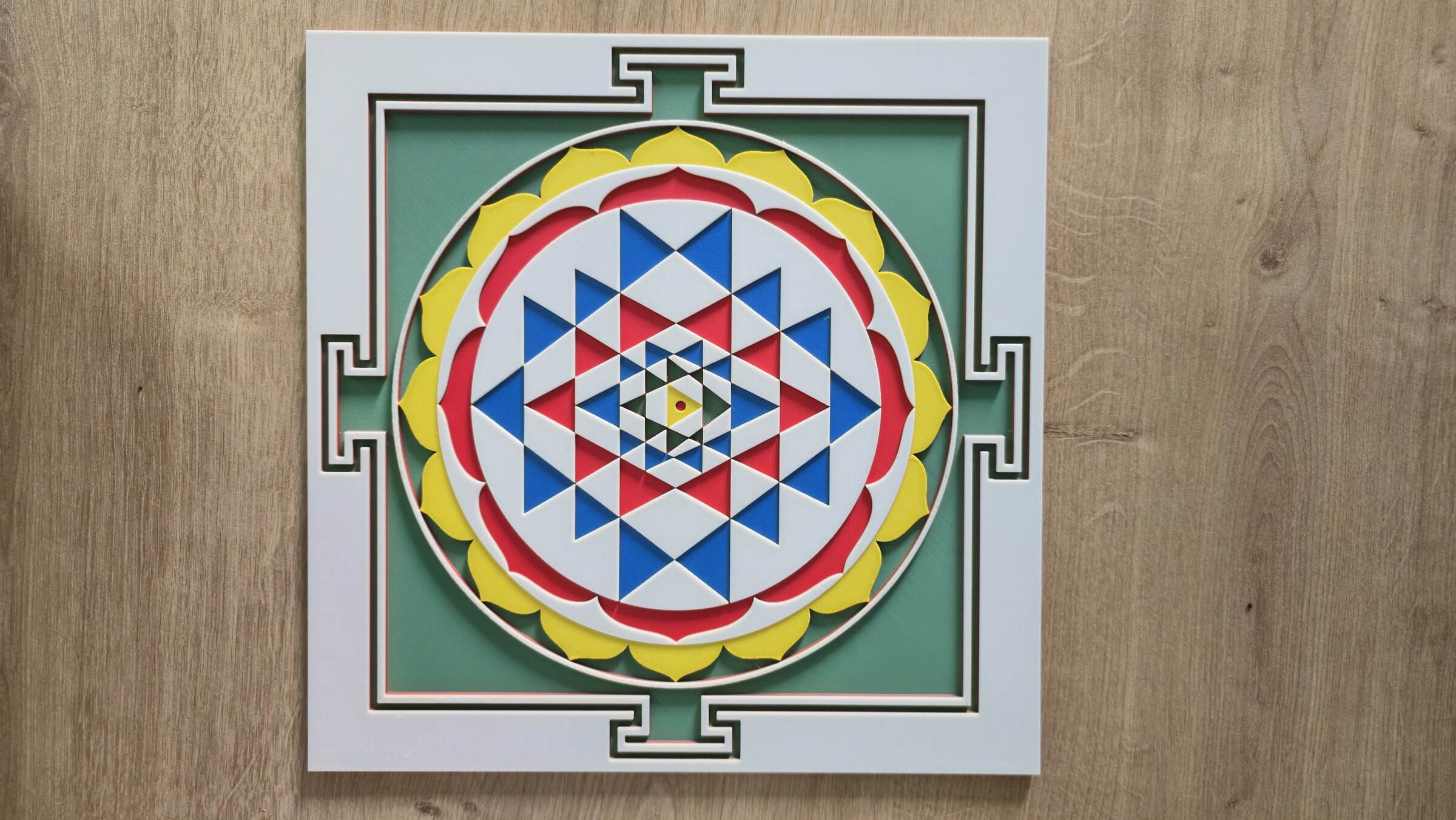
What you don’t need to buy. You don’t need a meditation cushion, an app subscription, incense, or a singing bowl. You need a candle and a quiet room. If you later want a more structured object to gaze at (a printed yantra or geometric pattern works well), you can explore that. But start with a candle. The point is to begin.
You didn’t fail at meditation. You were given the wrong kind.
Sources
- Brewer JA, Worhunsky PD, Gray JR, Tang YY, Weber J, Kober H. (2011). “Meditation experience is associated with differences in default mode network activity and connectivity.” PNAS, 108(50):20254-20259. PMID: 22114193.
- Creswell JD. (2025). “The Meditation App Revolution.” American Psychologist. Carnegie Mellon University. PMC12333550.
- Grover S, LCSW. (2022). “5 Reasons Why Meditation Doesn’t Work for Everyone.” Psychology Today.
- Huberty J, et al. (2023). “Mindfulness Meditation App Abandonment During the COVID-19 Pandemic: An Observational Study.” Mindfulness, 14:1239-1250. PMC10158687.
- Kim HJ, et al. (2022). “Open Eyes Increase Neural Oscillation and Enhance Effective Brain Connectivity of the Default Mode Network.” Frontiers in Neuroscience, 16:861247. PMC9092973.
- Lindahl JR, Fisher NE, Cooper DJ, Rosen RK, Britton WB. (2017). “The varieties of contemplative experience: A mixed-methods study of meditation-related challenges in Western Buddhists.” PLOS ONE, 12(5):e0176239. PMID: 28542181.
- Muktibodhananda S. (1993). Hatha Yoga Pradipika. Yoga Publications Trust, Bihar School of Yoga. Chapter 2, Verses 22, 31-32.
- Raghavendra BR, Singh P. (2016). “Immediate effect of yogic visual concentration on cognitive performance.” Journal of Traditional and Complementary Medicine, 6(1):34-36. PMID: 26870677.
- Swathi PS, Bhat R. (2021). “Effect of Trataka on the Performance in the Corsi-Block Tapping Task.” Frontiers in Psychology, 12:773049. PMID: 34975664.
- Tseng J, Poppenk J. (2020). “Brain meta-state transitions demarcate thoughts across task contexts exposing the mental noise of trait neuroticism.” Nature Communications, 11:3480.
- Wei J, et al. (2020). “Opening or closing eyes at rest modulates the functional connectivity of V1 with default and salience networks.” Scientific Reports, 10:9462.
- Winter C. “Meditation & Trauma: Why Can’t I Meditate?” AccountabilityMuse.