Fixed-Gaze Meditation: 6 Techniques From Trataka to Zazen
Miha Cacic · April 9, 2026 · 6 min read
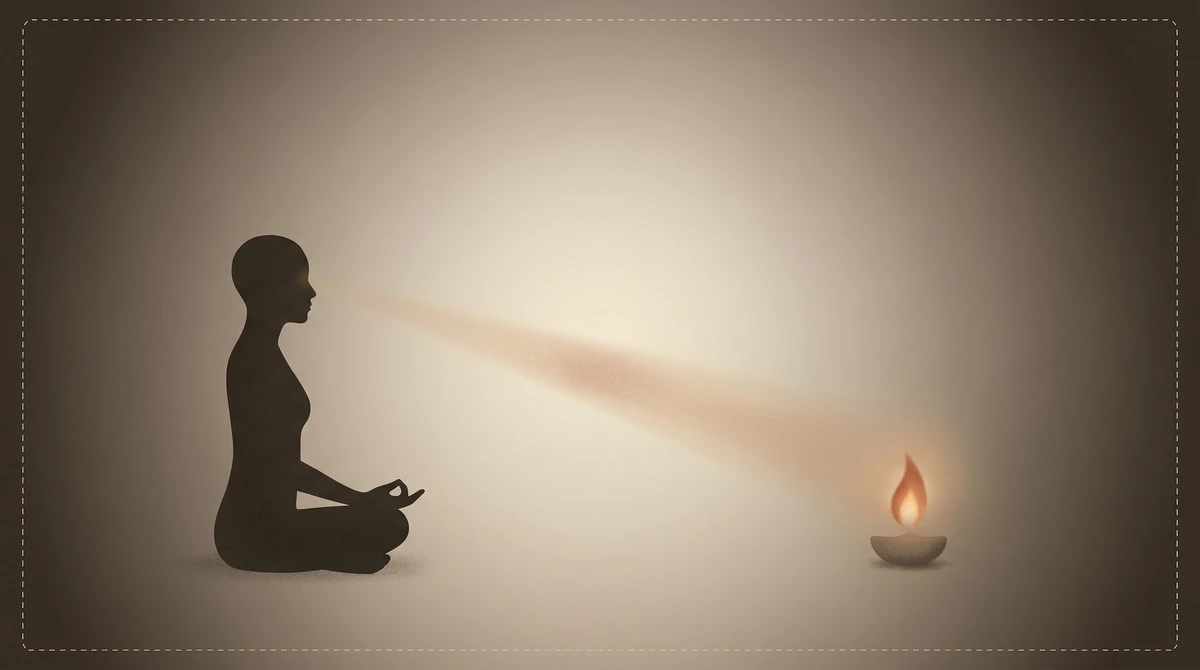
Fixed-gaze meditation is exactly what it sounds like: you pick a point, fix your eyes on it, and hold your attention there. The yoga tradition calls it trataka. But the family of gaze-based practices is broader than any single technique. Zen Buddhists sit facing a wall with a soft, unfocused gaze. Tibetan practitioners gaze into open sky. The principle across all of them: when you stabilize the eyes, the mind follows.
Most articles on this topic hand you a candle and a set of instructions. This article covers the major gaze-based approaches, explains the neuroscience behind them, and gives you a framework for choosing the one that fits your life.
Why fixing your gaze stills your mind
Your eyes aren’t passive sensors. The retina develops as a direct outgrowth of the brain during embryonic development, and according to MIT research, roughly half the brain is devoted directly or indirectly to processing visual information. The eyes and the brain are, in a meaningful sense, the same organ.
Even when you think you’re staring at something, your eyes make tiny involuntary movements called microsaccades, a few times every second. These movements send a constant stream of signals to the reticular activating system, a brainstem network that regulates arousal and alertness. Each microsaccade is an update to the brain: keep scanning, stay alert, something might change.
When you deliberately still your gaze on a single point, you likely reduce that stream of signals. With less proprioceptive input telling it to stay in scanning mode, the reticular activating system dials down arousal. The measurable data fits this model: a 2014 study found that a single session of trataka decreased heart rate and breathing rate, reduced sympathetic nervous system activity, and increased parasympathetic (rest-and-digest) activity (Raghavendra & Ramamurthy, 2014, cited in Swathi et al., 2021).
The eye-brain connection runs both directions. Kinsbourne’s 1972 research demonstrated that the direction of gaze reflects which brain hemisphere is dominant (eyes right for verbal processing, eyes left for spatial). The logical implication: a centered, steady gaze may promote balanced bilateral activation. The most dramatic evidence for the bidirectional link comes from EMDR therapy, where an NIMH-funded clinical trial found that guided eye movements were at least as effective as fluoxetine for PTSD, with 75% of adult-onset trauma patients reaching asymptomatic functioning at six-month follow-up compared to none in the medication group (Van der Kolk et al., 2007). EMDR uses eye movements where trataka uses eye stillness, but both demonstrate the same principle: what the eyes do changes what the brain does.
This may be why fixed-gaze meditation works for people who struggle with breath meditation. The visual feedback loop is faster and more tangible. You know immediately when your attention has drifted because your gaze moves or your eyes lose focus. That instant feedback makes it easier to return.
The main techniques
These techniques share the same principle (stabilizing the gaze to stabilize the mind) but vary in what you look at, what tradition they come from, and what kind of mental experience they produce. Organized here from most accessible to more advanced.
Candle-flame gazing (trataka)
The most well-known version and the one most articles cover exclusively.
You sit in a dark, draft-free room with a candle at eye level, about an arm’s length away. Fix your gaze on the tip of the wick (the steadiest part of the flame, not the flickering body). Hold a relaxed, steady gaze. When tears begin to form or your eyes feel strained, close them and observe the afterimage on the inside of your eyelids. When the afterimage fades, open your eyes and repeat.
The candle works well for beginners because the flame is a natural attention magnet. Its slight movement holds interest without becoming a distraction, and it produces a vivid afterimage that gives you something concrete to work with in the eyes-closed phase.
One critical distinction: this is meditation, not the purification practice described in the Hatha Yoga Pradipika. The original text defines trataka as “gazing steadily at a small mark, till eyes are filled with tears” (HYP 2:31), and that kriya (cleansing) tradition deliberately pushes past comfort to produce copious tears. The meditation version is gentler. Blink when you need to. Keep your eyes relaxed, not straining. Confusing these two approaches is the single biggest source of headaches and eye strain among beginners. 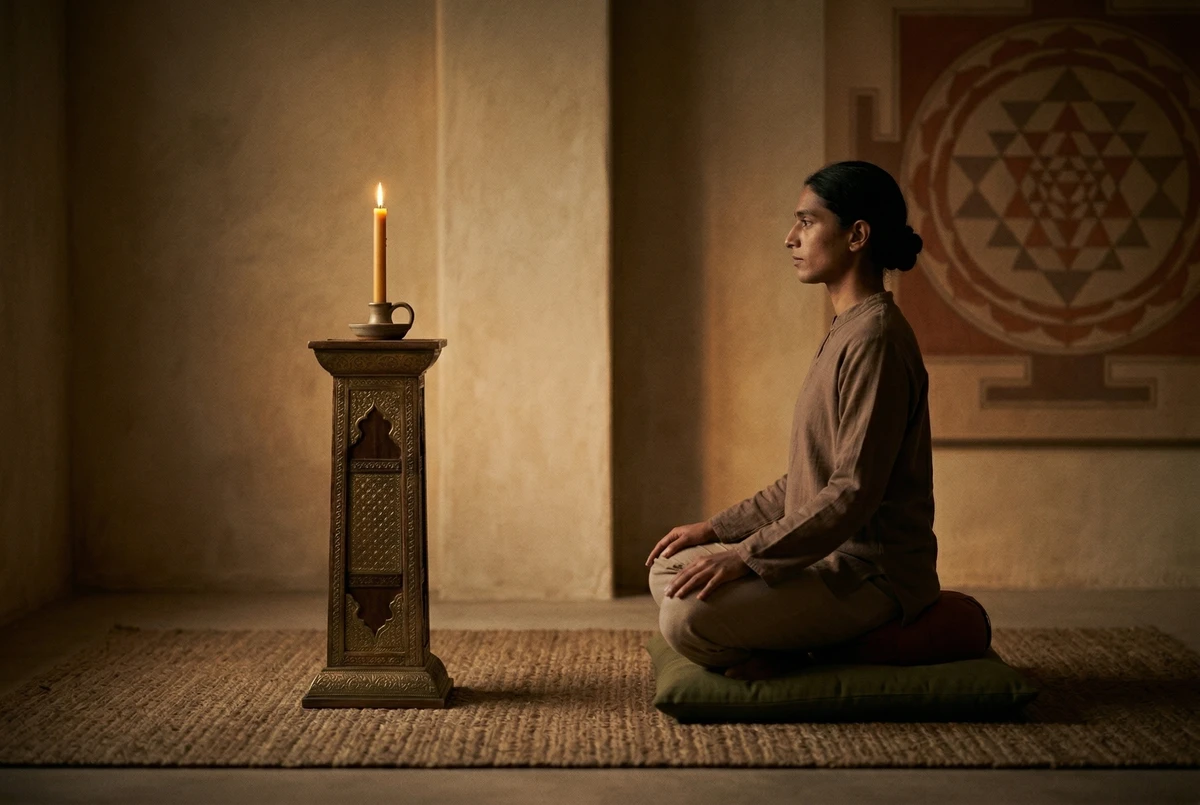
Start with 2 to 3 minutes of total practice time and build to 10 minutes over several weeks.
Dot on the wall (bindu trataka)
The simplest and most portable version. Stick a pea-sized black dot on white paper and tape it to a wall at eye level.
No fire, no darkened room, no draft concerns. You can practice at a desk, in a dorm room, or in a shared apartment. The tradeoff: a static dot provides less visual interest than a flame, which means your concentration muscles work harder. The afterimage is less vivid, but the concentration training is arguably stronger because there’s less sensory reward to keep you engaged.
Same technique as candle gazing: steady gaze on the dot, close eyes when ready, observe the afterimage, repeat.
Nose-tip gazing (nasikagra drishti)
No external object needed at all.
Nose-tip gazing means focusing both eyes on the tip of your own nose. The traditional training method: hold your index finger at arm’s length, focus on it, then slowly bring it toward your nose while keeping your gaze fixed on the fingertip. When the finger reaches your nose, transfer your focus to the nose tip itself and remove the finger.
Traditional yoga texts describe nasikagra drishti as “an excellent technique for calming anger and disturbed states of mind.” Because it requires no props or setup, you can use it anywhere: at a desk, before a meeting, on public transit. Even 2 to 3 minutes produces a noticeable settling effect.
Limit initial practice to 5 minutes and build gradually. The convergence of both eyes at such close range can cause fatigue if overdone.
Eyebrow-center gazing (shambhavi mudra)
Shambhavi mudra directs the gaze upward to the space between the eyebrows, the point traditionally associated with the ajna chakra. You can practice with eyes open, half-closed, or fully closed (focusing on the internal sensation of the point).
Practitioners describe shambhavi mudra as alerting and expansive, in contrast to the calming, grounding quality of nose-tip gazing. The Hatha Yoga Pradipika connects the practice to mental stability: “so long as the gaze is fixed between the eyebrows, there is no fear from Death” (HYP 2:40). It appears across Kundalini, Kriya, and Tantra traditions.
This is more demanding than the previous techniques. The upward eye position is unfamiliar and tiring at first. Build a foundation with candle gazing or nose-tip gazing before adding shambhavi mudra to your practice.
Sky gazing (Dzogchen)
A fundamentally different approach to working with gaze.
In the Dzogchen tradition of Tibetan Buddhism, you gaze into a clear blue sky with a soft, wide, unfocused gaze. The goal is not concentration on a point but resting in natural awareness. The sky represents the mind’s open, spacious nature. Thoughts pass like clouds. You recognize the spaciousness itself as your natural state.
The practice instructions, as described by meditation teacher Chad Foreman: find a high place with a clear view of the sky, sit comfortably, calm the breath, tilt the head slightly upward, and gaze without distraction or dullness into the expansive blue. Let go of all thoughts. Encourage awareness to merge with the open sky.
This is not fixed-point concentration. It’s the opposite: releasing the eyes from seeking objects. The gaze is soft and panoramic. If trataka is a flashlight on one spot, sky gazing is being the sky that holds all the light.
Wall gazing (zazen)
The subtlest version of gaze-based practice.
In Soto Zen zazen, you sit facing a wall with eyes half-open. The gaze rests about 2 to 3 feet ahead on the floor, or about a third of the way up the wall, cast downward at roughly a 45-degree angle. The key instruction: gaze through the surface, not at it. Eyes open but unfocused.
The gaze in zazen is a support structure, not the meditation object. Attention goes to the breath or to “just sitting” (shikantaza). The half-open eyes serve a specific function: minimal visual stimulation prevents the drowsiness that closed-eye meditation can cause, while the soft gaze allows peripheral awareness without becoming a distraction.
Bodhidharma, the legendary founder of Zen, is said to have spent nine years in wall gazing at Shaolin Temple. Dogen, founder of the Soto school, equated this wall gazing with shikantaza itself.
If you already practice seated meditation and want to add gaze stability, this is the most natural entry point.
How to choose the right technique
You want a strong visual anchor and enjoy ritual. Candle gazing. The flame holds attention naturally and the darkened room creates a contemplative atmosphere.
You want the simplest setup with no special conditions. Dot on the wall. A piece of paper and a marker. Works anywhere with a wall.
You want something you can do anywhere with no props. Nose-tip gazing. Nothing to carry, set up, or put away. Two minutes at your desk counts.
You want an energizing, expansive practice. Shambhavi mudra, once you’ve built some foundation with a simpler technique.
You resonate more with openness and spaciousness than with concentration. Sky gazing. Different tradition, different philosophy, same family of practices.
You already practice seated meditation and want to add gaze stability. Wall gazing, zazen-style.
You can’t use candles (renter, dorm, young kids). Dot gazing or nose-tip gazing solve this completely.
They all share the same insight: what you do with your eyes, you do with your mind. Start with whatever appeals to you. If it doesn’t click after a few weeks of honest practice, try another. You’re not choosing a lifelong commitment; you’re finding which doorway you walk through most naturally.
Common mistakes
Straining not to blink. The meditation version of trataka is not a staring contest. The purification kriya deliberately pushes to tears; the meditation practice does not. Blink when you need to. Relaxed eyes concentrate better than tense ones.
Too much too soon. Start at 2 to 3 minutes total. Headaches, eye fatigue, and stranger problems (one forum practitioner reported communication difficulties after 30 to 40 minutes of daily candle gazing for 2.5 months) almost always stem from excessive duration without adequate progression. Build slowly over weeks.
Mistaking perceptual changes for problems. When you hold a steady gaze, you may notice colors shifting, the object seeming to disappear, or peripheral vision fading. These are normal effects of reduced eye movement: as microsaccades slow, your visual processing shifts. The technique is working. If you experience persistent headaches or vision changes that last after practice, shorten your sessions.
Skipping the afterimage phase. In candle or dot gazing, the eyes-closed phase where you observe the afterimage isn’t a rest break between rounds of staring. It’s where deeper concentration training happens: you’re sustaining attention on an internal object without any external stimulus holding your focus. Don’t skip it for another round of external gazing.
Wrong distance or height. Place your object at eye level, about an arm’s length away. Looking up or down creates neck strain. Too close creates eye strain. These setup details matter more than they seem.
What to expect as you progress
First week. Your eyes water. You blink constantly. Your mind wanders every few seconds. This is normal. You’re training a capacity that’s never been specifically exercised before.
Weeks 2 through 4. You can hold your gaze for 30 to 60 seconds without blinking. Practitioners report the afterimage appearing more reliably and holding for 5 to 10 seconds. A settling quality begins, a sense of the mind quieting that feels different from just sitting with closed eyes.
Months 1 through 3. Gaze stabilizes for several minutes. The afterimage becomes vivid and steady. You notice improved focus carrying over into daily life: easier to read without distraction, easier to listen without your attention fragmenting. A 2014 randomized controlled trial on elderly subjects found significant improvements in working memory, attention, and executive function after one month of daily trataka (Talwadkar, Jagannathan & Raghuram, 2014). A 2016 study of 30 male university students found measurable improvements in selective attention, cognitive flexibility, and response inhibition after a single session (Raghavendra & Singh, 2016).
Beyond three months. The external object becomes less necessary. You can enter a concentrated state faster, sometimes within the first minute. Some practitioners transition to purely internal trataka (visualizing the object without external gazing) or to subtler practices like sky gazing.
Progress isn’t linear. You’ll have sessions where your mind is wild and your eyes won’t cooperate, weeks or months in. Consistency matters more than session length. Five minutes every day will outperform 30 minutes once a week.
Sources
- Talwadkar S, Jagannathan A, Raghuram N. (2014). “Effect of trataka on cognitive functions in the elderly.” International Journal of Yoga, 7(2):96-103. PMC4097909.
- Raghavendra BR, Singh P. (2016). “Immediate effect of yogic visual concentration on cognitive performance.” Journal of Traditional and Complementary Medicine, 6(1):34-36. DOI: 10.1016/j.jtcme.2014.11.030.
- Swathi PS, Raghavendra BR, Saoji AA. (2021). “Health and therapeutic benefits of Shatkarma: A narrative review of scientific studies.” Journal of Ayurveda and Integrative Medicine, 12(1):206-212. PMC8039332.
- Shathirapathiy G, et al. (2020). “Effect of trataka (yogic gazing) on insomnia severity and quality of sleep in people with insomnia.” Explore, 18(1):46-50. PMID: 33036930.
- Van der Kolk BA, et al. (2007). “A randomized clinical trial of EMDR, fluoxetine, and pill placebo in the treatment of PTSD.” Journal of Clinical Psychiatry, 68(1):37-46. PMID: 17284128.
- Kinsbourne M. (1972). “Eye and head turning indicates cerebral lateralization.” Science, 176(4034):539-541. PMID: 5032358.
- Raghavendra BR, Ramamurthy V. (2014). “Immediate effect of trataka on heart rate variability and breathing rate.” Cited in Swathi et al. 2021.
- Mallick T, Kulkarni R. (2010). “The effect of trataka on critical flicker fusion.” Journal of Alternative and Complementary Medicine, 16:1265-1267. PMID: 21091294.
- Swami Swatmarama. Hatha Yoga Pradipika, Chapter 2, Verses 31-32, 40. Sacred-texts.com translation.
- Niranjanananda SS. (2012). Commentary on the Yoga Teachings of Maharshi Gheranda. Yoga Publications Trust, Munger, India.
- MIT News. (1996). “Brain Processing of Visual Information.” MIT News.