Best Focal Point for Concentration Meditation
Miha Cacic · April 11, 2026 · 6 min read

A visual object you can fix your open eyes on (a candle flame, a black dot, a geometric form like the Sri Yantra) is the most effective focal point for building concentration. Breath is where most people start, and for good reason. But if your specific goal is developing single-pointed focus (not relaxation, not mindfulness), visual focus trains it faster. Here’s why, and how to use it.
Why the focal point matters more than you think
Concentration meditation trains one skill: noticing when your attention has drifted and bringing it back to the target. The focal point is that target. The clarity of the target determines how quickly you improve.
If you’re learning to shoot, you want a crisp bullseye, not a vague cloud. A visual object gives you a crisp target. You know the exact moment your eyes (and attention) leave it. Breath gives you something subtler, a sensation that fades in and out. You might drift for thirty seconds before you notice.
This matters because the “noticing you drifted” moment is the actual rep. It’s the bicep curl of concentration training. The faster you notice, the more reps you get per session. A clear focal point produces more reps.
One distinction worth making up front: concentration meditation (called samatha in Buddhism, dharana in yoga) is specifically about narrowing attention to a single point. It’s different from mindfulness or insight meditation, which deliberately broaden attention. The “best” focal point depends on which kind of meditation you’re doing. Everything in this article is about concentration specifically.
The most common focal points, compared
Not all focal points are equal for building concentration.
Breath is always available and requires nothing. It’s the first focal point most people learn, and it’s good for daily practice. But the signal is subtle. The sensation of air at the nostrils is faint, and when your attention drifts to thinking about lunch, you might not notice for a long time. Breath works for building concentration. It’s just slower.
Mantra (a repeated word or phrase) gives the mind verbal structure. It works well for people who think in words and is effective for calming the mind. But mantras don’t give you clear feedback when your attention slips. You can keep reciting syllables on autopilot while your mind is somewhere else entirely. A visual object catches you the moment you look away.
Body sensations (body scan, awareness of the hands) are useful for mindfulness practice but too diffuse for single-pointed concentration. There’s no single crisp target to return to.
Visual objects (candle flame, black dot, yantra, sacred image) give you the tightest feedback loop of any focal point. When you gaze at a fixed point, you have immediate, objective feedback: you know when your eyes move away. That feedback is what makes the training efficient. Vision also commands significant neural real estate. MIT neuroscientist Mriganka Sur has noted that half of the human brain is devoted directly or indirectly to vision, which means a visual focal point recruits a large portion of the brain’s processing capacity in service of the task. 
Internal visualization (imagining a flame, a deity, a point of light) is powerful but demands concentration you may not have built yet. It’s a destination, not a starting point.
The research supports the effectiveness of visual concentration training, though the studies are small. Raghavendra and Singh (2016) tested 30 young male volunteers on the Stroop color-word test, a standard measure of selective attention and cognitive flexibility, before and after a single session of trataka (the yogic practice of visual gazing). Performance improved significantly compared to a control session (p<0.001). Swathi, Bhat, and Saoji (2021) found that trataka improved working memory and spatial attention on the Corsi-Block Tapping Task, and outperformed matched eye exercises, isolating the concentration component rather than mere eye movement. Talwadkar, Jagannathan, and Raghuram (2014) showed that even among elderly subjects (ages 60-80), one month of daily trataka significantly improved working memory, attention, and executive function, with gains maintained at one-month follow-up.
None of these studies compared trataka directly against breath meditation. But the feedback-loop argument is strong: a focal point you can see gives you faster error correction than one you can only feel.
The eye-mind connection: why visual focus works
The reason visual focal points train concentration faster isn’t spiritual theory. It’s neurological architecture.
Your retina isn’t just connected to your brain. It is brain tissue. During embryonic development, the retina forms as a direct outgrowth of the forebrain. The optic nerve isn’t a peripheral nerve; it’s a central nervous system tract. Eyes and brain are, literally, the same structure.
This connection runs deeper than anatomy. Your mental state moves your eyes, and your eye movement reflects your mental state. When your mind is restless, your eyes make rapid involuntary movements called microsaccades. When your attention narrows and concentrates, microsaccade rates drop. Neuroscientists now use microsaccade patterns as a reliable window into attention because the link between eye stillness and mental focus is so consistent. 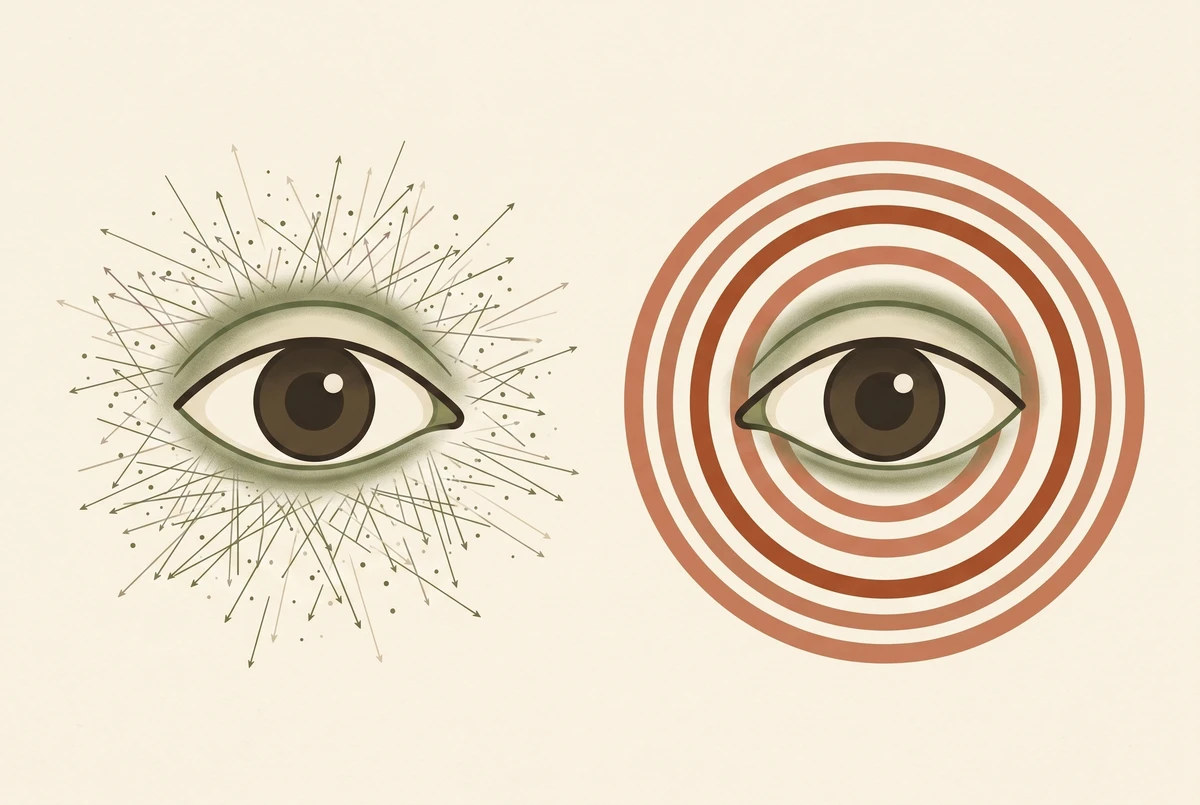
The trataka tradition discovered this principle empirically, thousands of years before we had tools to measure it. The Hatha Yoga Pradipika (15th century) prescribes gazing steadily at a small object until the eyes water, calling it a practice that “eradicates all eye diseases, fatigue and sloth” (HYP 2:31-32). The instruction embodies a practical insight: fix the eyes and the mind follows.
Brain imaging adds further support. Ganesan et al. (2022), in a systematic review and meta-analysis of 28 fMRI studies, found that focused attention meditation consistently recruits the anterior cingulate cortex, dorsolateral prefrontal cortex, and insula, key hubs of the brain’s attentional control and salience networks. A separate EEG study by Yoshida et al. (2020) showed that eight weeks of focused attention meditation training changed brain activity patterns and shortened reaction times in non-meditators. These studies examined focused attention meditation broadly, not visual focus alone, but they confirm that the skill concentration meditation trains has a measurable neural signature.
Sit with your eyes closed following your breath, and your mind might wander for a full minute before you notice. Fix your gaze on a single point, and you’ll catch yourself drifting within seconds. The visual system provides a tighter feedback loop.
How to choose your focal point
Instead of “pick whatever feels right,” here’s a framework based on where you are.
If you’re brand new to meditation, start with breath. You need no equipment, and it teaches the fundamental skill of noticing when attention has drifted. Practice for two to four weeks to build the habit.
If you’ve been doing breath meditation but your mind constantly wanders, switch to a visual object. The stronger sensory signal gives your attention more to grip (a word that comes up repeatedly in practitioner accounts). A candle flame is the easiest visual starting point.
If your goal is specifically to build concentration fast, make trataka your primary practice. Use a candle flame, a black dot on white paper, or a yantra.
If you meditate for spiritual or devotional reasons, use whatever your tradition prescribes (mantra, deity image, chakra focus). Concentration is a means in these contexts, not the end.
If breath meditation triggers anxiety, visual objects or sound-based focus can work better. Not everyone has a neutral relationship with their breath, and that’s a legitimate reason to choose a different focal point.
The progression: external, internal, formless
The best practitioners don’t stay on one focal point forever. They move through stages. The Bihar School of Yoga, which has produced the most systematic English-language trataka instruction, describes the progression this way:
Stage 1: External gazing (bahiranga trataka). Eyes open, fixed on a physical object. This builds raw concentration by giving you the clearest possible feedback signal. You know when you’ve drifted because you can see it. 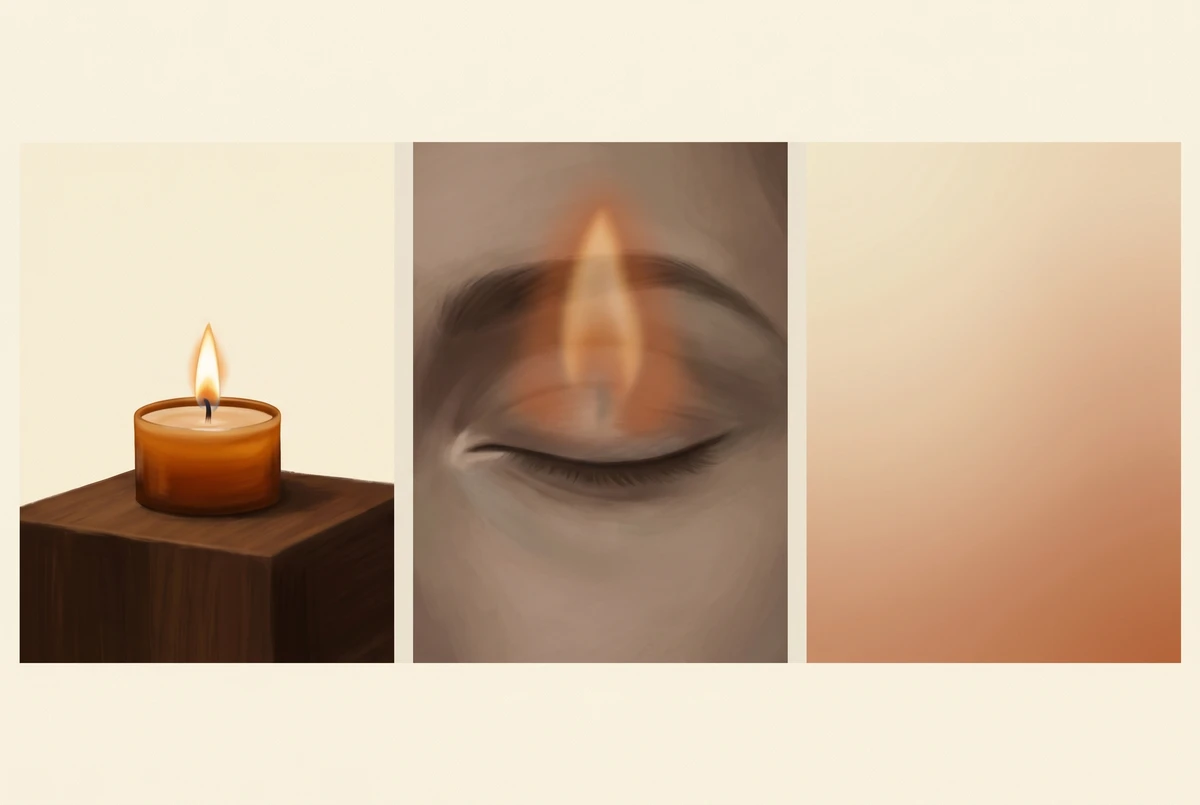
Stage 2: Internal visualization (antaranga trataka). Eyes closed, holding the afterimage of the object or a mental image of it. The object lives in your mind now, not in the world. This deepens concentration into visualization ability.
Stage 3: Formless awareness. No object at all. Resting in pure concentrated awareness. This is what Patanjali’s Yoga Sutras describe as the progression from dharana (concentration on a point) through dhyana (unbroken attentional flow) to samadhi (complete absorption), where the distinction between the meditator and the object of meditation dissolves.
Here’s a key insight most guides miss: breath meditation starts at stage 2. You’re attending to something internal, something you feel rather than see. Trataka starts at stage 1, the external world, where the target is most concrete. This is why visual focus is actually more beginner-friendly for concentration training than most people realize, even though it’s often presented as an “advanced” technique.
Many meditators assume you must close your eyes to meditate properly. This is contradicted by Zen (which uses a soft downward gaze), Tibetan Dzogchen (sky gazing), and the entire yogic trataka tradition. Open-eye meditation isn’t advanced. It’s where visual concentration training naturally begins.
The Sri Yantra as a focal point
Any visual object works for trataka. A candle flame. A black dot on paper. A mark on the wall. But some objects sustain concentration better over longer sessions.
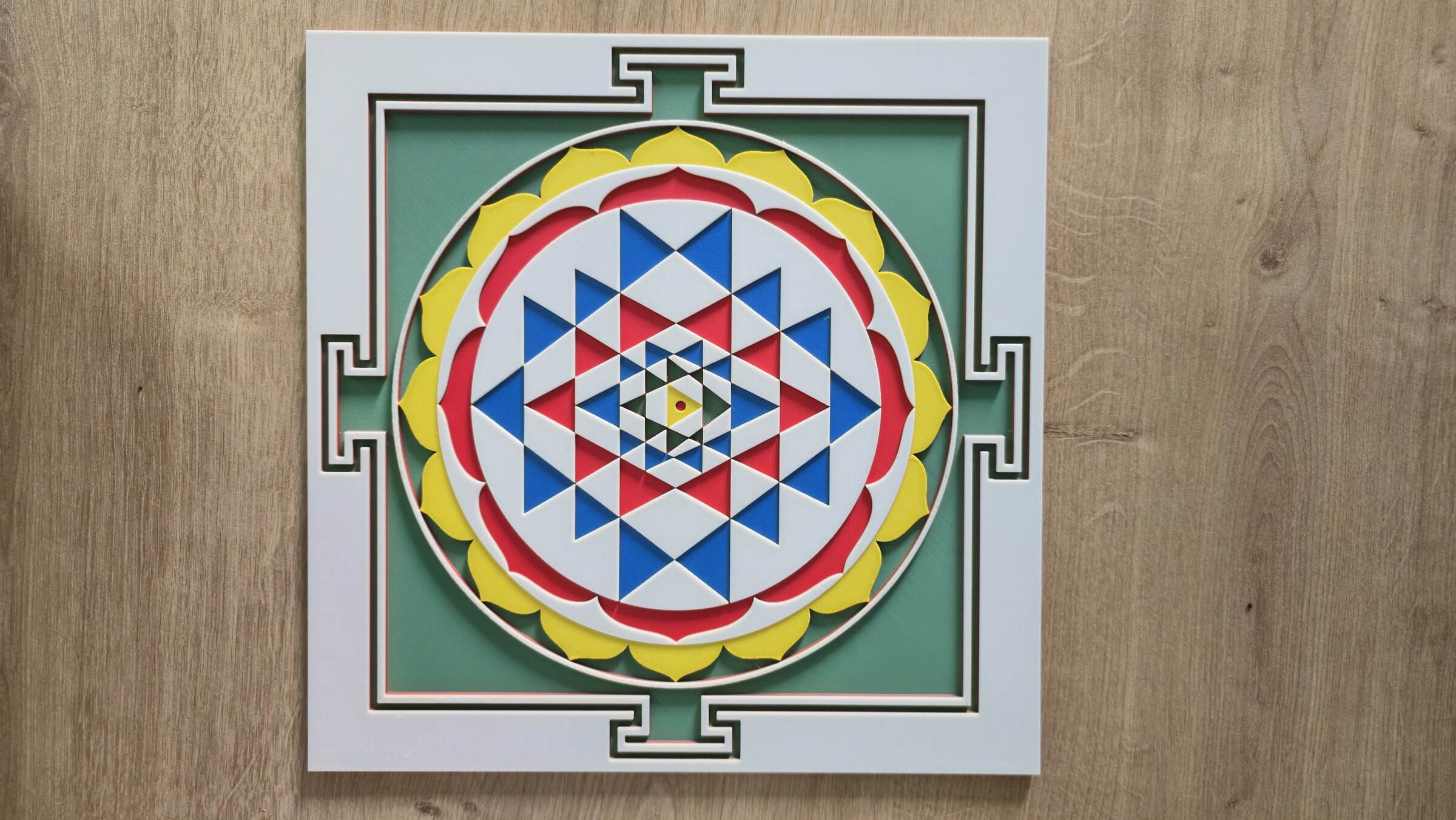
The Sri Yantra is a geometric diagram composed of nine interlocking triangles (four pointing upward, five pointing downward) radiating from a central point called the bindu. The intersections create 43 smaller triangles, surrounded by lotus petal rings and a square outer boundary with four gates. It comes from the Shakta Tantric tradition and is central to the Sri Vidya school of practice. 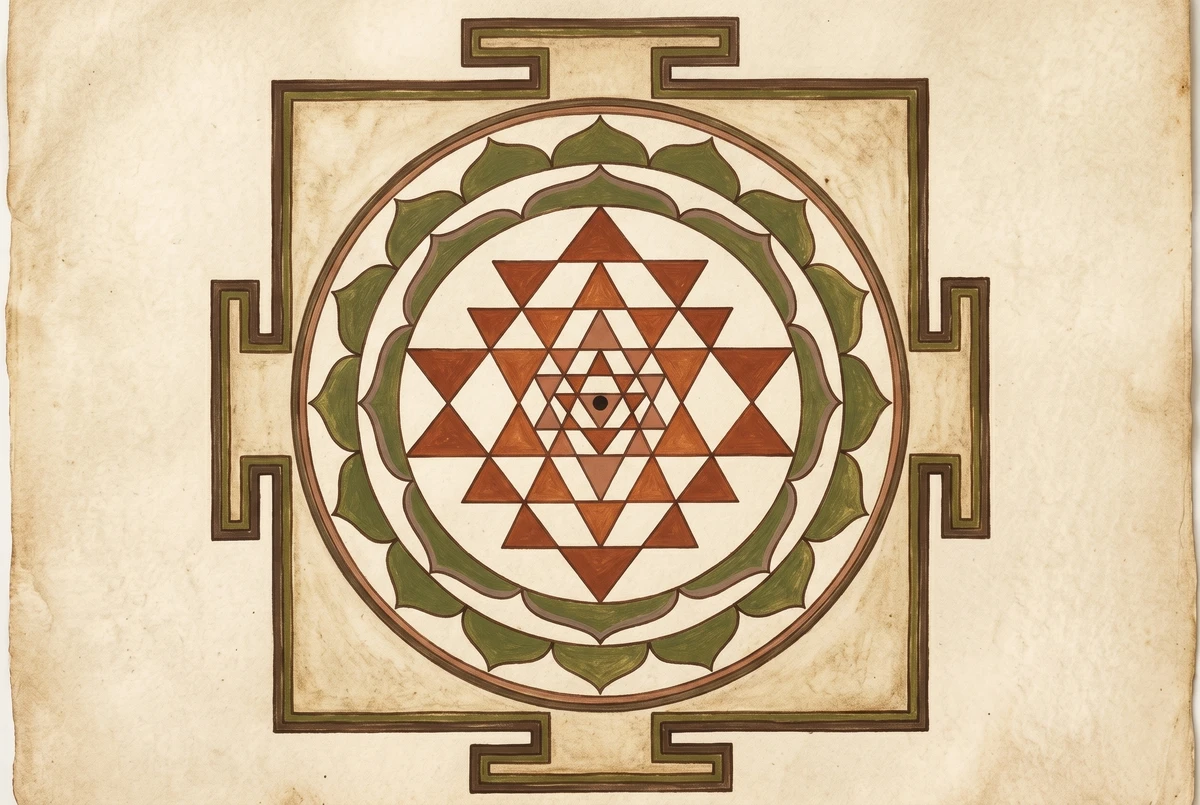
For concentration training, this structure has specific advantages.
The bindu gives a precise center point for the gaze. Unlike a candle flame, which flickers and shifts, the bindu stays perfectly still.
The surrounding geometry keeps the visual system engaged without overwhelming it. Practitioners often find that a simple dot becomes monotonous enough that the mind drifts rather than concentrates. The Sri Yantra’s layered complexity provides enough visual structure to sustain attention.
The concentric layers create a natural progression. You can start by taking in the outer triangles, then gradually narrow your focus toward the bindu, mirroring the external-to-internal progression of trataka itself.
The Sri Yantra is also stable and portable. A candle requires a darkened room and carries safety considerations around staring at a luminous object. A printed or drawn Sri Yantra works in any lighting, anywhere.
The Soundarya Lahari tradition, attributed to Adi Shankaracharya, describes yantras as geometric encodings of mantras, with the Sri Yantra as the primary visual form. Practitioners often describe it as the visual counterpart to the sacred syllable Om: where Om represents the totality of reality in sound, the Sri Yantra encodes it in geometric form.
You don’t need a Sri Yantra to practice trataka or to build concentration. Any stable visual object will work. The Sri Yantra’s advantage is structural: its complexity sustains engagement over longer sessions, making it particularly useful as your practice grows past ten or fifteen minutes.
How to start: a simple trataka practice
Pick any visual object and begin. Here’s the basic method.
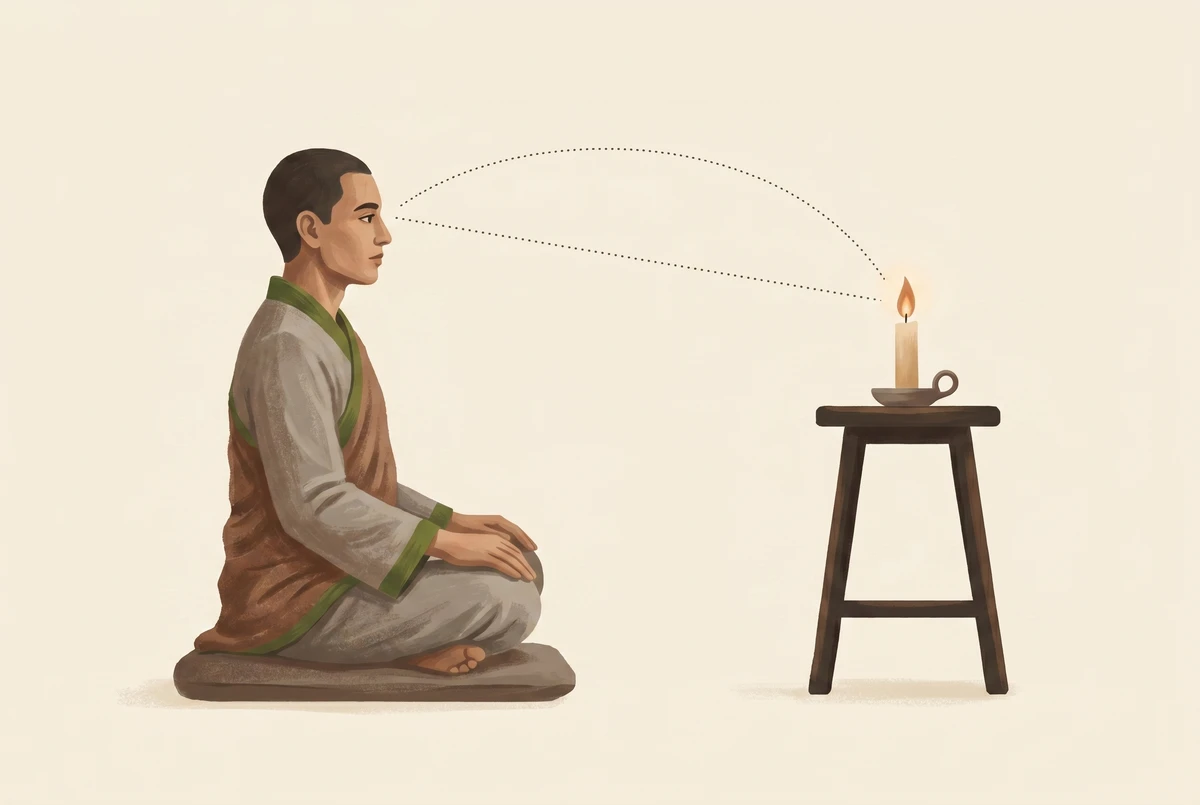
Choose your object. A candle flame is the most traditional. A black dot drawn on white paper (about the size of a coin) works just as well and avoids concerns about bright light. A printed Sri Yantra is ideal for longer sessions.
Set up. Place the object at eye level, roughly an arm’s length away. If using a candle, dim the room so the flame is prominent but not the only light source.
Sit comfortably with your spine straight. This isn’t about endurance; it’s about stability.
Gaze softly at the center of the object without blinking, for one to three minutes. “Softly” means relaxed eyes, not a hard stare. Let the object fill your visual attention naturally.
When your eyes water or tire, close them. You’ll see an afterimage (especially with a candle flame). Hold your attention on that afterimage. This is antaranga trataka, the internal phase.
When the afterimage fades, open your eyes and repeat.
Start with five to ten minutes total. Build gradually. There’s no rush.
If you used a candle, splash cool water on your closed eyes afterward.
Safety notes: Don’t practice candle trataka for more than ten minutes per session without experienced guidance. If you practice regularly with a candle flame, take periodic breaks (a few days off every couple of months) and consider alternating with a non-luminous object. People with cataracts, glaucoma, or photosensitive epilepsy should use a black dot, yantra, or other non-luminous focal point instead of a flame.
Sources
- Raghavendra BR, Singh P. (2016). “Immediate effect of yogic visual concentration on cognitive performance.” Journal of Traditional and Complementary Medicine, 6(1):34–36. PMCID: PMC4738033.
- Swathi PS, Bhat R, Saoji AA. (2021). “Effect of Trataka (Yogic Visual Concentration) on the Performance in the Corsi-Block Tapping Task: A Repeated Measures Study.” Frontiers in Psychology, 12:773049. PMCID: PMC8718544.
- Talwadkar S, Jagannathan A, Raghuram N. (2014). “Effect of trataka on cognitive functions in the elderly.” International Journal of Yoga, 7(2):96–103. PMCID: PMC4097909.
- Ganesan S, et al. (2022). “Focused attention meditation in healthy adults: A systematic review and meta-analysis of cross-sectional functional MRI studies.” Neuroscience & Biobehavioral Reviews, 141:104846. ScienceDirect.
- Yoshida K, et al. (2020). “Focused attention meditation training modifies neural activity and attention: longitudinal EEG data in non-meditators.” Social Cognitive and Affective Neuroscience, 15(2):215–224. Oxford Academic.
- Sur M, et al. (1996). “Brain Processing of Visual Information.” MIT News, December 20, 1996.
- Swatmarama. Hatha Yoga Pradipika, Chapter 2, Verses 31–32. 15th century.
- Patanjali. Yoga Sutras, 3.1–3.4.
- Swami Satyananda Saraswati. Asana Pranayama Mudra Bandha. Bihar School of Yoga.
- Swami Niranjanananda Saraswati. Dharana Darshan. Bihar School of Yoga.