How to Meditate with a Sri Yantra
Miha Cacic · April 8, 2026 · 8 min read
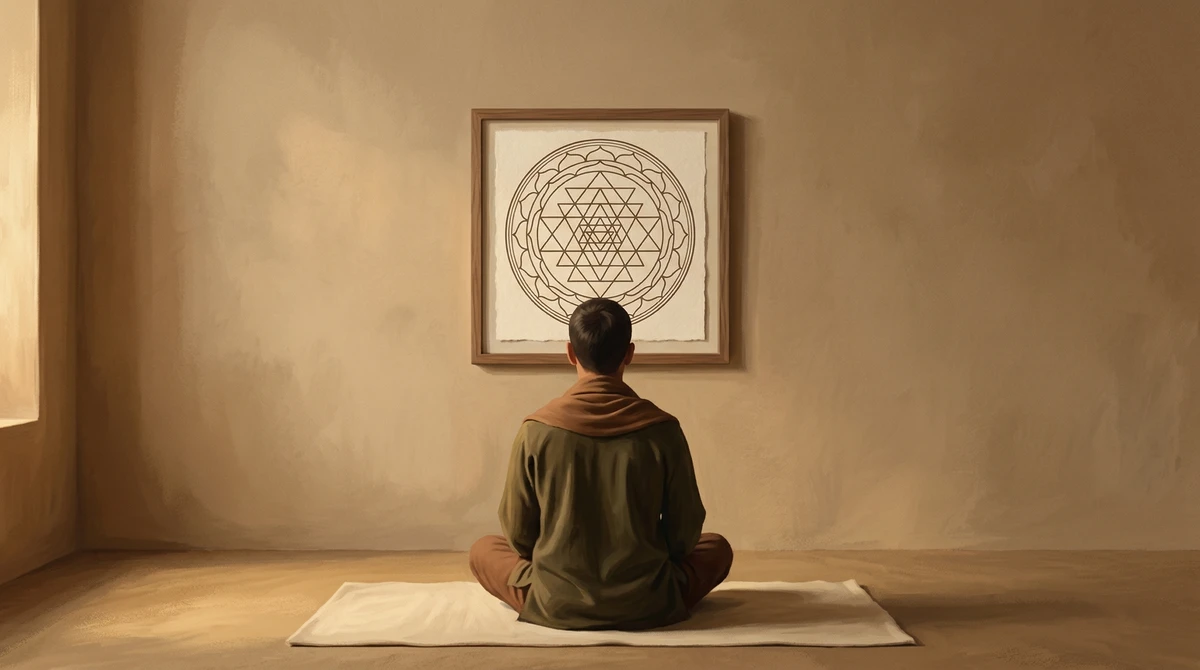
Sri Yantra meditation is a form of trataka (open-eyed gazing meditation) where you fix your eyes on the central point of the Sri Yantra, called the bindu, and hold your gaze there without blinking until your eyes water. Then you close your eyes and observe the afterimage. That’s the entire practice. The rest is learning to do it well, understanding what the visual phenomena actually are, and building it into something that deepens over weeks.
What is Sri Yantra trataka (and how is it different from candle trataka)
Trataka is one of the six shatkarmas (purification practices) described in the Hatha Yoga Pradipika, a 15th-century yoga manual. The original instruction is simple: “Being calm, one should gaze steadily at a small mark, till eyes are filled with tears” (Chapter 2, verse 31). The text promises that trataka “destroys eye diseases and removes sloth” and should be “kept secret very carefully, like a box of jewellery.”
Most people know trataka as candle gazing. You stare at a flame, your eyes water, you close them and watch the afterimage fade. It works. But a candle flame is a single point of light. It produces a simple, uniform afterimage and straightforward perceptual effects.
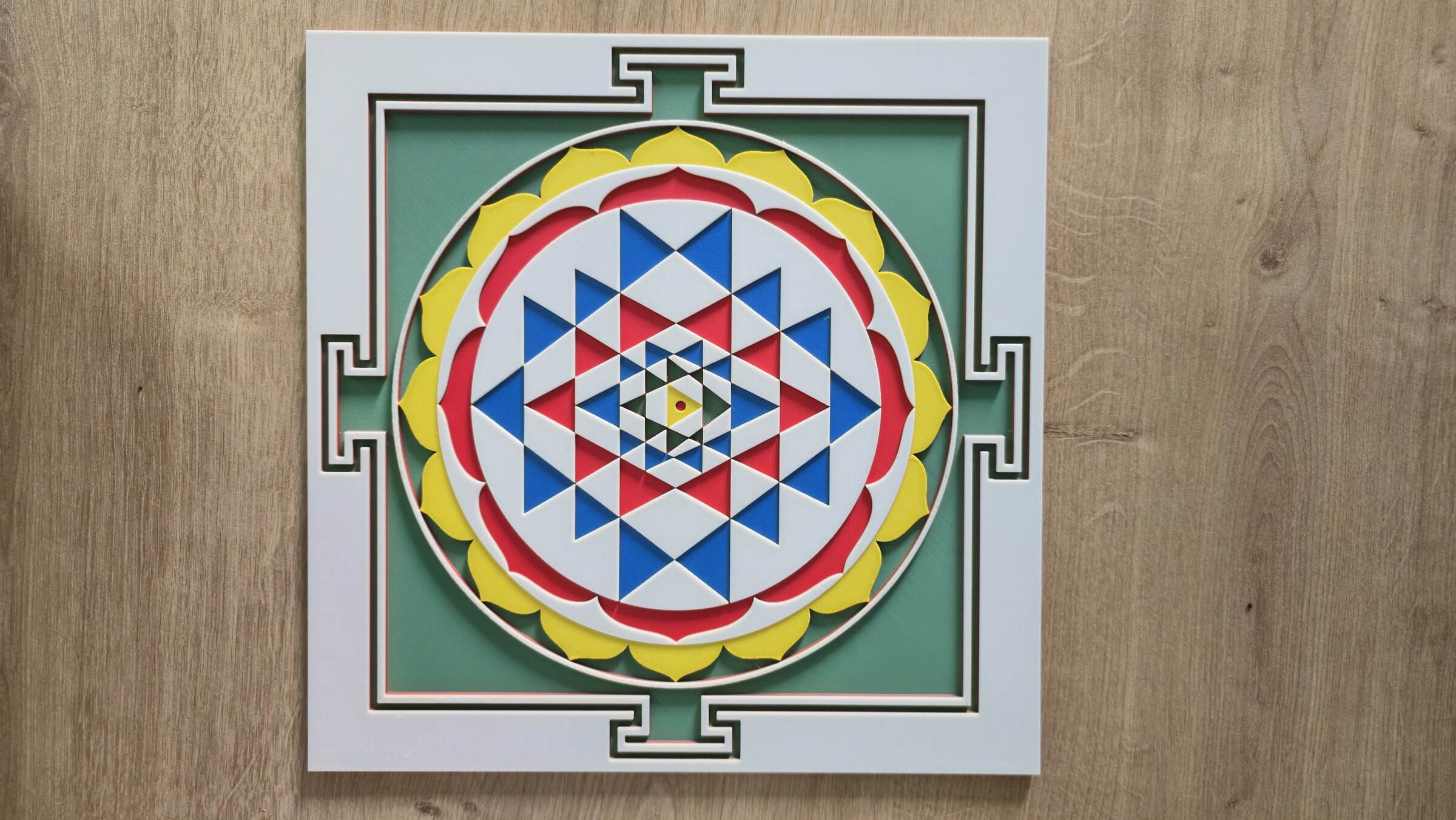
The Sri Yantra is something else entirely. Nine interlocking triangles (four pointing upward, five pointing downward) create 43 smaller triangles, surrounded by two rings of lotus petals and enclosed in a square with four gates. At the center sits the bindu, a single dot. When you gaze at the bindu, this entire geometric field sits in your peripheral vision, and your visual system has to process it all.
This complexity is what makes Sri Yantra trataka different from candle trataka. The nested triangles contain multiple spatial frequencies (fine triangle edges, medium-sized petals, large circular forms), and these different regions adapt at different rates during sustained fixation. A candle produces a simple pulsing afterimage. The Sri Yantra produces layered effects: some areas fade while others remain, creating apparent motion, depth, and geometric shifts that practitioners have reported for centuries.
In the Sri Vidya tradition, the Sri Yantra is not just a meditation aid. It is a map. The nine enclosures (navaavarana) from the outer square to the central bindu correspond to layers of consciousness, with the bindu representing Sahasrara (the crown). Whether or not you share this framework, it gives the practice a directional structure that a candle flame lacks: attention moves from complexity toward singularity, from periphery to center.
What you need before you start
A Sri Yantra image. Use a black-and-white line diagram rather than a colored version. The high contrast between black lines and white paper creates a sharper afterimage, which is the whole point of trataka. Colored Sri Yantras are traditional for puja (devotional worship), but for gazing practice, you want crisp lines. If the central bindu is too small to see clearly, darken it with a pen.
Print it on standard paper (A4 or letter size) and mount it on a wall at eye level when you’re seated. Sit 2 to 3 feet away so the full yantra fills your central field of vision. If the yantra is too small or too far, your eyes will strain to resolve the details. If it’s too large or too close, you can’t take in the full geometry peripherally.
Your seat. Floor (cross-legged, Padmasana, or Siddhasana) or a chair. The only requirement is that your eyes are level with the bindu without tilting your head up or down. If your neck is craned, you’ll create tension that competes with the concentration you’re trying to build. 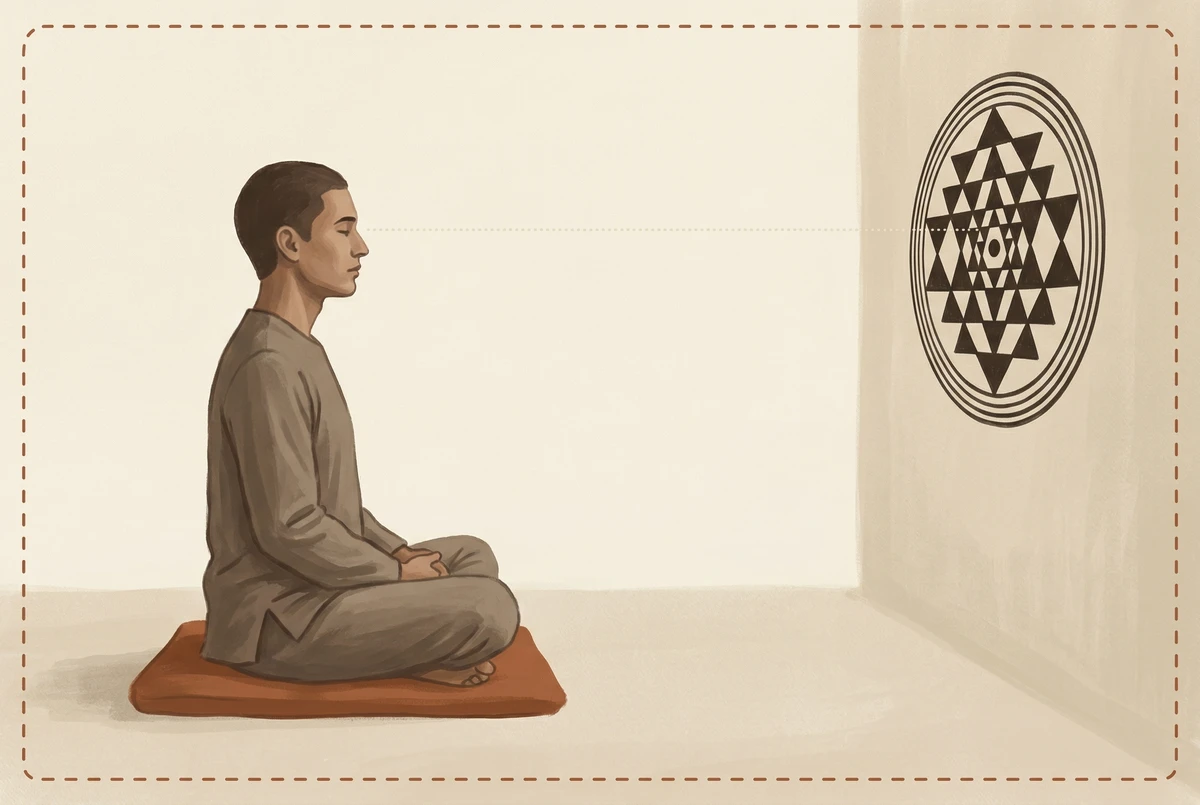
Lighting. Soft and even. No glare on the paper (matte surfaces help), and enough light to see the lines clearly without squinting. A dim room forces eye strain; a bright room washes out contrast.
Time of day. Early morning or evening is traditional and practical (lower ambient light, calmer nervous system), but a consistent daily time matters more than which time you pick.
Step-by-step: your first Sri Yantra meditation session
Settle (2 minutes). Sit down, close your eyes, and take 5 to 10 slow breaths. You’re not trying to achieve a meditative state yet. You’re letting your body stop moving and your breathing find a rhythm.
External gazing (5 to 10 minutes). Open your eyes and rest your gaze on the bindu. Not a hard stare, not a squint. Just place your attention on that central dot the way you’d rest your hand on a table. Blink as little as you can, but don’t make it a contest. Your eyes will water. This is normal. The Hatha Yoga Pradipika literally defines trataka as gazing “till eyes are filled with tears.” Mechanically, reduced blinking dries the corneal surface, triggering the lacrimal reflex. When the tearing becomes too much to see through, close your eyes.
Internal gazing (2 to 5 minutes). With your eyes closed, you’ll see an afterimage of the yantra, a complementary (negative) version floating in your visual field. If you were looking at black lines on white paper, the afterimage will appear as light lines on a dark background. Hold your attention on this image. It will drift and fade. Keep gently returning your focus to it, the same way you’d return to the bindu during external gazing. When the afterimage disappears completely, you can either open your eyes and repeat the cycle, or sit in the stillness.
Close (1 to 2 minutes). Sit with eyes closed. Don’t try to do anything. Just notice how your mind feels compared to when you sat down.
Your first session, start to finish, should take about 10 to 15 minutes.
Where to focus your gaze (and what to do when it wanders)
The bindu. The central dot. Not the central triangle, not the intersection of two lines near the center, not the negative space between triangles. The dot itself.
Your gaze should be steady but not rigid. Think of “resting” your eyes on the point rather than “drilling into” it. A locked, tense stare creates facial tension and headaches. A soft, steady gaze allows your peripheral vision to naturally take in the surrounding geometry without you actively trying to expand your awareness.
As your eyes stabilize on the bindu, you’ll start to notice the interlocking triangles and lotus petals in your peripheral vision. You don’t need to do anything about this. It happens on its own as the mind settles.
Your eyes will want to wander. They’ll trace a triangle edge, jump to an interesting intersection, or follow an apparent movement in the geometry. When you notice this, bring your gaze back to the bindu. This is the actual training. Each return to the bindu is a repetition that strengthens dharana (concentration). Yoga tradition identifies two forces you’re working against here: aakshep (the tossing mind that jumps from object to object) and vikshep (the wandering mind that drifts without direction).
One practical note from experienced practitioners: when the geometry starts shifting or moving, don’t get curious about it. Don’t try to examine what’s happening. If you shift to analytical thinking, you increase saccadic eye movements (your eyes dart around to examine details), which breaks the sustained fixation that produces the effects in the first place. Just notice and stay on the bindu.
Some traditions teach an alternative approach: starting from the outer square gates and moving your focus inward through the lotus petals, through each layer of triangles, arriving finally at the bindu. This is a navaavarana meditation practice from the Sri Vidya tradition. It is a different (and more elaborate) practice than trataka. If you’re starting out, start with the bindu.
How long to meditate (and how to build up over weeks)
The following timelines are approximate, based on what practitioners commonly report. Your experience will vary.
Week 1 to 2. Total session: 5 to 10 minutes. Gaze for 3 to 5 minutes, then close your eyes for 2 to 5 minutes. Your eyes will water heavily. The afterimage will be faint and brief. This is normal. You’re calibrating.
Week 3 to 4. Total session: 10 to 15 minutes. Your eyes water less. The afterimage gets stronger and lasts longer. You can start doing 2 to 3 open-close cycles per session.
Month 2 to 3. Total session: 15 to 20 minutes. The perceptual effects start showing up. The geometry may appear to shift, glow, or develop depth. The afterimage begins to include more structural detail of the yantra, not just a blob where the bindu was.
Month 3 onward. 20 to 30 minutes is a solid, mature practice. Swami Satchidananda’s instruction was to “start by gazing for just a few minutes and then gradually increase” and noted that “after some months, the visualization will become easy and your meditation will go deeper.”
When to add time. When you can sit for the full current duration without agitation and your eyes feel relatively stable, add 2 to 3 minutes.
The one rule that matters most. Consistency beats duration. Ten minutes every day is more effective than 45 minutes once a week. Meditation research consistently finds that frequency of practice predicts cognitive benefits more reliably than session length. A 2021 study of 41 volunteers at S-VYASA university found significant improvements in working memory and spatial attention after just 2 weeks of daily trataka practice (20 minutes per day, 6 days per week). The gains were specific to trataka, not just eye exercise. A control group that did eye exercises alone showed no significant improvement.
What you’ll experience (and why it happens)
Your eyes will water. Heavily at first. Over weeks, you develop a softer gaze with less tension, and the tearing decreases.
The yantra will appear to glow or pulse. This is Troxler’s fading, a visual phenomenon first documented by Swiss physician Ignaz Paul Vital Troxler in 1804. When you fixate on a single point, unchanging stimuli in your peripheral vision fade from awareness, then snap back as your eyes make tiny involuntary movements (microsaccades). The result is a pulsing, breathing quality. Research by Martinez-Conde, Macknik, and Hubel (2004) in Nature Reviews Neuroscience established that microsaccade suppression during fixation is the key mechanism: peripheral neurons adapt to the static stimulus and reduce their firing rate.
The lines will appear to move or rotate. Neural adaptation affects different spatial frequencies at different rates. The fine triangle edges, the medium-sized petals, and the larger circular forms all fade and recover on different timescales. Your brain fills in the fading peripheral information with slight variations, creating apparent motion. One practitioner described the outer petals rotating one direction while the inner geometry rotated the other. This is consistent with how complex images produce layered adaptation effects.
The afterimage will become more vivid over time. Retinal fatigue creates the initial afterimage: photoreceptors exposed to one pattern produce a complementary (opposite) response when the stimulus is removed. With practice, the afterimage improves because your fixation gets longer and more stable, creating more complete retinal adaptation. But the process is not purely retinal. Research in Scientific Reports (2017) showed that afterimage signals originate in the retina but are shaped by cortical grouping mechanisms, and Hsieh and Tse (2006) demonstrated that perceptual fading itself occurs partly in the brain. A 2024 study in Neuroscience of Consciousness found a correlation between visual imagery vividness and afterimage strength: people who are better at mental visualization also perceive sharper, longer-lasting afterimages. The causal direction isn’t established, but it points toward a possible feedback loop between visualization practice and afterimage quality.
You may perceive depth in the flat image. The nested, concentric triangles create optical depth cues. With sustained fixation, binocular processing can interpret the flat geometry as receding planes. The yantra seems to become three-dimensional.
Your mind will get quieter. Not through effort, but through mechanics. Sustained focused attention activates the parasympathetic nervous system: heart rate drops, breathing slows, and the mental chatter subsides as your attention is absorbed into the object. A 2024 systematic review proposed that trataka activates the bilateral dorsolateral prefrontal cortex (DLPFC), the brain region associated with working memory, attention, and executive function. A 2022 randomized controlled trial (Swathi, Saoji, & Bhat) found that trataka significantly reduced mind wandering and increased state mindfulness compared to controls, in a sample of 106 volunteers.
A note on framing. These experiences are signposts, not destinations. The visual phenomena are interesting, but they’re side effects of sustained concentration. If you start chasing them (trying to make the geometry move more, or analyzing the afterimage), you lose the very concentration that produces them.
Adding mantra to your practice (optional)
Trataka alone is a complete practice. But if you want to deepen it, mantra can help by giving the verbal mind something to do while the visual mind is occupied with the yantra. This double-anchoring (one anchor for each channel of attention) can accelerate concentration.
The traditional mantras associated with the Sri Yantra come from the Sri Vidya tradition: “Om Shreem Hreem” or “Om Aim Hreem Shreem” (bija, or seed, mantras of Lakshmi and the Sri Vidya lineage). These are widely shared and appropriate for personal practice, though in the Sri Vidya tradition, specific mantras are formally transmitted by a guru during initiation (diksha).
To combine mantra with trataka: silently repeat the mantra while gazing at the bindu. The mantra provides an auditory thread of attention alongside the visual thread. During the eyes-closed phase, continue the silent repetition while observing the afterimage. When the afterimage fades, the mantra remains, giving you something to sustain focus on.
Harish Johari, writing in “Tools for Tantra,” described this combination: “Practitioners of tantra combine the universal pattern of the yantra with the cosmic sound of a mantra to achieve a higher state of awareness.” Whatever the metaphysical framework, the practical principle is straightforward: two anchors hold attention more firmly than one.
Common mistakes and how to avoid them
Straining your eyes. If your forehead is tense, your brow is furrowed, or you’re squinting, you’re working too hard. Soften your face. The gaze should feel effortless, like looking at a painting in a museum, not like reading fine print.
Forcing yourself not to blink. Blink when you need to. The goal over weeks is to gradually extend the natural interval between blinks, not to endure discomfort. Even experienced practitioners report that after some practice, they learned to blink without losing their state of focus.
Analyzing the experience while it’s happening. When the geometry starts shifting, the natural impulse is to examine it. “What’s happening? Why is that triangle moving?” This analytical shift breaks fixation. Just notice what’s happening and return to the bindu.
Using a poorly proportioned yantra. The Sri Yantra has precise geometric relationships. If the central triangle is misshapen or the bindu is off-center, your gaze won’t settle naturally and you’re more likely to develop eye strain. Use a properly constructed diagram.
Expecting immediate visual fireworks. Some people see geometric shifts in their first session (beginners in a meditation class reported seeing the yantra “morph into a variety of geometrical figures” during their first attempt). For others, the effects emerge after 2 to 4 weeks of consistent practice. Neither timeline means you’re doing it wrong.
Practicing in near-darkness. Dim lighting might seem more meditative, but you need enough light to clearly see the yantra’s lines without squinting. Low light forces your pupils to dilate and your eyes to strain, working against the relaxed gaze you’re trying to build.
Sources
- Svātmārāma. (~15th century CE). Hatha Yoga Pradipika. Trans. Pancham Sinh, 1914. Chapter 2, verses 21-32. https://sacred-texts.com/hin/hyp/hyp04.htm
- Gheraṇḍa. (~17th century CE). Gheranda Samhita. Chapter 1, verses 53-54.
- Raghavendra, B.R. & Singh, P. (2014). “Immediate effect of yogic visual concentration on cognitive performance.” Journal of Traditional and Complementary Medicine, 6(1), 34-38. PMID: 26870677. https://pubmed.ncbi.nlm.nih.gov/26870677/
- Talwadkar, S., Jagannathan, A., & Raghuram, N. (2021). “Effect of Trataka (Yogic Visual Concentration) on the Performance in the Corsi-Block Tapping Task: A Repeated Measures Study.” Frontiers in Psychology, 12, 773049. PMCID: PMC8718544. https://pmc.ncbi.nlm.nih.gov/articles/PMC8718544/
- Jagannathan, A., et al. (2014). “Effect of trataka on cognitive functions in the elderly.” Indian Journal of Psychiatry. PMCID: PMC4097909. https://pmc.ncbi.nlm.nih.gov/articles/PMC4097909/
- Swathi, P.S., Saoji, A.A., & Bhat, R. (2022). “The role of trataka in ameliorating visual strain and promoting psychological well-being during prolonged use of digital displays: A randomized controlled trial.” Work, 71(3), 711-718. PMID: 35095011. https://pubmed.ncbi.nlm.nih.gov/35095011/
- “Trataka and cognition: A systematic review with a proposed neurophysiological mechanism.” (2024). Journal of Neurosciences in Rural Practice. https://ruralneuropractice.com/trataka-and-cognition-a-systematic-review-with-a-proposed-neurophysiological-mechanism/
- Martinez-Conde, S., Macknik, S.L., & Hubel, D.H. (2004). “The role of fixational eye movements in visual perception.” Nature Reviews Neuroscience, 5(3), 229-240. DOI: 10.1038/nrn1348. PMID: 14976522. https://pubmed.ncbi.nlm.nih.gov/14976522
- Hsieh, P.-J. & Tse, P.U. (2006). “Illusory color mixing upon perceptual fading and filling-in does not result in ‘forbidden colors’.” Vision Research, 46(14), 2251-2258. DOI: 10.1016/j.visres.2005.11.030. PMID: 16469353. https://pubmed.ncbi.nlm.nih.gov/16469353
- “Cortical mechanisms for afterimage formation: evidence from interocular grouping.” (2017). Scientific Reports, 7, 41101. PMCID: PMC5253736. https://pmc.ncbi.nlm.nih.gov/articles/PMC5253736/
- “Visual imagery vividness correlates with afterimage conscious perception.” (2024). Neuroscience of Consciousness, 2024(1), niae032. PMCID: PMC11294681. https://pmc.ncbi.nlm.nih.gov/articles/PMC11294681/
- Troxler, I.P.V. (1804). On the disappearance of objects from our visual field during sustained fixation. Vienna.
- Johari, H. Tools for Tantra. Via Sanatan Society. https://www.sanatansociety.org/yoga_and_meditation/yantra_meditation.htm
- Swami Satchidananda. “Tratak: Meditation on a Form or Yantra.” Integral Yoga Magazine. https://integralyogamagazine.org/tratak-meditation-on-a-form-or-yantra/