How to Choose a Sri Yantra for Meditation
Miha Cacic · April 9, 2026 · 6 min read
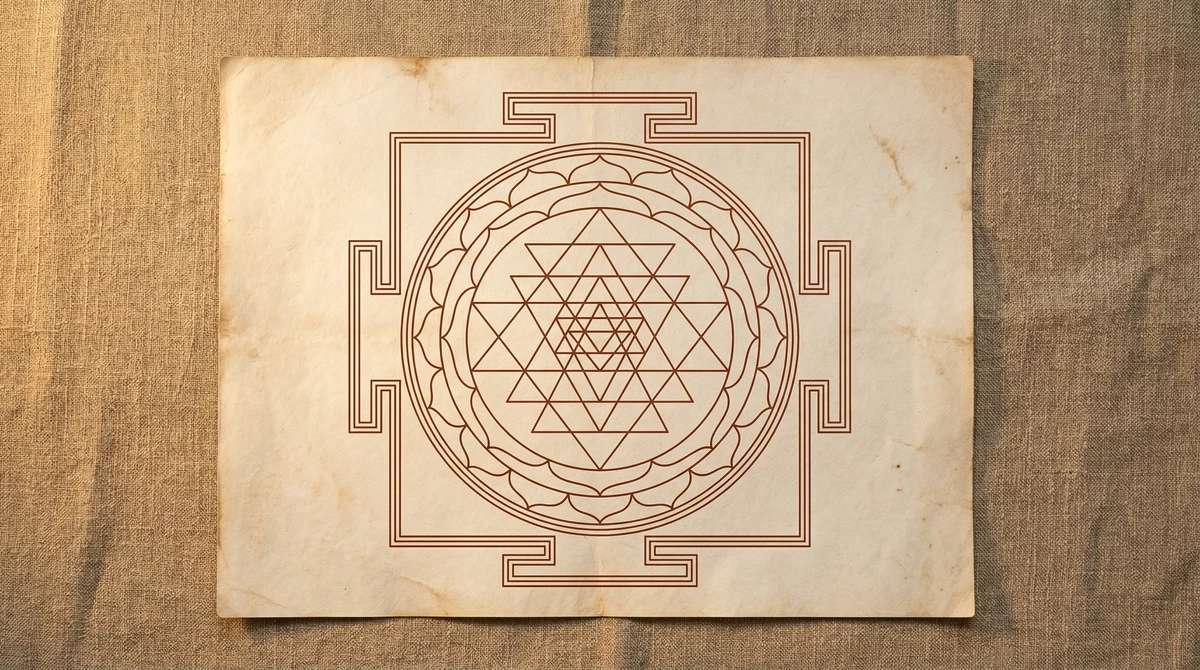
The most important thing about a Sri Yantra for meditation isn’t whether it’s made of copper, crystal, or gold. It’s whether the geometry is correct. Many commercially sold Sri Yantras have errors in their construction: lines that should meet at a single point don’t, triangles are asymmetric, the central bindu sits off-center. These aren’t minor cosmetic flaws. For gazing meditation, where your eyes fixate on the yantra’s structure for minutes at a time, visible geometric errors become focal distractions rather than focal points.
What type of meditation are you doing?
The right Sri Yantra depends on how you’ll use it. There are three common uses, and each demands different physical properties.
Trataka (steady gazing). You fix your gaze on the bindu (the central point) without blinking until tears form, then close your eyes and hold the afterimage. The Hatha Yoga Pradipika (verse 2.31) describes it simply: “Being calm, one should gaze steadily at a small mark, till eyes are filled with tears.” This is a shatkarma, a yogic cleansing practice. The Gheranda Samhita (verses 1.53–54) explicitly names yantra as a suitable trataka object, distinguishing between external gazing (bahir trataka) and internal visualization (antar trataka). For external trataka, you need a flat, high-contrast image with sharp lines and a clearly visible bindu. Visual clarity is everything.
Contemplative yantra meditation. A softer gaze where you relax your eyes and move awareness through the yantra’s layers. Traditionally, the outward path (sristi) follows the yantra’s expansion from the bindu to the outer boundary, while the inward path (samhara) traces the return to the center. Swami Satchidananda describes the rhythm: “Gently gaze at it, holding the main part of the attention on the central dot. After some time, close the eyes and visualize the form mentally. When visualization becomes difficult, open the eyes and practice the gentle gazing again.” Same physical requirements as trataka, though slightly less strict on contrast since you’re not chasing an afterimage.
Altar or puja placement. The yantra sits in your space as a devotional object. Here, material, three-dimensional form, and consecration become relevant. You’re not staring at it for 20 minutes, so visual clarity matters less than symbolic and ritual significance.
This article focuses on the first two uses. If you want an altar piece, that’s a different buying decision with different criteria.
Geometric accuracy: the one thing that actually matters
The Sri Yantra is nine interlocking triangles (four pointing up, five pointing down) that create exactly 43 subsidiary triangles. This count is confirmed across mathematical analyses and traditional texts alike, including verse 11 of Shankaracharya’s Saundarya Lahari, which describes “the forty-three elements that make up Your angular refuge.”
The construction problem is that these nine triangles must intersect so that every point where three lines meet is perfectly concurrent, meaning three lines converge at a single mathematical point, not a tiny triangle or gap. This is an over-determined geometric problem: there are more constraints than free parameters. Bolton and Macleod (1977) called the intersecting pattern “extremely complex” and noted that its “precise mathematical structure does not appear to have been derived.” Kulaichev (1984) went further, concluding that perfect construction “would require knowledge of higher mathematics which the medieval and ancient Indian mathematicians did not possess.”
In practical terms: getting a Sri Yantra right is genuinely hard. C.S. Rao developed computational models in Mathematica to achieve correct concurrency, and the results are visibly different from most hand-drawn or machine-engraved commercial versions.
This matters for meditation for two reasons. The traditional reason: the Saundarya Lahari identifies the Sri Yantra as the geometric form of the goddess Lalita Tripura Sundari, and an incorrect yantra is traditionally regarded as a misrepresentation of the divine form. The practical reason: when you gaze at a yantra during trataka, your eyes rest on the intersection points and the bindu. Where three lines should meet at a crisp point but instead form a small triangle, the eye has no clean resting place. The pattern’s visual coherence (the quality that lets your gaze settle rather than search) depends on accurate concurrency. No controlled study has compared meditation outcomes between accurate and inaccurate yantras, but the logic is straightforward: a focus object with visible errors gives your attention something to snag on rather than settle into.
How to check before buying. Look at the five innermost triangles surrounding the bindu. Each intersection where three lines meet should form a crisp point, not a tiny triangle or a visible gap. The central downward-pointing triangle should be equilateral, and the bindu should sit at its exact center. Tejaswini, a practicing Sri Vidya sadhak, gives the same test: verify “that the central triangle is perfectly equilateral and the central dot/Bindu is in its exact center.” If the seller’s product photo is too small or too blurry to check these details, that’s a reason to look elsewhere.
Flat vs. Meru: which form for which purpose
Sri Yantras come in several traditional forms. The two you’ll encounter most often when shopping are flat (Bhuprishtha) and Meru (pyramid).
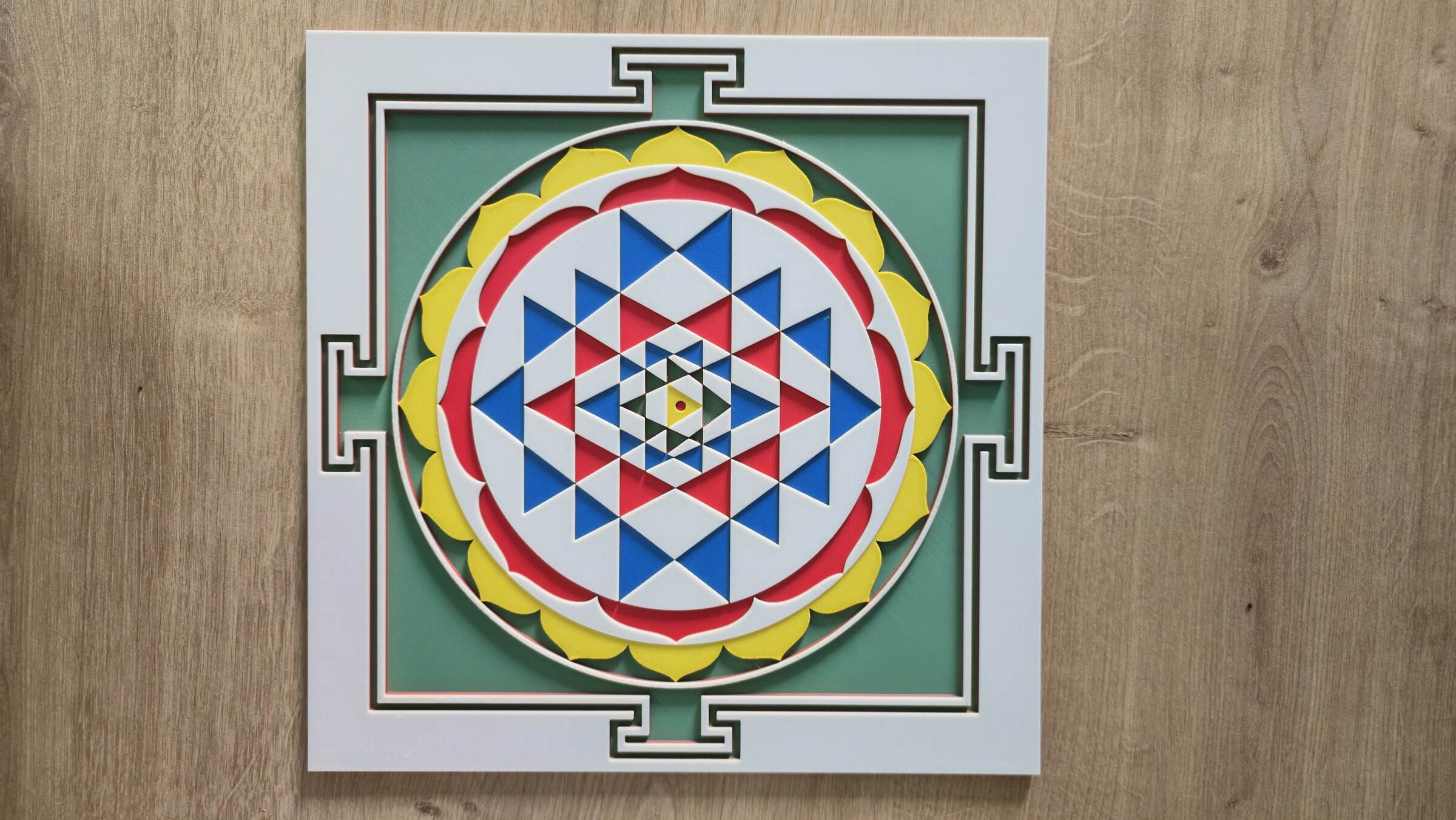
Flat (Bhuprishtha). A two-dimensional diagram, the standard form for all gazing meditation. This is what you need for trataka or contemplative yantra meditation. Your gaze rests on a single plane, the bindu is clearly visible, and the geometry can produce a clean afterimage when you close your eyes.
Meru (three-dimensional pyramid). The same nine-triangle geometry projected upward into a pyramid shape, named after Mount Meru. These are striking objects, often made in copper or crystal, and they’re appropriate for altar placement and puja. But they are unsuitable for gazing meditation: there is no single flat plane to focus on, the bindu sits at the apex and is difficult to fixate on steadily, and no coherent afterimage can form from a three-dimensional surface. Many sellers market Meru yantras for “meditation” without making this distinction.
A third traditional form, Kurma Prishtha (tortoise-back, slightly convex), appears in practitioner literature but is uncommon in commercial products. 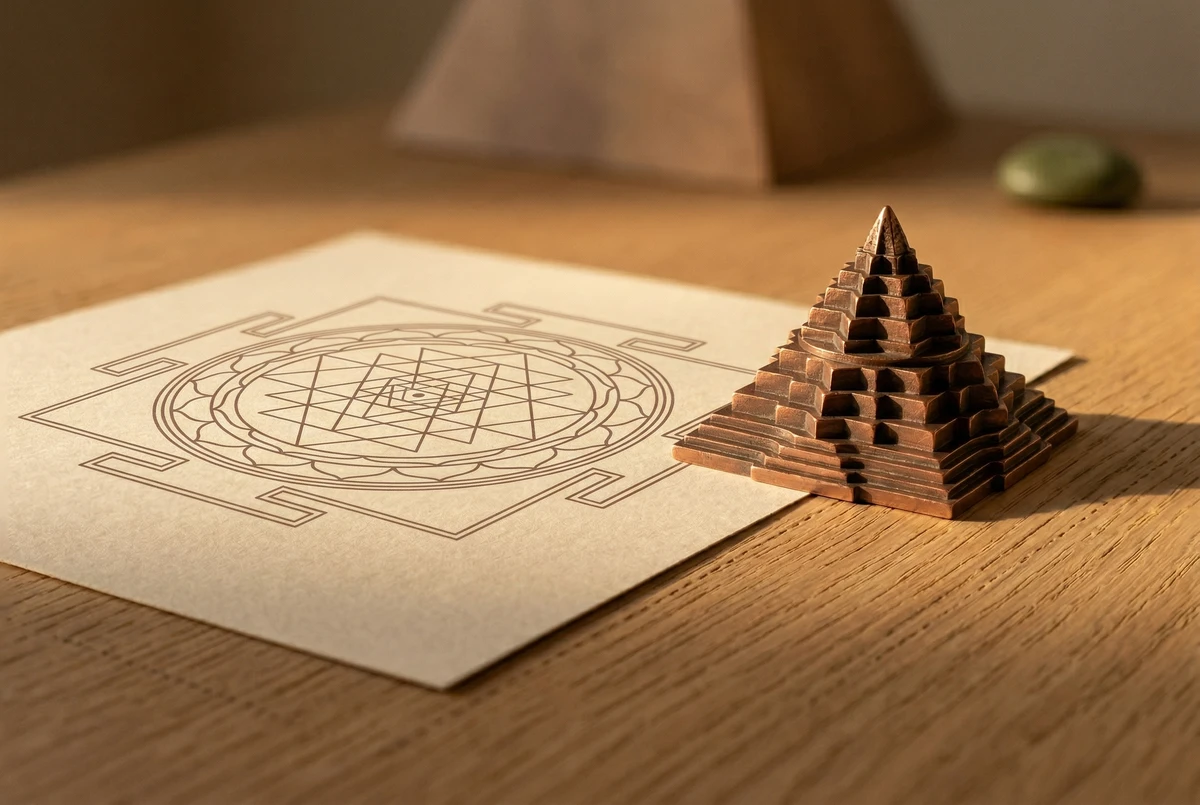
If you’re buying for gazing meditation, you need a flat 2D Sri Yantra.
Material: what matters and what doesn’t
For trataka and gazing meditation, material is nearly irrelevant. What matters is visual clarity: sharp lines, high contrast, clean geometry.
Paper or print. Often the best choice for trataka. Tejaswini recommends “a line diagram on white paper,” and her advice is practical: a correctly printed black-and-white Sri Yantra on paper gives you maximum contrast, verifiable geometry, easy replacement when worn, and the right size for your setup. A high-quality laser print costs almost nothing.
Copper. The traditional material, durable, and good for altar placement. An engraved copper yantra can work for gazing if the lines are sharp and filled with a contrasting color. But many copper yantras have shallow engraving that catches ambient light unevenly, creating glare and reducing the contrast you need for sustained gazing and afterimage formation.
Crystal or stone (Sphatik). Almost always in Meru (3D) form. Meant for altar or devotional use, not trataka.
Gold or silver plated. Reflective surfaces create glare, making them poor choices for gazing meditation.
The “energized” marketing claim. Many sellers charge premiums for “energized” or “prana pratishthit” yantras. Prana pratishtha is a real consecration ceremony with meaning in traditional puja practice. But for trataka, your gaze interacts with lines and geometry. Consecration doesn’t change the physical visual properties that make a yantra function as a meditation tool. A correctly drawn $2 printout will serve your trataka practice better than an incorrectly drawn $200 “energized” copper plate.
Size and viewing distance
The Sri Yantra should be large enough that you can clearly see the bindu and perceive the surrounding triangles, but small enough that your eyes don’t need to move to take in the whole form.
Practical guidelines. A printed yantra of about 15 to 20 cm (6 to 8 inches) works well at arm’s length (50 to 70 cm). A larger print (30 cm or more) should be mounted on a wall at 1 to 2 meters. The Swathi et al. (2021) study on trataka placed the focus object at eye level at a distance of 2 meters, though that study used a candle flame (a point source) rather than a complex diagram, so closer distances make sense for a yantra where you need to perceive geometric detail.
Too small means you strain to see the bindu, your eyes fatigue from focusing effort, and the afterimage is weak. Pendants and jewelry-sized yantras are for wearing, not meditating.
Too large means your eyes want to scan the geometry rather than rest on the bindu. The gaze becomes restless instead of steady.
Match the yantra’s size to your sitting setup. Don’t adjust your posture to accommodate the yantra.
Physical vs. digital: can you meditate on a screen?
A Sri Yantra displayed on a screen is geometrically identical to a printed one. The gaze mechanics are the same. But screens introduce practical problems.
Eye strain compounds. Trataka already pushes your eyes to the point of tears. Screens emit light directly into your eyes, adding blue light exposure and glare on top of the deliberate strain of sustained gazing. Paper reflects ambient light, which is a gentler stimulus.
Afterimage quality differs. A self-luminous screen produces a different afterimage than a printed image under ambient light. Direct light emission causes faster photoreceptor adaptation than reflected light, and research on afterimage formation shows that both retinal and cortical processes shape the resulting internal image. Practitioners report that paper produces cleaner, more stable afterimages — consistent with the underlying optics, though no controlled study has compared the two directly.
Distraction is real. Notifications, screen timeout, the peripheral awareness of other apps. A piece of paper on a wall has zero cognitive overhead.
When digital works. Traveling, trying out trataka before committing to a physical print, or using a dedicated tablet in airplane mode with a fixed brightness setting in a dark room.
Print it. It’s free (or nearly so), it’s better for your eyes, and it eliminates every digital distraction.
Where to place your Sri Yantra for meditation
Eye level when seated. The bindu should align with your natural eye level in your meditation posture. Craning your neck up or tilting your head down creates tension that breaks concentration. Swami Satchidananda’s instruction in Integral Yoga Magazine is direct: “have a picture of it in front of you at eye level.”
Background. Place the yantra against a plain, neutral surface. Photos, decorations, or patterns in your peripheral vision compete for attention and undermine the single-pointed focus that makes trataka effective.
Lighting. Even, diffused light from the side or above. Avoid direct light on the yantra’s surface (causes glare, especially on metal or glossy prints) and avoid backlighting (which turns it into a screen). Side-lighting can enhance the perception of line depth on a printed yantra.
Traditional direction. East-facing or north-facing placement is the traditional recommendation. Whether this matters energetically depends on your tradition and practice. What matters practically is that you’re not facing a window with changing light conditions that will distract you mid-session.
Fixed vs. portable. If you meditate in the same spot daily, mount the yantra permanently. If your location varies, keep a portable print you can prop up or tape to any wall.
A practical buying checklist
- Decide your purpose. Gazing meditation or altar/puja? This determines everything else.
- For meditation, choose flat 2D. Not Meru, not any three-dimensional form.
- Check geometric accuracy. Concurrent intersections (three lines meeting at a sharp point, not a tiny triangle), centered bindu, equilateral innermost triangle.
- Prioritize visual clarity. Sharp lines, high contrast, clearly visible bindu.
- Material is secondary. A geometrically correct printout on paper beats an incorrect copper plate at ten times the price.
- Size it to your viewing distance. 15 to 20 cm for desk use at arm’s length, larger for wall mounting at 1 to 2 meters.
- Ignore “energized” marketing for trataka purposes. Consecration has meaning in puja, but it doesn’t change the lines your eyes interact with during gazing meditation.
Most research on trataka’s cognitive benefits, including improved attention (Talwadkar et al., 2014), working memory (Swathi et al., 2021), and executive function (Raghavendra & Singh, 2016), used candle flames rather than yantras as the focus object. But the underlying mechanism is the same: sustained visual concentration on a fixed point. Those benefits depend on doing the practice correctly, and doing it correctly starts with having the right tool. For gazing meditation, the right tool is a geometrically accurate, high-contrast, flat Sri Yantra at eye level. Everything else is optional.
Sources
- Talwadkar S, Jagannathan A, Raghuram N. (2014). “Effect of trataka on cognitive functions in the elderly.” International Journal of Yoga, 7(2):96–103. PMC4097909
- Swathi PS, Bhat R, Saoji AA. (2021). “Effect of Trataka (Yogic Visual Concentration) on the Performance in the Corsi-Block Tapping Task: A Repeated Measures Study.” Frontiers in Psychology, 12:773049. PMC8718544
- Raghavendra BR, Singh P. (2016). “Immediate effect of yogic visual concentration on cognitive performance.” Journal of Traditional and Complementary Medicine, 6(1):34–36. PMC4738033
- Sherlee JI, David A. (2020). “Effectiveness of yogic visual concentration (Trataka) on cognitive performance and anxiety among adolescents.” Journal of Complementary and Integrative Medicine, 17(3). PMID: 32415824
- Mallick T, Kulkarni R. (2010). “The effect of trataka, a yogic visual concentration practice, on critical flicker fusion.” Journal of Alternative and Complementary Medicine, 16:1265–1267. PMID: 21091294
- Bolton NJ, Macleod G. (1977). “The geometry of the Śrī-yantra.” Religion, 7:66–85. DOI
- Kulaichev AP. (1984). “Sriyantra and its mathematical properties.” Indian Journal of the History of Science, 19(3):279–292. PDF
- Swatmarama. Hatha Yoga Pradipika (15th century CE), translated by Pancham Sinh (1914). Chapter 2
- Gheranda Samhita (17th–18th century CE). Verses 1.12, 1.53–54.
- Shankaracharya. Saundarya Lahari (8th century CE). Verse 11
- Johari, Harish. (1986). Tools for Tantra. Destiny Books / Inner Traditions. ISBN: 0892810556. Publisher page
- Rao CS. (1998). “Śrī Yantra Geometry.” sriyantraresearch.com
- Joseph, George Gheverghese. The Crest of the Peacock: Non-European Roots of Mathematics. Mathematical analysis of Sri Yantra construction. UCSC mirror
- “Cortical mechanisms for afterimage formation.” Scientific Reports. DOI