Sacred Geometry in Meditation: How and Why It Works
Miha Cacic · April 8, 2026 · 6 min read
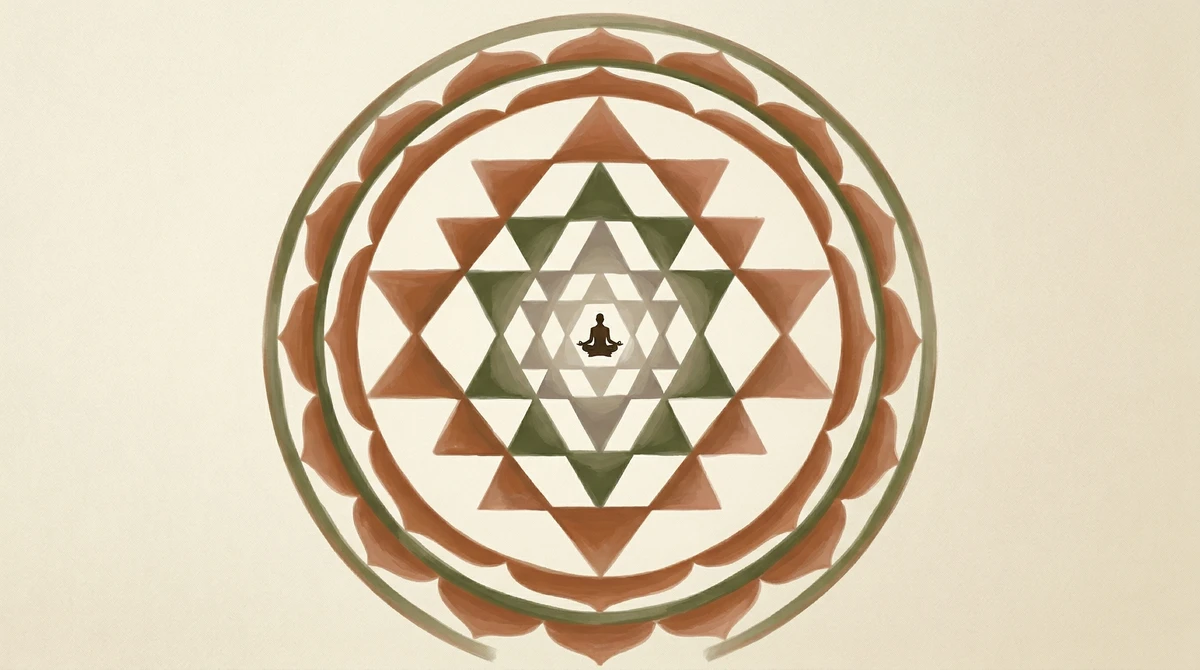
Sacred geometry works in meditation because geometric patterns recruit automatic visual processing that produces concentration without deliberate effort. When you gaze at a symmetrical, concentric design like a yantra or mandala, your eyes are drawn involuntarily toward the center point. This creates the single-pointed focus that meditation traditions call dharana, and it happens whether or not you understand the symbolism. The geometry does the focusing for you.
Why geometric patterns focus the mind
Your visual system is wired to detect and respond to symmetry. Jacobsen and Höfel (2003) demonstrated this with EEG recordings: participants viewing symmetrical patterns showed a sustained posterior negativity (a specific neural signature of automatic symmetry processing), and their symmetry judgments were faster than their beauty judgments. You don’t decide to pay attention to a symmetrical pattern. Your visual cortex pays attention for you.
This automatic engagement extends beyond noticing symmetry. Di Dio, Macaluso, and Rizzolatti (2007) used fMRI to show that Classical and Renaissance sculptures embodying golden ratio proportions activated the anterior insula (associated with emotional feeling) even when participants weren’t asked to judge beauty. The brain has a non-conscious response to harmonic proportion. Sacred geometry traditions, which extensively use these proportions, likely tap into this same automatic response.
The anxiety-reducing effect of geometric engagement is also measurable. Curry and Kasser (2005) found that coloring structured geometric patterns reduced anxiety significantly more than unstructured coloring in a study of 84 undergraduates, a result confirmed by a 2012 replication (Carsley & Heath, Art Therapy 29:2). But the finding most articles overlook: a plaid pattern reduced anxiety just as effectively as a mandala. The mechanism is geometric structure itself, not the cultural symbolism layered on top. Note that these studies tested coloring (active motor engagement with geometry), not the sustained gazing practices described later in this article, but they establish that geometric structure itself affects mental states.
A deeper mechanism likely operates during sustained visual fixation. Holding the gaze on a single point engages the dorsal attention network (the superior colliculus, frontal eye fields, and posterior parietal cortex) while reducing saccadic eye movements. Attention researchers have linked saccade reduction to quieting of the Default Mode Network, the neural architecture responsible for mind-wandering. If this model is correct, geometric gazing stills the brain’s wandering circuitry by stabilizing the eyes.
These mechanisms help explain why contemplative traditions across cultures independently arrived at using geometry for meditation. Not because they all received the same mystical insight, but because they all discovered the same perceptual reality: nested geometry focuses attention more reliably than trying to think about nothing.
How contemplative traditions use sacred geometry
Hindu and tantric traditions developed yantras: geometric diagrams used as gazing objects in meditation. Each yantra pairs with a mantra. The practice is eyes-open gazing (trataka), not visualization with eyes closed. A yantra’s concentric layers (outer square boundary, lotus petals, interlocking triangles, central point) correspond to progressively deeper states of attention. Swami Satchidananda described yantras as externalized maps of what meditators see internally: “Those who went into deep meditation experienced something in the unconscious levels of the mind. Upon returning to normal consciousness, they expressed what they had experienced in the form of mantras and yantras” (Integral Yoga Magazine).
Tibetan Buddhism uses mandalas, which are more pictorial than yantras but built on the same concentric geometry. Meditation involves mentally “entering” the mandala and traversing its layers toward the center. Sand mandalas add the dimension of impermanence: the form is destroyed after completion, teaching non-attachment to the very focus object that produced the contemplative state.
Islamic tradition takes a different geometric approach. Mosque tilework uses infinite tessellation rather than concentric patterns. There is no center point. The geometry directs attention everywhere and nowhere simultaneously, producing an expansive quality of contemplation rather than the absorptive focus of a centered yantra.
Christian tradition uses labyrinths and rose windows. The labyrinth at Chartres Cathedral applies geometry to walking meditation; rose windows use radial symmetry for seated contemplation.
The Vijñāna Bhairava Tantra, a 7th-century Kashmiri text, prescribes 112 meditation techniques, several involving geometric visualization and concentration on specific points. Lemanski (2019) traced how logic diagrams, sacred geometry, and religious symbols across cultures share structural resemblance, arguing this relationship is functional rather than coincidental.
The key sacred geometry forms used in meditation
Each form works differently in practice.
The bindu (point) is the simplest and most fundamental. Every geometric meditation converges on a single point. In yantra practice, the bindu is the final destination where focused attention becomes absorption. It has no dimension, no complexity. It is where the geometry ends and stillness begins.
The circle serves as boundary and container. The outer ring of a mandala defines the field of attention. The eye can travel along it endlessly, which makes it calming but less focusing than a design with a central convergence point.
The triangle introduces dynamic tension. In tantric iconography, upward-pointing triangles represent Shiva (consciousness); downward-pointing triangles represent Shakti (creative energy). When interlocked, they create the complex interference patterns found in yantras.
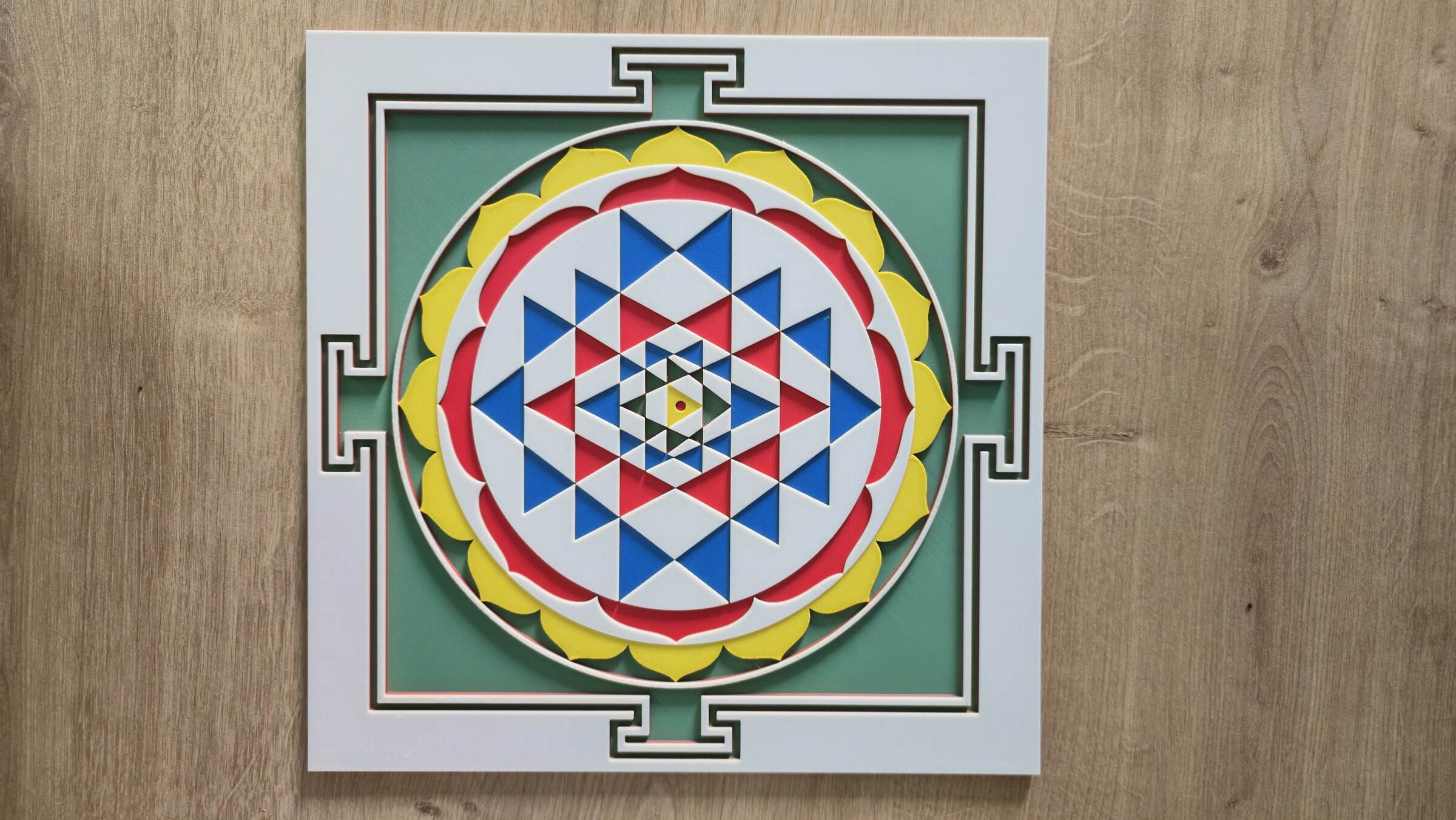
The Sri Yantra is the most geometrically complex traditional meditation object: nine interlocking triangles (four pointing upward, five downward) whose intersections create exactly 43 smaller triangles arranged in five concentric levels around a central bindu. The construction is mathematically precise (all intersections must align perfectly) and notoriously difficult to draw. In practice, the Sri Yantra’s density means the eye never runs out of detail to explore. Attention is continuously refreshed rather than habituated, which is why advanced practitioners prefer it over simpler forms.
The Flower of Life is a pattern of overlapping circles in hexagonal arrangement. It appears in ancient sites including the Temple of Osiris at Abydos in Egypt, though the specific dating is debated among archaeologists. It’s used as a contemplation object, though less traditionally codified than yantras. As discussed below, this pattern also appears spontaneously during deep meditation, which may explain why multiple cultures independently identified it as significant.
The golden ratio and spiral appear frequently in nature and architecture. The mathematical relationship between golden ratio proportions and the Great Pyramid’s slope angle (approximately 51.83°) has been noted, though whether ancient builders used the ratio deliberately or arrived at it through practical measurement systems remains debated. The Fibonacci spiral is used more in contemporary sacred geometry meditation than in traditional practice.
Trataka: the technique behind sacred geometry meditation
Most writing on “sacred geometry meditation” tells you to visualize a shape, feel its energy, and align with its frequency. This is like telling someone to learn piano by imagining a keyboard.
The technique is trataka. It is one of the six shatkarmas (purification practices) codified in the Hatha Yoga Pradipika, a 15th-century Sanskrit manual: “Looking intently with an unwavering gaze at a small point until tears are shed is known as trataka by the acharyas.” The Gheranda Samhita, a 17th-century text, confirms the practice.
Trataka is usually taught with a candle flame, but traditionally it’s practiced with yantras, symbols, and deity images. It IS the method for meditating with sacred geometry. Without it, sacred geometry meditation reduces to “look at pretty patterns and hope something happens.”
The research supports what practitioners have reported for centuries. Raghavendra et al. (2021) found that trataka produces significant increases in alpha (8-12 Hz) and theta (4-7 Hz) brainwave activity after as little as ten minutes. Alpha states correspond to calm wakefulness; theta to deep relaxation and subconscious imagery. Garg (2023) demonstrated that a two-week trataka programme produced statistically significant reductions in mind-wandering (p < 0.001) and visual strain (p = 0.002). A 2021 narrative review of 37 research articles found that trataka enhances working memory, spatial memory, and spatial attention. 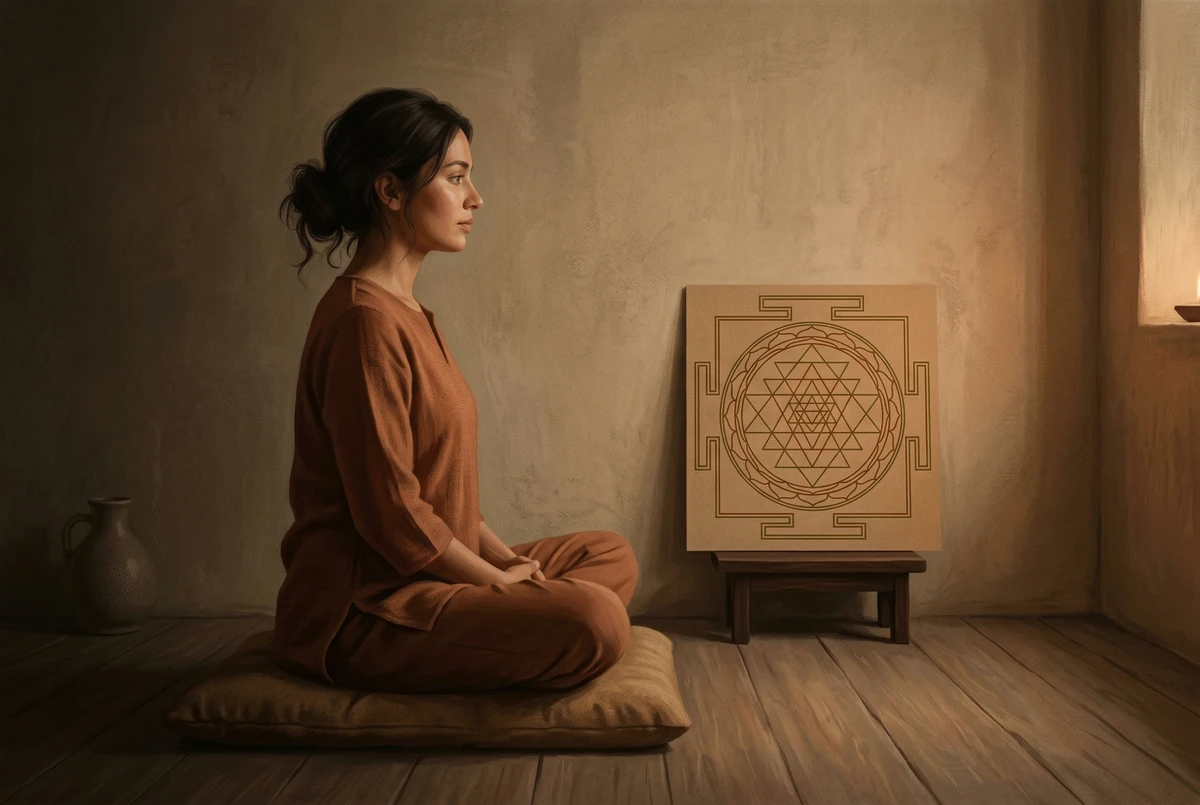
The tears mentioned in the Hatha Yoga Pradipika aren’t just a side effect. Tearing is a parasympathetic response, consistent with the nervous system’s shift from vigilance to receptive stillness that the brainwave studies also measure.
Here is the technique applied to sacred geometry:
- Place the geometric form (a printed yantra works fine) at eye level, arm’s length away, in dim lighting to reduce glare.
- Sit comfortably with your spine upright.
- Gaze softly at the center point. Do not strain or force the eyes open.
- Let the surrounding geometry draw your attention naturally. The concentric layers create a progression from peripheral awareness to single-pointed focus.
- When your eyes water or tire, close them and observe the after-image. It appears in complementary colors.
- The after-image becomes your internal meditation object. Rest with it.
- When it fades, open your eyes and repeat. Three to five cycles make a session.
Why this works better with geometry than with a candle flame: A flame gives a single point. A yantra gives a structured field with layers that progressively deepen engagement. The meditator doesn’t have to decide where to focus. The concentric design creates a natural progression from broad awareness to absorption.
The connection to Patanjali’s framework is direct. Yoga Sutra 3.1 defines dharana (concentration) as “binding the mind to one place.” The geometric form serves this binding. Sutra 3.2 says that when concentration flows uninterrupted, it becomes dhyana (meditation). The after-image bridges to this continuous flow. Sutra 3.3 describes samadhi: when only the essence of the object remains in awareness. The dissolution of the after-image opens toward this. As Shankara wrote in the 8th-century Upadesha Sahasri, one-pointedness (ekagrata) is the state where “the one-pointed intellect of the seer of the supreme Truth becomes established in the one Self.”
Seeing geometry during meditation: what it means
Meditators ask this more than anything else about sacred geometry: “I’m starting to see geometric patterns when I meditate. Is this common?”
It’s common, well-documented, and has both neurological and contemplative explanations. The two aren’t mutually exclusive.
The neuroscience: Bressloff, Cowan, Golubitsky, Thomas, and Wiener (2001) mathematically modeled how spontaneous neural firing patterns in the primary visual cortex (V1) produce geometric forms. When external visual input is reduced (as in eyes-closed meditation), the visual cortex’s intrinsic architecture becomes visible to conscious awareness. The specific patterns, classified by Klüver as “form constants” (gratings, lattices, honeycombs, spirals, tunnels, cobwebs), correspond to mathematically predictable stable states in the cortex’s interconnected hypercolumns. The geometry people see isn’t random. It reflects the physical structure of the visual system itself.
The contemplative interpretation: Traditions describe these visions as signs of progression along the meditative path. Practitioners spontaneously report seeing patterns like the Flower of Life during meditation, sometimes without prior knowledge of the symbol.
Both explanations can be true simultaneously. The patterns are real perceptual phenomena with measurable neurological correlates. They also reliably indicate deepening meditation. The fact that the visual cortex’s intrinsic geometry matches what contemplative traditions identified as significant across cultures is itself remarkable: these traditions may have been mapping neural architecture from the inside out.
The practical advice from experienced practitioners is consistent: notice the patterns, don’t chase them, and don’t let them become the goal of your practice. As one practitioner put it: “See them, and then dwell not on them. The mind likes to put labels on everything. The better part of meditation is when you go beyond the mind.” They are signposts, not destinations.
How to start a sacred geometry meditation practice
Choose your form. For beginners, start with a simpler yantra rather than the Sri Yantra, which has enough complexity to overwhelm new practitioners. A single-triangle yantra or a Ganesh yantra works well. A clearly printed image is all you need.
Set up for practice. Quiet space, image at eye level, dim lighting. Start with 10-15 minutes. No incense, ritual, or special equipment required. The geometry is the technology.
The basic session: Soft gaze on the center point. Let peripheral geometry draw attention naturally. When eyes water or tire, close them for the after-image. Rest in the internal pattern until it fades. Open eyes and repeat. Three to five cycles per session.
Progress markers you’ll notice:
- The after-image lasts longer and appears more vividly
- The mind quiets faster in subsequent sessions
- You feel the geometry “pulling” attention inward without effort
- Internal visualization becomes vivid without needing the external form
Common mistakes:
- Straining the eyes. This is soft gazing, not staring. If your eyes hurt, you’re trying too hard.
- Trying to decode the symbolism mid-session. Understanding deepens over time. During practice, just gaze. Intellectual analysis and meditation use different cognitive modes.
- Switching forms too often. Stick with one geometric form for at least a month. Familiarity deepens the practice because the visual system builds increasingly detailed internal representations.
- Expecting dramatic experiences immediately. The brainwave shifts measured by Raghavendra et al. happened after ten minutes. Garg’s mind-wandering reductions took two weeks. The practice works, but on the timescale of neural adaptation, not instant gratification.
The difference between looking at sacred geometry and meditating with it is the difference between hearing a song and learning to play the instrument. Trataka is the technique. The geometry is the instrument. The concentration state is the music.
Sources
- Jacobsen, T. & Höfel, L. (2003). “Descriptive and evaluative judgment processes: Behavioral and electrophysiological indices of processing symmetry and aesthetics.” Cognitive, Affective, & Behavioral Neuroscience, 3(4), 289–299. PMID: 15040549.
- Curry, N.A. & Kasser, T. (2005). “Can coloring mandalas reduce anxiety?” Art Therapy: Journal of the American Art Therapy Association, 22(2), 81–85. DOI: 10.1080/07421656.2005.10129441.
- Carsley, D. & Heath, N.L. (2012). “Can Coloring Mandalas Reduce Anxiety? A Replication Study.” Art Therapy, 29(2).
- Bressloff, P.C., Cowan, J.D., Golubitsky, M., Thomas, P.J. & Wiener, M.C. (2001). “Geometric visual hallucinations, Euclidean symmetry and the functional architecture of striate cortex.” Philosophical Transactions of the Royal Society B, 356(1407), 299–330. PMID: 11316482.
- Di Dio, C., Macaluso, E. & Rizzolatti, G. (2007). “The golden beauty: Brain response to classical and Renaissance sculptures.” PLoS ONE, 2(11), e1201. DOI: 10.1371/journal.pone.0001201.
- Lemanski, J. (2019). “Logic Diagrams, Sacred Geometry and Neural Networks.” Logica Universalis, 13(4), 495–513. DOI: 10.1007/s11787-019-00239-9.
- Raghavendra et al. (2021). Trataka and EEG brainwave activity. Frontiers in Psychology. Via Cannelevate.
- Garg, R. (2023). Two-week Trataka programme study. VAYU USA.
- Swatmarama. Hatha Yoga Pradipika (15th century CE). Chapter 2, Verses 31–32.
- Patanjali. Yoga Sutras. Sutras 3.1–3.3 (Dharana, Dhyana, Samadhi).
- Shankara. Upadesha Sahasri (8th century CE).
- Vijñāna Bhairava Tantra (c. 7th–8th century CE).
- Gheranda Samhita (17th century CE).