The Mathematics of the Sri Yantra
Miha Cacic · April 8, 2026 · 6 min read
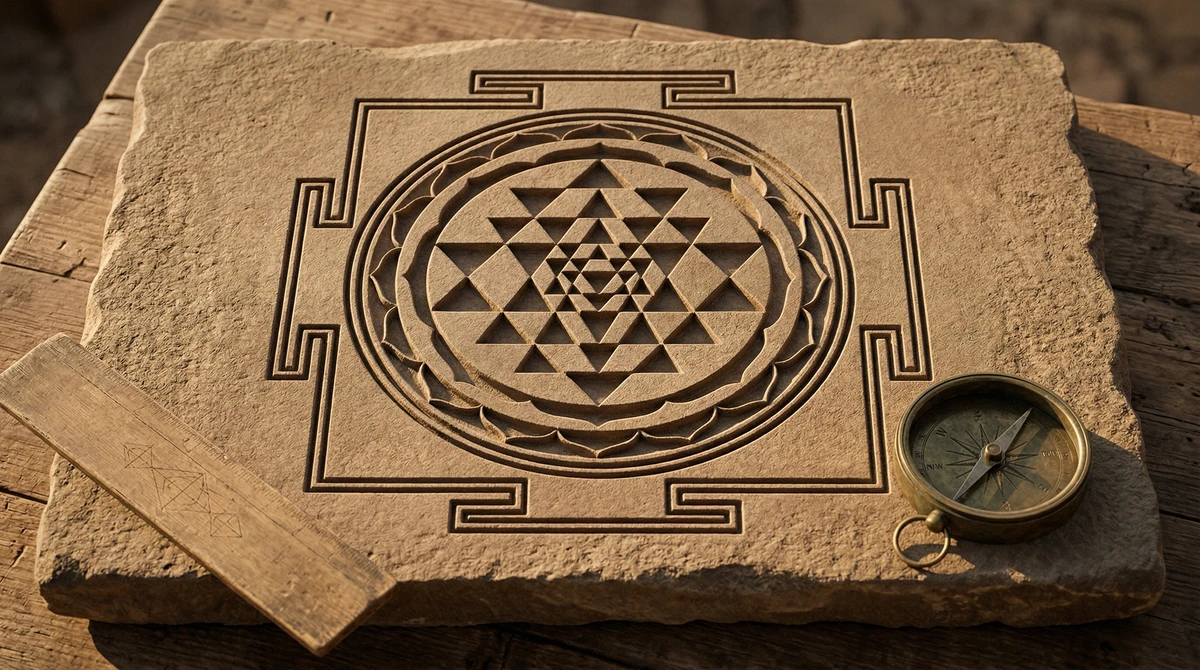
The Sri Yantra looks like a simple pattern of overlapping triangles. Nine of them, interlocked inside a circle. Then you try to draw one, and something strange happens: the lines won’t meet where they should. You can spend hours adjusting, and two or three intersection points will still be slightly off. This isn’t a failure of technique. When 20th-century mathematicians formalized the problem, they concluded it was a fundamental property of the geometry itself. In 2021, a French mathematician proved them wrong.
Nine triangles, 43 spaces, and 33 intersections that must be exact
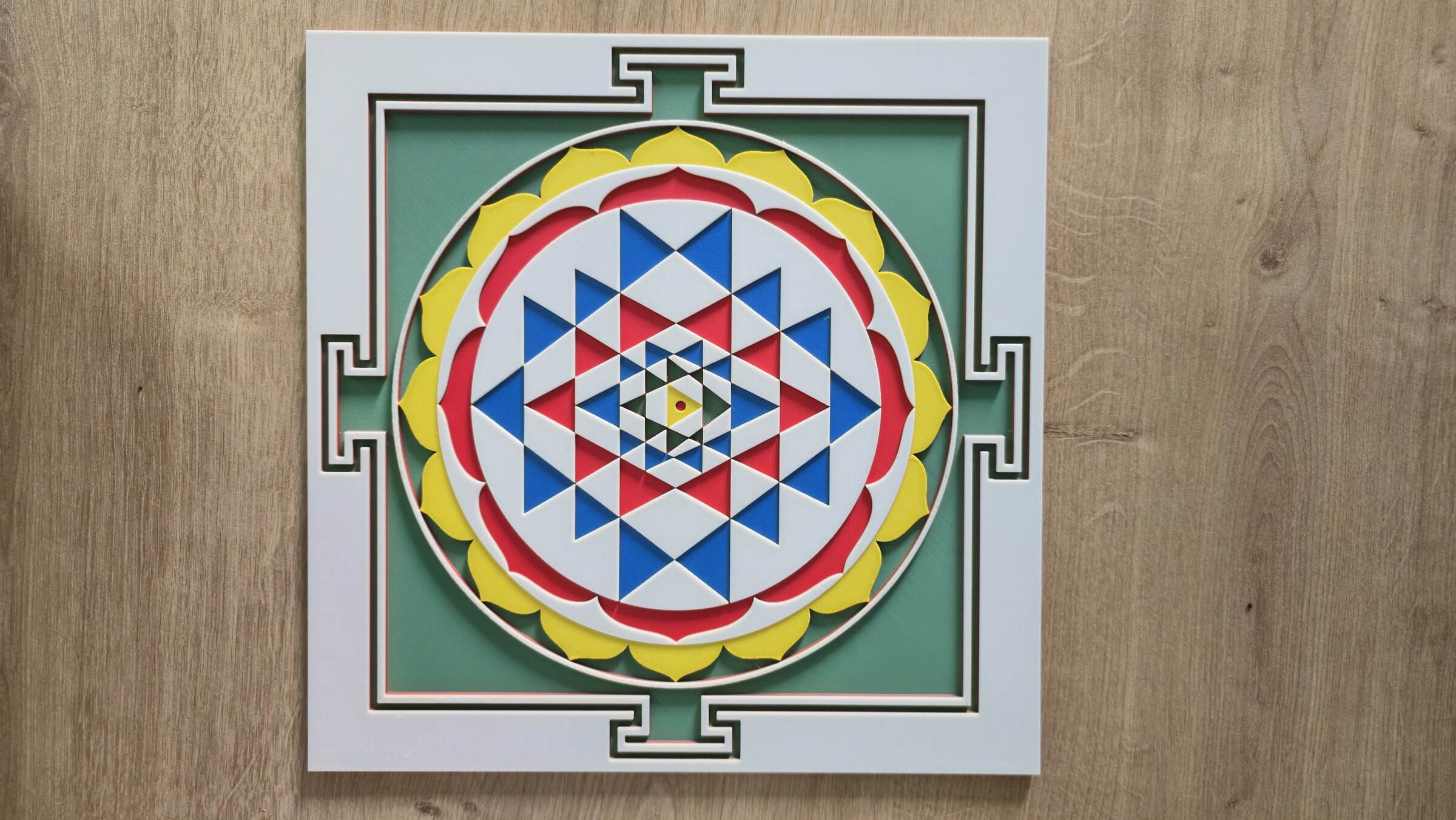
The Sri Yantra consists of four upward-pointing triangles (representing Shiva in Hindu tradition) and five downward-pointing triangles (Shakti). These nine triangles overlap to create exactly 43 subsidiary triangles, arranged in concentric rings around a central point called the bindu.
Around the triangles: two rings of lotus petals (8 and 16), enclosed by a square frame called the bhupura with gates on four sides.
The geometry that matters is inside. The nine triangles create 33 points where exactly three lines must pass through a single point, plus 24 points where two lines cross. Those 33 “triple intersections” are the source of all the trouble. In most geometric diagrams (the Flower of Life, a Star of David) symmetry makes intersection points fall into place naturally. The Sri Yantra’s nine triangles are all different sizes, positioned at different heights, and every one shares vertices with the others. As sriyantraresearch.com puts it: “Every triangle is connected to the others by common points, and this is the reason why it is so difficult to draw correctly. Changing the size or position of one triangle often requires changing the position of many other triangles.”
This interconnection is what makes the Sri Yantra fundamentally different from simpler sacred geometry.
Why a perfect Sri Yantra seemed mathematically impossible
The core problem is a mismatch between freedom and constraint.
When you set out to draw a Sri Yantra, you start with a circle. Inside it, you need to position nine triangles. But these triangles are not independent. Except for the two largest (whose three vertices all touch the outer circle), every triangle’s apex must land on the base of another triangle. That interlocking requirement means you can only freely choose the position of a small number of horizontal lines. Everything else is determined by the intersections those choices create.
How many free choices do you actually get? Gérard Huet, a computer scientist at INRIA, formalized the Sri Yantra as a problem in Euclidean geometry and found four independent parameters (Huet, 2002). If you count the radius of the outer circle as a choice rather than fixing it at 1, you get five. Either way, the number of constraints (33 triple intersections that must be exact, plus concentricity and symmetry requirements) far exceeds the number of free parameters.
In mathematics, this is called an overdetermined system: more equations than unknowns. C.S. Rao translated the Sri Yantra into a system of 20 constraint equations and used Mathematica to search for solutions (Rao, 1998). The errors could be made very small, but never zero. Using an optimal drawing sequence, errors persist in at least two of the 33 triple intersections.
This is why so many different versions of the Sri Yantra exist. Each one represents a different set of trade-offs about which intersections to make perfect and which to approximate. Kulaichev (1984) surveyed historical specimens and classified them into three types based on how many constraint equations they satisfied. Type III specimens (about 10% of the total, typically the oldest, engraved on metal or stone) satisfied the complete system of four equations; their solutions are discrete and rigid. Types I and II, which make up 90% of known specimens, satisfied only partial systems, allowing continuous deformation. Kulaichev concluded that Type III likely represents the original prototype, with the degradation to Types II and I reflecting centuries of imprecise copying.
Then, in 2021, Alessandro Chiodo at the Sorbonne published a paper in Comptes Rendus Mathématique that upended this understanding. He showed that the Sri Yantra construction problem is equivalent to a specific variant of the Problem of Apollonius: given a circle, a line, and a point, find a circle tangent to the first, tangent to the second, and passing through the third.
Apollonius of Perga posed this problem around 200 BCE. Chiodo demonstrated that by using this ancient Greek technique with straightedge and compass, you can construct a Sri Yantra with perfect concurrency at every triple intersection (Chiodo, 2021). No iterative approximation. No residual errors. The first mathematically perfect Sri Yantra construction ever published.
The response from sriyantraresearch.com, the most thorough independent analysis site: “This is a major achievement. This has never been done before as far as I know.”
The impossibility was an artifact of the approach, not a property of the geometry. The simultaneous-equations method treats the problem as algebra; the Apollonius method treats it as pure geometry. The geometry was solvable all along.
The golden ratio: designed in or emergent?
If you’ve read anything about the Sri Yantra, you’ve encountered this claim: the Sri Yantra encodes the golden ratio. The evidence usually cited is the largest triangles’ base angle of approximately 51 degrees, close to the Great Pyramid of Giza’s slope of 51.84 degrees (51 degrees, 50 minutes, 35 seconds). At that angle, the ratio of a triangle’s slant side to half its base approximates phi, 1.618.
Joseph’s analysis at UCSC confirms the link: “The largest isosceles triangle of the sriyantra design is one of the face triangles of the Great Pyramid in miniature.”
But the claim deserves more scrutiny than it usually gets.
The taxonomy of golden ratio triangles distinguishes several types. The “King” golden triangle (72-degree base angles, sides in ratio phi to 1) and “Queen” golden triangle (36-degree base angles) both have a defining property: you can subdivide them into smaller copies of themselves, producing the self-similar spiral that makes the golden ratio famous. The approximately 51-degree triangle found in the Sri Yantra is what researchers classify as a “cousin.” It has phi in its proportions, but it lacks the self-similar subdivision property. This is the difference between a triangle built from the golden ratio and one that merely contains it.
So: is the golden ratio a design input or an emergent property?
The UCSC golden ratio construction method starts with phi and derives the triangle positions from it, producing a valid Sri Yantra. But other construction methods (Rao’s simultaneous equations, Chiodo’s Apollonius approach) start from different principles and arrive at similar angles. The ~51-degree angle may be what naturally falls out of optimizing the constraint system rather than something deliberately encoded.
The geometry is sensitive to this angle. Even a shift of one or two degrees from the ~51-degree mark causes construction errors to grow sharply, suggesting the angle is a structural optimum. But whether ancient geometers chose it because they recognized phi in it, or because it minimized construction error (and the two happen to coincide), remains an open question.
The golden ratio is present in the Sri Yantra’s proportions, but calling it a “golden ratio diagram” overstates the case. The mathematical structure that makes the Sri Yantra unique is its constraint system, not its angular proportions.
The three keys to an optimal configuration
Not all Sri Yantras are equal. Beyond just making lines meet, three criteria define an optimal configuration:
Concurrency. All 33 triple intersections should be true points, with three lines meeting precisely, rather than forming tiny triangles where lines barely miss each other. This is the hardest criterion to satisfy across all points simultaneously, and the most visible when it fails.
Concentricity. The center of the innermost triangle should coincide with the center of the outer circle. In suboptimal configurations, these two points drift apart, producing a lopsided figure.
Equilateral inner triangle. The innermost of the 43 subsidiary triangles should have angles of 60 degrees, forming an equilateral triangle.
When all three criteria are satisfied, the bindu (the central point of meditation focus), the center of the outer circle, and the geometric center of mass all align at the same point. The figure becomes, in the mathematical sense, centered.
The Sri Yantra at the Sringeri Sharada Peetham, one of the oldest known specimens (attributed to Adi Shankaracharya, 8th century CE, carved on a rock in the Tunga river), has an innermost triangle angle very close to 60 degrees. The shape of its lotus petals and outer frame match patterns that sriyantraresearch.com identifies as characteristic of early configurations. Whether the original designer understood these criteria explicitly or arrived at this precision through geometric intuition and careful craftsmanship, the result satisfies them.
How to actually construct one (and what goes wrong)
If you sit down with a compass and straightedge to draw a Sri Yantra, here’s what you face.
You draw a circle. You choose the position of five horizontal lines (the bases of five of the nine triangles). These five choices are your degrees of freedom. Everything else follows from intersections: where lines cross determines where the next triangle’s vertices go. Certain triangles must be drawn first because they create the reference points for later ones.
The last line is the problem. In traditional construction methods, it’s placed by trial and error, adjusted until the final triple intersections look right. In Rao’s computational approach, it’s solved iteratively, minimizing residual error. In Chiodo’s method, it’s determined exactly by solving the Apollonius circle-line-point problem.
One property that surprises everyone who tries: the Sri Yantra is bilaterally symmetric left to right (the vertical axis is a mirror line) but asymmetric top to bottom. No two triangles are the same. The four upward triangles are all different sizes, as are the five downward triangles. This asymmetry is structural: four triangles and five triangles of different sizes, sharing vertices within the same circle, produce an inherently non-symmetric solution along the vertical axis. Many tutorials and supposedly accurate Sri Yantras get this wrong, drawing the two largest triangles as if they were identical. They aren’t.
The plane form (flat, straight lines) is the most common. The Meru form (pyramidal, with overlapping triangle outlines elevated in steps, named after the mythological Mount Meru) requires consistent three-dimensional intersections. The Kurma form (spherical, drawn on a dome with curved lines representing spherical triangles, named after the turtle incarnation of Vishnu) is the rarest and most mathematically demanding, because straight-line intersections on a flat plane become problems in spherical geometry.
What ancient geometers knew (and what they shouldn’t have)
The mathematical sophistication required to construct a precise Sri Yantra raises a historical puzzle.
The earliest known physical Sri Yantras date to Buddhist inscriptions in 7th-century South Sumatra (referenced in de Casparis, 1956, cited by Chiodo). The Sringeri specimen dates to the 8th century. A hymn in the Atharva Veda tradition references a figure resembling the Sri Yantra (called “Navayoni Chakra,” the nine-triangle wheel), with the core Atharva Veda text dated to roughly 1200 to 1000 BCE, though the specific references appear in later appendices.
The modern mathematical study of the Sri Yantra began with Bolton and Macleod (1977), who proposed a seven-by-seven grid technique for construction and provided an early systematic geometric analysis. Kulaichev (1984) went deeper and found something troubling. The spherical (Kurma) form of the Sri Yantra requires working with spherical triangles, a branch of mathematics that medieval Indian scholars were not believed to have developed. Yet Kurma specimens exist from this period.
Kulaichev’s conclusion was careful: he proposed “the existence of unknown cultural and historical alternatives to mathematical knowledge, e.g. the highly developed tradition of special imagination.” Perhaps there were ways of achieving geometric precision that didn’t involve the formal mathematics we would use today.
Then came Chiodo’s 2021 paper, which reframed the entire construction problem as an instance of Apollonius’s circle-line-point problem. Apollonius worked in the 3rd century BCE. The connection is striking: an ancient Indian geometric construction, whose mathematical basis puzzled 20th-century researchers, turns out to be solvable through a technique that an ancient Greek geometer had already described in a different context.
None of this proves that ancient Indian geometers knew Apollonius’s work (or vice versa). But it suggests that the Sri Yantra’s construction may have been more accessible through geometric intuition than through algebraic analysis. The simultaneous-equations approach that Rao used in 1998, which made perfection appear impossible, is a modern framework imposed on the problem. The straightedge-and-compass approach is older than both the Sri Yantra and modern algebra, and it’s the one that works.
The Sri Yantra’s mathematics isn’t remarkable because it hides the golden ratio (the ratio is present, but as a “cousin” rather than a defining property). It’s remarkable because modern mathematicians spent decades believing they faced an unsolvable problem, until someone looked at it with older tools.
Sources
- Bolton, Nicholas J. and Macleod, D. Nicol G. (1977). “The geometry of the Śrīyantra.” Religion, 7(1), 66-85. DOI: 10.1016/0048-721X(77)90008-2.
- Chiodo, Alessandro. (2021). “On the construction of the Śrī Yantra.” Comptes Rendus. Mathématique, 359(4), 377-397. DOI: 10.5802/crmath.163.
- Huet, Gérard. (2002). “Śrī Yantra Geometry.” Theoretical Computer Science, 281(1-2), 609-628. DOI: 10.1016/S0304-3975(02)00028-2.
- Kulaichev, Alexey Pavlovich. (1984). “Śrīyantra and its Mathematical Properties.” Indian Journal of History of Science, 19(3), 279-292. MR: 784700.
- Rao, C.S. (1998). “Śrīyantra: A study of spherical and plane forms.” Indian Journal of History of Science, 33(3), 203-227. MR: 1651351.