Best Physical Meditation Tools: What Each Type Actually Does
Miha Cacic · April 11, 2026 · 7 min read
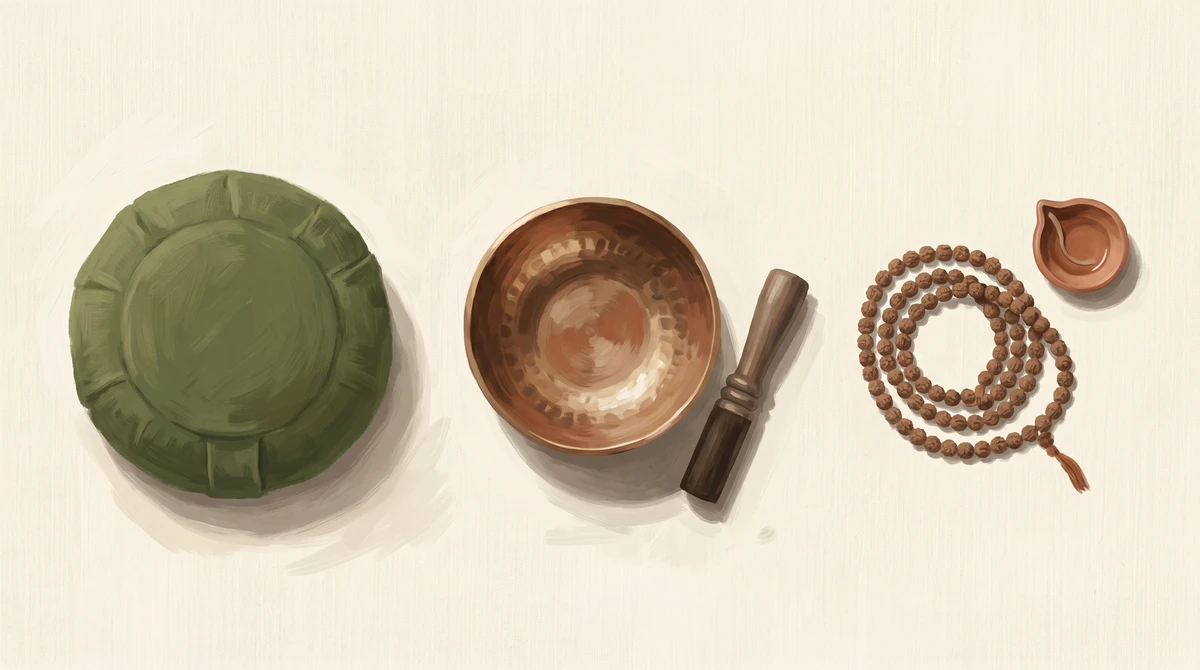
You don’t need tools to meditate. But the tools you choose shape the kind of meditation you end up doing. A cushion and a mala bead are not the same category of object, even though every “best meditation tools” listicle puts them side by side. The real question isn’t “what should I buy?” but “what do I want this object to do to my attention?”
Do you actually need physical meditation tools?
The most-upvoted answer on Quora to “What supplies do I need to meditate?” is: “1. Your breath. 2. A chair.” That’s not wrong. Meditation existed for millennia before anyone tried to sell you a buckwheat cushion.
The anti-tools crowd has a point. Buying gear can become a substitute for sitting down. If you’ve spent more time researching singing bowls than actually meditating, the tools are the problem, not the solution.
But the argument has a blind spot. It treats all tools as optional accessories, when some tools aren’t accessories at all. A mala without japa meditation is a necklace. A candle without trataka is a candle. In those practices, the physical object IS the meditation. Removing it doesn’t simplify the practice; it removes the practice entirely.
The useful distinction isn’t “tools vs. no tools.” It’s understanding what each tool actually does.
The three types of physical meditation tools
Most articles lump cushions, singing bowls, and mala beads into the same flat list, as if they all serve the same function. They don’t. Physical meditation tools do three fundamentally different things:
Comfort tools solve a body problem. Cushions, benches, chairs, eye pillows. They remove physical pain so you can focus on the meditation itself. One practitioner put it plainly: “I struggled for years trying to make myself comfortable in yoga positions. I would spend so much time adjusting my body that I could not go into a deep meditation.” Comfort tools fix that.
Ambiance tools set the sensory conditions. Incense, singing bowls, bells, dedicated lighting. They create a psychological boundary between practice and everything else.
Attention tools participate directly in the meditation. Mala beads, trataka objects (candles, dots, yantras), kasina disks, breathing stones. These give your mind a physical structure to work with. They don’t just make sitting easier or more pleasant. They change what your mind does during the session.
The distinction matters practically. If your mind races through every session, buying a nicer cushion won’t help. Your problem isn’t comfort. It’s that your attention has nothing to hold onto. An attention tool (a mala, a candle flame) addresses the actual issue.
The best comfort tools (and why you only need one)
The right seat is the one that lets you forget about your body within the first two minutes of sitting. If you’re still adjusting after five minutes, it’s the wrong seat.
A zafu cushion (the round, buckwheat-hull-filled kind) is the traditional Zen choice. It tilts the pelvis forward, aligns the spine, and keeps the hips above the knees. Works well if you have decent hip flexibility. Buckwheat hulls create natural air gaps, so the cushion breathes and doesn’t trap heat.
A meditation bench is better if your knees or hips protest against cross-legged sitting. Kneeling with a bench takes pressure off the joints while keeping the spine upright. Same postural benefit, different geometry.
A firm chair works too. Meditation doesn’t require the floor. A slight forward tilt of the seat (a folded towel under the back edge does this) maintains the same spinal alignment a zafu provides. This is the most accessible option and there’s nothing lesser about it.
An eye pillow serves a different purpose: lying-down practices like yoga nidra or body scan. The gentle weight blocks light and helps you stay inward.
On filling materials: Buckwheat hulls are firm and breathable. Kapok fiber is softer and naturally resistant to mold, mildew, and dust mites (the hollow, waxy fibers discourage allergens). Memory foam contours to your shape but traps more heat. Pick based on whether you prefer firm support or cushioned softness.
You need one. Not a zafu AND a bench AND a bolster. Pick the seat that matches your body and move on.
The best ambiance tools (and when they help vs. distract)
Ambiance tools work by building ritual. When the same sensory cue precedes every session, your brain starts associating that cue with the meditative state. This isn’t mystical. It’s classical conditioning.
Singing bowls
A singing bowl’s primary function in most meditation practice is simple: the strike marks the beginning and end of the session. It creates a sonic boundary. Pressing “start” on a phone app doesn’t carry the same weight.
The research behind singing bowls is more interesting than you’d expect, though it studied something different from this use. Goldsby and colleagues (2017) tested 60-minute immersive “sound baths” where 62 participants lay in a half-circle surrounded by Tibetan bowls, crystal bowls, gongs, and bells. They found large reductions in tension, anger, anxiety, confusion, and fatigue (all statistically significant, with large effect sizes). Participants who had never tried singing bowl meditation before showed the greatest reductions in tension. 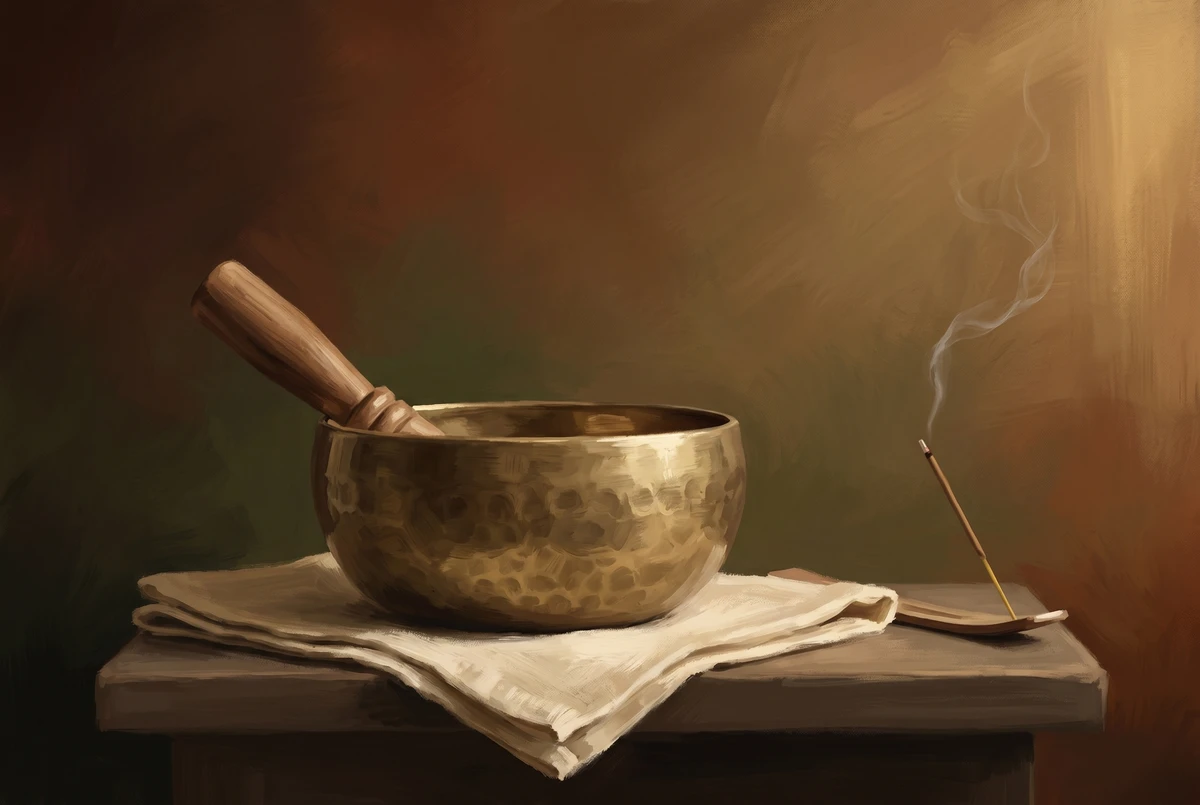
Separately, Landry (2014) ran a more rigorous crossover study (n=51) comparing Himalayan singing bowls to silence. The singing bowl condition produced significantly greater drops in systolic blood pressure (p=.044) and heart rate (p=.003).
A caveat: both studies tested immersive, extended exposure to bowl sounds, not the brief start-and-end strike most meditators use. The bookending function of a singing bowl likely works through ritual and psychological transition rather than the acoustic mechanisms these studies measured.
Tibetan bowls (metal alloy) produce complex, layered harmonics. Crystal bowls (quartz) produce a cleaner, more sustained tone. No comparative study exists on their psychological effects. Choose by which sound draws you inward rather than distracting you.
Incense and scent
Scent is uniquely wired for conditioning. The olfactory bulb projects directly to the amygdala, entorhinal cortex, and hippocampus, bypassing the thalamus. No other sense takes this shortcut. That’s why a specific smell can instantly recall a memory or emotional state that you couldn’t summon deliberately.
A consistent scent paired with meditation can exploit this pathway. After enough sessions, practitioners report that the smell itself begins to cue a settled, practice-ready state. Sandalwood and lavender are the most commonly used. Use sparingly: heavy smoke can irritate and become its own distraction.
When ambiance becomes avoidance
If your pre-meditation ritual takes longer than two minutes, it has become its own activity. Light one thing, strike one thing, sit down.
The best attention tools (the ones that actually change your meditation)
This is the category most articles skim, and it’s the one that matters most for people who struggle with focus. Attention tools don’t set the mood. They restructure what your mind does.
Mala beads
A mala is 108 beads on a string, plus a larger “guru” bead that marks the start and end of a cycle. You repeat a mantra (any word or phrase) while moving one bead per repetition between your thumb and middle finger.
What makes this work is that it gives the wandering mind multiple anchors at once. Your fingers move (tactile). Your mind recites the mantra (verbal). The beads track your count (sequential). Three channels of engagement instead of one. This is why japa meditation with a mala is one of the most accessible entry points for people who find breath-only meditation impossibly abstract. When “just watch your breath” fails, having something to hold, say, and count often succeeds.
The earliest literary reference to mala practice comes from the Mu Huanzi Jing, a Mahayana Buddhist text from the 4th to 5th century CE, which describes a king asking the Buddha for a simple practice. The instruction: string 108 seeds from a soapberry tree and recite while passing the mala through your fingers. The 108-bead count corresponds to the “one hundred and eight passions” in Buddhist tradition (Hindu tradition links 108 to the number of Upanishads, among other things).
Materials: Rudraksha seed malas are the traditional Shaiva Hindu choice. The trees fruit in 3 to 4 years, making them relatively sustainable. Sandalwood malas carry a calming fragrance but the wood takes at least 15 years to reach commercial harvest quality. Crystal and stone malas are the most popular in the West but the least sustainable. For practice purposes, the material matters less than the bead size (it should feel comfortable between your fingers) and the string quality (it should move freely, not stick).
No comparative study exists pitting mala meditation against silent breath meditation for beginners. The triple-channel engagement rationale is traditional and experiential, not clinically tested. But the logic is sound: more anchors for attention means fewer openings for distraction.
Trataka objects (candle, dot, yantra)
Trataka is steady gazing at a fixed point. The Hatha Yoga Pradipika defines it as “gazing steadily at a small mark until tears flow” and classifies it among the six shatkarma (purification practices), alongside nasal cleansing and breath purification. The Gheranda Samhita also lists it as shatkarma but adds that it prepares the mind for deeper concentration (dharana). The classical texts frame trataka as both physical purification and a gateway to sustained focus. 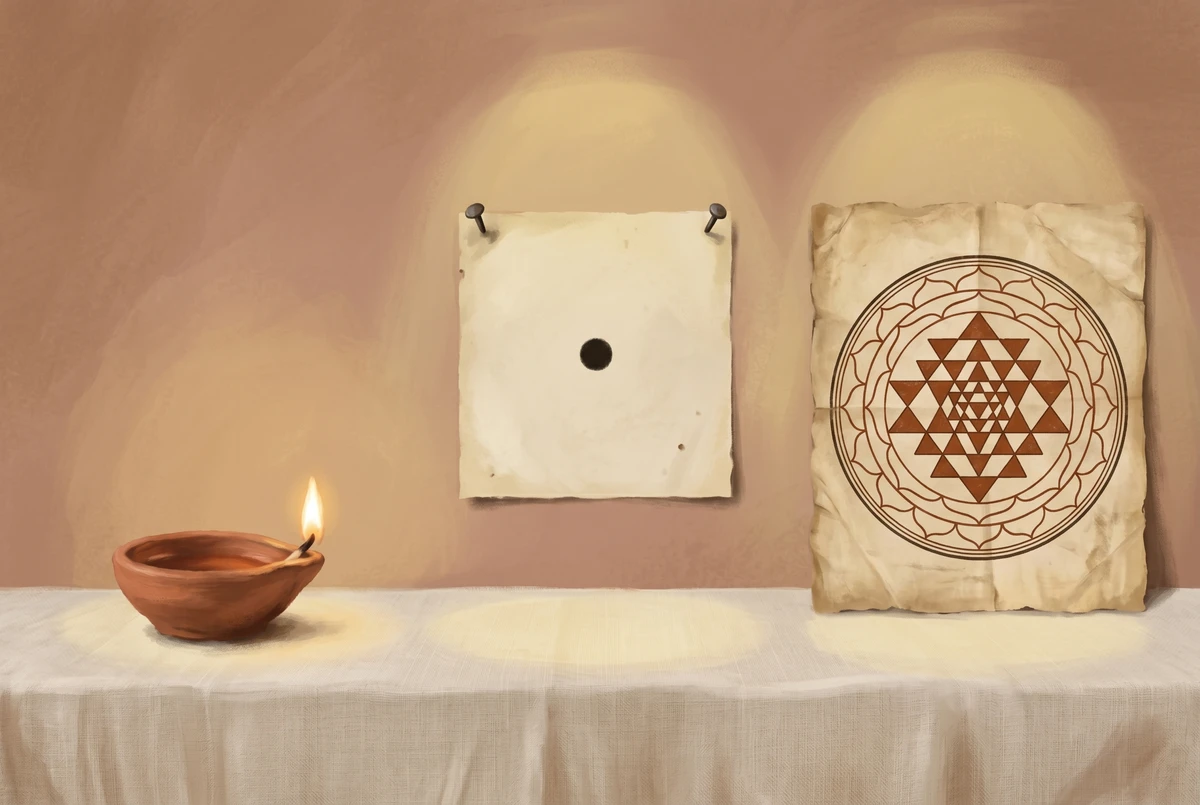
The three common trataka objects train attention differently:
A candle flame is the easiest starting point. The natural flicker holds visual interest, and after sustained gazing, closing your eyes reveals a vivid afterimage (the retinal impression of the flame). This bridges the gap between external focus and internal visualization. Beginners often find this more engaging than watching their breath because the flame gives the eyes something to track.
A black dot (bindu) on a white wall strips away that visual interest. There’s nothing inherently compelling about a dot. Holding your gaze on it requires pure intention. The difficulty is higher, but the concentration it builds is stronger because it relies on internal effort rather than external stimulus.
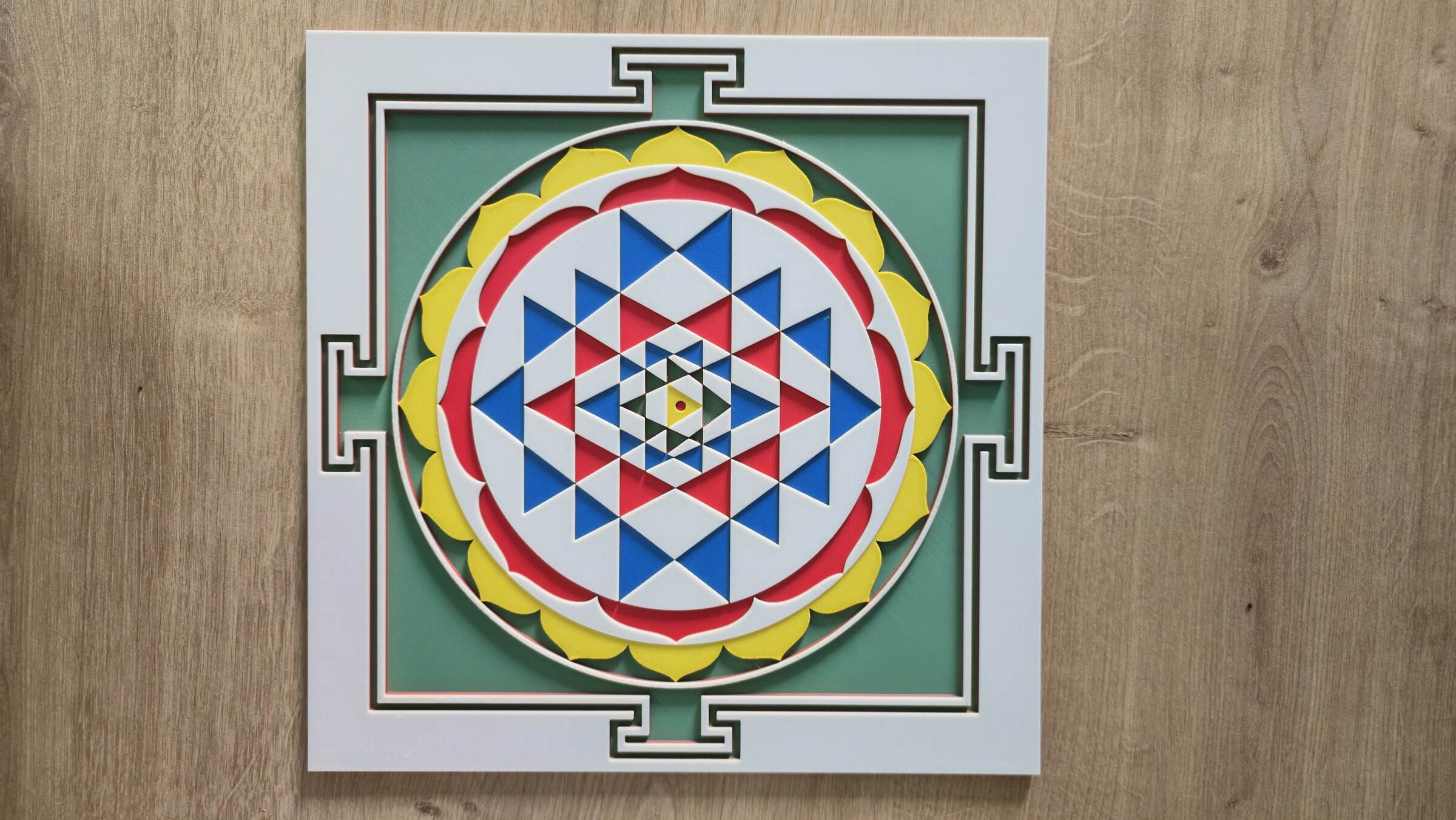
A yantra (especially the Sri Yantra) adds geometric complexity. The Sri Yantra consists of nine interlocking triangles surrounding a central bindu, forming 43 smaller triangles within concentric circles of lotus petals. The traditional gazing instruction starts at the center point and gradually expands outward. This is the opposite movement from most concentration practices: instead of contracting attention to a single point, Sri Yantra meditation expands from the point into architecture. Your gaze anchors at the center while your peripheral awareness explores the surrounding geometry.
This progression (flame to dot to yantra) mirrors the traditional teaching sequence, from simple to complex, from externally assisted to internally driven.
Trataka is often presented as an advanced practice, but the College of Psychic Studies frames it as ideal for practitioners who “struggle with closed-eye meditation” because it provides an external visual anchor for minds that scatter when the eyes shut. That framing matches what most trataka practitioners report: it’s one of the more accessible forms of meditation, not one of the harder ones.
A note on kasinas: The Theravada Buddhist tradition has its own system of ten gazing objects (earth, water, fire, colored disks, light, space) called kasinas. The practice is functionally parallel to trataka (gaze at a physical object, then internalize the image with eyes closed), but kasina meditation places more emphasis on developing a stable mental image (the nimitta) that persists after the object is gone. If you’re drawn to visual focus practices, kasinas are worth exploring alongside trataka.
Breathing tools
Bamboo breathing necklaces force slow, controlled exhalation through a narrow opening. Smooth palm stones rise and fall on the belly with each breath. These are practical for one specific problem: when “just watch your breath” is too abstract.
Some people cannot feel their own breathing without external feedback. A physical object that makes the breath visible or tangible (a stone that moves, a tube that you blow through) bridges that gap. Most practitioners treat these as transitional tools, useful until you can track the breath on its own.
Fidget and tactile tools
Spinning meditation rings (based on Tibetan prayer wheels), worry stones, textured beads. These occupy the restless hands and the part of the brain that craves physical stimulation, freeing the rest of the mind to settle.
These aren’t traditional meditation tools. They’re modern adaptations for people with high-stimulus lives or attention differences, most useful as a bridge while learning to sit still.
Analog vs. digital: why the format matters
The real question isn’t “should I use an app or a timer?” It’s “what happens when I introduce a screen into my meditation practice?”
Digital tools (apps, EEG headbands, smart cushions) provide guidance, structure, data, and accountability. They work for building a habit and getting started.
But a phone that can send you a notification is categorically different from a mala that cannot. Many meditators eventually migrate away from phone-based practice specifically because the device that times their meditation is the same device that interrupts everything else in their life. The psychological boundary between “meditation mode” and “everything mode” dissolves when both run on the same hardware.
Analog tools (singing bowls, sand timers, mala beads) create a tactile boundary. Striking a singing bowl is not the same psychological act as tapping a phone screen, even if both mark the start of a session. The physical object belongs to the practice. It doesn’t also belong to your inbox.
EEG headbands and biofeedback devices (Muse, Flowtime) are a separate case. These provide real-time feedback on brain activity, which is useful for calibrating your subjective experience against objective data. If you think you’re focused but the EEG says otherwise, that’s valuable information. But they’re best treated as temporary scaffolding. Use them to learn what focused attention feels like in your body. Then set them aside. The goal is to internalize the skill, not to depend on the data feed.
The progression most practitioners follow: start with guided apps (structure and instruction), move to a physical timer (independence from the screen), then drop the timer entirely. The tools scaffold the practice and then fall away.
How to choose the right meditation tool
Skip the “top 10 meditation tools” approach. Start with the problem you actually have.
“I can’t sit comfortably for more than five minutes.” Start with a comfort tool. A zafu, a bench, or a firm chair with a folded towel. Solve the body problem first. Everything else is irrelevant if your knees are screaming.
“I can sit fine, but my mind races the entire time.” Start with an attention tool. Mala beads for mantra practice, or a candle for trataka. Your problem isn’t comfort. It’s that your mind has nothing to hold onto. Give it a physical track to follow.
“I can’t get myself to start practicing consistently.” Start with an ambiance tool. A singing bowl, a specific incense, a dedicated corner. Build the sensory trigger that makes starting automatic rather than effortful.
“I’ve been meditating for a while but feel stuck.” Consider switching your attention tool rather than adding more accessories. If you’ve only done breath meditation, a mala or a trataka candle might open a different dimension of practice. The new object changes the cognitive demand, which can break a plateau.
“I want data on my progress.” An EEG headband or HRV monitor can provide objective feedback. Use it for a few months to calibrate your sense of when you’re actually focused vs. when you think you are. Then shelve it.
Start with one tool that addresses your biggest obstacle. Master it before adding a second. The best tool is the one that eventually fades into the background, supporting the practice without dominating it.
Sources
- Goldsby, T.L., Goldsby, M.E., McWalters, M., & Mills, P.J. (2017). “Effects of Singing Bowl Sound Meditation on Mood, Tension, and Well-being: An Observational Study.” Journal of Evidence-Based Complementary & Alternative Medicine, 22(3), 401-406. doi: 10.1177/2156587216668109. PMID: 27694559. PMC5871151.
- Landry, J.M. (2014). “Physiological and psychological effects of a Himalayan singing bowl in meditation practice: a quantitative analysis.” American Journal of Health Promotion, 28(5), 306-9. doi: 10.4278/ajhp.121031-ARB-528. PMID: 23941101.
- Svatmarama. Hatha Yoga Pradipika (~15th century CE). Trataka described as one of the six shatkarma (purification practices).
- Gheranda Samhita. Trataka listed as shatkarma and recommended as preparatory to dharana (concentration).
- Mu Huanzi Jing (Eastern Jin era, 4th-5th century CE). Taishō Tripiṭaka vol. 17, no. 786. Earliest literary reference to mala use for mantra recitation.
- Devi-Bhagavata Purana (9th-14th century CE). Rudraksha garland instructions for worship.
- Rudrakshajabala Upanishad. Rudraksha beads as sacred to Shiva, mantras for use with them.
- Lovic, V. “What Are Kasinas and What Is Their Role in Jhana Meditation?” jhana8.com.
- “Discovering the Sri Yantra: The Ultimate Meditation Tool.” College of Psychic Studies.