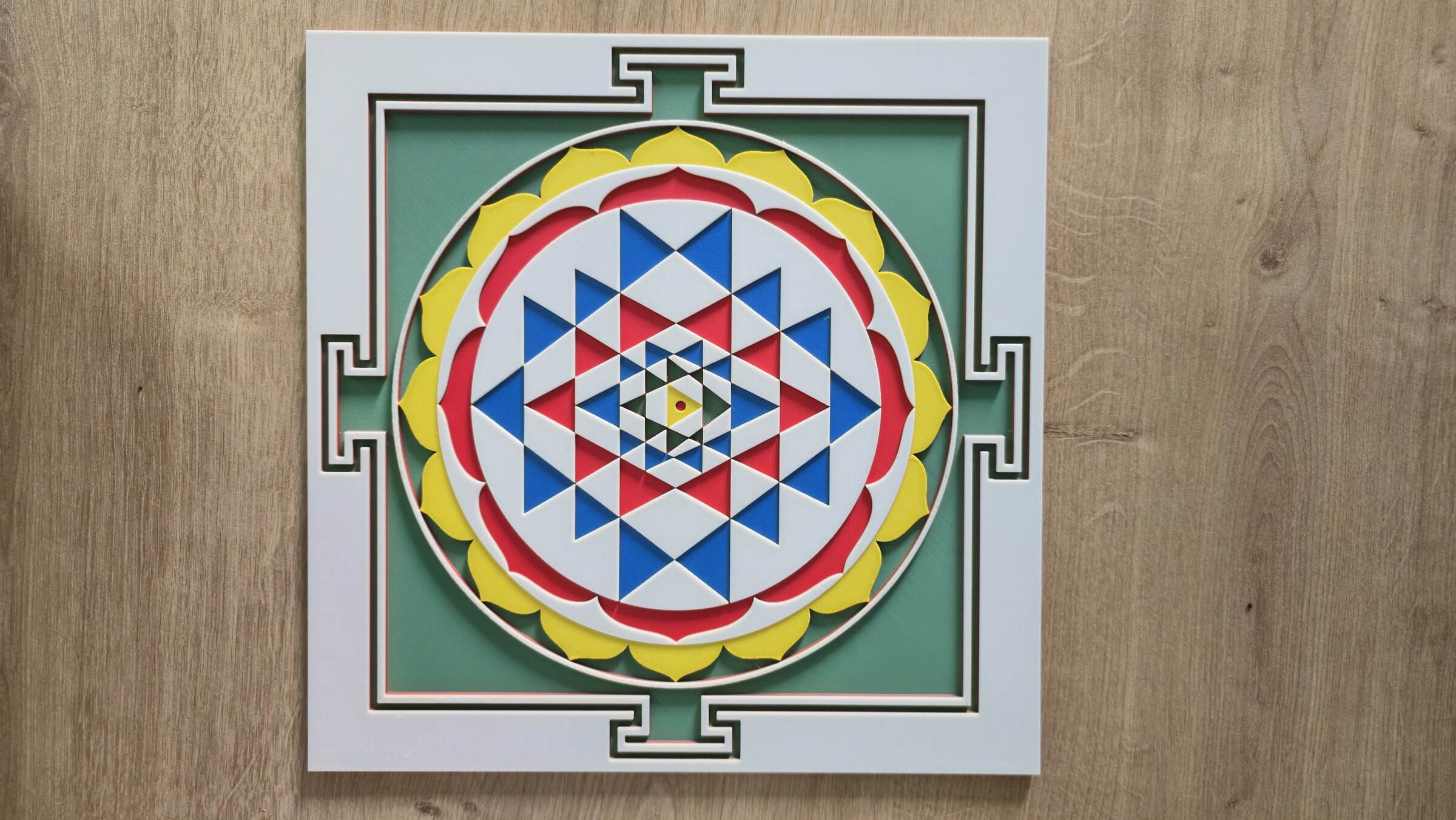
How to Do Trataka Meditation: A Step-by-Step Guide
Miha Cacic · April 8, 2026 · 9 min read
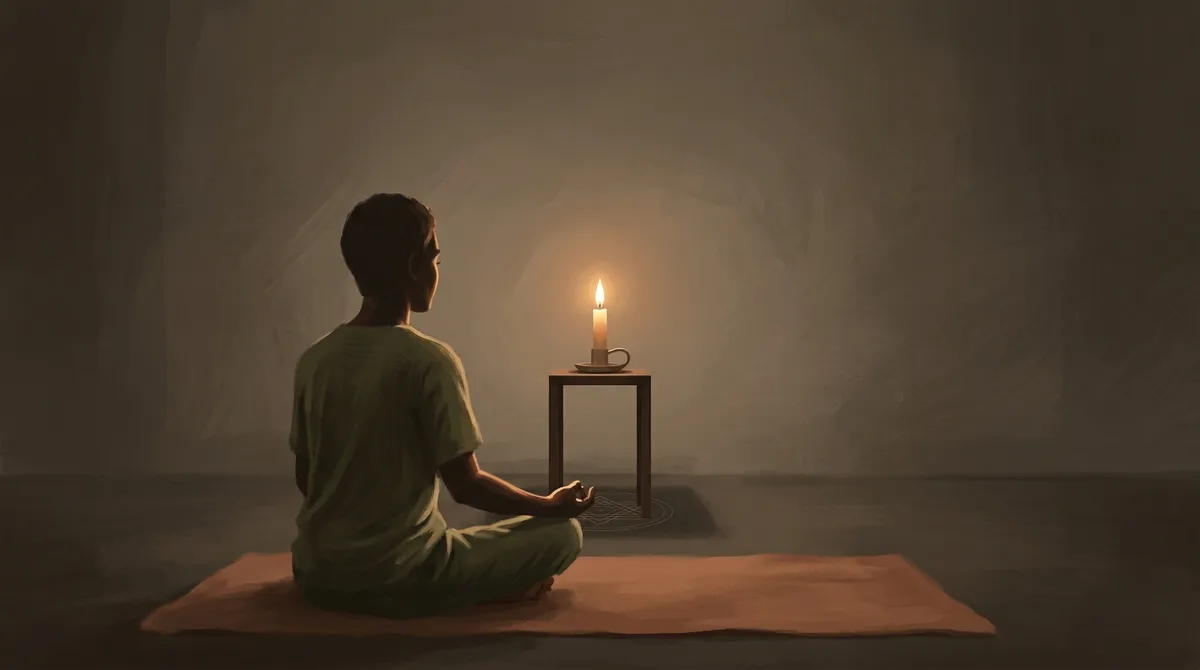
Trataka is a gazing meditation where you stare at a fixed point (usually a candle flame) without blinking, then close your eyes and hold the afterimage in your mind. The technique is simple. The challenge is knowing what’s supposed to happen at each stage, especially once your eyes are closed. This guide covers the full practice, including what you’ll actually experience, so you can tell whether you’re on track.
What is trataka (and what it isn’t)
Trataka means “to gaze” in Sanskrit. The Hatha Yoga Pradipika, a 15th-century yoga text, defines it plainly: “Being calm, one should gaze steadily at a small mark, till eyes are filled with tears. This is called Trataka by the teachers” (verse 2:31).
But that definition covers two different practices, and most guides mash them together.
Trataka as a cleansing technique (kriya). In the hatha yoga tradition, trataka is one of the six shatkarmas, purification practices for the body. The goal here is to hold the gaze until tears flow freely. The tears flush the eyes and tear ducts. You gaze, you tear up, you’re done. The Hatha Yoga Pradipika says trataka “destroys eye diseases and removes sloth” (verse 2:32).
Trataka as meditation. The gazing part is just the setup. The real practice is what happens after you close your eyes: holding the afterimage, stabilizing your attention on it, and eventually moving from that concrete internal image into deeper concentration. This is the path from dharana (focused concentration) toward dhyana (meditation).
The traditional framework divides the practice into two stages. Bahiranga (external) trataka is the open-eyed gazing. Antaranga (internal) trataka is the closed-eyes phase where you work with the afterimage. The internal phase is where the meditation happens, but most guides spend almost all their words on bahiranga and cover antaranga in a sentence or two.
This article covers trataka as meditation. If you’re doing it for eye cleansing, the gazing instructions still apply, but the afterimage work described later is the part that distinguishes meditation from a shatkarma.
How to set up for trataka
What to gaze at
A candle flame is the best starting object for beginners. It produces a strong afterimage (important for the closed-eyes phase), it naturally draws the eye, and it requires a dark room, which eliminates visual distractions. Other options exist: a black dot on white paper, a geometric yantra, or a small image. These work if you can’t use a flame (more on that in the contraindications section), but they produce weaker afterimages and require more practice to work with.
The candle
Use a plain, unscented stick candle or taper candle with a cotton wick. Avoid tealights (too low, too dim) and scented candles (soot and distracting smell). Trim the wick to about 1 cm for a stable, steady flame. If the wick is bent, face its tip toward you so the brightest point of the flame is in your direct line of sight.
Distance and height
Place the candle at arm’s length, roughly 50 to 75 cm from your eyes. Closer produces a more intense afterimage but also more eye strain. Farther is gentler but may give a weaker afterimage. The principle: close enough that the flame fills your central vision, far enough that your gaze stays relaxed. 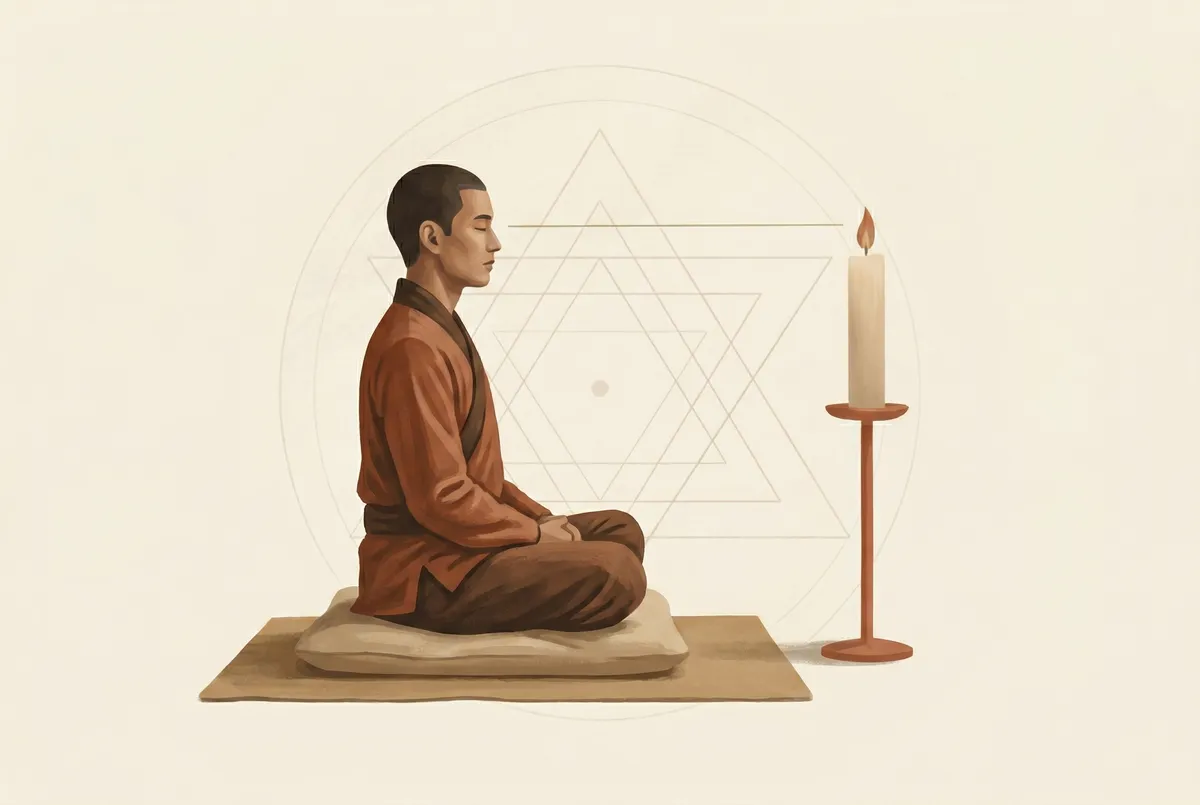
The flame should sit at eye level or very slightly below. If you need to raise the candle, stack some books under it. Looking up at a flame for several minutes strains the neck and changes the quality of the gaze.
The room
Dark or very dim, with no drafts. A flickering flame defeats the purpose: your eyes chase the movement instead of settling into a steady gaze. Close windows, turn off fans, shut down screens. The darker the room, the stronger the afterimage when you close your eyes.
Posture
Any stable seated position where your spine is upright works: cross-legged on the floor, on a meditation cushion, in a chair. The key requirement is that you can sit still for the full session without fidgeting. If you’re uncomfortable, you’ll be thinking about your knees instead of the flame.
At a desk? Yes. Sit upright, place the candle at eye level (on a stack of books if needed). The main limitation is that office environments tend to have drafts and ambient light, so minimize both.
Lying down? Not recommended. The flame can’t be at eye level when you’re horizontal, and the supine position promotes drowsiness, which is the opposite of what trataka cultivates. If you can’t sit upright, use a reclined chair with the candle adjusted to match your eye line.
Glasses and contacts
Remove contact lenses before starting. The extended non-blinking gaze will dry them out, causing discomfort and defeating the practice. Glasses are a judgment call. If removing them means you can only see a blurry blob where the flame should be, keep them on. If your vision is mildly impaired but you can still make out the bright core of the flame, try without. A softer focal point can help some practitioners relax their gaze.
When to practice
Any time you’re alert and have digested your last meal. The traditional recommendation is early morning (4 to 6 AM) or before bed. Practicing before sleep works particularly well: in a small study of 29 participants over 10 days, Tubbs et al. (2020) found that daily trataka sessions reduced insomnia severity, with Insomnia Severity Index scores dropping from clinically moderate insomnia to subthreshold levels. Avoid practicing when you’re already drowsy. Trataka cultivates focused alertness, not relaxation into sleep.
Step-by-step trataka practice
1. Settle in (2 to 3 minutes)
Sit down, close your eyes, and let your body arrive. Feel the contact points: sitting bones on the cushion, hands on your knees or thighs, feet on the floor. Let your breathing slow down on its own. Don’t skip this. If you jump straight from checking your phone to gazing at a candle, you’ll bring that scattered energy into the practice and wonder why it feels hollow.
2. Open your eyes and gaze (3 to 5 minutes for beginners)
Fix your gaze on one specific point: the brightest part of the flame or the glowing tip of the wick. Keep your gaze steady and soft. This is not a hard, forced stare; think of it as resting your eyes on the flame. Let your eyelids open slightly wider than usual. Try not to blink, but don’t clench your face or strain.
If you need to blink, blink. Then resume. The ability to hold a non-blinking gaze lengthens naturally with practice.
3. What you’ll experience while gazing
Your eyes will water. This is normal and expected, not a sign of anything wrong. The flame may appear to change color or develop a halo or aura around it. Your peripheral vision may darken or disappear entirely. These are predictable effects of sustained fixation: your photoreceptors adapt and Troxler’s fading causes static peripheral images to vanish from awareness (Martinez-Conde et al., 2006).
Thoughts will arise. That’s fine. You don’t need to stop them. Let them pass and return your attention to the flame each time you notice it has drifted. This returning is the practice.
4. Close your eyes
When your eyes water heavily or feel strained, close them gently. Don’t squeeze them shut. This is the transition from external to internal trataka, and the real meditation begins here.
5. The afterimage: what to expect
Immediately after closing your eyes, you’ll see a bright shape (often a dot or oval) against the darkness, usually in the complementary color of the flame: blue, purple, or cyan instead of orange. This is a normal retinal aftereffect, not a hallucination. The photoreceptor cells stimulated by the flame are temporarily fatigued, so when you close your eyes, your visual system reads that imbalance as an image in the opposite color. (The full mechanism is covered in the afterimage section below.)
The afterimage will likely float, drift, or pulse. This happens because your eyes are moving behind closed lids. The afterimage is “imprinted” on specific retinal cells, so when your eyes rotate, the image moves with them.
Try to hold the image at the eyebrow center (the space between your brows). Don’t chase it. Instead, fix your internal gaze and let the image settle there. This stabilization is itself the concentration practice. You’re training your attention to stay with a single object.
The afterimage will fade. Sometimes in seconds, sometimes over a minute or more, depending on how long you gazed and how dark the room is. It may shift through several colors as it fades (blue to green, green to gold). This is normal photoreceptor adaptation, not a spiritual event, though yogic tradition does associate these color shifts with stages of practice.
When the afterimage disappears completely, sit with whatever remains: residual sensation, darkness, stillness. Don’t immediately open your eyes.
6. When the afterimage is gone
You have two options. You can open your eyes and repeat the gazing cycle (recommended for beginners, who typically do 2 to 4 cycles per session). Or you can stay with closed eyes and hold the memory of the image, even though the retinal afterimage is gone. This second option is the beginning of genuine visualization practice, the shift from working with a retinal impression to working with a mental image. It develops over weeks and months, not in the first sitting.
7. Finishing the practice
Rub your palms together until they’re warm. Cup them gently over your closed eyes without pressing on the eyeballs. Hold for 10 to 15 seconds. This palming step lets your eyes rest in complete darkness before re-engaging with ambient light.
Open your eyes slowly. The Bihar School of Yoga tradition recommends splashing your eyes with cool water after practice: cup room-temperature water in your palm and blink your open eye into it, one eye at a time. This is optional but soothing, especially if your eyes feel dry.
What the afterimage is (and why it matters)
The science
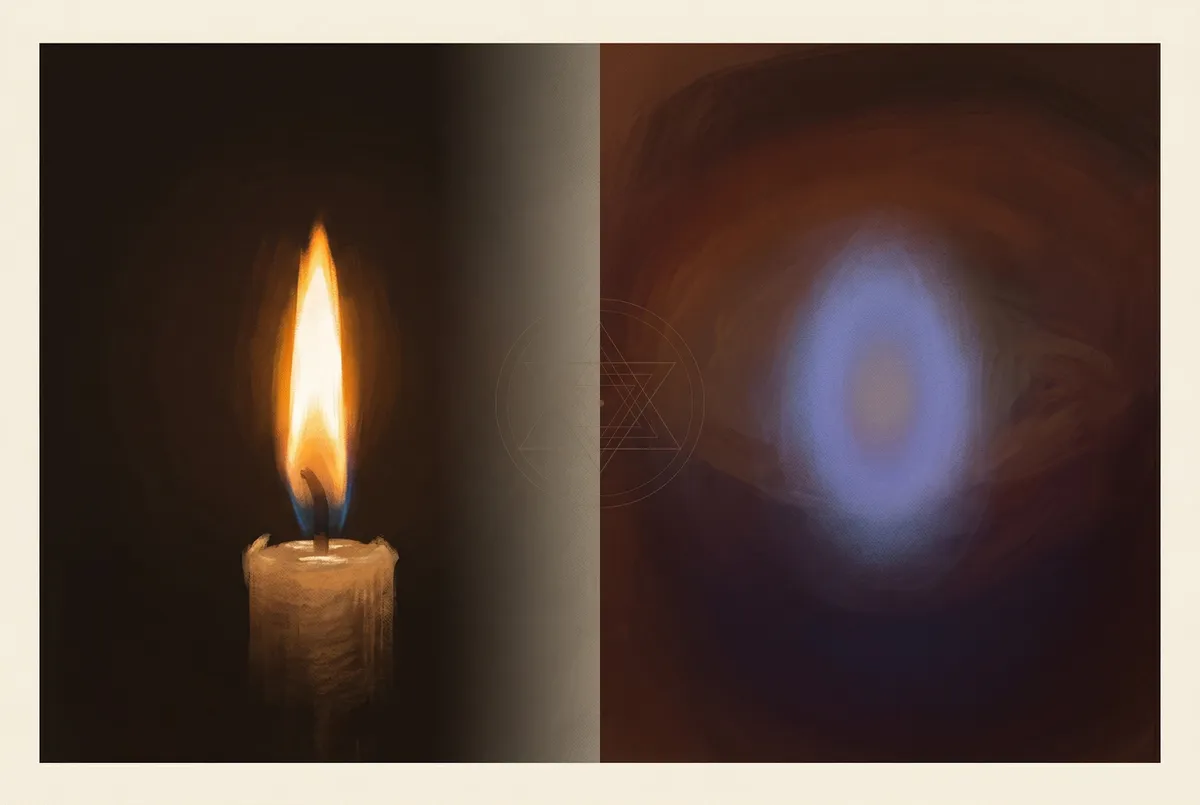
When you stare at a candle flame, the concentrated light heavily stimulates specific photoreceptors in your retina (primarily L-cones and M-cones, which respond to the warm orange-yellow wavelengths). These cells fire continuously. Their photopigments, molecules of 11-cis retinal, undergo a conformational change called bleaching. The cells become temporarily less responsive.
When you close your eyes, there’s no external light, but those bleached receptors are now sending weaker signals than the surrounding cells. Your visual system reads that difference as an image, in the complementary color of the original stimulus. For an orange flame, that’s blue or purple.
As the photopigments regenerate (over seconds to minutes), the signal imbalance fades. The afterimage disappears. This is well-understood retinal physiology, not mysticism.
Why this matters for meditation
Most meditation techniques ask you to focus on something subtle: the breath at the nostrils, a mantra, a body sensation. These objects are easy to lose. The mind wanders, you forget you were meditating, and minutes pass before you notice.
The trataka afterimage is vivid. It’s right there, impossible to ignore for as long as it lasts. It gives your mind a concrete internal object to hold. And the challenge of stabilizing a drifting afterimage is a direct, visceral form of concentration training. You can feel yourself succeed or fail in real time.
This is why trataka is traditionally described as a bridge between the body-oriented practices of yoga (asana, pranayama) and the mind-oriented practices (dharana, dhyana). You start with something physical (the candle) and transition to something mental (the internal image). A 2025 systematic review proposed a neurophysiological explanation: focused gazing enhances top-down attentional networks and thalamic filtering while reducing the brain’s default mind-wandering activity.
There’s a broader principle at work, too. Vision is our dominant sense: roughly half the brain is involved, directly or indirectly, in visual processing (Sur, 1996). Marcel Kinsbourne’s research demonstrated that gaze direction correlates with hemispheric brain activation: looking right activates the left hemisphere, looking left activates the right (Kinsbourne, 1972). The inference, suggested by meditation teacher Giovanni Dienstmann, is that a perfectly centered, still gaze may produce more balanced brain activity. This is a plausible interpretation, not a proven finding, but it helps explain why stilling the eyes seems to still the mind.
What to do if you can’t see the afterimage
This is common for beginners. Possible causes: room too bright, gaze too short, too much tension in your eyes or mind. Don’t try to manufacture a visualization. Sit with whatever you see, even if it’s just darkness. The afterimage gets clearer and lasts longer with practice.
What to do if it moves around
Your eyes are moving behind your closed lids. Don’t chase the image. Fix your internal gaze at the eyebrow center and let the image drift toward it. The stabilization itself is the concentration exercise.
What to do when it fades
Don’t panic. Sit with the residual sensation. Over weeks of practice, you’ll find you can hold the image longer, and eventually maintain it past the point where the retinal impression has faded. That transition, from retinal afterimage to genuine mental visualization, is the progression from bahiranga to antaranga trataka.
How long and how often to practice
The advice across sources varies wildly, from 2 minutes to 40 minutes. Here’s a framework.
Beginners: Start with 5 to 10 minutes total, including the settling-in phase. The gazing phase might last 1 to 3 minutes per round. Do 2 to 3 rounds. Don’t push it. Your eyes need time to adapt to sustained gazing, and your mind needs time to learn what to do with the afterimage.
Intermediate: 15 to 20 minutes total. The gazing phase extends naturally to 3 to 5 minutes as your eyes adapt and your tears come less quickly.
Cap on continuous candle gazing: Multiple experienced teachers recommend not gazing at a flame for more than 10 continuous minutes in a single round. Prolonged exposure to a concentrated light source fatigues retinal cells, and there’s no reason to push past the point of heavy tearing and strain.
Frequency: Daily practice produces the clearest results in the available research. A 2014 study by Raghavendra and Singh found that 26 days of daily sessions produced significant improvements in working memory, selective attention, and executive function in elderly participants, though the sessions included preparatory eye exercises, chanting, and relaxation alongside trataka, so the gains can’t be attributed to gazing alone. A smaller study of 30 adolescents found improvements in selective attention, cognitive flexibility, and reduced anxiety (Ramanathan et al., 2020). Neither study compared different practice frequencies, but the pattern across meditation research generally favors consistency over duration.
The two-month break rule. Some experienced yoga teachers recommend taking a 1 to 2 week break from candle-based trataka every two months of daily practice, or switching to a non-flame object (a black dot or yantra) during the break. The concern is that sustained daily candle gazing could create cumulative retinal fatigue. This precaution comes from oral teaching traditions, not from classical texts or published research. It’s reasonable and costs nothing to follow.
Best time of day: Early morning or evening. Before bed works well, as mentioned above. After a meal is fine as long as you’re not drowsy.
Common mistakes and how to avoid them
Straining to not blink. The gaze should be steady but relaxed. If you’re clenching your face muscles, you’re working too hard. Blinking when you need to is not failure. The non-blinking duration lengthens naturally with practice.
Gazing at the wrong part of the flame. Pick one specific point: the tip of the wick or the brightest core of the flame. Keep your eyes there. If your gaze wanders around the flame, you’re not doing trataka, you’re watching a candle.
Rushing through the closed-eyes phase. This is the most common mistake. The afterimage stage is the meditation. Don’t treat it as a brief pause between gazing rounds. Sit with it. Let it fade. Stay with the darkness after it’s gone. Give the internal phase at least as much time as the gazing phase.
Flickering flame. If the flame dances, there’s a draft. Fix the environment before trying to practice. A moving flame makes steady gazing impossible and produces a messy afterimage.
Wrong candle. Tealights sit too low, burn too dim, and flicker in their own pool of wax. Scented candles produce soot and distracting smells. Use a plain stick candle or taper candle.
Practicing with contact lenses. They will dry out, cause discomfort, and distract you. Remove them before you start.
Over-practicing. More is not better, especially as a beginner. Don’t do 30-minute candle gazing sessions in your first week. Build gradually. The Hatha Yoga Pradipika describes trataka as something to be kept secret “like a box of gold” (verse 2:32). Treat your practice with proportional care.
Who should not do trataka
Safety anxiety is real with this practice, partly because forum advice oscillates between “it’s perfectly harmless” and “you’ll damage your eyes without a guru.” Neither extreme is accurate. Here are the actual contraindications.
Glaucoma. A 2022 randomized controlled trial found that trataka-based eye exercises produced only a small, clinically insignificant reduction in intraocular pressure (Sankalp & Dada, 2022). The researchers explicitly stated the exercises “cannot be recommended for management of raised IOP in glaucoma patients.” If you have glaucoma, consult your ophthalmologist before practicing.
Cataracts or severe myopia. The sustained non-blinking gaze and bright focal point may not be appropriate for compromised eyes. One study found trataka produced moderate improvements in visual clarity comparable to conventional eye exercises for mild refractive errors (Nimaje et al., 2013), but the evidence does not support treating serious eye conditions with gazing practice. Get medical clearance first.
Epilepsy. A flickering flame can trigger seizures in photosensitive individuals. If you have epilepsy and want to try trataka, use a black dot on white paper instead of a candle, and consult your neurologist.
Acute eye infections or inflammation. Wait until resolved. Gazing through irritated, infected eyes will make things worse.
Psychosis or schizophrenia. Intense concentration practices can be destabilizing for people with these conditions. This is a contraindication mentioned in classical yoga texts and by modern teachers. It’s not scaremongering.
Children under 12. Their eyes are still developing. Gentle, short versions may be fine, but err on the side of caution and keep sessions brief.
For everyone else: Trataka is safe when practiced with common sense. Don’t stare past real discomfort. Don’t skip breaks. Don’t use a bright external light source like the sun (that’s a different, advanced practice requiring expert guidance). If your eyes feel sore the next day, you practiced too long or too hard. Back off.
Sources
- Raghavendra BR, Singh P. (2014). “Effect of trataka on cognitive functions in the elderly.” International Journal of Yoga, 7(2), 96–103. PMC4097909.
- Ramanathan M, Bhavanani AB, Trakroo M. (2020). “Effectiveness of yogic visual concentration (Trataka) on cognitive performance and anxiety among adolescents.” Journal of Complementary and Integrative Medicine, 18(2). PubMed: 32415824.
- Tubbs AS, Kennedy KER, Alfonso-Miller P, Worley SL, Grandner MA. (2020). “Effect of trataka (yogic gazing) on insomnia severity and quality of sleep in people with insomnia.” Explore. PubMed: 33036930.
- Nimaje GT, Tripathy TB, Deole YS. (2013). “A clinical study to evaluate the efficacy of Trataka Yoga Kriya and eye exercises in the management of Timira.” Ayu, 34(1), 81–86. PMC3665208.
- Sankalp, Dada R. (2022). “Effect of Tratak (Yogic Ocular Exercises) on Intraocular Pressure in Glaucoma: An RCT.” International Journal of Yoga, 15(1). PMC9015087.
- “Trataka and cognition: A systematic review with a proposed neurophysiological mechanism.” (2025). Journal of Neurosciences in Rural Practice. Link.
- Martinez-Conde S, Macknik SL, Troncoso XG, Hubel DH. (2006). “Microsaccades counteract visual fading during fixation.” Neuron, 49(2), 297–305. ScienceDirect.
- Kinsbourne M. (1972). “Eye and head turning indicates cerebral lateralization.” Science, 176(4034), 539–541. Link.
- Sur M. (1996). “Visual processing and the brain.” MIT News. Link.
- Swatmarama. (c. 15th century). Hatha Yoga Pradipika, translated by Pancham Sinh (1914). Sacred Texts Archive.
- Gheranda Samhita (c. 17th century). Verses 1:53–54.
- Dr. Giridhar ‘Yogeshwar’. (1983). “Trataka or Yogic Gazing.” Yoga Magazine (Bihar School of Yoga). Link.
- Cambell D. (2021). “Trataka — Benefits of Candle Gazing Techniques.” SJPBS, 5(5). Lupine Publishers.