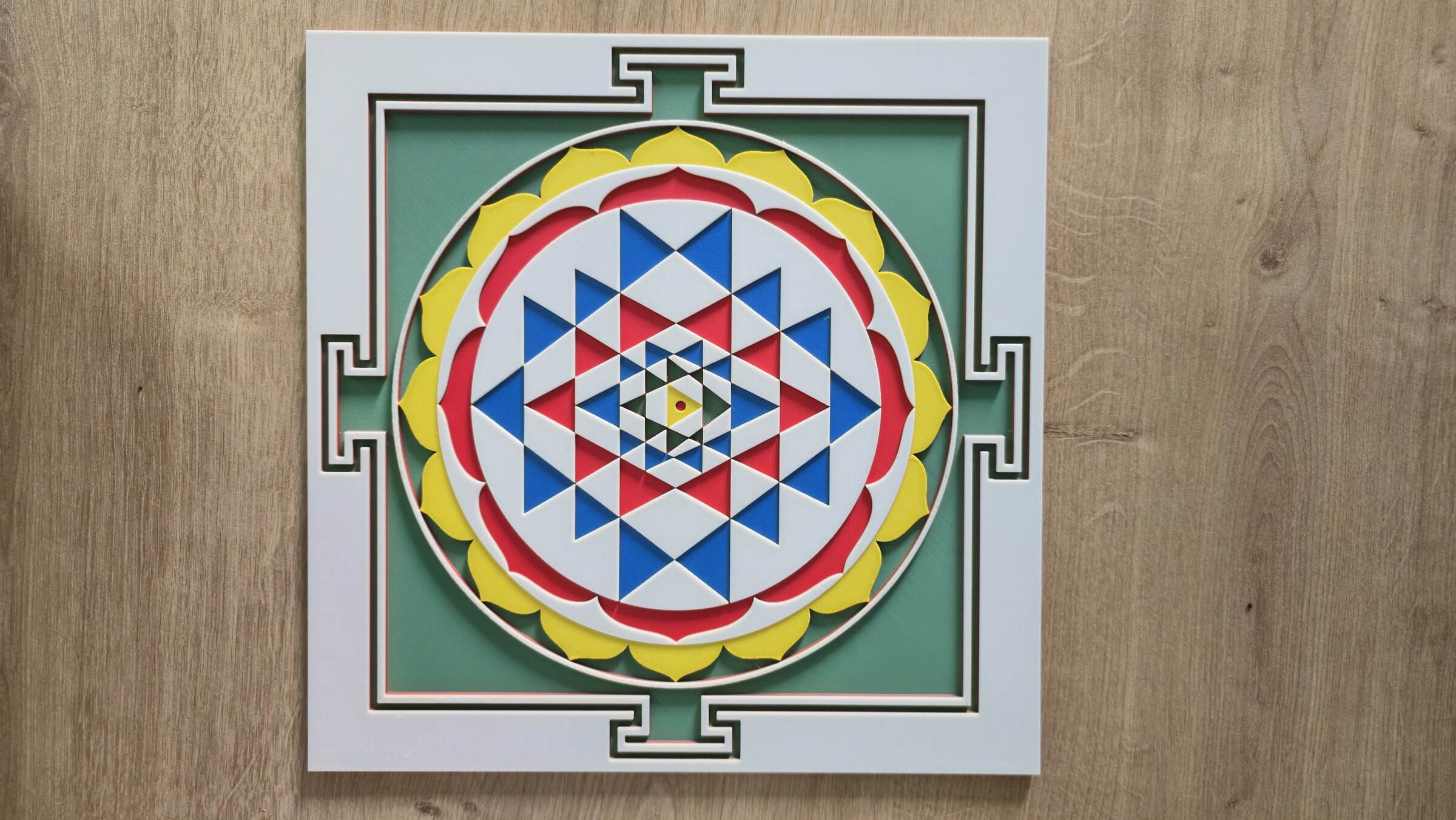
What Is a Sri Yantra? Meaning, Geometry, and How to Use It
Miha Cacic · April 9, 2026 · 7 min read
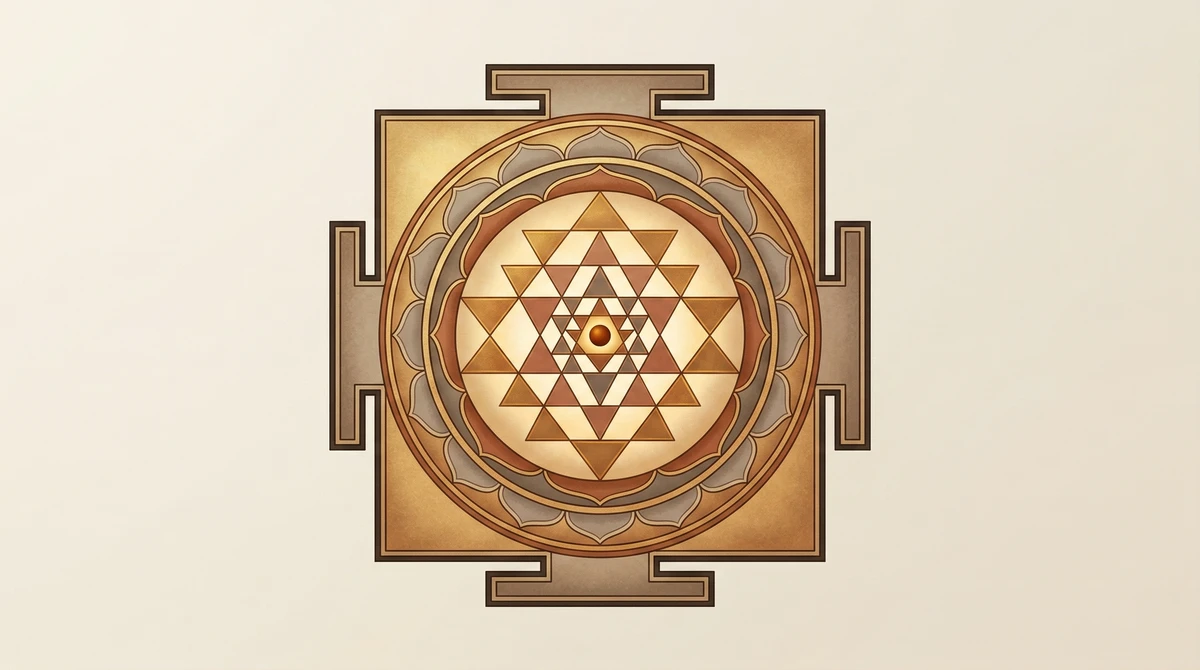
A Sri Yantra is a geometric diagram of nine interlocking triangles, used as a meditation tool and map of consciousness in the Hindu tantric tradition of Shri Vidya. It is not decorative sacred geometry. Every line, angle, and intersection encodes a specific relationship between the forces that, according to this tradition, create and dissolve the universe.
What makes the Sri Yantra different from other spiritual symbols is that it’s designed to be read, not just admired. Starting from the outer square (the material world) and moving inward through nine distinct enclosures to the central point (pure consciousness), each layer represents a stage of the journey from ordinary perception to the source of awareness. The diagram is a navigation chart.
What does Sri Yantra mean?
“Yantra” comes from the Sanskrit roots yam (to hold, sustain) and tra (instrument, tool). A yantra is literally an instrument for holding the mind in concentration. Not an artwork. Not a talisman. A tool.
“Sri” (also spelled Shri or Shree) carries the meaning of auspiciousness and radiance. In this context, it refers to Tripura Sundari, the goddess at the center of Shri Vidya worship. So “Sri Yantra” means, roughly, “the auspicious instrument” or “the instrument of the Goddess.”
You’ll see it called Sri Yantra, Shri Yantra, Shree Yantra, Sri Chakra, or Shri Chakra. These all refer to the same diagram. The scholar Madhu Khanna defined yantras broadly as “visual meditative tools composed of concentric linear shapes centered on the Bindu, a dimensionless point” (Khanna, 2005). The Sri Yantra is considered the most complex and complete of all yantras.
One distinction worth knowing: the flat version you usually see is called “Bhuprashta” (earth-backed). The three-dimensional pyramid form, which raises the triangles into a mountain shape, is called “Meru Prushta” or Maha Meru, named after Mount Meru, the cosmic axis in Hindu cosmology. Two rarer forms also exist: “Kurma Prushta” (tortoise-backed, a dome shape) and “Patala Prushta” (inverted/concave). According to SriYantraResearch.com, the pyramidal form is often incorrectly called “Kurma,” but the true tortoise-back form is a separate and extremely rare construction. 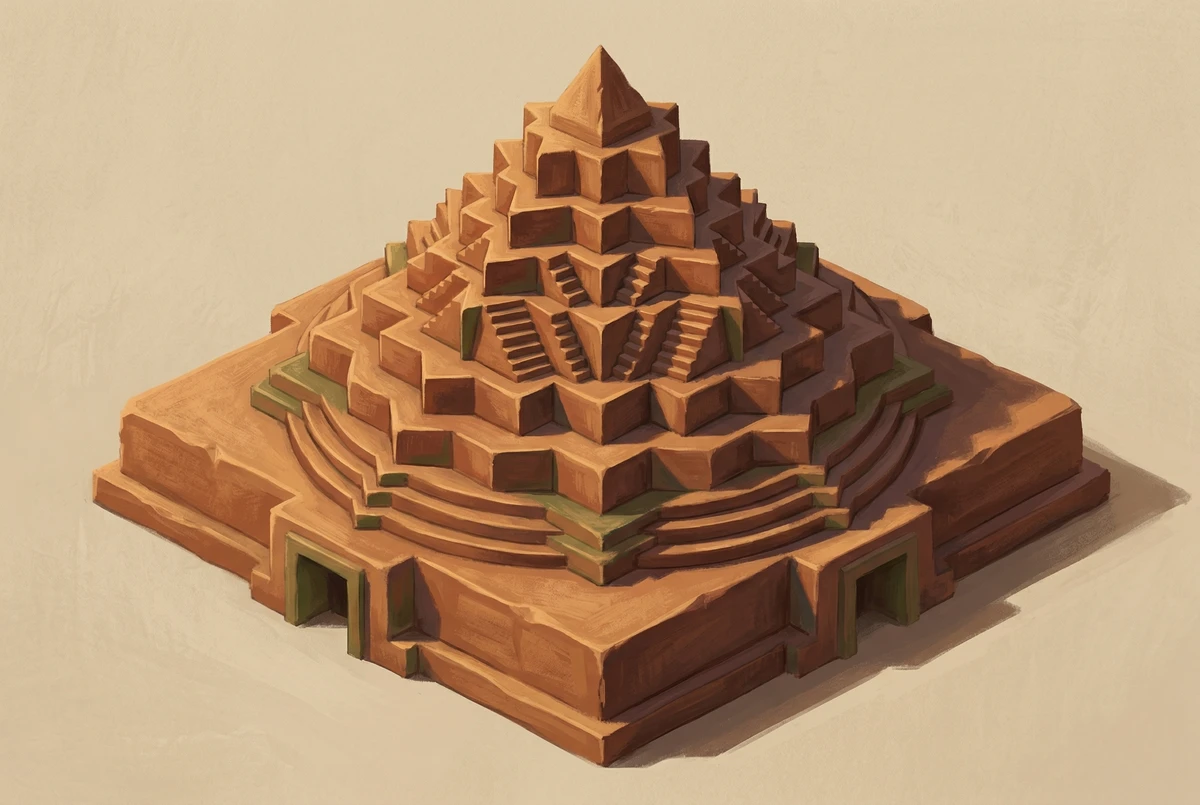
The geometry: nine triangles, 43 triangles, and the bindu
The Sri Yantra starts with nine primary triangles. Four point upward, representing Shiva (consciousness, the masculine principle). Five point downward, representing Shakti (creative energy, the feminine principle). The asymmetry is intentional: Shakti gets the extra triangle because the manifest world, according to Shri Vidya cosmology, is weighted toward creative expression rather than dissolution. As the scholar S. Rangarajan (2009) explains, the five Shakti triangles correspond to the five primal elements (space, earth, fire, water, air), while the four Shiva triangles represent higher cosmic principles.
When these nine triangles interlock, they create 43 smaller triangles arranged in five concentric rings. This count is consistent across every source, traditional and academic (Sathisha, 2023; Mahesh, 2023). Some texts, including the Soundarya Lahari, count 44 by including the bindu (the central point) as a “point-triangle.”
The five rings, from outside to inside:
- 14 triangles (outermost ring)
- 10 triangles (outer-inner ring)
- 10 triangles (inner ring)
- 8 triangles (innermost ring)
- 1 triangle (center, surrounding the bindu)
At the absolute center sits the bindu, a dimensionless point from which the entire figure emerges and into which it dissolves. The bindu represents the state before creation, where Shiva and Shakti are undifferentiated. In meditation, this is where attention ultimately comes to rest.
Here’s what makes the geometry extraordinary: all nine triangles must intersect so that every triple-intersection point (where three lines meet) aligns perfectly. The mathematician A. P. Kulaichev (1984) showed that constructing the Sri Yantra accurately is a problem that, in its spherical form, requires mathematics beyond what medieval Indian scholars are known to have possessed. He suggested this “may indicate the existence of unknown cultural and historical alternatives to mathematical knowledge, e.g. the highly developed tradition of special imagination.” 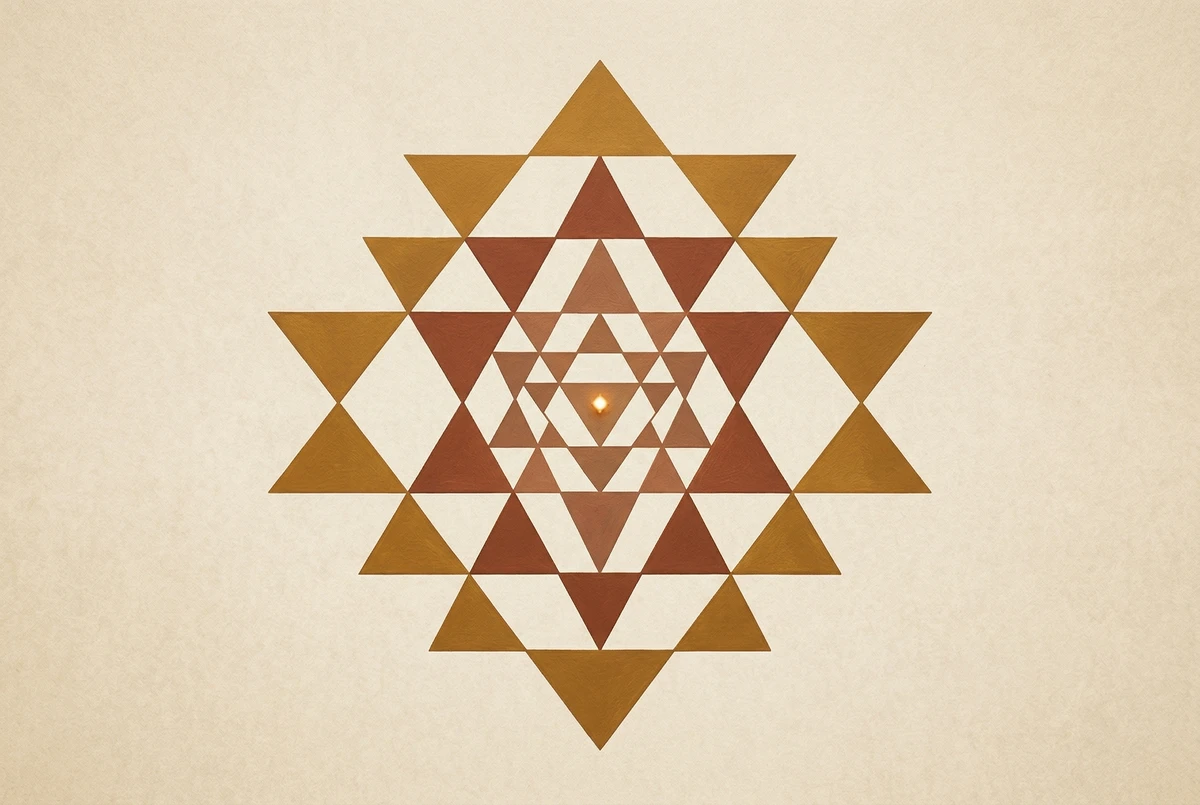
SriYantraResearch.com identifies three criteria for a correctly constructed Sri Yantra: perfect concurrency (all triple intersections meet at exact points), concentricity (the center of the innermost triangle aligns with the center of the outer circle), and an equilateral inner triangle (60-degree angles). The diagram has five degrees of freedom, which is why so many variant versions exist and why many commercially available versions are geometrically incorrect. Some don’t even connect triangle apexes to the bases of other triangles, which defeats the fundamental property of interconnectedness.
Beyond the triangles: lotus petals, circles, and the outer square
The triangles don’t float in space. Concentric layers surround them, each encoding its own set of correspondences.
Two rings of lotus petals surround the triangle complex. The outer ring has 16 petals, corresponding (per the Hindutone guide) to the 16 Nitya Shaktis (the 15 lunar phases plus Lalita herself as the 16th), the 16 vowels of the Sanskrit alphabet, and 16 fundamental human desires, from knowledge and beauty to liberation. The inner ring has 8 petals, representing the 8 Vak Shaktis (powers of speech), the same eight deities who, according to tradition, composed the Lalita Sahasranama.
Three concentric circles enclose the lotus petals. They traditionally represent the three gunas (fundamental qualities of nature: sattva, rajas, tamas) and the three states of consciousness (waking, dreaming, deep sleep).
The bhupura (outer square with four gates) forms the boundary. Each gate opens in a cardinal direction. This square represents the earth element, the material world, and the starting point for anyone reading the diagram inward. The bhupura is a threshold, not a border.
The nine enclosures: reading the Sri Yantra as a map
The Sri Yantra is not a flat symbol with various meanings attached. It’s a map with nine distinct zones, called nava avarana (nine enclosures), each with a name, a presiding deity, and a specific function.
Reading from outside to inside:
Trailokya Mohana (the bhupura, outer square): “Enchanter of the three worlds.” The plane of ordinary experience, where perception is dominated by attraction and aversion.
Sarva Aasha Paripuraka (16-petal lotus): “Fulfiller of all hopes.” The layer of desire, where the 16 fundamental aspirations pull attention outward.
Sarva Sankshobhana (8-petal lotus): “Agitator of all.” The stirring of spiritual awakening, where the comfortable surface of ordinary life gets disrupted.
Sarva Saubhagyadayaka (14 triangles): “Bestower of all auspiciousness.” The first entry into the triangle complex, where the geometry of consciousness begins to reveal itself.
Sarva Arthasadhaka (outer 10 triangles): “Accomplisher of all purposes.” The layer where intention aligns with deeper patterns.
Sarva Rakshakara (inner 10 triangles): “Giver of all protection.” A stabilizing layer where the practitioner’s awareness becomes less reactive.
Sarva Rogahara (8 triangles): “Remover of all afflictions.” The dissolution of mental obstacles.
Sarva Siddhiprada (central triangle): “Giver of all attainments.” The last layer of differentiation before unity.
Sarva Anandamaya (bindu): “Full of all bliss.” Pure consciousness, without subject or object.
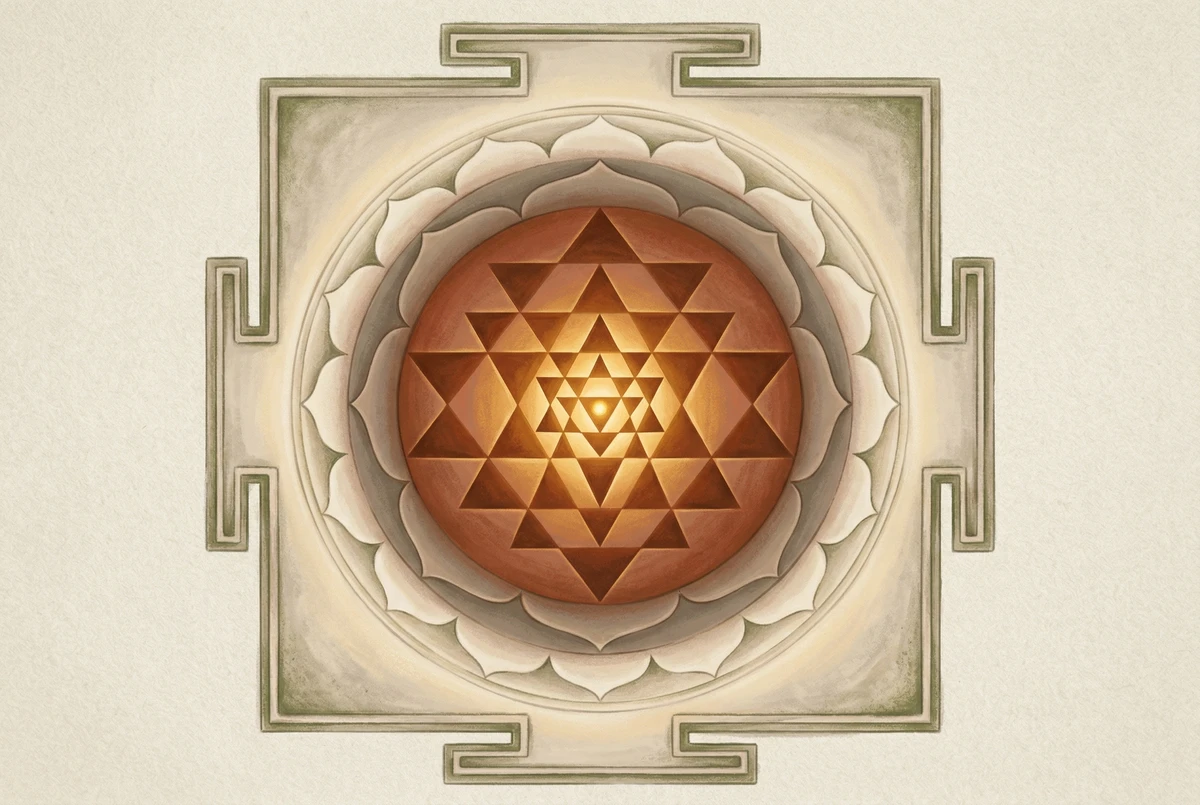
Each enclosure strips away a layer of identification with the material world. The journey from bhupura to bindu mirrors the journey from gross to subtle experience. According to the Lalitopakhyana (a section of the Brahmanda Purana), the goddess Lalita Tripura Sundari’s divine city, Sri Nagara, was the Sri Chakra itself. Her army, attendant goddesses, and generals were manifestations of the different triangles and layers. The map is also, in this mythology, a city.
The nine enclosures are also why the Sri Yantra is used in trataka (gazing meditation): the concentric structure pulls the eyes from periphery to center. The geometry doesn’t just symbolize the inward journey. It guides it.
Why is the Sri Yantra considered sacred?
The Sri Yantra’s sacred status rests on several distinct foundations.
The geometry is difficult. This isn’t symbolism projected onto a simple shape. The mathematician K. Mahesh (2023) showed that the nine triangles cannot be perfectly constructed with compass and straightedge using classical Euclidean methods. Any small error in one triangle propagates through the entire figure. George Gheverghese Joseph, drawing on the work of Bolton and Macleod (1977), noted that the largest triangles have a base angle of approximately 51 degrees, creating proportions that approximate the golden ratio (phi, about 1.618). This is the same angle as the Great Pyramid at Giza. The golden ratio connection applies to the largest triangles, not to the entire figure, but it’s a real mathematical property, not a folk attribution.
The Shri Vidya tradition considers it the visual form of the goddess. Name 421 in the Lalita Sahasranama, “Sri Chakra Raja Nilaya,” means “She who dwells in the king of all Chakras.” Wikipedia captions its Sri Yantra diagram as “The Lalita Sahasranama in diagrammatic form.” The diagram and the goddess are, in this tradition, the same thing.
Its structure mirrors the process it represents. The emanation from bindu to bhupura (center to periphery) mirrors how consciousness becomes the material world. The return from bhupura to bindu mirrors spiritual realization. The diagram is both the territory and the map.
A note on the OM connection. You’ll sometimes hear that chanting OM into a cymatics device produces a Sri Yantra pattern. This is false. The story originated from a captioning error in a 1979 film still reproduced in Madhu Khanna’s book Yantra: The Tantric Symbol of Cosmic Unity. The research team at SriYantraResearch.com contacted the film company, which confirmed the caption was a mistake. Cymatics produces rounded, organic patterns, not sharp angular geometry. That said, there is a traditional metaphorical connection: the Sri Yantra is considered the visual equivalent of OM in the sense that both represent the complete cycle of manifestation, one as sound, one as form. This is a philosophical claim, not a physics claim.
History and origin of the Sri Yantra
The honest answer is: we don’t know exactly how old it is.
The formalization of the Sri Yantra within the Shri Vidya tradition is dateable to approximately the 8th to 9th century CE, based on the earliest tantric texts that describe it in detail (the Vamakeshvara Tantra and the Parasurama Kalpa Sutra). The Soundarya Lahari, traditionally attributed to Adi Shankaracharya (8th century CE), contains an explicit description of the Sri Chakra’s structure, counting “forty-four triangles” including the bindu. Scholars debate whether the first 41 verses may have been composed by an earlier author, Pushpadanta.
Some scholars push the date further back. Subhash Kak (2008-2009) argued in the journal Brahmavidya that the description in the Sri Sukta hymn of the Rigveda matches the Sri Yantra. George Gheverghese Joseph mentions an Atharvaveda hymn dedicated to an object that closely resembles it. These are minority scholarly positions, and the Rigvedic connection in particular is flagged as underdeveloped by other academics. But they suggest the underlying ideas may predate the formal diagrams.
What we can say with confidence: the Sri Yantra is central to Shri Vidya, which is a living tradition with an unbroken lineage. The key texts are the Soundarya Lahari, the Lalita Sahasranama, and the Tripura Rahasya. Adi Shankaracharya is credited with installing Sri Yantras at major temples across India, though, as one source notes, “there are no historical records available” to confirm a standard list. The Sringeri matha (one of four monasteries founded by Shankaracharya) claims the oldest known specimen, and geometric analysis of its construction confirms a high degree of precision.
In the modern era, philosopher Sri Aurobindo used the Sri Yantra as the symbol for his journal Dharma, calling it “a symbol where heaven and earth meet.” The California Institute of Integral Studies adopted it as the university’s official sacred symbol. And it has spread widely through sacred geometry communities, yoga studios, and meditation practitioners worldwide.
This modern adoption creates a tension the tradition-minded recognize: the commercial yantra market produces countless versions, many of which are geometrically incorrect and have no connection to the Shri Vidya practices the diagram comes from.
How the Sri Yantra is used in meditation
Three main approaches exist, ranging from accessible to tradition-specific.
Trataka (gazing meditation) is the primary method and the most accessible. Place a Sri Yantra at eye level, about an arm’s length away. Gaze at the bindu (the central point) with soft, steady focus, without straining. Start with 5 to 10 minutes and work up. As a Sri Vidya teacher puts it: “Keep looking at the Bindu as much as possible… Whatever you focus, you become that.”
The concentric geometry pulls the eyes from periphery to center, following the path through the nine enclosures. When you close your eyes after gazing, you’ll see an after-image of the diagram. This is part of the practice, not a side effect. As the Buddhist thangka painter Tiffani Gyatso describes: “When you finally close your eyes, you can still see the image fixed by light upon your retinas. You can imagine this form directly between your eyes, in the position of what we call the ‘third eye.‘” 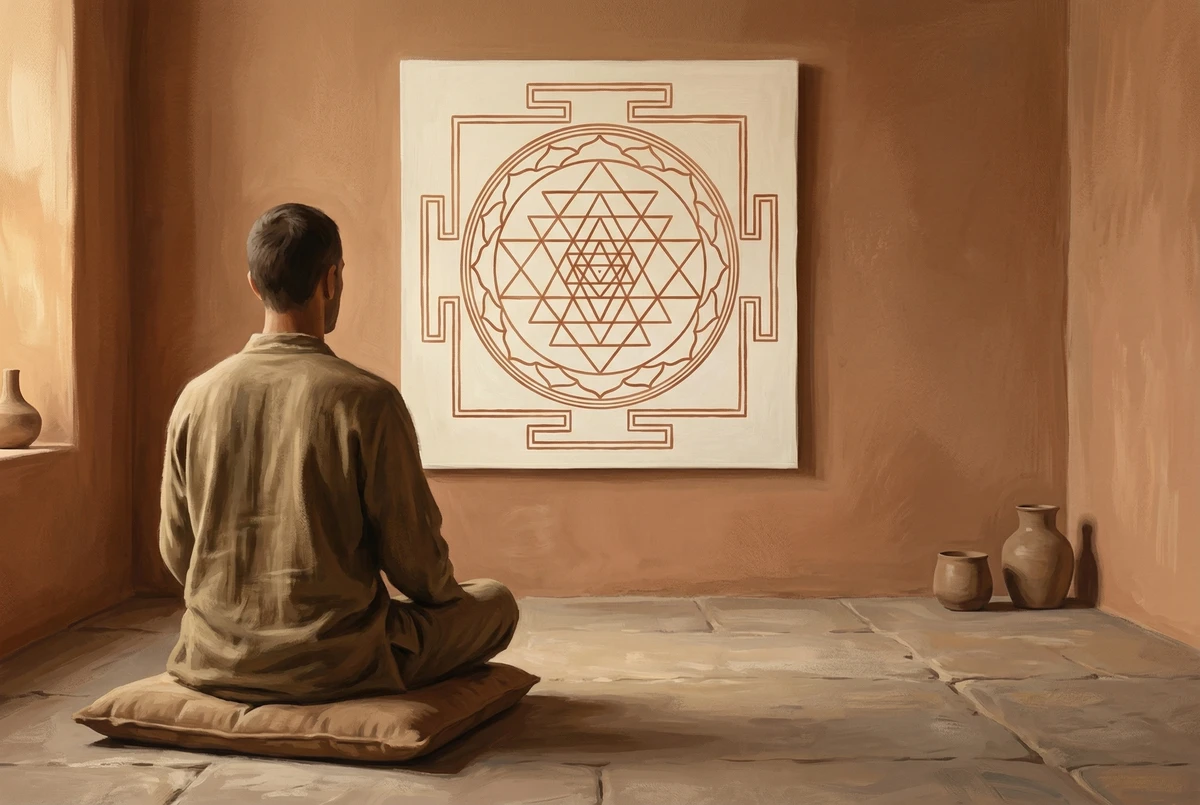
Practitioners report visual experiences during trataka. One meditation teacher on IndiaDivine.org described the Sri Yantra appearing to dissolve into a mandala with anthropomorphic figures, and noted that even beginners in the class “saw the Yantra morph into a variety of geometrical figures.” These visual shifts appear in multiple practitioner accounts and are likely a feature of sustained geometric gazing rather than of any particular belief system.
Internal visualization comes after establishing familiarity through gazing. With closed eyes, the practitioner mentally reconstructs the Sri Yantra and traces the path through its layers. Traditional literature describes two directions: the inward path (bhupura to bindu, associated with dissolution and liberation) and the outward path (bindu to bhupura, associated with creation). The inward approach is more common in meditation practice. Internalizing the diagram’s full complexity takes sustained practice over weeks or months.
Navavarana puja is the formal Shri Vidya ritual worship that progresses through each of the nine enclosures with specific mantras, offerings, and invocations. The Lalita Sahasranama is recited at the bindu, the most sacred moment of the ceremony. This practice requires initiation and guidance from a qualified teacher within the tradition. It’s mentioned here because it exists and matters, not because you should attempt it from a blog post.
One common question: do you need to be Hindu to meditate on a Sri Yantra? For trataka, no. Gazing at a geometric form to steady attention doesn’t require a specific belief system. But the deeper ritual practices belong to a living tradition. Approaching them with respect means recognizing that initiation exists for a reason, and that the Sri Yantra carries meaning for practitioners that goes beyond what any article can convey.
Sources
- Bolton, N. J., and D. N. G. Macleod. (1977). “The Geometry of the Sri-Yantra.” Religion, 7, 66-85.
- Joseph, George Gheverghese. Discussion of the Sriyantra mathematics, adapted from The Crest of the Peacock: Non-European Roots of Mathematics. Available at: http://alumni.cse.ucsc.edu/~mikel/sriyantra/joseph.html
- Kak, Subhash. (2008-2009). “The Great Goddess Lalita and the Śrī Cakra.” Brahmavidya: The Adyar Library Bulletin, vols. 72-73, pp. 155-172.
- Khanna, Madhu. (1979). Yantra: The Tantric Symbol of Cosmic Unity. Inner Traditions. ISBN 0892811323.
- Khanna, Madhu. (2005). “Yantra.” In Jones, Lindsay (ed.). Gale’s Encyclopedia of Religion, Second edition. Thomson Gale.
- Kulaichev, A. P. (1984). “Sri Yantra and Its Mathematical Properties.” Indian Journal of History of Science, 19(3), 279-292.
- Mahesh, K. (2023). “Understanding the Geometry of Sri Chakra.” International Journal of Sanskrit Research, 9(6). doi:10.22271/23947519.2023.v9.i6d.2277.
- Rangarajan, S. (2009). “The Mandalic Consciousness: Sri Chakra as Psychocosmogram.” The Trumpeter, 25(1). ISSN: 0832-6193.
- Sathisha, M. (2023). “Cosmic Elements as Represented in the Sri Chakra.” International Journal of Advanced Multidisciplinary Research and Studies, 3(6), 465-468.
- Shankaranarayanan, S. (1979). Sri Chakra. Dipti Publications, Pondicherry. 3rd edition.
- SriYantraResearch.com. “The Optimal Sri Yantra.” https://sriyantraresearch.com/Optimal/optimal_sri_yantra.htm
- SriYantraResearch.com. “Sri Yantra from OM?” https://sriyantraresearch.com/Article/Om/om_sri_yantra_legend.html