Why Does My Mind Race During Meditation?
Miha Cacic · April 8, 2026 · 5 min read
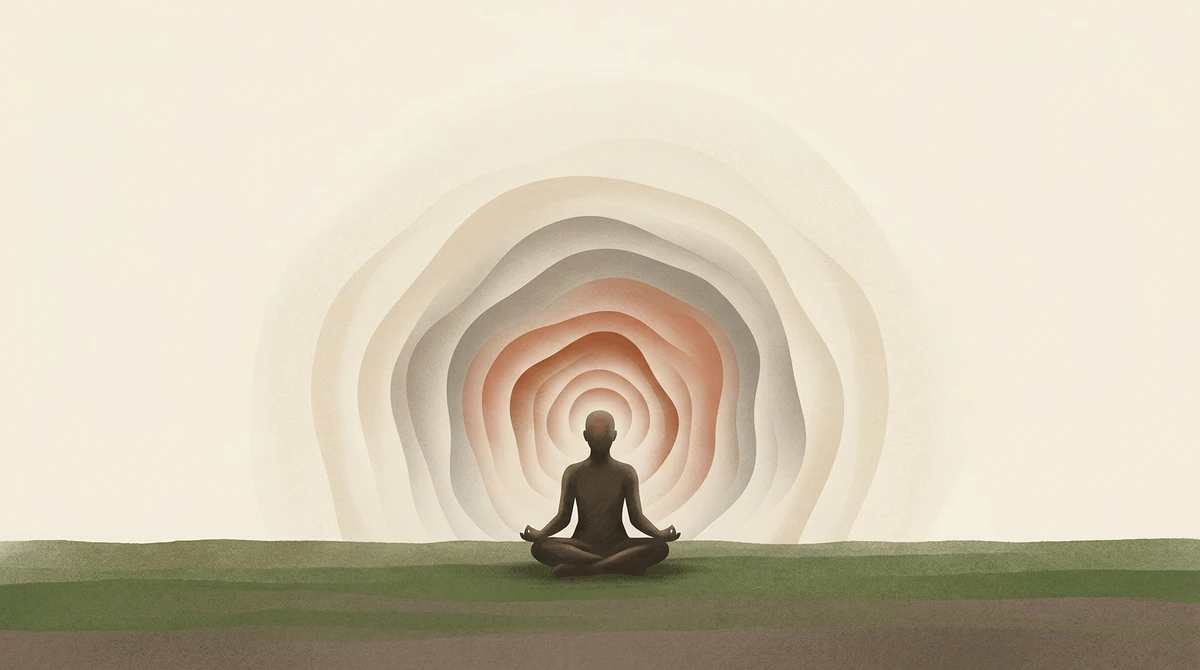
Your mind races during meditation because you’ve removed everything that was drowning it out. That constant stream of thoughts (work, errands, worries, random fragments of conversation from three years ago) was always running. Screens, conversations, and activity kept it in the background. The moment you sit down and close your eyes, the stream becomes the only thing in the room.
This isn’t a sign you’re bad at meditation. It’s the first thing meditation is designed to show you.
Your brain has a default narrator (and meditation turns up its volume)
Your brain has a network of regions, centered on the medial prefrontal cortex and the posterior cingulate cortex, that activate whenever you’re not focused on an external task. Neuroscientist Marcus Raichle at Washington University discovered this network in 2001 and named it the default mode network (DMN). It handles self-referential thinking: planning, ruminating, replaying memories, imagining future conversations, composing mental to-do lists.
This network is always on. A 2010 study by Killingsworth and Gilbert in Science found that people spend 46.9% of their waking hours thinking about something other than what they’re currently doing. Nearly half your day, your brain is narrating, worrying, or daydreaming, regardless of what you’re doing.
During daily life, external stimuli compete with the DMN for your attention. Your phone buzzes, someone talks to you, the TV is on. These inputs occupy your attention networks and push the DMN’s chatter to the background. In meditation, you deliberately remove those competitors. The DMN’s output becomes the dominant signal in your awareness.
Your brain’s intrinsic background activity, of which the DMN is a major component, consumes the vast majority of its energy budget. Focused tasks add less than 5% to your brain’s energy use (Raichle et al., 2001). The machinery of thought is running at nearly the same intensity whether you’re solving a math problem or staring at a wall. Meditation doesn’t create mental chatter. It removes the noise that was masking it.
Why it feels worse in the first few minutes (and when it shifts)
The opening minutes of a meditation session are typically the noisiest. You’ve just stopped scrolling, talking, or working, and your brain hasn’t shifted gears yet. The DMN is running at full volume, and the attention task you’re trying to give yourself (focus on the breath, repeat a mantra) hasn’t caught yet.
Your brain processes this transition through brainwave shifts: from beta waves (13–30 Hz, associated with active thinking) through alpha waves (8–13 Hz, relaxed alertness) toward theta waves (4–8 Hz, deep meditation and the edge of sleep). For beginners, this transition tends to be gradual, and a short session may stay in the beta range throughout. That’s normal.
The good news: this changes with practice, and the evidence is both structural and functional. Hölzel and colleagues at Harvard found that after eight weeks of mindfulness practice, participants showed increased gray matter density in brain regions involved in learning, memory, and emotion regulation (2011). That’s structural brain change in two months. Separately, a study by Brewer and colleagues compared experienced meditators to novices and found that meditators showed reduced DMN activity not just during meditation, but even at rest (2011), suggesting that years of practice reshapes the brain’s default functional patterns.
Garrison and colleagues (2015) extended this by showing that meditators’ DMN reduction during practice goes beyond normal task-related suppression. Meditation doesn’t just quiet thoughts the way any focused task would. It trains a distinct capacity to quiet the DMN.
The practical takeaway: sessions that are all turbulence gradually develop pockets of quiet, then stretches of quiet, then a quiet baseline with occasional turbulence.
You were never supposed to stop thinking
The biggest misconception about meditation is that the goal is an empty mind. It isn’t.
The Yoga Sutras of Patanjali, one of the foundational texts of meditation practice, states the purpose this way in Sutra 1.2: yogaś citta-vṛtti-nirodhaḥ. This is often mistranslated as “yoga is the stopping of thoughts.” A more accurate reading: “Yoga is the cessation of identification with the fluctuations of consciousness.” The word nirodha doesn’t mean forceful suppression. It implies a natural settling, like muddy water becoming clear when you stop stirring it.
The difference matters. Patanjali isn’t telling you to empty your mind. He’s describing a state where thoughts arise but don’t pull you in, where you become the observer of the stream rather than someone swept along by it.
Patanjali’s tradition maps the progression. The five states of mind (chitta bhumi) begin with Kshipta, the restless state where attention can’t stay on a single object for more than a few seconds. This is the Buddhist ”monkey mind,” where awareness jumps from branch to branch. It is literally stage one, not a dead end. The progression moves through distraction (Vikshipta), one-pointed focus (Ekagra), and eventually mastery (Niruddha). A racing mind during meditation places you at the recognized starting point of a mapped path.
What you’re training is metacognition: the ability to notice your own thinking. Jankowski and Holas (2014) described mindfulness as operating at the highest level of metacognitive skill in their model published in Consciousness and Cognition. Each time you realize you’ve drifted into thought, that moment of realization is the skill developing. The noticing is the meditation working, not the interruption of it.
What to actually do when a thought hijacks you
A 2012 fMRI study by Hasenkamp and colleagues mapped what happens in the brain during the meditation cycle. They found four distinct stages, each with its own neural signature:
- Mind-wandering. The DMN activates. You’re lost in thought about dinner or that thing your coworker said.
- Awareness. The salience network fires (anterior insula and anterior cingulate cortex). You realize you’ve drifted.
- Shifting. The executive network engages (dorsolateral prefrontal cortex). You redirect your attention.
- Sustained attention. The executive network maintains focus on your meditation object (breath, mantra, visual point).
Then it happens again. And again.
Here’s how to work with each stage:
Notice. You realize you’ve been thinking. Don’t skip past this moment. It’s the most valuable part of the cycle because it’s the one that builds the metacognitive muscle.
Label (optional). Silently note what pulled you away: “planning,” “worrying,” “remembering.” This creates a small gap between you and the thought. Many teachers in the Insight meditation tradition recommend this step because naming a thought makes it an object you’re observing rather than a story you’re living inside.
Release. Don’t push the thought away. Let it dissolve on its own, the way you’d let go of a helium balloon rather than trying to pop it.
Return. Bring your attention back to your meditation anchor. Research by Herrero and colleagues (2018) found that focused breathing recruits brain networks in the anterior cingulate, insular, and hippocampal cortices that directly compete with DMN activity. Breath focus doesn’t just give you something to do. It neurologically suppresses the mental chatter.
If you ran this cycle 50 times in a 10-minute session, that’s 50 repetitions of the core skill. Nobody calls a set of 50 bicep curls “failing at exercise.” The repetition is the training.
Can’t close your eyes without chaos? Try opening them
If eyes-closed meditation feels impossible because the moment you shut them, your thoughts take over, there’s a traditional practice designed for this problem: trataka.
Trataka is steady gazing at a single point. The Hatha Yoga Pradipika, a 15th-century yoga text, describes it as one of the six shatkarmas (purification practices): “Looking intently with an unwavering gaze at a small point until tears are shed.” The Gheranda Samhita gives a nearly identical description and recommends it as a preparatory exercise for deeper concentration.
Why does gazing at something help a racing mind? Vision dominates your brain’s processing. By some estimates, nearly half the brain is involved in visual processing, and the majority of sensory information reaches you through your eyes. When you give your visual system a concrete focus point (a candle flame, a geometric pattern, a dot on the wall), you recruit a large portion of your attention network. That leaves less bandwidth for the DMN to run unchecked.
Eyes-closed meditation asks you to generate focus internally, which is hard when your internal landscape is chaos. Trataka gives you an external anchor, something concrete to hold attention, and trains concentration as a foundation.
The traditional practice: sit about two to three feet from a candle flame or other visual object. Gaze steadily without blinking until your eyes water. Then close your eyes and hold the afterimage in your mind’s eye for as long as it lasts. This afterimage becomes a bridge, giving closed-eye meditation an anchor that you generated through the open-eye phase.
Practitioners often favor geometric patterns like the Sri Yantra because their visual complexity gives the mind enough to engage with without allowing it to wander. A simple dot might hold attention for a few seconds before boredom sets in. A structured geometric form sustains engagement longer.
If sitting with closed eyes and watching your breath feels like the deep end, trataka is the shallow end where you build the concentration that makes breath meditation accessible.
Sources
- Killingsworth, M. A., & Gilbert, D. T. (2010). “A wandering mind is an unhappy mind.” Science, 330(6006), 932. DOI: 10.1126/science.1192439
- Brewer, J. A., Worhunsky, P. D., Gray, J. R., Tang, Y.-Y., Weber, J., & Kober, H. (2011). “Meditation experience is associated with differences in default mode network activity and connectivity.” Proceedings of the National Academy of Sciences, 108(50), 20254-20259. DOI: 10.1073/pnas.1112029108
- Garrison, K. A., Zeffiro, T. A., Scheinost, D., Constable, R. T., & Brewer, J. A. (2015). “Meditation leads to reduced default mode network activity beyond an active task.” Cognitive, Affective, & Behavioral Neuroscience, 15(3), 712-720. DOI: 10.3758/s13415-015-0358-3
- Hasenkamp, W., Wilson-Mendenhall, C. D., Duncan, E., & Barsalou, L. W. (2012). “Mind wandering and attention during focused meditation: A fine-grained temporal analysis of fluctuating cognitive states.” NeuroImage, 59(1), 750-760. DOI: 10.1016/j.neuroimage.2011.07.008
- Hölzel, B. K., Carmody, J., Vangel, M., Congleton, C., Yerramsetti, S. M., Gard, T., & Lazar, S. W. (2011). “Mindfulness practice leads to increases in regional brain gray matter density.” Psychiatry Research: Neuroimaging, 191(1), 36-43. DOI: 10.1016/j.pscychresns.2010.08.006
- Herrero, J. L., Khuvis, S., Yeagle, E., Cerf, M., & Mehta, A. D. (2018). “Breathing above the brain stem: Volitional control and attentional modulation in humans.” Journal of Neurophysiology, 119(1), 145-159. DOI: 10.1152/jn.00551.2017
- Raichle, M. E., MacLeod, A. M., Snyder, A. Z., Powers, W. J., Gusnard, D. A., & Shulman, G. L. (2001). “A default mode of brain function.” Proceedings of the National Academy of Sciences, 98(2), 676-682. DOI: 10.1073/pnas.98.2.676
- Jankowski, T., & Holas, P. (2014). “Metacognitive model of mindfulness.” Consciousness and Cognition, 28, 64-80. DOI: 10.1016/j.concog.2014.06.005
- Patanjali. Yoga Sutras, Sutra 1.2. Translation and commentary via Yogapedia.
- Ram Jain. “Understanding Patanjali’s 5 States of Mind.” Arhanta Yoga.
- Swatmarama. Hatha Yoga Pradipika, Chapter 2 (15th century CE). Sacred Texts.
- Gheranda Samhita, verses 1.53, 5.54 (c. 17th century CE). Via Yoga International.