Ancient Meditation Techniques Still Practiced Today
Miha Cacic · April 11, 2026 · 8 min read
At least seven meditation techniques older than 2,000 years are still actively practiced today in recognizable form: Vipassana, Samatha, Trataka, Zazen, Mantra meditation, Pranayama-based meditation, and Loving-kindness (Metta). But the more interesting fact isn’t the list. It’s that cultures with no contact with each other, on different continents, independently invented nearly identical solutions to the same problem: the untrained human mind cannot hold attention in one place.
Understanding why this convergence happened is more useful than memorizing which tradition came first. It gives you a framework for choosing a technique that fits how your mind actually works, rather than picking whichever tradition has the best marketing.
The problem every ancient culture tried to solve
The oldest meditation texts don’t open with instructions. They open with a complaint.
In the Bhagavad Gita (roughly 400-200 BCE), Arjuna tells Krishna that the mind is “more difficult to control than the wind” (6.34). Buddhist texts compare the untrained mind to a monkey swinging between branches. The Zhuangzi (4th century BCE) prescribed “fasting of the heartmind” to empty the mind of its habitual chatter. The Desert Fathers of early Christianity described logismoi, intrusive thoughts that attack anyone who tries to sit still and pray.
These people didn’t read each other’s work. Yet they arrived at the same diagnosis: human attention scatters by default, and left untrained, it generates a constant stream of mental noise.
Modern cognitive science confirms the diagnosis. Killingsworth and Gilbert found in a 2010 Science study that the human mind wanders roughly 47% of waking hours, and that people are measurably less happy when it does.
The archaeological record pushes meditation’s origins back further than any single text. Seals from the Indus Valley Civilization (roughly 2600-1900 BCE), including the well-known Pashupati Seal from Mohenjo-daro, appear to show figures in yogic seated postures. The Brihad Aranyaka Upanishad (roughly 800-700 BCE) traces a teaching lineage back through dozens of generations, suggesting an oral meditation tradition extending centuries before anyone wrote it down. 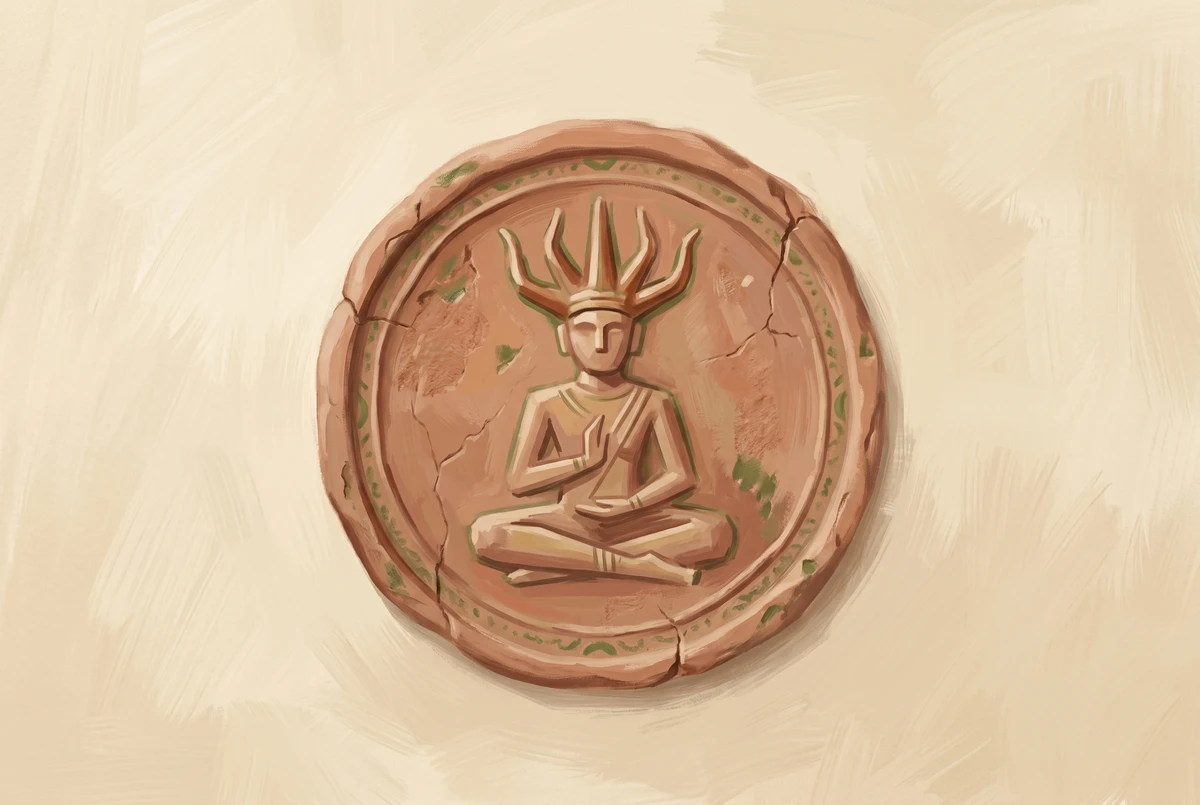
The evolutionary psychologist Matt Rossano has proposed that ritualistic fire-gazing practices may reach back 200,000 years, strengthening the brain regions involved in working memory and attention. That hypothesis is contested (Richard Klein at Stanford doubts gradual cognitive development models), but the core observation stands: the problem of scattered attention is as old as the human brain, and people have been trying to solve it for a very long time.
The shared architecture: anchor, wander, return
The surviving ancient meditation techniques, despite their different cultural origins, run on variations of the same three-step loop. 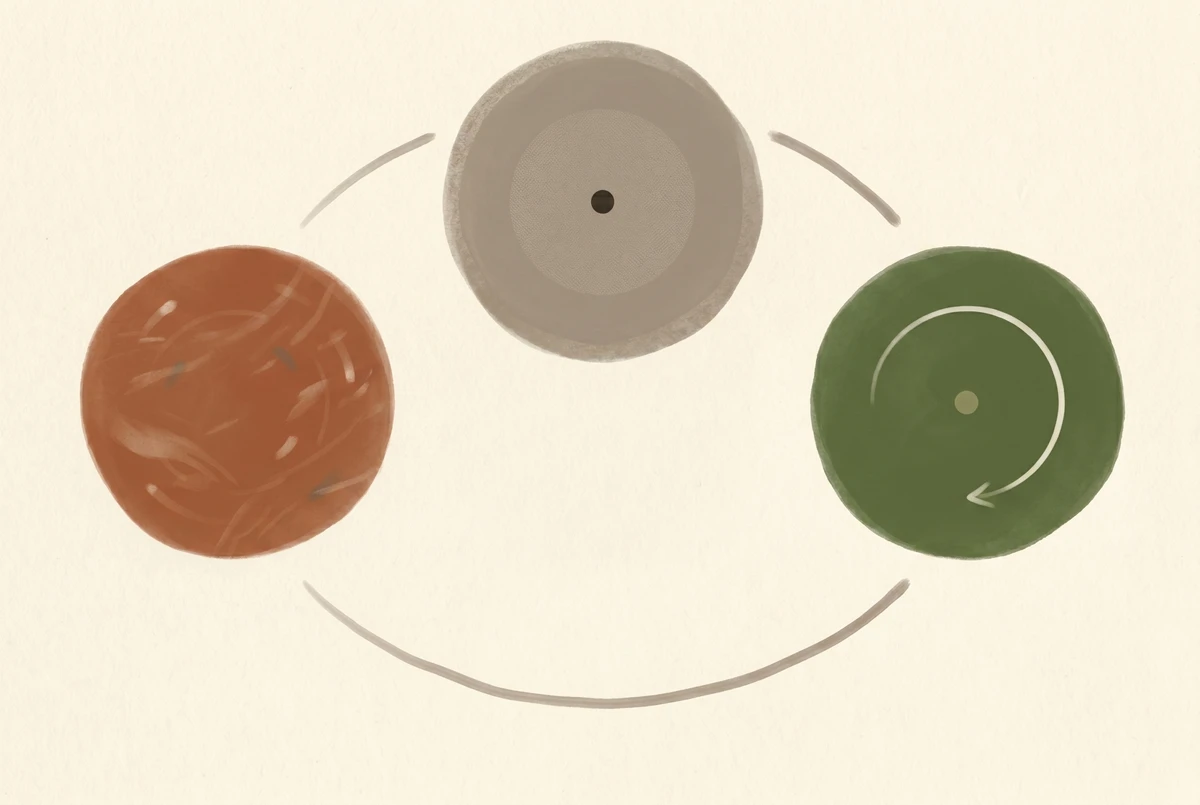
The anchor. You give the mind something specific to rest on. This might be the breath (Buddhist Anapanasati), a repeated sound (Vedic mantra, Sufi dhikr, the Christian Jesus Prayer), a visual point (Hindu trataka, Buddhist kasina), bodily sensation (Vipassana body scanning), or a paradoxical question (Zen koan).
The wander. The mind leaves the anchor. This is not failure. Every tradition is explicit on this point. Noticing that you’ve wandered is the training.
The return. You bring attention back to the anchor, without frustration or self-criticism.
The variation between traditions isn’t in this loop. It’s in the choice of anchor, and that choice reflects each culture’s theory of what attention is for. Vedic traditions emphasize sound because they saw sacred vibration as the fabric of reality. Buddhist traditions emphasize sensation because direct experience of impermanence is the path to liberation. Zen strips the anchor away entirely because the goal is awareness itself.
This convergence happened because the anchor-wander-return cycle maps onto how human attention actually operates. Modern neuroscience describes the mechanism: the prefrontal cortex (executive attention) learns to recognize when the default mode network (mind-wandering) has activated and redirects focus back to the chosen object. Ancient practitioners didn’t have this vocabulary, but thousands of years of contemplative practice led them to the same functional discovery.
Breath-based techniques: Anapanasati and Pranayama
The breath is the most widely used anchor in meditation history, for a practical reason: it’s always happening, it’s always in the present moment, and you can observe it without doing anything special.
Pranayama (breath regulation) appears in the Upanishads (roughly 800-500 BCE) as part of a broader yogic framework. The Kaushitaki Upanishad (roughly 700-500 BCE) contains one of the earliest written uses of the word dhyana (the Sanskrit root that became Chinese Chan and Japanese Zen): “With mind, meditate on me as being prana.” Modern pranayama retains the core breath patterns but is often practiced separately from its original meditation context.
Anapanasati is the Buddha’s specific breath awareness technique, described in the Anapanasati Sutta (Majjhima Nikaya 118). The scholar-monk Thanissaro Bhikkhu calls it “the most detailed meditation instructions in the Pali Canon.” It lays out a 16-step progression organized into four tetrads: contemplation of the body (simple breath awareness), feeling (experiencing joy and rapture), mind (concentrating and freeing the mind), and dhammas (contemplating impermanence and relinquishment).
Most meditation apps teach only the first four steps of this progression (notice the breath, notice whether it’s long or short, experience the whole body, calm the body). The remaining twelve steps move from basic breath awareness into deep insight and are rarely taught outside traditional Theravada centers. The technique is the same; the depth of instruction has compressed.
What breath-based practice specifically develops: present-moment awareness (you can only breathe now) and interoceptive sensitivity (awareness of internal body states). If you tend to live in your head, breath meditation anchors you in physical sensation.
Insight meditation: Vipassana
Vipassana means “to see things as they really are.” Attributed to Gautama Buddha (5th century BCE), the technique was likely building on earlier contemplative traditions. What makes Vipassana distinct from breath meditation is its specific purpose: not calm, but insight into the nature of impermanence.
Lay practice of the technique had nearly died out. For centuries, Vipassana was practiced mainly within monastic communities in Southeast Asia. In the late 19th century, the Burmese monk Ledi Sayadaw (1846-1923) began teaching it to laypeople, motivated partly by fear that Buddhist texts would be lost under British colonialism. His student Saya Thetgyi passed the technique to U Ba Khin, who trained S.N. Goenka, an Indian-born Burmese businessman who began teaching in India in 1969.
The mechanism works like this: you systematically scan bodily sensations, observing their arising and passing without reacting. A pain in your knee appears. You notice it. It changes. It fades. A pleasant warmth appears. You notice that too. It also changes. Over hours and days of practice, the meditator develops equanimity (non-reactivity) not as an idea but as a trained response.
Goenka’s organization now runs 264 permanent centers and 393 total locations across 94 countries. Courses are free, funded entirely by donations from past students. The 10-day residential retreat format is Goenka’s innovation for teaching the technique systematically, and it’s one of the few modern formats that attempts to preserve the intensity of ancient intensive practice. The technique is also taught in prisons, schools, and addiction recovery programs.
What Vipassana develops compared to concentration-based techniques: direct experiential understanding of impermanence (anicca), which reduces the automatic reactivity to pleasant and unpleasant experiences that drives most of human suffering.
Gazing meditation: Trataka and Kasina
Gazing meditation uses vision as the anchor, and it may be one of the oldest meditation techniques in existence. Giovanni Dienstmann of Live and Dare argues that gazing was likely among the first meditation techniques ever practiced, and Rossano’s fire-gazing hypothesis places a version of the practice deep in prehistory. What’s certain is that at least four unconnected traditions developed it independently.
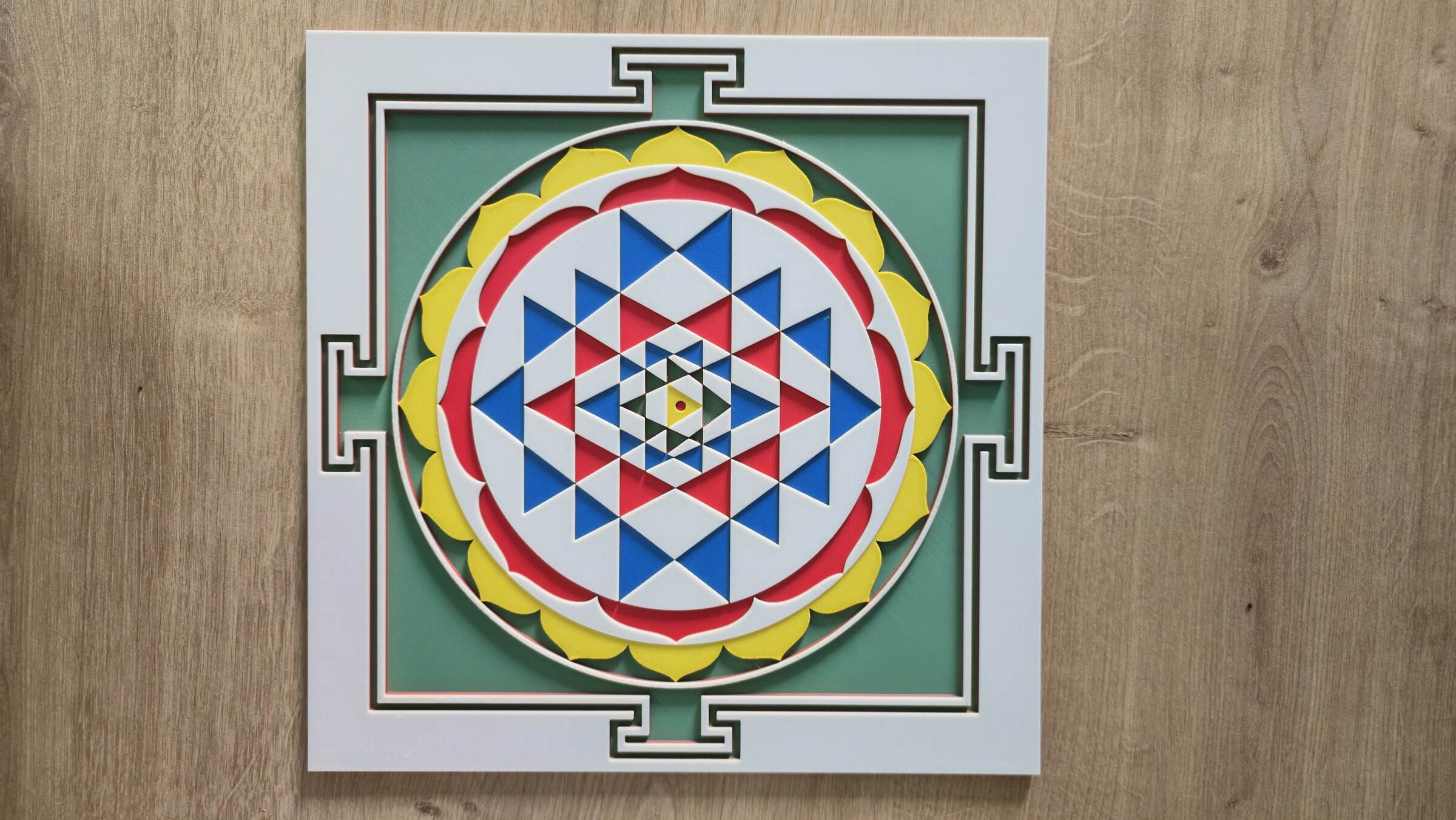
Trataka is described in the Hatha Yoga Pradipika (15th century CE, compiling older oral traditions) as one of the six shatkarmas (purification practices). The instruction is simple: gaze steadily at a single point (traditionally a candle flame, a black dot, or a yantra) without blinking until the eyes water. The HYP explicitly compiles from 35 earlier masters, indicating the technique predates the text by centuries. 
Buddhist Kasina is a parallel practice described in Buddhaghosa’s Visuddhimagga (5th century CE). Practitioners gaze at colored discs, flames, or earth circles until a “counterpart sign” (an internal visualization) arises, which then becomes the concentration object for deep absorption.
Greek omphaloskepsis (“navel-gazing”) and Sufi gazing practices represent Western and Islamic parallels that developed with varying degrees of independence.
Why the visual anchor keeps showing up across cultures: the eye has a built-in fixation mechanism that makes gazing one of the most concrete, low-ambiguity anchors available. You know instantly when your gaze has drifted, which gives the meditator immediate feedback about the state of their attention. Dienstmann notes that “steady gaze reduces central nervous system and autonomic nervous system activity through the diminution in proprioceptive feedback to the reticular activating system.” When the gaze stills, the mind stills. Nearly half the brain is dedicated to visual processing, and the retina is a direct outgrowth of the brain, so stabilizing visual input has outsized effects on mental activity.
The research on trataka is small but consistent. Raghavendra and Singh (2016) found significant improvement in selective attention, cognitive flexibility, and response inhibition after a single trataka session in 30 male volunteers (p<0.001 on Stroop color-word test). Talwadkar, Jagannathan, and Raghuram (2014) ran a randomized trial with 60 elderly subjects and found significant cognitive improvement after one month of trataka practice (digit span p<0.01, trail-making p<0.01). Physiological studies have documented decreases in blood pressure, pulse rate, and cortisol after a single 30-minute session.
What hasn’t changed from ancient to modern: trataka is trataka. Gazing is gazing. The technique itself has been preserved almost exactly. What has been lost is the broader yogic context: the HYP presents trataka as a preparatory practice (purification for deeper meditation), not as an end in itself. Modern practice often treats it as a standalone technique.
Sound-based techniques: Mantra and Dhikr
Mantra meditation targets a channel that many beginners find especially distracting: the inner narrator.
Vedic mantra practice, documented in texts dating to roughly 1500-1200 BCE, understood sacred sounds not as words to think about but as vibrations to inhabit. The mantra occupies the verbal-thinking channel, giving the “inner narrator” something constructive to do instead of generating random thoughts. This is why mantra meditation is often recommended for people who find breath-watching too open-ended.
Transcendental Meditation is Maharishi Mahesh Yogi’s mid-20th century systematization of this Vedic tradition. It assigns specific mantras to practitioners and became one of the most researched meditation techniques after the Beatles brought it to Western attention in 1967. Harvard cardiologist Herbert Benson studied TM extensively and found something that applies to all sound-based meditation: repeating any word or phrase on the outbreath produces the same physiological relaxation response as specific Sanskrit mantras (Benson, 1975). The content of the sound matters less than the repetition.
Sufi dhikr (remembrance of God) involves rhythmic repetition of divine names, often combined with synchronized breathing and body movement. The Mevlevi Order, followers of Rumi (13th century CE, Konya), took dhikr to its kinetic extreme in the whirling ceremony. The spinning dissolves the boundary between mantra and movement.
The Christian Jesus Prayer (“Lord Jesus Christ, Son of God, have mercy on me, a sinner”) functions identically to mantra meditation. Systematized in the Hesychast tradition (Gregory of Sinai, c. 1260-1346 CE provided detailed instructions), the practice synchronizes the prayer with the breath, combining sound anchor and breath anchor in a single technique. The Stoic philosopher Athenodorus (1st century BCE) taught a proto-mantra technique of reciting the alphabet on the outbreath for anger management, showing the same principle at work in Greco-Roman contemplative tradition.
The common thread: all sound-based meditation works by occupying verbal processing with a repetitive pattern, preventing the default mode network from generating its usual stream of commentary. Benson’s research confirmed that the key factor wasn’t the specific sound but the practitioner’s attitude toward intrusive thoughts: notice them, don’t engage, return to the repetition.
Stillness techniques: Zazen and Zuowang
Some traditions remove the anchor entirely.
Zazen, the meditation of Zen Buddhism, arrived at this approach through a long cultural evolution. When Bodhidharma brought Buddhist meditation from India to China in the 5th or 6th century CE, the practice encountered Daoist ideas about emptiness and non-doing. Chan Buddhism (later Zen in Japan) developed shikantaza, “just sitting”: sit, face the wall, be aware. No object, no mantra, no guidance. 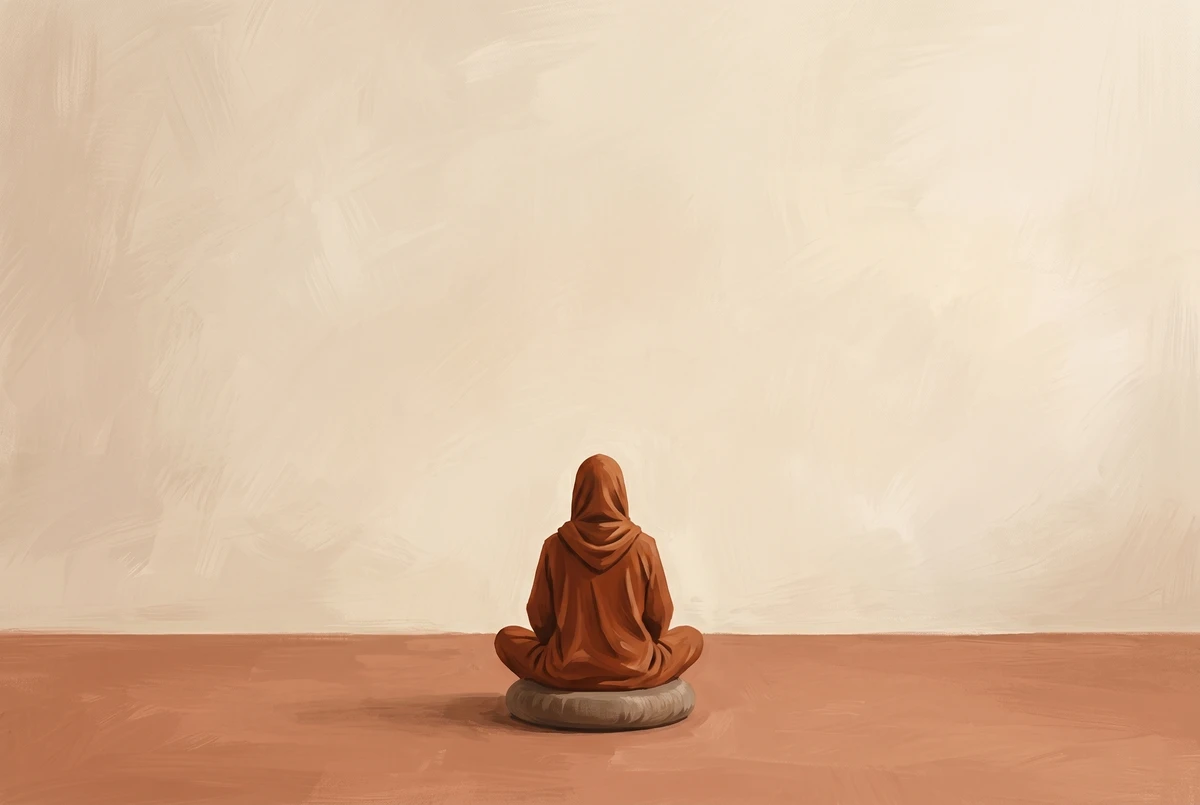
Zuowang (“sitting and forgetting”) predates Zen by nearly a millennium. In the Zhuangzi (4th century BCE), the student Yan Hui tells Confucius he has “sat down and forgotten everything,” including his body and knowledge. Confucius asks to join him. This is one of the oldest descriptions of objectless meditation in any tradition.
Koan practice is Zen’s alternative to pure objectless sitting. A paradoxical question (“What is the sound of one hand clapping?”) serves as an anti-anchor: it’s deliberately unsolvable by the thinking mind, designed to short-circuit conceptual processing until the practitioner drops into direct awareness.
An honest caveat: most teachers consider objectless awareness advanced practice. Without an anchor, a beginner’s mind simply wanders. This is why most Zen teachers start students with breath-counting before transitioning to shikantaza, and why Patanjali’s Yoga Sutras (roughly 2nd century BCE to 4th century CE) sequence concentration (dharana) before meditation (dhyana) before absorption (samadhi). “Yoga is the stilling of the movements of the mind” (Yoga Sutras 1.2), but stilling requires training, and training requires an anchor first.
Modern Zen practice preserves the ancient format remarkably well. Soto and Rinzai schools maintain direct lineage transmission, and multi-day intensive retreats (sesshin) continue the immersive sitting practice described in classical texts.
Techniques that didn’t survive, and why
Not every ancient meditation tradition made it. The reasons for survival and loss reveal what holds a practice together across centuries.
Egyptian practices from the Book of the Dead contain contemplative instructions, but no living lineage transmits them. Greek contemplative philosophy (Plato, Plotinus) was absorbed into Christian mysticism; no independent Greek meditation lineage survived. Indigenous contemplative traditions (shamanic journeying, vision quests, fire-gazing rituals) represent some of the oldest practices on Earth, but oral transmission and colonization disrupted their continuity.
The pattern: techniques with institutional backing were far more likely to survive. Monastic orders, temple systems, guru-disciple lineages, and organizational structures like Goenka’s Vipassana network created the transmission infrastructure that kept techniques alive across generations. Oral-only traditions were more vulnerable. The techniques that survived also tended to be those that could be taught systematically to new practitioners, not just transmitted through direct experience.
Jain Samayika is a notable survivor that rarely appears in Western meditation discussions. A daily 48-minute practice focused on equanimity (treating all experiences equally), Samayika is one of six essential duties in Jain practice. Jainism predates Buddhism (Mahavira, roughly 599-527 BCE, was a contemporary of the Buddha), making Samayika potentially one of the oldest structured meditation practices still in active use.
How to choose: matching technique to temperament
The anchor-wander-return framework makes technique selection straightforward. The question isn’t “which tradition is most authentic?” but “what kind of anchor fits how my mind actually works?”
If your inner narrator never stops talking: mantra meditation. The sound gives verbal thinking a constructive replacement rather than asking it to be quiet (which it won’t).
If you’re visual, or you struggle to “feel” the breath: trataka or gazing meditation. The visual anchor is the most concrete available, and you know immediately when your attention has drifted because you can see it happen.
If you want structured, progressive training: Vipassana in the Goenka tradition. The 10-day course is the most systematic curriculum available, with clear stages and a global network of free retreat centers.
If you find objects of focus constraining: zazen or shikantaza. But be honest about whether this reflects genuine readiness for objectless awareness or avoidance of concentration work.
If you want a practice embedded in daily activity, not just cushion time: walking meditation (Buddhist kinhin), Sufi dhikr, or the Jesus Prayer were all designed for integration into daily life.
Most ancient traditions recommend starting with concentration practice (samatha in Buddhism, dharana in yoga) before moving to insight practice (vipassana, prajna). Modern secular meditation often skips this order. The Yoga Sutras sequence concentration before meditation for the same reason you learn the alphabet before reading: the prerequisite skill enables the advanced one.
Choosing a technique matters less than practicing consistently. The research on meditation, across traditions, points to regularity as the primary predictor of results. Pick the anchor that your mind finds naturally engaging, and start there.
Sources
- Sharma H. (2015). “Meditation: Process and effects.” Ayu, 36(3), 233-7. PMC4895748.
- Raghavendra BR, Singh P. (2016). “Immediate effect of yogic visual concentration on cognitive performance.” Journal of Traditional and Complementary Medicine, 6(1), 34-36. doi:10.1016/j.jtcme.2014.11.030.
- Talwadkar S, Jagannathan A, Raghuram N. (2014). “Effect of trataka on cognitive functions in the elderly.” International Journal of Yoga, 7(2), 96-103. PMC4097909.
- Rajpoot PL, Vaishnav P. “Effect of Trataka on Anxiety among Adolescents.” World Academy of Science, Engineering and Technology. doi:10.5281/zenodo.1099920.
- Rossano MJ. (2007). “Did meditating make us human?” Cambridge Archaeological Journal, 17(1), 47-58.
- Lazar SW, et al. (2005). “Meditation experience is associated with increased cortical thickness.” NeuroReport, 16(17), 1893-7.
- Killingsworth MA, Gilbert DT. (2010). “A wandering mind is an unhappy mind.” Science, 330(6006), 932.
- Benson H. (1975). The Relaxation Response. New York: William Morrow.
- Kaplan A. (1985). Jewish Meditation. New York: Schocken Books.
- Dienstmann G. “Trataka Meditation: Still Eyes, Still Mind.” Live and Dare.
- Robertson DJ. (2017). “An Ancient Stoic Meditation Technique.” donaldrobertson.name.
- Thanissaro Bhikkhu (trans.). “Anapanasati Sutta: Mindfulness of Breathing.” Access to Insight.