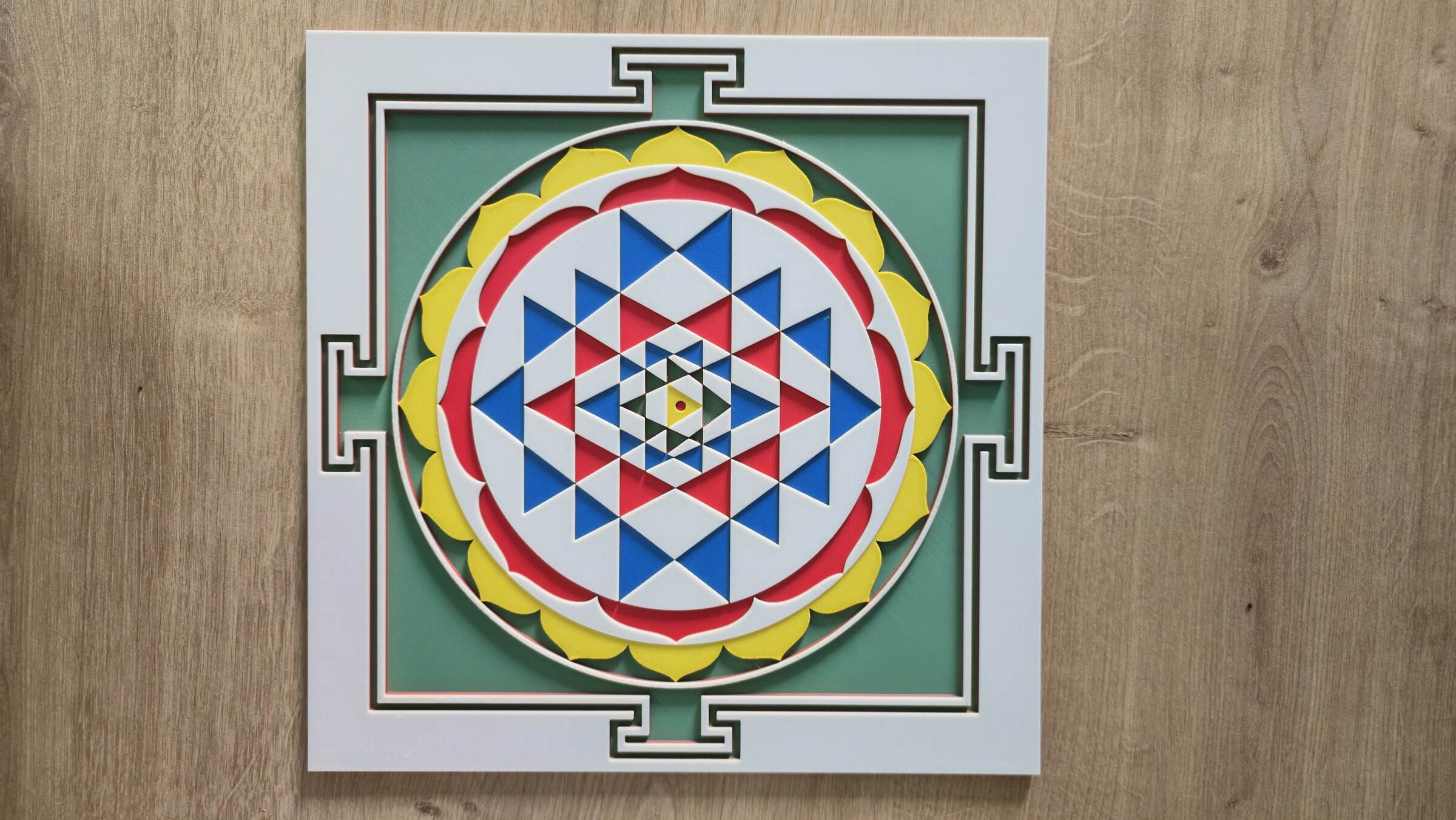
What Is a Yantra? Sacred Geometry for Meditation
Miha Cacic · April 8, 2026 · 6 min read
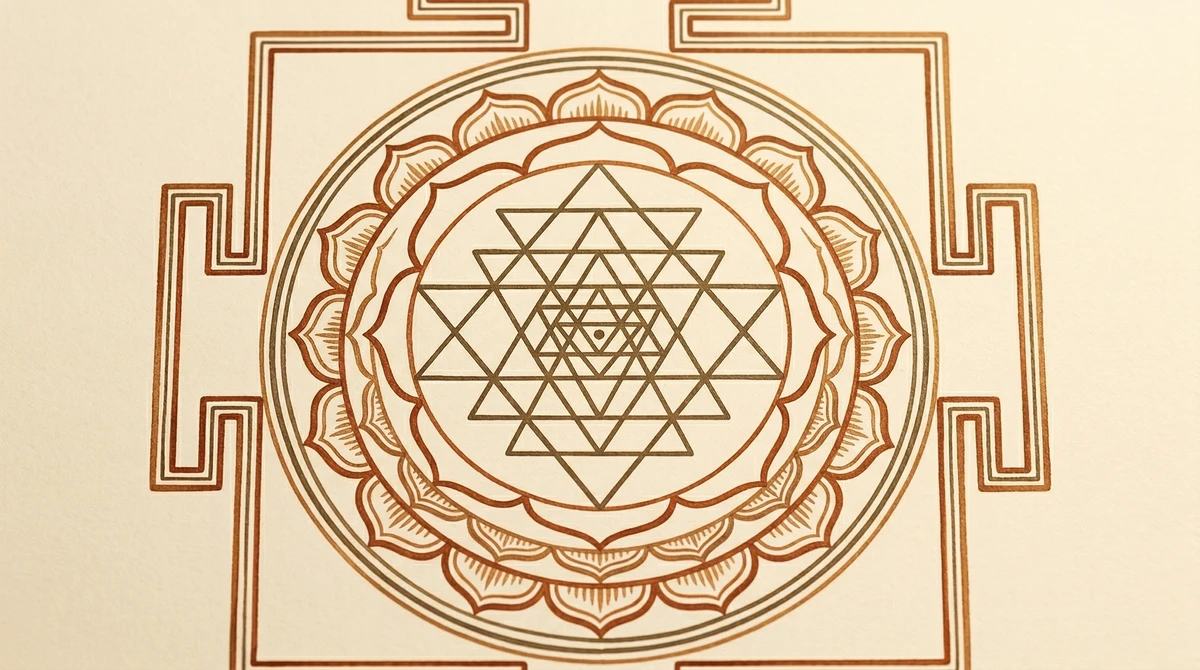
A yantra is a geometric diagram used as a visual tool for meditation, originating from the tantric traditions of Hinduism. But calling it a “diagram” undersells what it does. A yantra’s concentric layers of squares, triangles, circles, and lotus petals aren’t decorative. They form a structured path that guides your gaze and your attention inward toward a single central point. The geometry itself is the meditation instruction.
What does ‘yantra’ mean?
The Sanskrit root yam carries meanings of restraining, holding, and sustaining. Add the suffix tra (instrument or tool), and yantra becomes “an instrument for holding” or “that which restrains.” The Agastya Samhita, a Pancaratra text, makes the meaning circular: “The word ‘yantra’ suggests that we fix our minds on that design, and by doing so our mind is fixed or controlled.” The word encodes the practice.
Yantra belongs to a triad. The Shiva Purana describes worship performed “in accompaniment with Tantra, Yantra and Mantra appliances.” Mantra is the instrument of sound. Tantra is the instrument of practice. Yantra is the instrument of form. Each serves the same purpose through a different sense: hearing, action, and sight.
These three emerge from the same tantric traditions, not from earlier Vedic ritual. The Brahmayamala Tantra, dated to roughly the 7th century CE, already describes yantras as portable geometric diagrams used alongside mantras and deity images in practice.
How a yantra is built: the anatomy of sacred geometry
A yantra reads from outside in, like a map with the destination at the center. Each layer corresponds to a stage of progressively deepening attention.
Bhupura (outer square with four gates). The outermost boundary, representing the material world. The four openings on each side are called “gates” and mark the entry point. When you sit down to meditate on a yantra, your awareness starts here: grounded in the body, oriented in physical space. 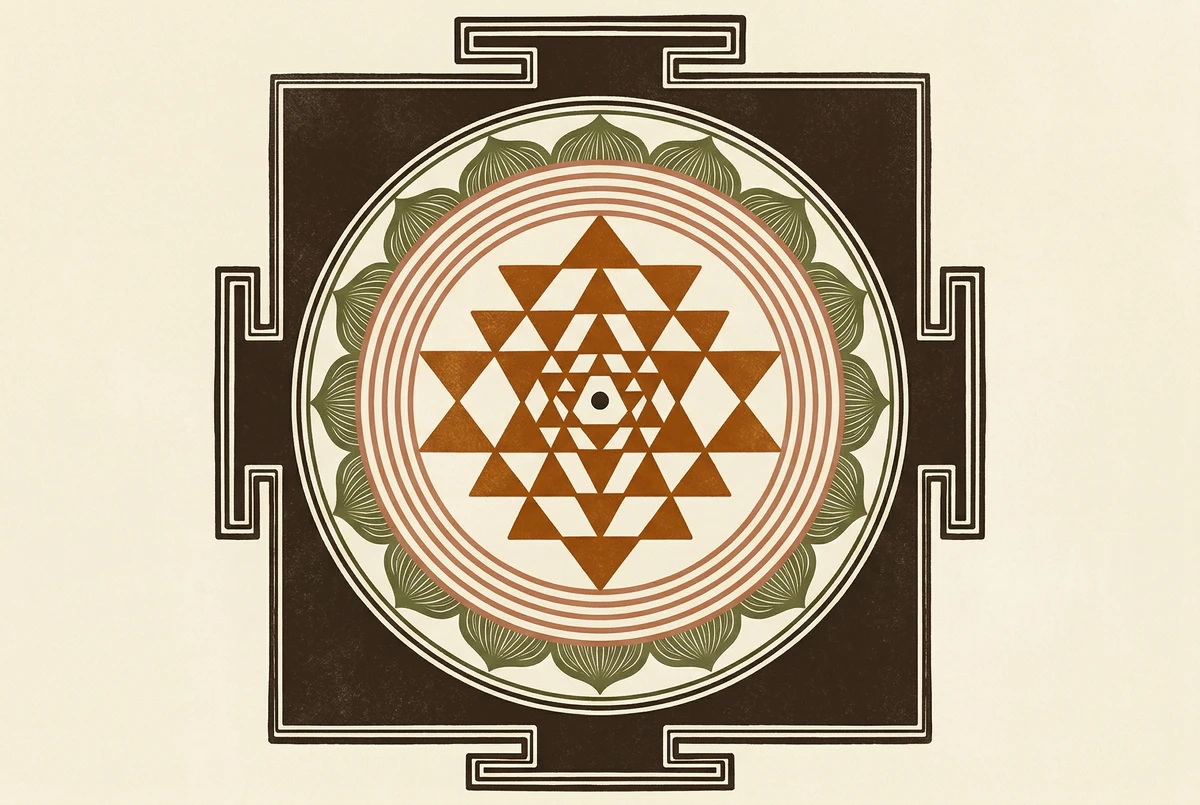
Lotus petals. Inside the square, rings of stylized lotus petals appear. These represent unfolding awareness, the transition from gross perception to subtler attention. The petals give the eyes their first curved paths to trace inward.
Circles. Concentric rings that create continuity and rhythm. They establish a sense of enclosure, marking the boundary between outer and inner space.
Triangles. The most dynamic element. Upward-pointing triangles represent Shiva (consciousness, aspiration, fire). Downward-pointing triangles represent Shakti (creative energy, grace, water). Where they interlock, tension and complexity hold the gaze. In the Sri Yantra, nine triangles (five pointing down, four pointing up) intersect to form exactly 43 smaller triangles, organized in five concentric levels. This count has been mathematically verified. The Sri Yantra is, in geometric terms, an under-determined Euclidean plane geometry problem requiring precise alignment of all intersections.
Bindu (central point). The destination. A single dot representing pure, undivided consciousness. All the geometry converges here, and so does your attention.
This layered structure isn’t arbitrary decoration. The Kularnava Tantra (Chapter VI, verse 85) states that “the deity, pleased when propitiated in the form of Yantra, is like the soul to the body and oil to the lamp.” In tantric understanding, the yantra IS the sacred principle rendered in geometry.
Types of yantras
By deity. Each yantra embodies a specific divine principle. The Sri Yantra (also called Sri Chakra) represents Tripura Sundari and the totality of creation. A Ganesh Yantra embodies obstacle removal. A Kali Yantra embodies transformation. The yantra is the deity in geometric form, just as the mantra is the deity in sonic form. As the Kularnava Tantra puts it: the yantra is to the deity what the body is to the soul.
By use. Tantric tradition, as catalogued in Aghori practice, identifies seven categories: Sharir yantras (of the body, such as chakra diagrams), Dharan (worn as amulets), Asan (placed under the meditation seat), Mandal (used in group ritual with participants at cardinal directions), Puja (installed for worship), Chhatar (carried on the person, in a pocket or under a hat), and Dharshan (displayed in temples for contemplation). Most people in the West encounter yantras in just one or two of these contexts, but the range shows how thoroughly yantras were woven into daily practice.
By material. Yantras can be drawn on paper, engraved on copper or silver plates, traced in colored powder for rituals, carved in stone, or constructed as three-dimensional forms (temple architecture as yantra, or the raised “meru” style Sri Yantra). The material matters most in ritual consecration contexts, where tradition prescribes specific metals. For trataka practice, the visual geometry is what matters, not the substrate.
How yantras work in meditation
The geometry guides attention. When you gaze at concentric, symmetrical patterns, your eyes naturally trace paths inward toward the center. The nested structure of a yantra draws on how visual perception works: symmetrical, layered forms pull the gaze toward their center of gravity. Practitioners often find this helpful when eyes-closed meditation feels too unstructured, because the geometry gives attention somewhere specific to go.
Trataka is the primary method. Trataka (steady gazing) is one of six shatkarmas (cleansing techniques) described in the Hatha Yoga Pradipika, the foundational medieval text on hatha yoga. The text defines it as “gazing steadily at a small mark until tears flow” and says it “eradicates all eye diseases, fatigue, and sloth.” Trataka is the only shatkarma that directly leads to meditation. The Hatha Yoga Pradipika calls it “the doorway to shambhavi mudra,” an advanced meditative state. The other five shatkarmas (neti, dhauti, basti, nauli, kapalabhati) are purely physiological. Trataka bridges the physical and the contemplative.
The afterimage becomes the internal object. During trataka, you gaze steadily at the yantra’s center. When your eyes tire or water, you close them. The yantra’s afterimage appears behind your eyelids in complementary colors. This afterimage becomes your meditation object. When it fades, you open your eyes and repeat. Practitioners report that this internal visualization grows stronger over weeks of practice, eventually sustaining itself without the external yantra. This progression from external support to internal focus mirrors the arc described in classical yoga: from dharana (concentration with effort) to dhyana (effortless absorption).
Each layer maps to a depth of attention. Traditional descriptions assign each layer a function: the outer square grounds awareness in the body, the lotus petals engage aesthetic attention, the interlocking triangles create dynamic visual tension that holds focus, and the bindu absorbs attention into a single point. You don’t consciously “move through the layers.” The geometry’s structure pulls attention inward as you soften your gaze.
Mantra amplifies the effect. Each yantra corresponds to a specific mantra. Repeating the mantra while gazing engages both auditory and visual processing, making the meditation more absorbing. The Agastya Samhita describes yantras as “filled up with mantra-syllables.” Tradition pairs form and sound because they reinforce each other.
The research supports the underlying mechanism. Most trataka studies use candle-flame gazing rather than yantra-specific gazing, but they test the same core mechanism: sustained visual concentration on a fixed point. A 2016 study by Raghavendra and Singh tested 30 male volunteers on the Stroop color-word test (a standard measure of selective attention) before and after candle-flame trataka sessions. After trataka, scores improved by 15–26% across measures, compared to 4–10% improvement in the control group (p<0.001). The researchers noted that Stroop performance is linked to prefrontal cortex activity, suggesting trataka may strengthen the brain region most associated with focused attention.
A 2020 randomized controlled trial by Sherlee and David found trataka significantly improved both cognitive performance and anxiety reduction in adolescents (p<0.0001). EEG studies have added further evidence: Kamthekar and Iyer (2021) used EEG analysis to examine trataka’s effects on brain waves for stress management, and a pilot study by Kapas et al. (2025) with three participants found that the increase in multifractal width during combined trataka and kapalbhati practice “is a signature of the increased concentration and attention-based activities in human brain.”
These are small studies with real limitations: sample sizes of 3 to 30 participants, all-male or age-specific populations, and none testing yantra gazing specifically. But the direction is consistent: sustained visual concentration produces measurable changes in attention, cognition, and brain activity. The traditional claim that trataka sharpens the mind has preliminary scientific support.
Yantra vs. mandala: what’s the difference?
These terms get used interchangeably in Western yoga spaces, but they refer to different things from different traditions. For a detailed comparison, see yantra vs mandala.
A yantra is a precise geometric instrument from Hindu Tantra. It has fixed proportions, corresponds to a specific deity, and serves as a tool for focused meditation or worship. It’s abstract: lines, triangles, circles, points.
A mandala is a symbolic cosmic map, most associated with Tibetan Buddhism. Mandalas often include figurative imagery (painted deities, landscapes, architectural elements) and can be ritually impermanent. Tibetan sand mandalas are painstakingly created and then deliberately destroyed, representing the impermanence of all things. This ritual destruction has no parallel in yantra practice.
The Britannica entry on yantras notes that “in its more elaborate and pictorial form [the yantra] is called a mandala,” suggesting the two exist on a spectrum. Both use concentric structure and inward movement. Both serve meditation. But yantras are abstract and permanent; mandalas are often pictorial and sometimes temporary.
If the diagram is geometric, abstract, and comes from Hindu tantric tradition, it’s a yantra. If it includes figurative elements and Buddhist associations, it’s likely a mandala. The terms blur in Hindu traditions that use “mandala” loosely, so the distinction isn’t always clean.
How to use a yantra
For trataka meditation (gazing practice):
- Place the yantra at eye level, about an arm’s length away. A dimly lit room works best, as it reduces competing visual stimulation.
- Sit comfortably with your spine straight.
- Soften your gaze on the center point (bindu). Don’t strain or force your eyes open.
- Let your peripheral vision take in the surrounding geometry naturally. Your eyes will trace paths through the triangles, petals, and circles without you directing them.
- When your eyes water or tire, close them. Observe the afterimage that appears behind your eyelids.
- When the afterimage fades, open your eyes and repeat.
- Start with 5–10 minutes. Build gradually.
Over weeks, the internal visualization becomes stronger and more sustained. The afterimage lasts longer. Eventually, the yantra’s form appears vividly in your closed eyes without needing the external support. The Bihar School of Yoga’s Dharana Darshan by Swami Niranjanananda Saraswati provides the most comprehensive modern guide to this progressive practice.
For ambient presence: Many practitioners hang a yantra in their living space or meditation room. The geometry naturally draws the eye, serving as a visual reminder to return to focused attention.
For ritual worship (puja): In traditional Hindu practice, yantras are consecrated with mantras, offered flowers and incense, and used as the focal point of devotional worship. This context typically requires initiation or guidance from a teacher.
Choosing your first yantra
Start with the Sri Yantra. It’s the most complex (nine interlocking triangles, 43 sub-triangles, five concentric levels) but also the most universal. It represents the totality of creation rather than a specific intention. Its complexity is an advantage for gazing meditation: more geometric paths means more for your eyes to trace, which makes sustained attention easier, not harder.
If you have a specific intention, other yantras serve those purposes: Ganesh Yantra for obstacles, Saraswati Yantra for learning, navagraha yantras for astrological work. The geometry changes; the practice doesn’t.
One thing that does matter: proportions. The Sri Yantra’s nine triangles must intersect so that all 33 triple-intersections and 24 double-intersections align precisely. A carelessly drawn yantra with wrong angles won’t produce the same visual effect, because the geometric relationships that guide your eyes inward depend on that precision. Traditions associate the first known drawings of the Sri Yantra with Adi Shankaracharya (8th century CE), though the form appears in Indonesian inscriptions from the 7th century and likely predates both sources. The geometry has been refined over centuries for a reason: it works when the proportions are right.
Sources
- Raghavendra, B.R., & Singh, P. (2016). “Immediate effect of yogic visual concentration on cognitive performance.” Journal of Traditional and Complementary Medicine, 6(1), 34–36. doi: 10.1016/j.jtcme.2014.11.030. PMC4738033.
- Sherlee, J.I., & David, A. (2020). “Effectiveness of yogic visual concentration (Trataka) on cognitive performance and anxiety among adolescents.” Journal of Complementary and Integrative Medicine, 17(3). doi: 10.1515/jcim-2019-0055. PMID: 32415824.
- Kamthekar, S., & Iyer, B. (2021). “Tratak Meditation As a CAM for Stress Management: An EEG Based Analysis.” International Conference on Intelligent Technologies (CONIT). doi: 10.1109/CONIT51480.2021.9498288.
- Kapas, P., Sanyal, S., Banerjee, A., & Ghosh, D.C. (2025). “A study on the combined effect of Trataka and Kapalbhati on EEG waves.” ResearchGate publication 390240426.
- Muktibodhananda, S. (1993). Hatha Yoga Pradipika (commentary). Yoga Publications Trust, Munger, India.
- Khanna, M. (1979). Yantra: The Tantric Symbol of Cosmic Unity. Thames & Hudson. ISBN: 0500272344.
- Johari, H. (1986). Tools for Tantra. Inner Traditions. ISBN: 0892810556.
- Swami Niranjanananda Saraswati. Dharana Darshan. Bihar School of Yoga.
- Editors of Encyclopaedia Britannica. (2003). “Yantra.” Encyclopaedia Britannica.
- Wisdomlib.org. “Yantra, Yamtra: 46 definitions.” Accessed 2025.