Open-Eye Meditation Techniques: A Complete Practice Guide
Miha Cacic · April 9, 2026 · 8 min read
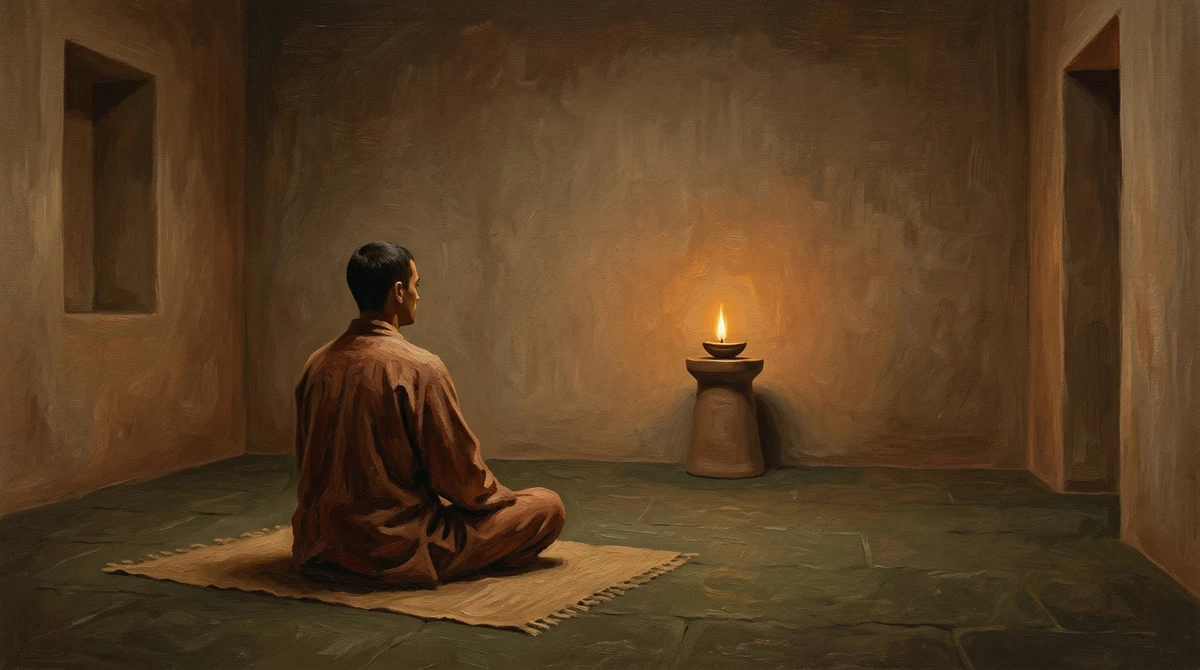
You can meditate with your eyes open. In several traditions, that’s not a workaround for drowsiness; it’s the primary method. Zen practitioners face a wall with eyes half-open. Yogis practice trataka on a candle flame. Tibetan Buddhists gaze at the sky. These are distinct techniques that use the visual system as the meditation itself, and they sit on a spectrum from soft ambient awareness to focused geometric contemplation.
Why open-eye meditation works: the eye-mind connection
The reason open-eye meditation is more than “regular meditation but with your eyes open” comes down to how deeply vision is wired into the brain.
Roughly half of the human brain is devoted directly or indirectly to visual processing (Sur, 1996). The retina itself develops as a direct outgrowth of the brain during embryonic development, making it central nervous system tissue rather than a peripheral sensor.
This matters for meditation because of a phenomenon called microsaccades. Your eyes make constant tiny involuntary movements that keep the visual field refreshed. A 2019 study by Matiz et al. measured eye movements in 32 experienced meditators during focused-attention meditation and found significantly smaller movement amplitudes compared to mind-wandering. More experienced meditators showed even less eye movement across both conditions. Still eyes, still mind.
The relationship appears to work in both directions. Neuropsychologist Marcel Kinsbourne demonstrated in 1972 that gaze direction reflects which brain hemisphere is dominant during a task: people look right during verbal processing and left during spatial processing. If gaze tracks cognitive mode, the hypothesis follows: shift the gaze, shift the mode.
The strongest clinical evidence for this bidirectional relationship comes from EMDR (Eye Movement Desensitization and Reprocessing), a trauma therapy that uses controlled eye movements as its core mechanism. In a randomized clinical trial of 88 PTSD subjects, van der Kolk et al. (2007) found that 75% of adult-onset trauma subjects receiving EMDR achieved asymptomatic functioning at six-month follow-up, compared with 0% in the fluoxetine (Prozac) group. The World Health Organization now recommends EMDR for PTSD treatment.
The yogic traditions arrived at a compatible principle through practice rather than clinical trials: control the eyes, influence the mind. EMDR uses controlled eye movement to process and release. Trataka uses controlled eye stillness to concentrate and calm. Both work through the visual system, though by different means.
The spectrum of open-eye techniques
Open-eye meditation isn’t a single practice. It spans three modes, each engaging the visual system at different depths:
Ambient mode uses open eyes with unfocused vision. Soft gaze, peripheral awareness, looking without looking at anything. The goal is present-moment alertness without visual fixation.
Focused mode makes vision the anchor of concentration. You gaze at a specific object (a candle flame, a dot on the wall, a flower) with sustained attention. The goal is single-pointed absorption.
Geometric mode uses complex visual patterns (yantras, mandalas, colored discs) as objects of deep meditation. The geometric complexity engages pattern recognition and creates richer internal imagery. The goal is altered states and insight.
These aren’t rigid stages. An experienced practitioner might use soft gaze for a morning sit, candle trataka for an evening concentration session, and yantra meditation on weekends. Match the technique to your intention.
Soft-gaze meditation
This is the most accessible open-eye technique and the one you’ll find across the widest range of traditions.
In Zen zazen, the practitioner sits facing a wall with eyes half-open (called hanganka), gaze falling at roughly a 45-degree angle about two to three feet ahead. Dogen Zenji emphasized this in his 13th-century Fukanzazengi instructions. The eyes don’t focus on anything specific. Light comes to you; you don’t reach out with your gaze.
The half-open position serves a specific purpose: it balances alertness (eyes open enough to prevent drowsiness) with inward focus (partially closed to reduce visual distraction and blinking urge). If you’ve ever tried to meditate with closed eyes and found yourself drifting into sleep, this is the fix.
Dzogchen sky gazing takes the opposite approach to environment. Instead of a blank wall, practitioners in the Nyingma school of Tibetan Buddhism gaze at the open sky with a soft, expansive gaze, allowing awareness to merge with the spaciousness. You don’t focus on any object. The sky itself is the support for meditation.
How to practice soft-gaze meditation:
- Sit in a comfortable posture. Face a blank wall (Zen style) or sit outdoors with a view of open sky (Dzogchen style).
- Let your eyelids rest at half-mast, or keep them naturally open.
- Soften your gaze. Don’t look at anything. Let the visual field exist without engaging with any part of it.
- Rest attention on your breath, body sensations, or simply on awareness itself.
- When your gaze sharpens or locks onto something, notice it and soften again.
The most common mistake is turning this into staring. Staring is effortful and tense. Soft gaze is receptive and relaxed. If your eyes feel strained, you’re working too hard.
Object-based meditation (dharana)
Where soft gaze diffuses attention across the visual field, object meditation concentrates it on a single point. In yoga, this falls under dharana (single-pointed concentration), the sixth of Patanjali’s eight limbs.
Choose something neutral and visually stable: a flower, a smooth stone, a tree, or any object that holds your attention without triggering a chain of associations. The object should be at eye level, somewhere between arm’s length and five feet away, visible without straining or moving your head.
The core skill is non-labeling. You look at the object without interpreting, naming, or building stories about it. A flower is not “the flower from the garden that reminds me of summer.” It’s shape, color, form, experienced directly. This is harder than it sounds because the naming mind is relentless. Each time you catch yourself narrating, return to pure seeing.
How to practice object meditation:
- Place your chosen object at eye level in good, even lighting.
- Settle with a few minutes of breath awareness, eyes closed.
- Open your eyes and rest your gaze on the object.
- Balance your focus: intense enough to stay anchored, relaxed enough to avoid eye strain. If your face is tense, soften.
- When thoughts arise, notice them and return to seeing.
- Start with 5 to 10 minutes.
This practice builds the foundation for all deeper gazing techniques. The ability to hold visual attention on a single point, without strain and without mental commentary, is the prerequisite for trataka.
Trataka: yogic gazing meditation
Trataka is the systematic, formalized version of everything described above. The Hatha Yoga Pradipika, a 15th-century text, defines it plainly: “Looking intently with an unwavering gaze at a small point until tears are shed is known as trataka by the acharyas [teachers].”
It holds a unique position in the yoga system. Trataka is one of the six shatkarmas (cleansing practices) alongside stomach cleansing, colon cleansing, nasal cleansing, abdominal massage, and skull-shining breath. It’s the only shatkarma that targets the mind rather than the body. The Gheranda Samhita (17th-18th century) classifies trataka not as cleansing but as dharana (concentration), confirming its dual nature as both cleansing practice and concentration technique.
The three stages of trataka
External trataka (bahiranga trataka): Gaze at a candle flame, a black dot on a white wall, or another focal point without blinking. Keep the gaze steady but relaxed. When tears come, close your eyes. Candle gazing is the most popular form because the flame provides a bright, self-luminous point that produces strong afterimages.
Internal trataka (antaranga trataka): After gazing, close your eyes and hold the afterimage on the “mind screen” (the visual field behind closed eyelids). The afterimage of a candle flame appears as a bright dot, often surrounded by color. Hold it at the point between your eyebrows. When it fades, open your eyes and repeat.
Void trataka: Gazing at empty space itself (sometimes called boochari mudra), or practicing in total darkness. This is the most advanced form, where the object of concentration is the absence of an object.
The afterimage stage is more important than it first appears. It trains the capacity for internal visualization by giving you something concrete to work with. The shift from seeing the external object to holding its impression internally is the bridge between outward concentration and inward meditation.
What the research shows
A randomized controlled trial by Talwadkar, Jagannathan, and Raghuram (2014) tested daily 30-minute trataka sessions on 60 elderly subjects over 26 days. The trataka group showed significant improvements in attention and concentration (measured by the Six Letter Cancellation Test), executive function (Trail Making Test-B), and working memory (Digit Span Test). Some benefits appeared immediately after a single session; working memory gains required sustained practice.
Separate research using the Stroop color-word test found that yogic visual concentration improved selective attention, cognitive flexibility, and response inhibition compared to controls (Sherma et al., 2014).
Safety
Trataka on a candle flame requires precautions:
- Session length: Start with 3 to 5 minutes. Don’t exceed 10 minutes per session for candle gazing.
- Rest periods: Experienced trataka teachers recommend a 2-week break from candle gazing every 2 months as a precaution against retinal overstimulation. This is a traditional guideline, not a clinically tested protocol.
- Contraindications: Avoid candle trataka if you have cataracts, glaucoma, or photosensitive epilepsy. The flickering flame can trigger seizures in susceptible individuals. People with epilepsy can practice trataka on a steady, non-flickering object like a black dot or yantra.
- Blinking: “Gazing without blinking” does not mean forcing your eyes open. Relax your face, soften the muscles around the eyes, and blinks will naturally become less frequent. If your eyes hurt, you’re straining.
- Corrective lenses: Wear glasses or contacts if you need them. Visual clarity matters for trataka.
Trataka on non-luminous objects (a dot, a symbol, a yantra) does not carry the same precautions as candle gazing and can be practiced for longer periods.
Yantra and mandala meditation
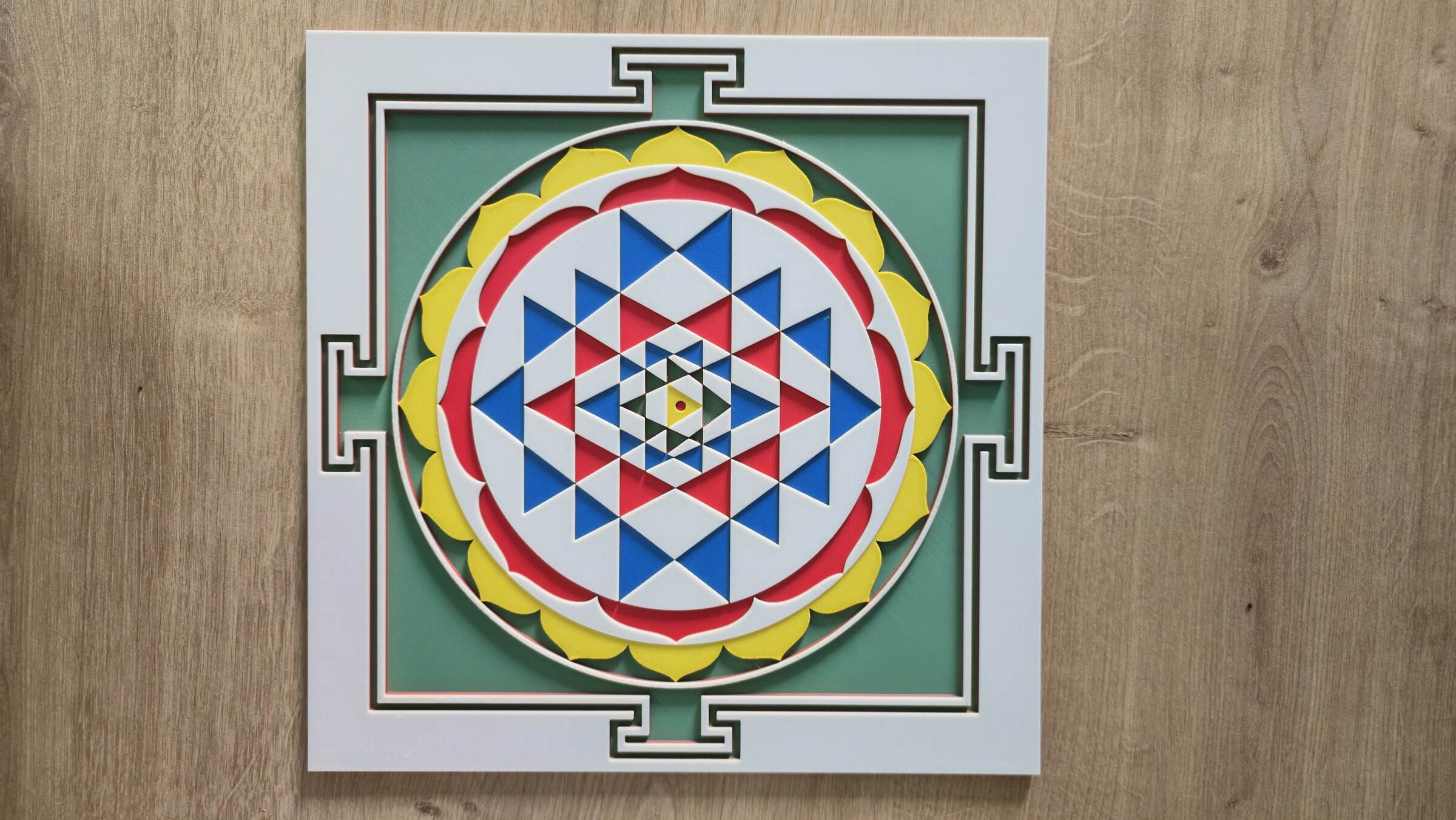
Yantra meditation is trataka applied to geometric complexity. Instead of a single point of light, the object is a geometric diagram (a yantra, mandala, or colored disc) whose visual architecture provides richer material for both external gazing and internal visualization.
When you gaze at a candle flame and close your eyes, the afterimage is a simple bright dot. When you gaze at a yantra and close your eyes, the afterimage preserves the geometric structure: interlocking triangles, concentric circles, the central point. This gives the mind more detailed visual territory to explore during the internal phase of practice.
The Sri Yantra, the most well-known yantra, is typically meditated on by first resting the gaze on the bindu (the central dot), then allowing awareness to expand outward through the interlocking triangles and surrounding gates. The reverse path (from the outer gates inward to the bindu) is also practiced, representing a movement from multiplicity to unity.
This practice exists across multiple traditions under different names:
- Kasina meditation in Theravada Buddhism uses colored discs (clay circles on a backing) as objects of concentration. The Visuddhimagga, a 5th-century meditation manual, lists ten kasina objects: earth, water, fire, air, blue, yellow, red, white, light, and space. The practitioner gazes at the physical disc until an eidetic afterimage (called a nimitta) forms, then meditates on the mental image alone. This is structurally identical to the external/internal trataka progression.
- Mandala meditation in Tibetan Buddhism uses painted or sand mandalas as visualization supports. The distinction between yantras and mandalas lies in their geometry and how they’re used in practice.
- Icon gazing in Orthodox Christianity uses painted icons as focal points for contemplative prayer.
The common thread is that geometric complexity gives the mind more to work with than a single point of light. A candle flame trains the ability to hold attention. A yantra or mandala trains the ability to hold and navigate complex visual structure, which practitioners across these traditions describe as a gateway to insight, not just concentration.
How to practice yantra meditation:
- Place a yantra (the Sri Yantra is a good starting point) at eye level in soft, even lighting. Print it at least 8 inches across so the geometric detail is visible.
- Settle with a few minutes of breath awareness, eyes closed.
- Open your eyes and rest your gaze on the bindu (the central dot). Don’t trace the lines; let the surrounding geometry exist in your peripheral vision.
- After 3 to 5 minutes, allow your awareness to expand outward through the triangles and gates, then draw it back to the center.
- Close your eyes and hold the afterimage. The geometric structure will appear as a visual impression, often in complementary colors. Rest your attention on it until it fades.
- Open your eyes and repeat. Start with 10 to 15 minutes total.
How to start: choosing your technique
Pick your technique based on what you actually need, not what sounds most advanced.
If you fall asleep during meditation: Start with soft gaze. The open eyes prevent drowsiness, and the technique requires no setup. Sit facing a wall or window and practice for any length of time.
If you want sharper concentration: Start with object meditation or candle trataka. Object meditation has no safety constraints; candle trataka is more intense but needs the time limits described above. Start with 3 to 5 minutes of gazing.
If you already meditate with closed eyes: Add one open-eye session per week. This builds the bridge between cushion practice and daily-life awareness, which is where most people struggle.
If you’re drawn to visual art or sacred geometry: Go directly to yantra meditation. The geometric complexity holds attention naturally, and many people find yantras more engaging than staring at a dot or flame.
Session length by technique
- Soft gaze: Any length. This is the most flexible technique and integrates easily into daily life.
- Object meditation: 5 to 20 minutes. No upper safety limit, but attention naturally fatigues.
- Candle trataka: Start with 3 to 5 minutes. Maximum 10 minutes per session. Take breaks as described in the safety section.
- Yantra meditation: 10 to 30 minutes. Since yantras are non-luminous, they don’t carry the same time restrictions as candle gazing.
Setting up
Good lighting matters more than most guides mention. Harsh overhead light creates glare on objects and strains the eyes. Soft, even, natural light is ideal. For candle trataka, practice in a dim (not dark) room with the flame at eye level, about two to three feet away. Eliminate drafts so the flame stays steady. Room temperature should be comfortable; cold rooms make the eyes water prematurely.
Common questions and misconceptions
“Is open-eye meditation legitimate?”
Not only legitimate, it’s the primary method in multiple major traditions. Zen Buddhism has practitioners meditate with eyes open as standard practice. Yoga’s trataka system is at least 500 years old and codified in the Hatha Yoga Pradipika. Dzogchen sky gazing is central to the Nyingma school of Tibetan Buddhism. The assumption that “real meditation” means closed eyes is a modern Western default, not a universal rule.
“Will it damage my eyes?”
No, if you follow basic precautions. Candle gazing specifically requires time limits (10 minutes maximum) and periodic breaks. Non-luminous objects (dots, symbols, yantras, natural objects) don’t carry these restrictions. Keep the gaze relaxed rather than forced. If your eyes feel strained, you’re gripping with the muscles around your eyes rather than softening.
“I see colors and visual distortions during practice. Is that normal?”
Yes. What you’re experiencing is a well-documented perceptual phenomenon called Troxler’s fading, first identified by Swiss physician Ignaz Paul Vital Troxler in 1804. When you fixate on a point, your eyes reduce their normal microsaccadic movements, and unchanging stimuli in the peripheral visual field gradually fade from awareness. Colors shift, objects appear to pulse or breathe, and afterimages form. These aren’t signs of doing something wrong. In trataka, these effects are part of the practice’s design: the afterimage becomes the object of internal meditation when you close your eyes.
“Should I keep my eyes fully open or half-open?”
Half-open reduces blinking urge and limits visual distraction. Fully open provides maximum alertness. Zen zazen uses half-open as a deliberate balance between the two. For trataka on a candle or dot, fully open is typical because you need clear focus on the object. Experiment and use what feels natural for your practice.
“Can I do this with glasses or contact lenses?”
Yes. Visual clarity is important for focused techniques like trataka and object meditation. Wear your corrective lenses. Soft gaze works fine with or without correction since you’re not focusing on anything specific.
Sources
- Matiz A, Crescentini C, Fabbro A, Budai R, Bergamasco M, Fabbro F. (2019). “Spontaneous eye movements during focused-attention mindfulness meditation.” PLoS ONE, 14(1): e0210862. DOI: 10.1371/journal.pone.0210862.
- Talwadkar S, Jagannathan A, Raghuram N. (2014). “Effect of trataka on cognitive functions in the elderly.” International Journal of Yoga, 7(2):96–103. PMCID: PMC4097909.
- van der Kolk BA, Spinazzola J, Blaustein ME, et al. (2007). “A randomized clinical trial of EMDR, fluoxetine, and pill placebo in the treatment of PTSD.” Journal of Clinical Psychiatry, 68(1):37-46. PMID: 17284128.
- Kinsbourne M. (1972). “Eye and Head Turning Indicates Cerebral Lateralization.” Science, 176(4034):539-541. DOI: 10.1126/science.176.4034.539.
- Biswas S, Sharma P. (2021). “Trataka-Benefits of Candle Gazing Techniques.” Scholarly Journal of Psychology and Behavioral Sciences, 5(5). DOI: 10.32474/SJPBS.2021.05.000225.
- Sur M. (1996). Brain Processing of Visual Information. MIT Department of Brain and Cognitive Sciences. Published in Science, December 20, 1996.
- Martinez-Conde S, MacKnik SL, Hubel DH. (2004). “The role of fixational eye movements in visual perception.” Nature Reviews Neuroscience, 5(3):229-40. DOI: 10.1038/nrn1348.
- Sherma NM, Sharma VK, et al. (2014). “Immediate effect of yogic visual concentration on cognitive performance.” Journal of Traditional and Complementary Medicine.
- World Health Organization. (2013). Guidelines for the management of conditions specifically related to stress. WHO: Geneva.
- Swatmarama. (15th century CE). Hatha Yoga Pradipika. Bihar School of Yoga translation by Muktibodhananda S, Saraswati SS. (2000). Yoga Publications Trust: Munger.
- Buddhaghosa. (5th century CE). Visuddhimagga.