Do Meditation Apps Actually Work Long-Term?
Miha Cacic · April 11, 2026 · 6 min read

Yes, for about a month. Apps like Headspace and Calm produce real, measurable improvements in stress, mood, and anxiety within two to eight weeks. Multiple randomized controlled trials confirm this. But “working long-term” means something different from “short-term relief you can repeat.” It means your practice deepens, your attention strengthens, and you can meditate without a screen telling you what to do. That’s where every app hits a structural wall.
What the research actually shows (and where it stops)
The evidence for short-term effectiveness is real.
A 2025 review in American Psychologist by J. David Creswell (Carnegie Mellon) and Simon Goldberg (University of Wisconsin) found that even 5 to 10 minutes of daily app-based meditation modestly reduces depression and anxiety symptoms. A 2018 Carnegie Mellon study went further: two weeks of app-based mindfulness training lowered salivary cortisol and systolic blood pressure during a stress test. Those are biological markers, not just self-reported feelings. Headspace-funded research (Economides et al., 2018) found improvements in stress and positive affect after 10 days of use, though the researchers were employed by Headspace at the time.
But the evidence has limits most articles don’t mention. A 2024 systematic review by Macrynikola et al. analyzed 28 studies and found that 53% of outcome comparisons favored the app group. That sounds decent until you look closer: most positive results came from comparisons against passive controls (waitlists). When apps were tested against active alternatives, only 30% of positive effects held up. Apps mostly outperform doing nothing, which is a low bar.
One of the few studies with meaningful follow-up, a Dutch trial of the VGZ Mindfulness Coach app, found that benefits from an eight-week program persisted at four months. That four-month mark is the outer edge of what anyone has measured. No published trial has tracked app-based meditation outcomes beyond that. The claim that “meditation apps work long-term” isn’t a research finding. It’s an extrapolation.
The dropout numbers make even that extrapolation hard to test. Baumel et al. (2019) found that only 4.7% of meditation app users remain after 30 days. A 2023 survey by Lam et al. found that while 58.8% of meditators have tried an app, only 21.7% use one weekly. Even if apps could work long-term, almost nobody sticks around to find out.
Why the benefits plateau
The typical arc looks like this. In weeks one through four, guided meditation helps. The voice calms your nervous system, the routine anchors your day, and the novelty keeps you engaged.
By months two or three, sessions feel repetitive. You go through the motions without feeling like you’re improving. The content library starts to feel like browsing Netflix. This is where users ask the question this article is answering: “Why don’t I feel like I’m getting better?”
Guided audio does the hardest part of meditation for you: it redirects your wandering attention. Early on, that scaffolding is useful because it shows you what focused attention feels like. But developing real concentration means learning to redirect your own attention, and that requires the scaffolding to come off. Apps never remove it, because a user who doesn’t need the voice doesn’t need the subscription.
The Carnegie Mellon dismantling study (Lindsay et al., 2018) revealed something important about this ceiling. The researchers split mindfulness training into two components: attention monitoring (noticing your breath, returning when distracted) and acceptance (sitting with discomfort without reacting). The acceptance component drove the biological stress reduction. Removing it “eliminated many of the benefits.” The typical guided session emphasizes the first part: notice your breath, come back when you wander. Fewer apps teach you to sit with boredom, restlessness, and the urge to stop, which is where the deeper development happens.
There’s also a subtler dynamic. Hirshberg et al. (2025, cited in Creswell and Goldberg) found that reductions in loneliness accounted for 62% of the distress reduction in a smartphone mindfulness program. Apps may work partly through comfort and routine (a daily ritual, something that feels like it cares about your wellbeing) rather than purely through attention training. If that sense of comfort becomes routine and loses its novelty, a significant portion of the measured benefit may go with it. 
Think of it like training wheels. They teach you what balance feels like by preventing you from falling. At some point, you need to fall and catch yourself. Apps are permanent training wheels.
Headspace vs Calm: does it matter which one you pick?
Together, Headspace and Calm account for 96% of daily active mental health app users (Wasil et al., 2020). If you’re considering an app, you’re likely choosing between these two.
Headspace takes an educational approach. Andy Puddicombe, a former Buddhist monk, teaches structured courses with clear progression: basics first, then themed packs on stress, sleep, and focus. It’s better for someone who wants to understand what meditation is and build a routine. As of 2026, Headspace has been involved in over 70 peer-reviewed studies.
Calm is a content library. Celebrity-narrated sleep stories, nature sounds, themed sessions you browse and pick. Its largest published trial (Huberty et al., 2022, n=1,029, cited in Creswell & Goldberg) found its strongest effect on insomnia (d = 0.94), with more modest results for depression (d = 0.32) and anxiety (d = 0.23). It’s better for someone who wants immediate relief, particularly around sleep.
If you want to build a practice, Headspace’s structured progression gives you a better starting point. If you want to sleep better tonight, Calm is the more direct path. Neither is designed to make you independent of the app.
The more important limitation is one they share. As AJ Keller noted in his 2026 comparison: both apps “track inputs (sessions, minutes) but zero outputs (attentional capacity, equanimity).” When you complete a session, the app knows one thing: that you didn’t close it for 10 minutes. It doesn’t know whether you meditated.
If you’ve already outgrown guided sessions, Insight Timer is worth considering. It’s primarily a timer for self-directed practice with a large free library and less gamification.
Why people switch to practicing without technology
The phone itself creates a contradiction. You’re using the device that fragments your attention to train your attention. As your awareness sharpens, the notifications, the loading screen, and the act of reaching for your phone to practice letting go become harder to ignore. 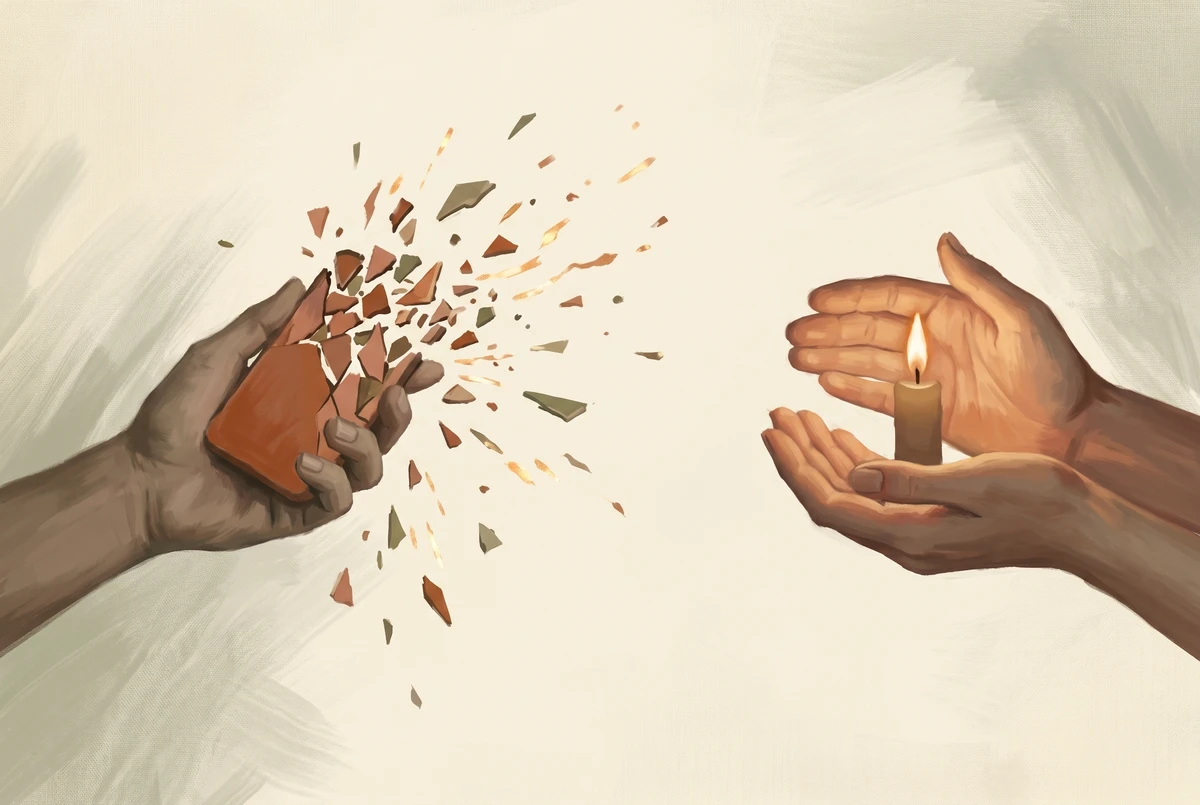
Session length is another ceiling. Apps default to 5 to 15 minutes. The Creswell and Goldberg review notes that average app use runs 10 to 21 minutes per day, 3 days per week, compared to 30 to 45 minutes daily in structured meditation programs. As Creswell put it: “That looks really different from the daily meditation practice you might get within an in-person group-based meditation program.” Longer sessions produce larger effects: Adams et al. (2018, cited in Creswell and Goldberg) found that greater daily practice time led to greater blood pressure reductions over six months, but adherence dropped fastest in the longer-session group. The practice duration that produces the most benefit is the one users are least likely to sustain.
The guided voice, initially helpful, eventually becomes the interruption. When your concentration can sustain itself for a few minutes, someone talking to you every 30 seconds breaks it rather than supporting it.
And the gamification metrics (streaks, badges, progress bars) reward consistency of behavior, not depth of practice. You can maintain a 365-day streak without once sitting in genuine silence. As one long-time meditator put it on Product Hunt: apps “have kind of gone the way of Duolingo in terms of being more about gamification and streaks and not so much about actually learning.”
What “practicing without technology” means isn’t buying special equipment. It means a practice that exists in your body and attention rather than on a screen. Your breath. A candle. A mantra. A place where you sit. Traditional practices like trataka (candle gazing), breath counting, and zazen have worked for thousands of years with nothing except a willing practitioner. 
How to know when you’ve outgrown your app
Five signs the app has given you what it can:
Sessions feel automatic. You complete them without registering the content. The session ends and you don’t feel any different from when you started.
You’re browsing more than practicing. Scrolling through the content library for the right session has replaced actually sitting. The variety that initially helped has become another form of choice paralysis.
You can’t sit in silence for two minutes. If meditating without a guided voice feels uncomfortable or impossible, the app is doing the work your attention should be learning to do. That’s dependency, not practice.
You meditate for the streak. When your motivation shifts from wanting to sit to not wanting to break a number, the metric has replaced the practice.
You feel stuck after two to three months. This is the plateau, and it’s the app’s ceiling, not your failure. Neurosity’s analysis described it precisely: “Once you’ve completed the foundational courses, the thematic packs follow a similar structure. Long-term users frequently report a plateau where sessions stop feeling like they’re pushing growth.”
The transition doesn’t need to be abrupt. Start with five minutes of silent sitting before your guided session. Gradually extend the silent portion. Use the app three times a week instead of daily. Eventually, the guided session becomes the warm-down, not the main event.
The honest answer
Apps produce real short-term benefits. No trial has shown they develop long-term meditation capacity, and the structural incentives of subscription products work against it.
The business model makes this structural, not incidental. A user who develops independent practice is a churned subscriber. This doesn’t make apps malicious. It makes them a business whose incentives eventually diverge from the user’s development. Creswell himself put it plainly: “I don’t think there is ever going to be a complete replacement for a good, in-person meditation group or teacher. But I think meditation apps are a great first step.”
If you used an app for a month and stopped, you didn’t fail at meditation. You finished the introductory course. The question isn’t whether to go back to the app. It’s whether you’re ready for what comes after it.
Meditation is one of the few skills where the tool you start with is supposed to become unnecessary. That’s not a flaw in the design. That’s the whole point.
Sources
- Creswell, J.D., & Goldberg, S.B. (2025). “The Meditation App Revolution.” American Psychologist. DOI: 10.1037/amp0001576. PMC full text.
- Lindsay, E.K., Young, S., Smyth, J.M., Brown, K.W., & Creswell, J.D. (2018). “Acceptance Lowers Stress Reactivity: Dismantling Mindfulness Training in a Randomized Controlled Trial.” Psychoneuroendocrinology, 87, 63–73. PMID: 29040891.
- Economides, M., et al. (2018). “Improvements in Stress, Affect, and Irritability Following Brief Use of a Mindfulness-based Smartphone App: A Randomized Controlled Trial.” PMID: 30294390.
- Baumel, A., Muench, F., Edan, S., & Kane, J.M. (2019). “Objective User Engagement With Mental Health Apps: Systematic Search and Panel-Based Usage Analysis.” Journal of Medical Internet Research, 21(9), e14567. DOI: 10.2196/14567.
- Lam, S.U., Xie, Y., & Goldberg, S.B. (2023). “Situating Meditation Apps Within the Ecosystem of Meditation Practice: Population-Based Survey Study.” JMIR Mental Health, 10, e43565. DOI: 10.2196/43565.
- Huberty, J., et al. (2022). Calm app randomized controlled trial (n=1,029). Cited in Creswell & Goldberg (2025), reference #33.
- VGZ Mindfulness Coach study. (2018). “Efficacy of a Mindfulness-Based Mobile Application: A Randomized Waiting-List Controlled Trial.” Mindfulness (Springer). PMID: 29387266.
- Macrynikola, N., et al. (2024). “The Impact of Mindfulness Apps on Psychological Processes of Change: A Systematic Review.” npj Mental Health Research, 3(14). DOI: 10.1038/s44184-023-00048-5.
- Wasil, A.R., et al. (2020). Cited in Creswell & Goldberg (2025) for the finding that Headspace and Calm account for 96% of daily active mental health app users.
- Hirshberg, M.J., et al. (2025). Cited in Creswell & Goldberg (2025) for the finding that loneliness reductions accounted for 62% of distress reduction in a smartphone mindfulness program.
- Adams, Z.W., et al. (2018). Cited in Creswell & Goldberg (2025) for dose-response findings on meditation duration and blood pressure reduction.
- Keller, A.J. (2026). ”Calm vs Headspace vs Waking Up for Meditation 2026.” Neurosity.