Evening Meditation Routine: A Step-by-Step Guide
Miha Cacic · April 11, 2026 · 7 min read
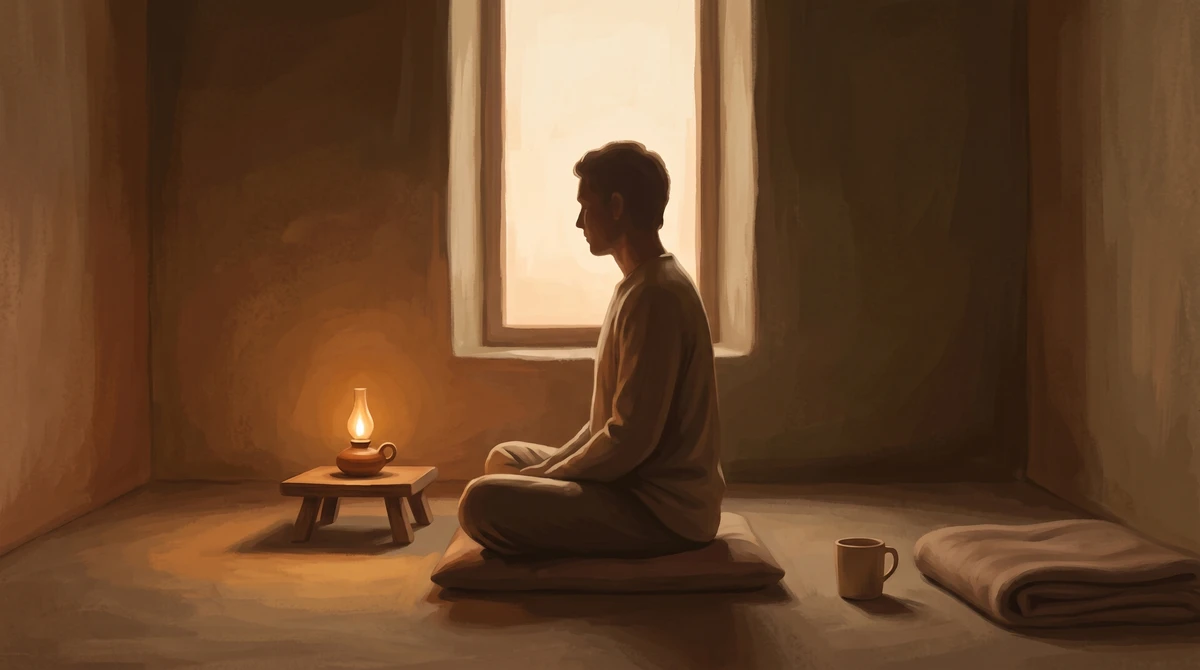
Most guides on evening meditation hand you a list of relaxation tips (dim the lights, brew tea, do a body scan in bed) and call it meditation. That’s a bedtime routine, not a meditation routine. An actual evening meditation practice has a specific purpose: transitioning from the noise of the day into genuine stillness. It has a specific timing: before you get into bed, not in it. And it works best with techniques that use your evening fatigue as an advantage rather than letting it pull you into sleep.
Why evening meditation is not the same as sleep meditation
Sleep meditation helps you fall asleep. Evening meditation helps you sit with what happened today, sharpen your concentration, and arrive at stillness before rest. They have different goals, different postures, and different techniques. Treating them as the same thing is why so many people either doze off or quit.
The difference is practical, not philosophical. When you always meditate lying in bed with your eyes closed, you train your nervous system to treat meditation as a sleep cue. It’s the same mechanism behind the clinical advice “don’t work in bed” from stimulus control therapy for insomnia. Over time, this association can bleed into your seated practice. The shared cues of closing your eyes and turning attention inward trigger the same drowsy response even when you’re sitting upright.
Adam Coutts, a meditation teacher in the Shinzen Young lineage, puts it clearly: broad, open awareness practices (like body scans) are “best for tranquilizing,” while concentration meditation “can produce an energetic alertness that is the opposite of drifting off to sleep.” This isn’t a flaw. It’s a design feature. If your goal is to stay awake and aware, you need a technique that promotes alertness, not one that sedates you.
Both approaches are valuable. You can do both in the same evening: meditate first (seated, alert), then use a sleep technique (lying down, releasing) when you get into bed. S.N. Goenka’s Vipassana tradition explicitly teaches this sequence, with body scanning in bed as a deliberate bridge between practice and sleep. The problem isn’t either practice. It’s calling them the same thing.
When to meditate in the evening
There are three distinct windows in the evening, and they produce different results. 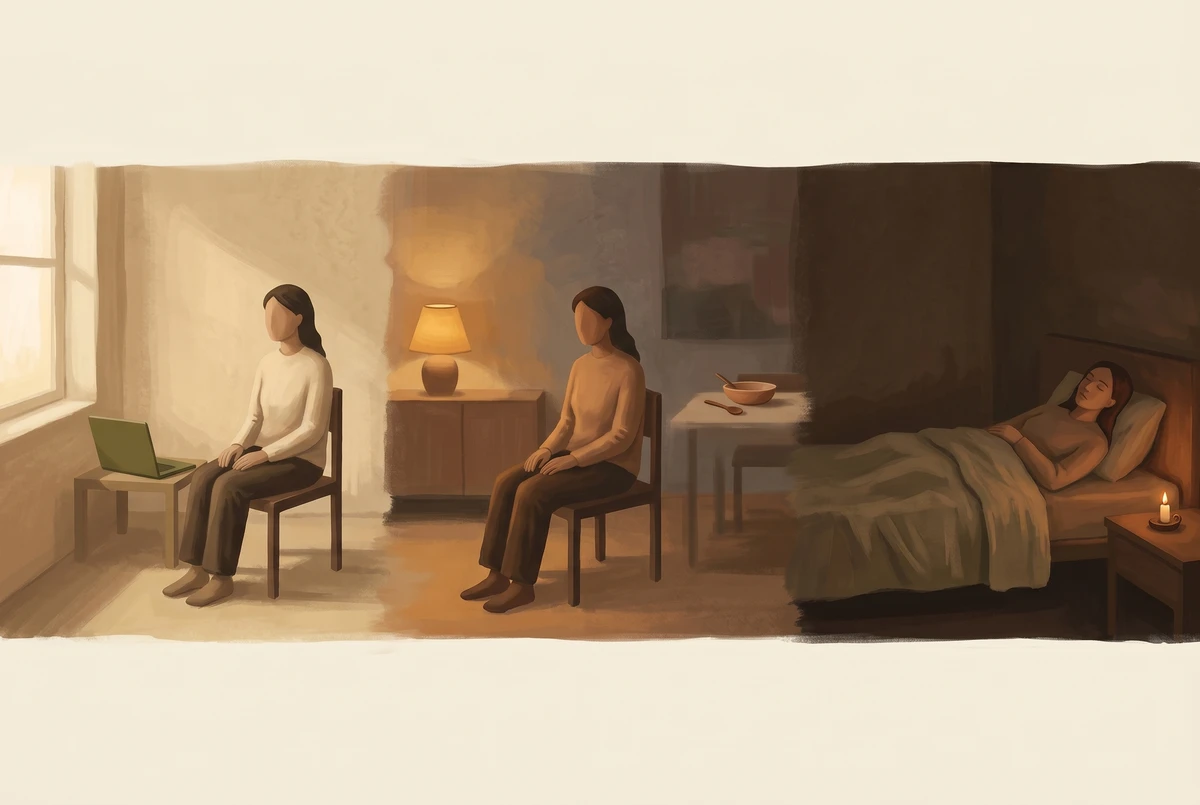
After work, before dinner. This creates a clean break between your work day and your home life. You’re still alert enough for seated practice, and the session acts as a reset. The downside: if you’re starving, hunger will be your meditation object whether you want it or not.
After dinner, before bed. The most common window, and it works well if you wait long enough after eating. Meditating on a full stomach produces sluggishness and drowsiness. Both the yoga tradition and practical experience point to waiting two to three hours after a meal. Christian Möllenhoff, a Satyananda tradition teacher, is direct about this: “If [you haven’t digested your last meal], you risk having a sleepy practice.”
In bed, at lights-out. This is sleep meditation, not evening meditation practice. It has its own value (and there’s solid research behind it), but it’s a different activity with a different goal.
The circadian timing works in your favor regardless of which window you choose. Cortisol follows a reliable daily curve: it peaks in the morning and drops to its lowest point in the late evening. Your nervous system is already shifting toward parasympathetic dominance. You don’t need to force relaxation. You just need to direct the stillness that’s already arriving.
One practical tip: attach your meditation to something you already do every evening (after brushing your teeth, after the kitchen is clean, after putting the kids to bed) rather than setting an arbitrary clock time. The habit sticks faster when it’s anchored to an existing routine.
What the evening gives you that morning doesn’t
Morning meditation works with a relatively blank slate. Evening meditation works with raw material: an entire day of experiences, conversations, decisions, and unprocessed reactions.
This is an advantage, not a problem. Your mind has something real to settle. Many practitioners find that evening fatigue actually helps: the buzzing mental energy that makes beginners feel like meditation isn’t working has already spent itself. For many people, this makes evening practice easier than morning, not harder.
One Quora practitioner with years of daily experience captured it well: “I love the nights. You are naturally at a certain ease. You are also more open to self-reflection compared to the busy day. Less calls, less noise.”
The Theravada Buddhist tradition frames it differently but arrives at the same conclusion. The instruction (found in teachers like Bhante Gunaratana) is to maintain mindful awareness as continuously as possible throughout waking hours. Meditating before sleep extends that awareness to the last conscious moment of the day. It’s not a backup for a missed morning sit. It’s the bookend that completes the practice.
There’s also a processing function unique to evening. Journaling does this cognitively (you write about what happened). Meditation does it somatically (you notice where the day’s tension lives in your body and let it release). The Satyananda yoga tradition calls this “digesting” the day’s impressions (samskaras), and they teach that unprocessed experiences carried into sleep generate restless dreams.
A structured evening meditation routine
Here’s a complete routine you can start tonight. Total time: 22 to 33 minutes. If you’re new to meditation, start with 15 minutes by shortening phases 2 and 3.
Phase 1: Transition (5 minutes)
Put away your phone and any screens. Sit wherever you’ll meditate. Do nothing for a moment. This buffer between activity and stillness is not meditation yet. It’s the equivalent of letting a car engine idle before turning it off. Your nervous system needs a few minutes to register that the doing part of the day is finished.
Phase 2: Body settling (5 minutes)
Three to five simple stretches, focusing on wherever you hold tension (neck, shoulders, hips, lower back). This isn’t a yoga class. You’re just releasing the physical residue of sitting, standing, or moving all day so it doesn’t distract you during meditation.
Follow the stretching with 10 to 15 slow breaths. Inhale through the nose for a count of four, exhale for a count of six or eight. The longer exhale activates your parasympathetic nervous system, slowing your heart rate and signaling safety.
Phase 3: Seated meditation (10 to 20 minutes)
Sit upright on a chair, cushion, or meditation bench. This is important: sit up, don’t lie down. The posture itself is a signal to your body that this is practice, not sleep.
Choose one technique:
Trataka (candle gazing). Light a candle and place it roughly arm’s length in front of you, with the flame at or just above eye level. Gaze at the brightest part of the flame without straining. Blink when you need to (some traditions say gaze until tears come, but gentle practice works). After three to five minutes, close your eyes and hold the after-image (a luminous impression of the flame) at the point between your eyebrows. Stay with this inner image until it fades, then open your eyes and repeat. 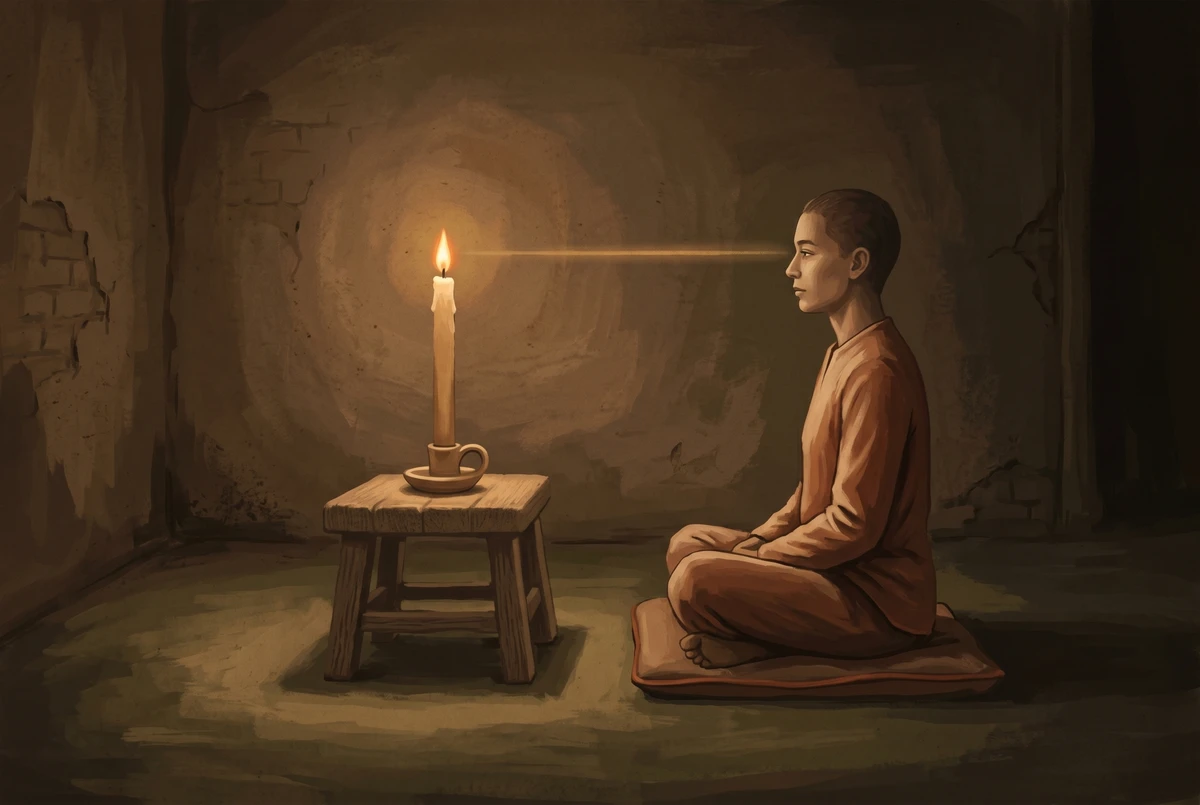
Trataka is particularly well suited to evening practice. The dark room it requires is naturally available at night. The external visual focus keeps your attention anchored, preventing the inward drift toward drowsiness. The Hatha Yoga Pradipika, one of the foundational yoga texts, says in verse II.32 that trataka “removes sloth,” which is exactly the problem evening practitioners face. Multiple traditions recommend it specifically for practitioners who struggle with insomnia.
Breath awareness. Count each exhale from 1 to 10, then restart. When you lose count (and you will), notice that you drifted, and begin again at 1. The simplicity is the point. This is concentration training, not a relaxation exercise.
Day review. Replay the day in reverse, from this moment backward to waking. The reverse direction matters: it keeps the review observational rather than letting you relapse into the day’s narrative. Watch each event like a film. Observe without re-engaging emotionally. This practice appears in the Satyananda tradition (related to chidakasha dharana) as a method for processing the day’s experiences without rumination.
If your eyes feel heavy, keep them open or half-open. Adjust your technique to your energy level. Ten alert minutes of practice are worth more than twenty drowsy ones.
Phase 4: Closing (2 to 3 minutes)
Release whatever technique you were using. Sit in open awareness with no object and no effort. Let whatever is present be present. After a minute or two, slowly open your eyes and transition to the rest of your evening.
The best evening meditation techniques (and which to avoid)
Not every meditation technique works well at night. The wrong choice can either knock you out or leave you wired.
Works well in the evening:
Trataka (candle gazing). External focus prevents drowsiness. The dark room is calming without being sedating. Christian Möllenhoff, drawing from the Satyananda tradition, notes that “many people appreciate concentration-based meditations such as tratak or nada yoga for late in the evening. They say such techniques give good sleep and clear dreams.”
Breath counting or breath awareness. Simple, portable, scales with experience. The slight effort of counting maintains alertness.
Seated body awareness. Scanning your body while sitting upright processes physical tension without inducing sleep. The upright posture is what makes the difference. A lying-down body scan uses the same basic technique but is designed to sedate. Sit up and the same practice sharpens attention instead.
Day review. Uses the day’s actual experiences as your meditation object. The evening is the only time this practice makes sense.
Use with caution:
Energizing pranayama (kapalabhati, bhastrika). These generate heat and alertness. Done too close to bedtime, they can leave you staring at the ceiling for hours.
“Do nothing” or open monitoring meditation. This can work well when you’re alert, but in the evening it often slides into drowsy daydreaming. If you notice yourself drifting repeatedly, switch to something with more structure.
Fine, but different work:
Guided audio relaxation, progressive muscle relaxation, and sleep stories are relaxation tools. They’re useful for falling asleep, and there’s nothing wrong with using them after your meditation. But they do different work than meditation practice: they supply the direction rather than training you to direct your own attention.
How to stop falling asleep during evening meditation
This is the most common problem with evening practice, and it has a straightforward explanation. You’re tired. You close your eyes. You relax. Your body interprets this as permission to sleep. It’s not a failure; it’s your nervous system doing exactly what it’s supposed to do.
The first question to ask is honest: are you trying to meditate, or are you trying to sleep? If you want sleep, let yourself sleep. If you want to meditate, make these adjustments:
Sit up. This is the single most effective change. Lying down is a sleep posture. Your body knows this. 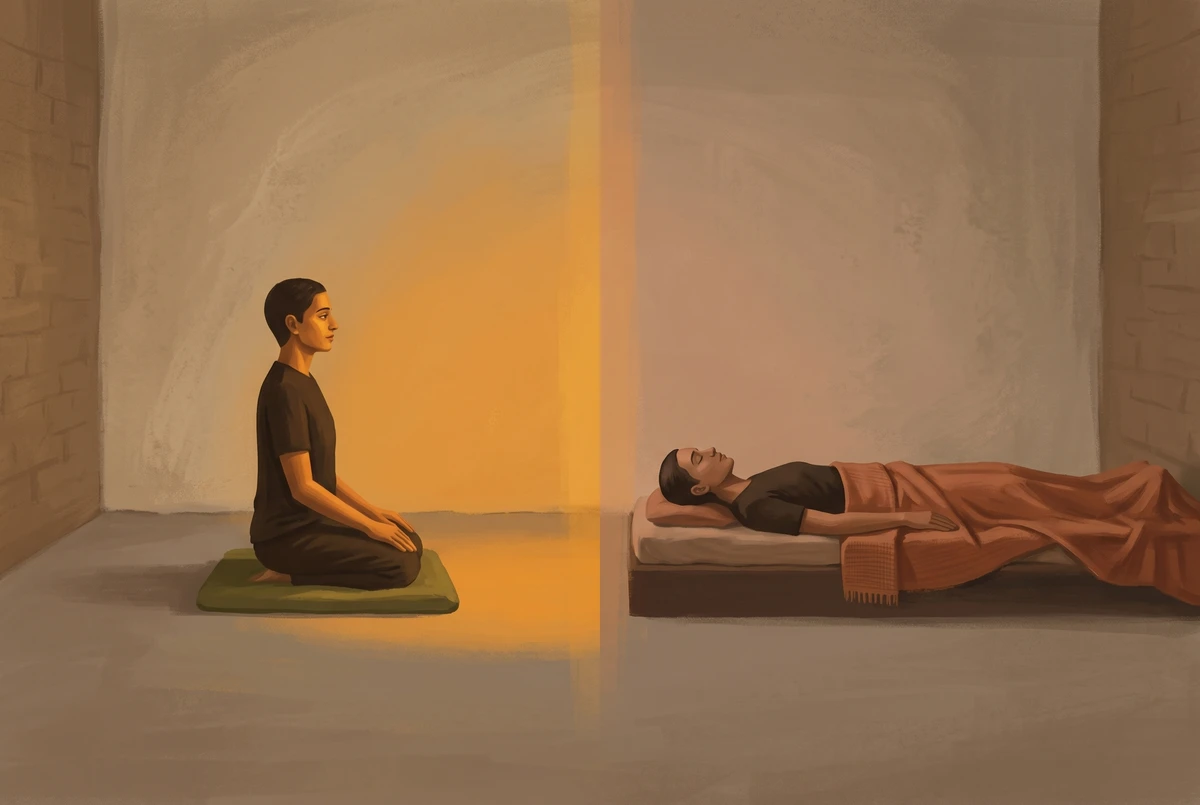
Keep your eyes open or half-open. Trataka is designed for exactly this situation. Even without a candle, a soft, unfocused gaze at a point on the floor keeps the visual system engaged enough to prevent sleep onset.
Meditate earlier in the evening. If you’re nodding off at 10:30 PM, try 8:30 PM. You’ll still get the benefits of evening practice without fighting your body’s sleep drive.
Shorten the session. Fifteen minutes of alert meditation is a real practice. Thirty minutes of nodding in and out is not.
Don’t meditate right after a heavy meal. A full stomach promotes drowsiness on its own, and that compounds your existing evening tiredness.
If none of these adjustments help, consider the possibility that falling asleep is giving you information about your sleep debt, not about your meditation skill. Meditation does improve sleep quality over time. A 2015 randomized trial (Black et al.) in JAMA Internal Medicine found that a six-week mindfulness program significantly improved sleep in older adults compared to sleep hygiene education alone (effect size 0.89). But that improvement came from consistent practice changing sleep patterns, not from pushing through exhaustion in any single session. If you’re chronically drowsy, address the sleep debt first.
There’s one more possibility. Drowsiness in evening meditation isn’t always physical fatigue. It can be a form of avoidance: your mind shutting down rather than looking at something uncomfortable that surfaced during the day. If you notice that you’re only drowsy when your mind touches certain topics, that’s worth paying attention to.
Evening meditation vs. morning meditation
They serve different functions. Morning meditation sets intention and clarity for the day ahead. Evening meditation processes what happened and practices letting go. Neither is superior.
If you can only do one, do whichever you’ll actually do consistently. A meta-analysis of 18 randomized trials (Rusch et al., 2019) found that meditation’s sleep-quality benefits were stronger at five to twelve month follow-up (effect size 0.54) than immediately after the intervention (effect size 0.33), suggesting the benefits deepen with sustained practice. That matters more than the specific hour on the clock.
Many established traditions prescribe both. Transcendental Meditation, the Satyananda tradition, and Zen all include morning and evening sits as standard practice. The evening sit isn’t a lesser version. It completes the daily cycle.
If you want to build toward both sessions, start with one and practice it consistently for four to six weeks before adding the other. Two shaky habits are worse than one solid one.
There’s also a biological argument for evening practice that often gets overlooked. Tooley et al. (2000) found that experienced meditators showed significantly higher plasma melatonin levels in the period immediately following meditation compared to a control night without meditation. If done in the evening, meditation may support the natural rise in melatonin that prepares your body for sleep. This was a small study with experienced practitioners, so it’s suggestive rather than definitive, but it aligns with what many evening meditators report: better sleep quality without using meditation as a sleep tool.
Sources
- Black, D.S., O’Reilly, G.A., Olmstead, R., Breen, E.C., & Irwin, M.R. (2015). “Mindfulness meditation and improvement in sleep quality and daytime impairment among older adults with sleep disturbances: a randomized clinical trial.” JAMA Internal Medicine, 175(4), 494–501. PMID: 25686304.
- Rusch, H.L., Rosario, M., Levison, L.M., Olivera, A., Livingston, W.S., Wu, T., & Gill, J.M. (2019). “The effect of mindfulness meditation on sleep quality: a systematic review and meta-analysis of randomized controlled trials.” Annals of the New York Academy of Sciences, 1445(1), 5–16. PMCID: PMC6557693.
- Tooley, G.A., Armstrong, S.M., Norman, T.R., & Sali, A. (2000). “Acute increases in night-time plasma melatonin levels following a period of meditation.” Biological Psychology, 53(1), 69–78. PMID: 10876066.
- Swatmarama. Hatha Yoga Pradipika, II.31–32. Trans. Pancham Sinh (1914).
- Möllenhoff, C. (2020). “How to Practice Tratak: Your Complete Guide.” Forceful Tranquility.
- Satyananda Saraswati, Swami. A Systematic Course in the Ancient Tantric Techniques of Yoga and Kriya (1981). Bihar School of Yoga.
- Gunaratana, B.H. (1991/2002). Mindfulness in Plain English. Wisdom Publications.