How Did People Meditate Before Apps and Timers?
Miha Cacic · April 11, 2026 · 4 min read
They didn’t use timers. For most of meditation’s history, nobody sat down, set a duration, and waited for a bell. The timer-dependent session is an invention of the last few decades, born when meditation left monasteries and entered living rooms. Before that, the practice itself told you when to stop.
The practice was the timer
For thousands of years, the question of “when am I done?” was answered without a clock.
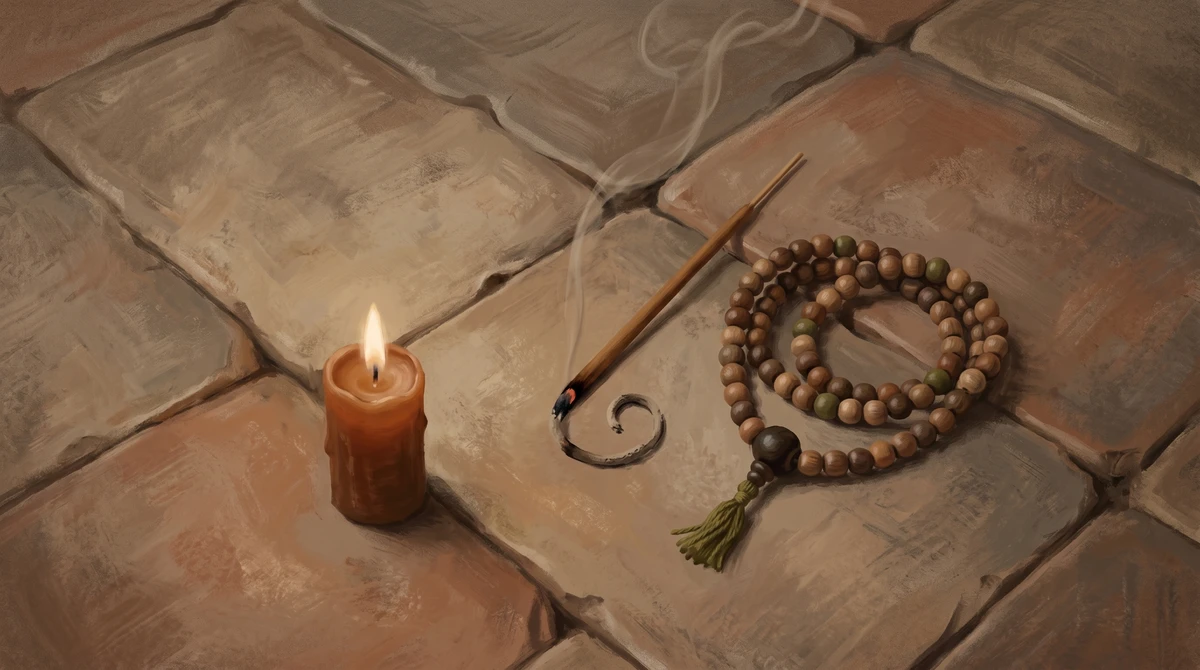
The object defined the session. In trataka, a yogic gazing practice documented in the Hatha Yoga Pradipika (15th century), you stare at a candle flame or a point until tears flow. That’s the complete instruction. The text defines the practice as “gazing steadily at a small mark until tears flow” (Svātmārāma, ch. 2, ślokas 31–32). The endpoint is physiological, not chronological. Your body decides when you’re done. 
In mantra meditation, practitioners used mala beads, a loop of 108 beads plus a “guru bead” that marks the starting point. You move one bead per repetition. When your fingers reach the guru bead again, one round is complete. The earliest literary reference to malas for counting mantras comes from a Buddhist text translated into Chinese during the Eastern Jin era (4th–5th century CE). The mala doesn’t tell you how long you’ve been sitting. It tells you when you’ve completed something, a structure fundamentally different from watching minutes count down. 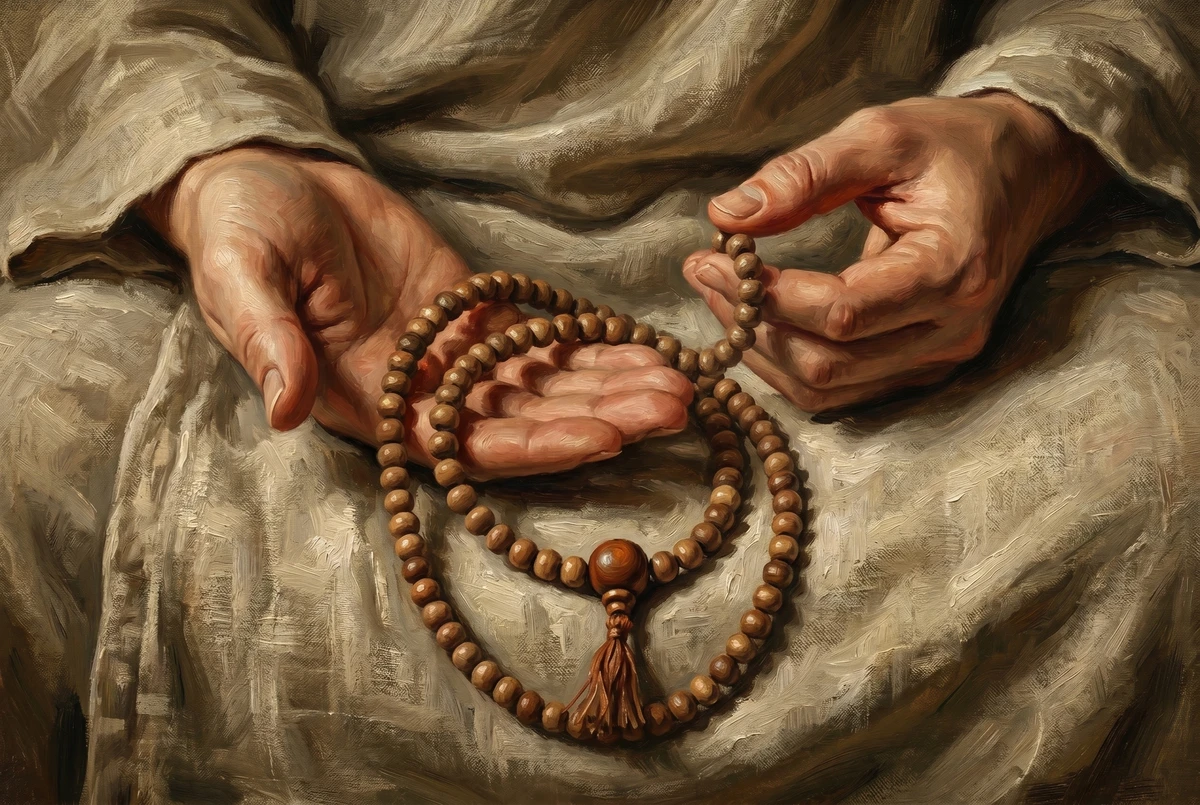
Combustion marked the time. Incense clocks appeared in China by at least the 6th century CE. The Chinese poet Yu Jianwu wrote: “By burning incense we know the o’clock of the night / With graduated candle we confirm the tally of the watch.” Silvio Bedini’s definitive 1963 study in the Transactions of the American Philosophical Society documents two main types: stick incense (calibrated to burn at known rates) and powdered “seal” incense (labyrinth-shaped trails pressed into grooved disks that could burn anywhere from 12 hours to a full month).
The engineering was sophisticated. Some clocks used differently scented incense at different points along the trail, so you could smell what time it was without opening your eyes. Others, called “dragon fire clocks,” had threads stretched across the incense body with small metal balls attached. As the incense burned to each thread, the heat broke it, the ball dropped into a brass pan below, and the clang served as an alarm. The Jesuit missionary Father Gabriel de Magalhaen, observing these in the mid-1660s, wrote: “This method of measuring time is so accurate and certain that no one has ever noted a considerable error.” 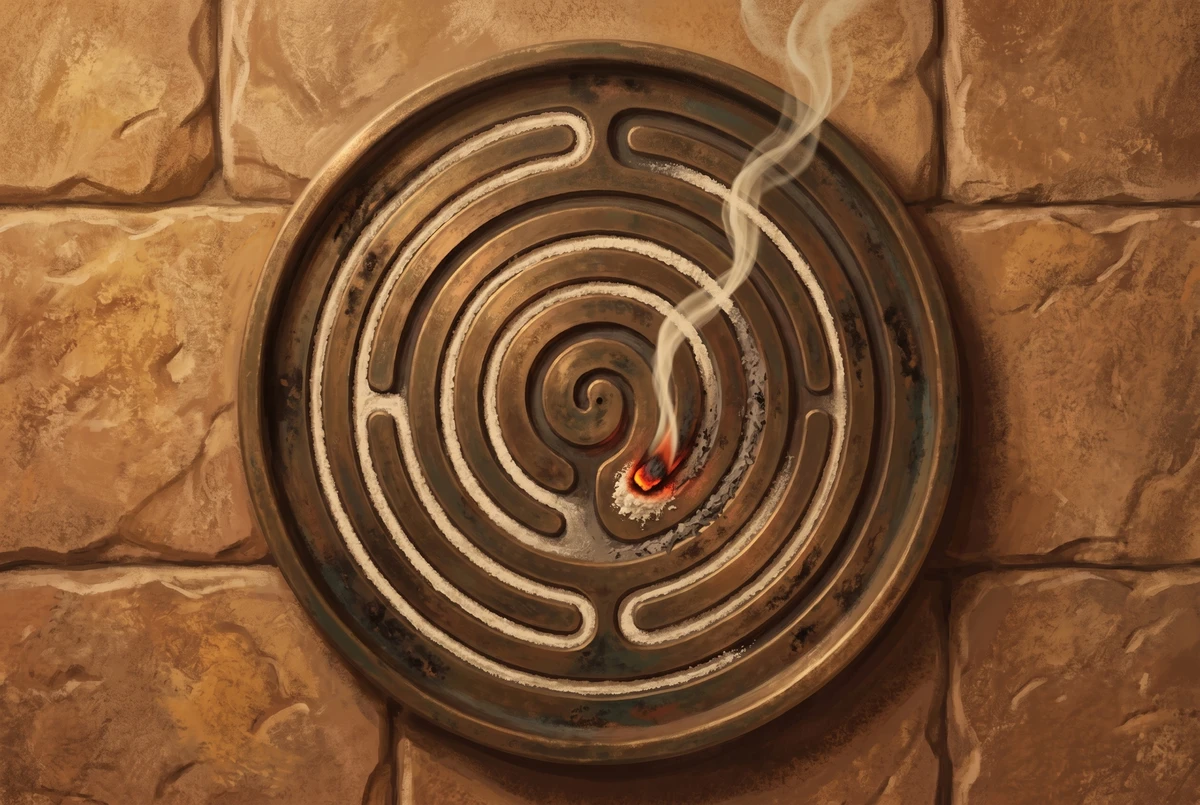
These weren’t niche curiosities. In Japan, geishas were paid by the number of senko-dokei (incense clocks) consumed during their visit, a practice that continued until 1924. In China, coal miners used incense to track time underground well into the 20th century.
Community and schedule replaced personal timers
For most of history, meditation wasn’t something you did alone at home. It happened in monasteries, temples, ashrams, and sanghas, and the community handled timing so the individual didn’t have to.
In Zen temples, a period of zazen begins with three bell rings (shijosho) and ends with one or two rings (hozensho). A designated timekeeper manages the schedule. Nobody in the meditation hall carries a personal timer because the institution handles every transition.
The structure of practice was different, too. Sessions didn’t follow a “sit for X minutes” format. In both Zen and Theravada traditions, sitting meditation alternates with walking meditation (kinhin), where practitioners walk slowly in circuits or along a straight path. The rhythm was sit-walk-sit, governed by the teacher or the monastic schedule. In the Tiantai (Tendai) Buddhist tradition, “Constantly Walking Samadhi” meant 90 continuous days of walking meditation while contemplating Amitabha. The unit of duration wasn’t minutes. It was retreat cycles. 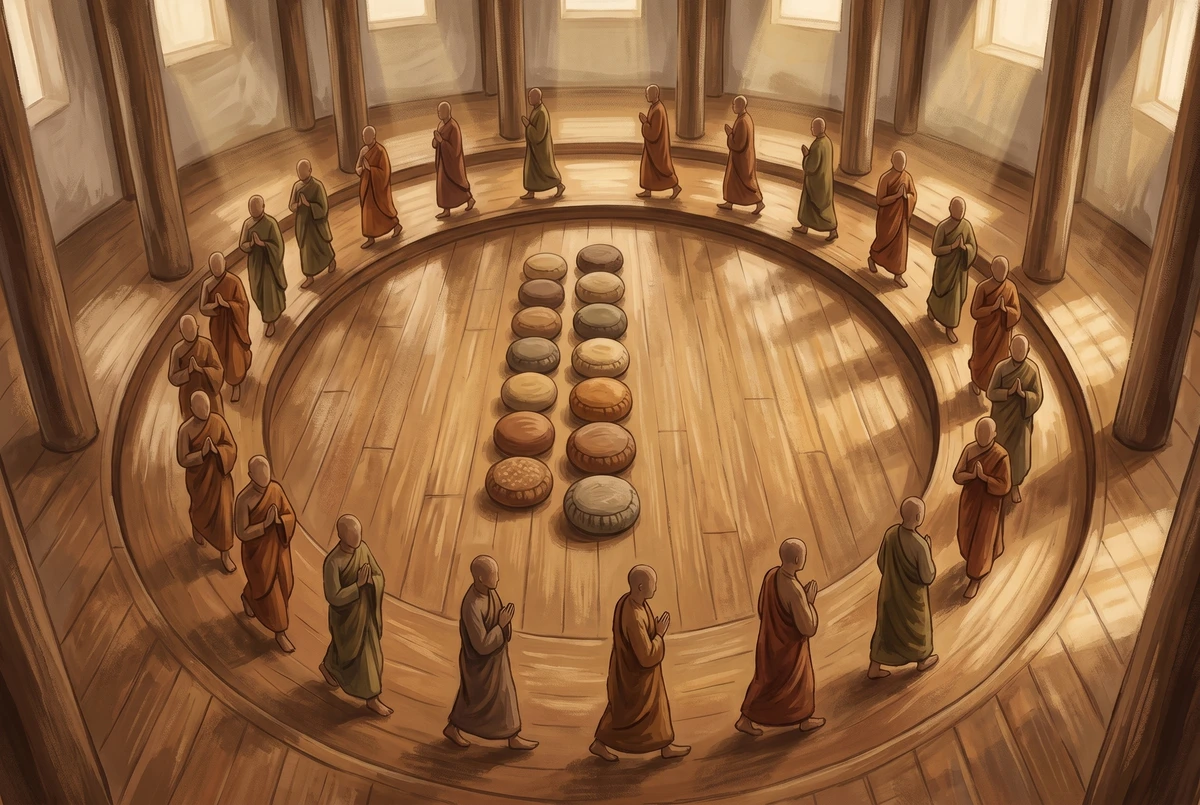
Hindu contemplative practice followed natural rhythms instead of clocks. Sandhyavandanam, a mandatory ritual referenced in the Ramayana and Mahabharata, was performed three times daily, timed to sunrise, noon, and sunset. The morning practice spans a window around dawn. No clock needed. The sun was the clock. 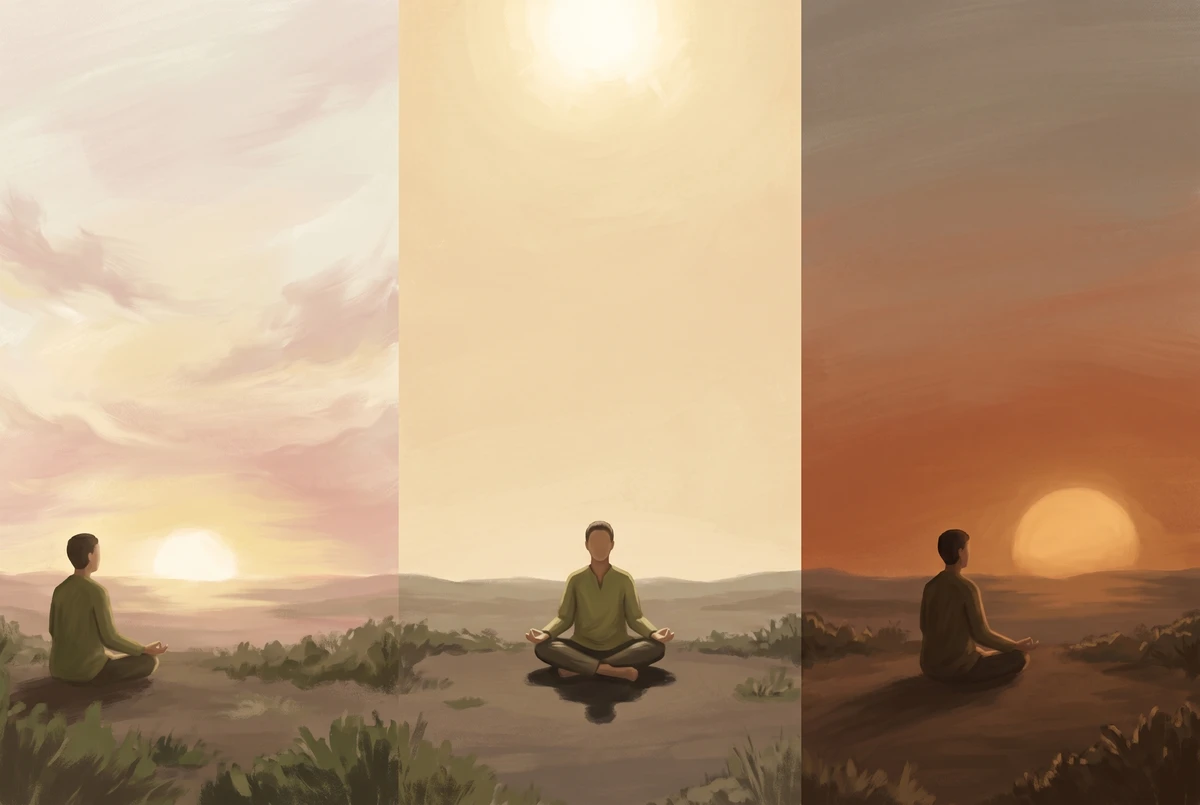
Notice what’s absent from all of these: any assumption that a solitary practitioner needs to decide how long to sit. The question doesn’t arise when the community, the teacher, or the sky determines your schedule.
“How long should I meditate?” is a modern question
This question barely existed before the 20th century. Traditional practitioners were embedded in lineages with teachers who prescribed the practice, its form, and its context. Duration was either implicit (the incense stick, the mala cycle, the bell) or beside the point (you practice until the state arises, not until a timer fires).
The fixed-duration prescription we now take for granted traces to a specific source: Maharishi Mahesh Yogi’s Transcendental Meditation movement. Maharishi began teaching TM publicly in 1955 and prescribed 15–20 minutes, twice per day. By the 1960s and 70s, with endorsements from the Beatles and the Beach Boys, this format became the default template for what a meditation session “should” look like. No classical meditation text prescribes a specific number of minutes. The Yoga Sutras of Patanjali describe dharana, dhyana, and samadhi as progressive states, not durations. You advance through depth, not clock time. The Pali canon’s teaching on Wise Effort (SN 45.8) instructs practitioners to cultivate wholesome states and abandon unwholesome ones. It says nothing about maintaining a seated position for any fixed period.
The need for personal timers emerged when meditation left its institutional context. Solo practitioners without teachers or sanghas needed something to replace the community structure. First it was kitchen timers and alarm clocks. Then phone alarms. Then Insight Timer (launched around 2009), Headspace (founded 2010, app launched 2012), and Calm (2012).
Meditation apps solved a problem that only exists because meditation was extracted from the context that originally made timers unnecessary.
What we lost (and what’s worth reclaiming)
Buddhist teacher Sean Feit Oakes argues that timers introduce a subtle distortion. They frame meditation as being about duration. His words: “when we introduce a timer, a subtle bad idea is introduced into the practice: that it’s about duration. That if we make it through to the end of the allotted time, whether that’s 5 minutes or 60, that we’ve succeeded.”
In meditation forums, people describe their practice with endurance language: “making it to the end,” “surviving” a 20-minute session, “getting through” the sit. The practice becomes a countdown to a finish line.
The original Buddhist instruction, as Oakes points out, works differently. The Pali canon describes concentrating the mind, then kneading the pleasure (piti, rapture) that arises naturally into the whole body until the body is saturated. When a hindrance appears, the instruction is to bring in an antidote, not to sit through it because the timer hasn’t gone off. There’s a real difference between sitting through discomfort because you have the energy and interest for your own growth, and sitting through it because a countdown is still running.
A 2015 study by Marc Wittmann and colleagues in Frontiers in Psychology approached this from another angle. They compared 42 experienced meditators (average 10 years of practice) against 42 matched controls. The meditators reported less time pressure and experienced time as passing more slowly. But they showed no improvement in psychophysical duration estimation tasks: they couldn’t estimate minutes and seconds any better than non-meditators. What changed wasn’t their internal clock’s accuracy. It was their relationship with time itself. The study was cross-sectional, so it can’t establish whether meditation produced this shift or whether people who experience time this way are drawn to meditation. But either reading points the same direction: experienced meditators aren’t better timekeepers. They’re less interested in timekeeping.
None of this means you should delete your meditation app. But if you want to experiment with the older approach, the simplest way is also the most ancient: light a stick of incense or a candle. If you practice trataka (candle gazing), the object is both the focus of your meditation and the timekeeper. When the incense burns down, or your eyes water, or your body says it’s done, you stop. No countdown. No bell anxiety. Just the practice containing its own ending, the way it did for centuries before anyone thought to set a timer.
Sources
- Bedini, Silvio A. (1963). “The Scent of Time: A Study of the Use of Fire and Incense for Time Measurement in Oriental Countries.” Transactions of the American Philosophical Society, 53(5), 1–51. DOI: 10.2307/1005923.
- Soth, Amelia. (2022). “Keeping Time with Incense Clocks.” JSTOR Daily.
- Wittmann, M., Otten, S., Schötz, E., Sarikaya, A., Lehnen, H., Jo, H.G., Kohls, N., Schmidt, S., & Meissner, K. (2015). “Subjective Expansion of Extended Time-Spans in Experienced Meditators.” Frontiers in Psychology, 5, 1586. DOI: 10.3389/fpsyg.2014.01586. PubMed: 25642205.
- Oakes, Sean Feit. “Ditch Your Meditation Timer (Use It Differently).” seanfeitoakes.com.
- Svātmārāma. Haṭha Yoga Pradīpikā (15th century CE), Chapter 2, ślokas 31–32.
- Gheranda Saṃhitā (17th century CE), Chapter 1.
- Patanjali. Yoga Sutras (~2nd century BCE).
- Samyutta Nikaya 45.8, “Wise Effort” (Pali Canon).
- Mu Huanzi Jing (Taishō Tripiṭaka vol. 17, no. 786), Eastern Jin era (4th–5th century CE).