How to Get Back Into Meditation After Quitting
Miha Cacic · April 11, 2026 · 5 min read

You don’t need more discipline to restart meditation. You need to figure out why you stopped, because the reason you quit determines which restart approach will actually stick. Most advice skips this step and hands you the same generic checklist that didn’t prevent you from quitting in the first place.
Why you stopped matters more than how you restart
Every article on restarting meditation gives you the same advice: start small, don’t judge yourself, be consistent. This is fine if your only problem was logistics. But quitting meditation follows at least four distinct patterns, and only one of them responds to the standard restart checklist.
The boredom quit. Your practice became routine. Sessions felt flat, benefits plateaued, and sitting down started to feel like filling out paperwork. The root cause isn’t laziness; it’s that your technique stopped engaging you. One Elephant Journal essayist described quitting after 30 years for exactly this reason: the form of the practice had outlived the experience it once produced. The fix here isn’t discipline. It’s a different technique. 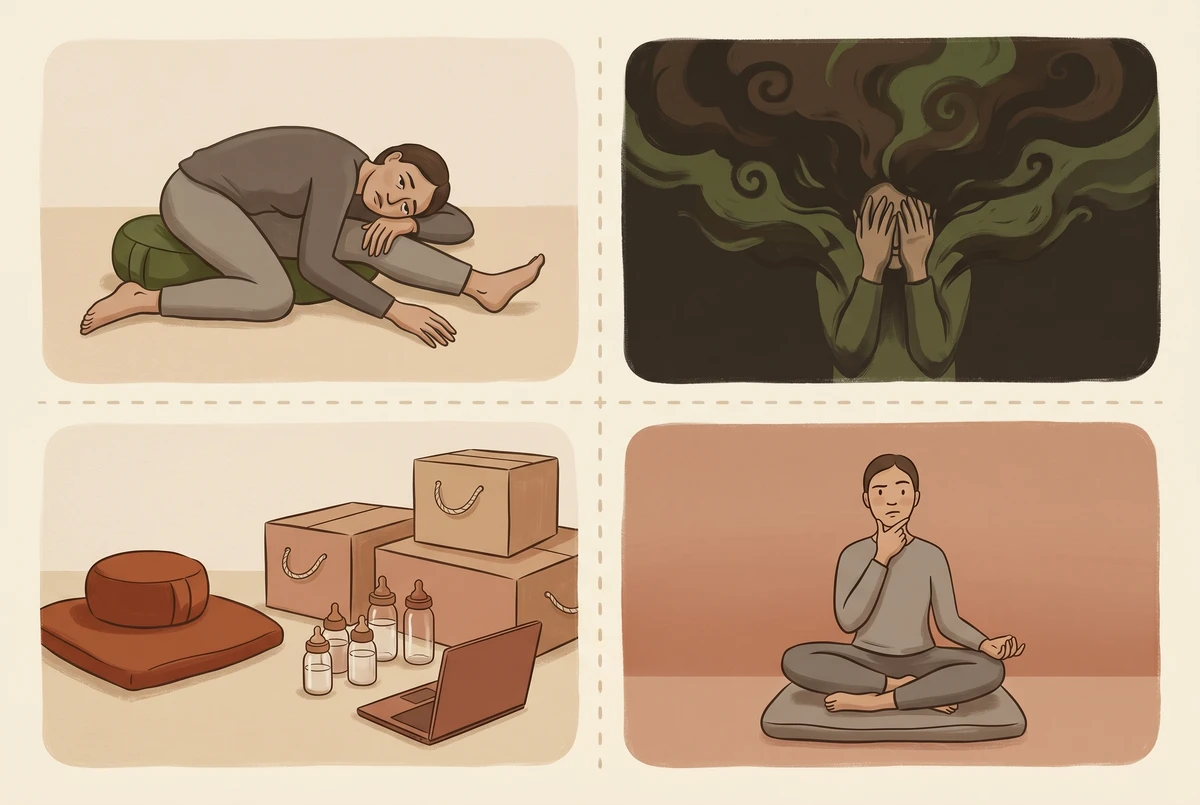
The overwhelm quit. Meditation surfaced difficult emotions (anxiety, grief, a restlessness you couldn’t sit with) and with no framework for processing them, you stopped. This is more common than most guides acknowledge. Clinical reviews of meditation-related adverse effects suggest that roughly one in four meditators report at least one challenging experience during or after practice. These aren’t signs that meditation is harmful; they’re signs that certain techniques, particularly open-monitoring practices like breath awareness, can surface material the practitioner isn’t equipped to process alone. One Headspace community member described the pattern: “I’d focus on my breath or an image, only to find myself back in the same negative loops.” The fix isn’t to push through. It’s to switch to a technique with an external anchor that gives your mind less room to spiral.
The life-disruption quit. A new baby, a job change, a move. Meditation fell off the schedule because everything fell off the schedule. This is the only pattern most restart advice actually addresses, because the solution is straightforward: rebuild the habit trigger, start absurdly small, and anchor the practice to something you already do every day. Huberty et al. (2023) studied 3,275 Calm app users in a clinical trial and found that anchoring meditation to an existing daily routine was the strongest modifiable predictor of continued engagement. 
The “nothing’s happening” quit. You meditated consistently but never felt the changes you expected. Not bored, not overwhelmed, just underwhelmed. The root cause is often a mismatch between technique and temperament. Breath meditation asks you to observe something subtle and repetitive, and “progress” can be nearly invisible from session to session. Techniques like trataka (candle gazing) provide concrete visual phenomena that change over time, giving the practitioner a sense of development that breath-only practices don’t. This isn’t about one technique being superior; it’s about matching the technique to what keeps the practitioner engaged.
If you’re in pattern one, two, or four, the standard restart advice will feel right, work briefly, and fail again, because it’s solving the wrong problem.
The advantage returning meditators don’t know they have
When you restart, you are not a beginner. You feel like one, but your nervous system disagrees.
True beginners have to learn what the meditative state feels like with no reference point. You already know. You know the felt difference between a mind that’s racing and a mind that’s beginning to settle. You know what it’s like when the technique “catches” and effort drops away. That knowledge doesn’t disappear because you stopped sitting.
Marta Brzosko put it well in Better Humans: “Beginner’s mind combined with previous experience is a surprisingly great place to be.”
The neuroscience offers partial support for this, with important caveats. Hölzel et al. (2011) showed that measurable gray matter changes occurred within eight weeks of MBSR practice in a sample of 16 participants, including increased density in the hippocampus and decreased density in the amygdala, the latter correlating with reduced self-reported stress. Lazar et al. (2005) found that experienced meditators showed greater cortical thickness in the right anterior insula and prefrontal cortex compared to non-meditators, though as a cross-sectional study, it cannot establish whether meditation caused the difference or whether people with thicker cortices are more drawn to sustained practice. No study has directly measured whether these structural changes persist during extended breaks. The honest statement is: meditation produces detectable changes in brain structure, and how durable those changes are without continued practice remains an open question. But even the conservative reading suggests that returning to meditation won’t mean starting from the same place a true beginner starts.
There is a catch: the comparison trap. Beginners have no reference point for disappointment. You do. You remember what a “good” session felt like, and early restart sessions rarely match that memory. This makes the first week feel worse than a beginner’s first week, even though you’re further along. The Yoga Sutras describe this through the concept of vairagya (non-attachment): practice paired with attachment to previous results becomes its own obstacle (Sutras 1.12–1.16). Recognizing the comparison trap is half of neutralizing it.
How to choose the right technique for your return
The technique you restart with should match the reason you stopped, not the technique you used before.
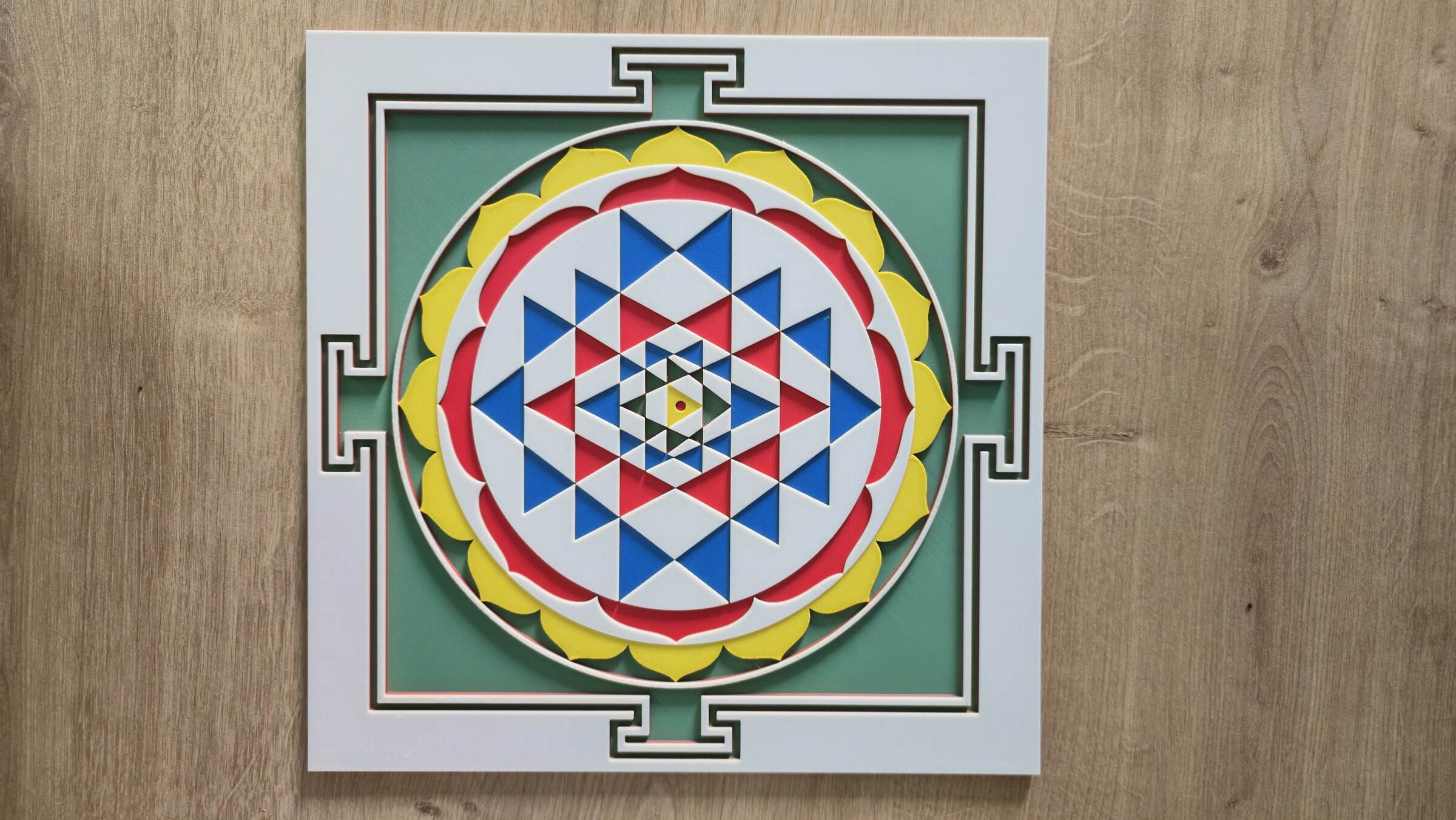
If you quit from boredom, you need something that re-engages curiosity. Trataka (steady gazing at a candle flame or geometric image like a yantra) works well here because it produces visual phenomena: afterimages, color shifts, perceptual changes that make early sessions feel exploratory rather than rote. The Hatha Yoga Pradipika describes trataka as gazing steadily at a small point until the eyes water, and lists it among the six shatkarma (purification) practices. 
If you quit from overwhelm, you need a technique with external structure. Trataka and mantra meditation both give the mind a concrete, external job rather than asking it to observe its own contents. For someone whose last experience of meditation was anxious, the open-ended nature of breath awareness can reproduce the conditions that caused the quit. An external anchor constrains attention and reduces the space available for rumination, the same principle behind grounding exercises used in anxiety treatment: directing attention outward interrupts ruminative loops. If difficult emotions persist across multiple techniques, a teacher trained in trauma-sensitive meditation is a better next step than another self-directed attempt.
If you quit from life disruption, the technique matters less than the trigger and the duration. Start with whatever you already know. Cut the time to something almost trivially short (two minutes). Anchor it to an existing daily action: after your morning coffee, before you open your phone. Huberty et al. (2023) found this behavioral anchoring was more important than any specific meditation technique for sustained engagement.
If you quit because nothing happened, consider whether you were practicing a technique suited to how your mind works. People who think in images may find breath-only practices frustrating because there’s nothing to see. People who need visible progress may do better with trataka, where the visual phenomena evolve session to session. These aren’t research findings; they’re patterns that meditation teachers report consistently. The point is that “nothing’s happening” often means “this technique doesn’t give me the feedback I need,” not “meditation doesn’t work for me.”
The first seven days back
This is a framework, not a prescription. Adjust based on your quit pattern.
Days 1 and 2: Two minutes only. Set a timer. Sit. If thoughts race, let them. The goal is not meditation quality. The goal is proving to yourself that you can show up.
Days 3 and 4: Five minutes. Introduce your chosen technique (breath awareness, trataka, or mantra, based on your quit pattern). If you’re trying trataka, a candle at arm’s length is all the setup you need.
Days 5 through 7: Five to ten minutes. Notice when the technique “catches,” the moment the mind settles without effort. It may not happen every session. It doesn’t need to.
Same time, same place. Pick a time and location and don’t vary them for the first two weeks. Lally et al. (2010) tracked 96 participants building new daily behaviors and found that the median time to automaticity was 66 days, not the 21-day myth. But the finding that matters most for you: missing a single day did not significantly affect the automaticity curve. A single missed session is not a reset.
Success in week one means you sat down every day. Not calm, not insight, not absence of thought. Just showing up seven times.
If you miss a day, keep going. The all-or-nothing streak mentality is what caused many people to quit in the first place. One practitioner’s comment captures the pattern: “I had a 365-day streak and then one day I missed and just… never went back.” The streak wasn’t the practice. Losing it shouldn’t end the practice either.
When the restart isn’t working
“I restart for a week and then stop again.” This usually means you’re addressing the wrong quit pattern. You’re applying life-disruption solutions (habit triggers, start small) to what is actually a boredom or overwhelm problem. Go back to the first section and diagnose honestly.
“I feel worse when I meditate than when I don’t.” This is the overwhelm pattern, and it signals that the technique needs changing, not that meditation is wrong for you. Switch from internal-focus practices (breath awareness, body scan) to external-focus practices (trataka, walking meditation, chanting). If difficult emotions persist across multiple technique changes, seek a teacher trained in trauma-sensitive meditation rather than continuing to self-direct.
“I can’t sit still.” The assumption that meditation requires sitting is itself a barrier. Walking meditation is a co-equal practice in Jon Kabat-Zinn’s original MBSR program, not a consolation prize. Standing meditation and lying-down practice are also legitimate options.
“I fall asleep every time.” Three adjustments: meditate at a different time of day (not before bed), change your posture (seated rather than lying down), and consider an eyes-open technique. Trataka addresses this directly. The Hatha Yoga Pradipika notes that trataka “destroys sloth and sleep.”
“I’ve tried everything in this article.” Consider whether you need a teacher, not an article. Dr. Christine Carter, a sociologist at UC Berkeley’s Greater Good Science Center, has practiced meditation for three decades and admits she has “never one single time meditated twice daily for six days in a row, as I was originally instructed.” Even experts struggle with self-directed practice. Personalized guidance from an experienced teacher is more valuable than any written advice.
Sources
- Hölzel, B.K., Carmody, J., Vangel, M., Congleton, C., et al. (2011). “Mindfulness practice leads to increases in regional brain gray matter density.” Psychiatry Research: Neuroimaging, 191(1), 36–43. PMID 21071182.
- Lazar, S.W., Kerr, C.E., Wasserman, R.H., Gray, J.R., et al. (2005). “Meditation experience is associated with increased cortical thickness.” NeuroReport, 16(17), 1893–1897. PMC1361002.
- Huberty, J., Puzia, M., Larkey, L., & Vranceanu, A.M. (2023). “Dropout and Engagement in a Meditation App Randomized Controlled Trial.” Mindfulness, 14, 1258–1272. PMC10158687.
- Lally, P., van Jaarsveld, C.H.M., Potts, H.W.W., & Wardle, J. (2010). “How are habits formed: Modelling habit formation in the real world.” European Journal of Social Psychology, 40(6), 998–1009.
- Carter, C. (n.d.). “3 Ways to Get Back Into Meditation.” Mindful.org. https://www.mindful.org/3-ways-get-back-into-meditation/
- Svatmarama. Hatha Yoga Pradipika (15th century), Chapter 2, Verses 31–32. Pancham Sinh translation. https://www.sacred-texts.com/hin/hyp/hyp20.htm
- Patanjali. Yoga Sutras, Book 1, Sutras 1.12–1.16. Translations referenced: Swami Satchidananda (Integral Yoga Publications); Georg Feuerstein (Shambhala).