Why Breath Meditation Doesn't Work for Everyone
Miha Cacic · April 8, 2026 · 6 min read
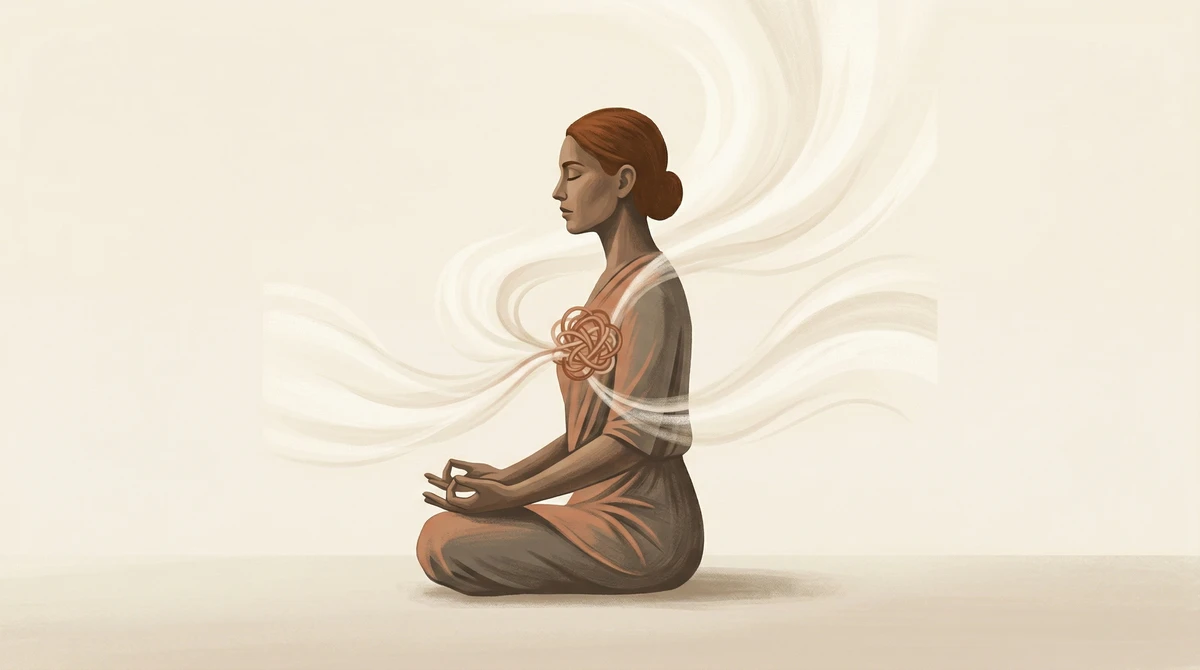
Breath meditation is the default instruction in nearly every app, class, and book, but for a significant number of people, it produces the opposite of calm. The problem isn’t that you’re doing it wrong. The problem is that the breath is a uniquely paradoxical meditation object, and it’s not suited to every nervous system.
The observation paradox: why watching your breath changes it
Your breathing runs on two separate neural systems. The preBötzinger complex in the brainstem generates automatic breathing rhythms without any conscious input (Hürlimann et al., 2022). But the motor cortex can override that rhythm at any time through direct neural pathways to the diaphragm, bypassing the brainstem entirely.
When you turn your attention to your breath, the voluntary system tends to engage. Unlike your heartbeat or digestion (which you can notice without altering), breathing shifts from automatic to at least partially voluntary once you become aware of it. Meditators report this consistently. As one practitioner on the Dhamma Wheel forum put it: “If I focus on my breath it becomes manual. If I try not to control my breath, while still focusing on it, I stop breathing.” The thread runs multiple pages. The experience is near-universal.
This isn’t a failure of willpower or technique. Philosopher Thomas Metzinger’s self-model theory offers a framework for understanding why: when a bodily process enters conscious awareness, the brain treats it as something “you” are doing (Metzinger, 2009). Metzinger doesn’t discuss breath meditation specifically, but the application follows from his broader framework: automatic breathing stays outside the self-model; the moment you observe it, it enters the model and you involuntarily take the wheel.
Compare this to other meditation anchors. You can listen to ambient sounds without creating them. You can watch a candle flame without changing its flicker. But you cannot observe your breathing the way you observe these external objects, because observation itself changes the thing observed. Among bodily processes, breathing may be unique in this regard. CARTA researchers at UC San Diego note that even among primates, voluntary override of automatic respiration may be a distinctly human trait, likely evolved for speech production.
Who struggles most, and why it’s not a personal failing
The observation paradox affects everyone to some degree. But for certain groups, it’s not just frustrating; it’s counterproductive. The issue in each case is a mismatch between technique and nervous system.
Trauma survivors. Nummenmaa et al. (2014) mapped where emotions register in the body and found that most basic emotions produce elevated sensation in the upper chest, exactly where breath meditation directs attention. For people carrying trauma in the chest and throat area, focusing on the breath can activate stored threat responses rather than producing calm. David Treleaven’s work on trauma-sensitive mindfulness documents how standard breath instructions can retraumatize survivors by directing attention to emotionally loaded areas of the body (Treleaven, 2018).
People with anxiety disorders. Anxiety is, at a neurological level, an altered interoceptive state. The insular cortex, which processes internal body sensations, shows heightened activation in anxious people (Paulus & Stein, 2010). A 2024 meta-analysis found that anxiety correlates not with feeling more bodily sensations, but with interpreting them more negatively (Koevoets et al., 2024). Breath meditation asks anxious people to focus on exactly the kind of internal sensation they’re already primed to read as dangerous.
The feedback loop runs deeper than interpretation. The amygdala has direct neural connections to the preBötzinger complex, the brain’s automatic breathing rhythm generator. Amygdala activation from fear or anxiety can directly disrupt breathing patterns (Hürlimann et al., 2022). For an anxious meditator: the negative interpretation of breathing sensations triggers anxiety, the amygdala disrupts breathing, and the disrupted breathing feeds more anxiety. The instruction “just relax and watch” does nothing to break this cycle.
People with respiratory conditions. The same feedback loop applies to anyone whose breathing is already a source of distress. If you have asthma or COPD, deliberate attention amplifies awareness of constriction and breathing irregularity, feeding the anxiety-breath cycle described above.
ADHD and neurodivergent minds. The breath is a low-stimulation, repetitive anchor. It does roughly the same thing every cycle. For brains that disengage rapidly from unchanging stimuli (a well-documented feature of ADHD), breath offers nothing to hold onto. As sensory modulation researcher Kristy Arbon notes, our brains “move away from the object of our attention toward our default mode of remembering and planning if we don’t have new stimulation to attend to” (Arbon, 2018). Arbon is describing a general neural tendency, but it’s amplified in neurodivergent populations.
How common are these difficulties? More common than meditation marketing suggests. Britton et al. (2021) found that 83% of participants in standard 8-week mindfulness programs reported at least one meditation-related side effect, with adverse effects impacting daily functioning in 37%. Earlier, Shapiro (1992) found 63% of meditators at an intensive Vipassana retreat reported adverse effects. A 2017 qualitative study from Brown University deliberately sought out practitioners with challenging experiences and found them across all seven domains measured (cognitive, perceptual, affective, somatic, conative, sense of self, and social), including among experienced practitioners with no pre-existing psychiatric or trauma histories (Lindahl et al., 2017; Brown University press release).
The hidden assumption: breath isn’t actually a beginner technique
Every meditation app defaults to breath. Every introductory class starts there. The implicit message: this is the easy one.
Tamara Russell, a clinical psychologist and neuroscientist at King’s College London, has argued the opposite. At a mindfulness teacher training in 2018, she suggested that breath meditation is quite an advanced practice, because interoception (the sense of internal body states) is the most challenging sensory channel (as cited in Arbon, 2018). Arbon’s sensory modulation framework ranks sensory channels from least to most activating: sight, sound, smell, balance, proprioception, taste, touch, and interoception. Breath awareness sits at the far end.
The yogic tradition agrees. In Patanjali’s eight limbs of yoga, pranayama (breath practice) is the fourth limb, positioned after the ethical foundations (yama, niyama) and physical practice (asana). It was never meant to be step one. The traditional progression builds capacity to sit with increasingly internal, increasingly subtle objects of attention.
Modern apps collapsed this progression into a single instruction. That serves many users well. But it also means the people who struggle are left thinking the problem is them, when the problem is that they’ve been handed an advanced technique labeled “beginner.”
What actually makes a meditation anchor work
External vs. internal. External anchors (sounds, visual objects, smells) don’t trigger the observation-control paradox. You can watch a flame without controlling it. You can hear traffic without generating it. Arbon’s sensory modulation framework ranks anchors from environment-expanding (sight, sound, smell) to body-centered (proprioception, interoception), with environment-expanding anchors being the least activating and body-centered ones the most (Arbon, 2018).
Micro-novelty. The brain disengages from unchanging stimuli. A flickering flame, ambient sounds, or a complex geometric pattern sustain attention because they offer slight, continuous variation. Arbon notes that “rhythm gives us a balance between novelty and predictability,” keeping both the dopamine-driven novelty system and the reward of meeting expectations engaged. The breath is repetitive with minimal variation, which is why it works for some people (calming, predictable) and fails for others (the brain checks out).
Emotional neutrality. Since most emotions are felt most strongly in the upper chest (Nummenmaa et al., 2014), any anchor that directs attention there risks activating emotional content. Anchors focused on the hands, feet, or external objects carry less emotional charge.
Trataka: the visual-focus alternative that sidesteps the paradox
Trataka is a yogic practice of steady gazing at a fixed point, traditionally a candle flame or a geometric pattern called a yantra. It appears in the Hatha Yoga Pradipika (15th century) as one of the six shatkarmas, or purification practices: “Being calm, one should gaze steadily at a small mark, till eyes are filled with tears” (Chapter 2, Verse 31). The Gheranda Samhita describes it as cultivating inner vision.
Trataka sidesteps the core problems breath meditation creates:
No observation paradox. The object is external. You cannot control a flame’s flicker or a yantra’s geometry by looking at it. The instruction is simple and non-contradictory: look at this.
Built-in micro-novelty. A flame moves. A yantra (particularly the Sri Yantra, with its nine interlocking triangles) reveals layers of detail as concentration deepens. The brain stays engaged because there’s always something slightly new to attend to.
Visual cortex, not interoception. Trataka engages the visual processing system rather than internal body awareness. For people who struggle with body-based anchors (trauma survivors, those with anxiety or respiratory conditions), this is a different neural pathway entirely.
The research base is small but positive. Raghavendra and Telles (2014) found that a single trataka session improved performance on the Stroop color-word test by 15-26% compared to a control group, indicating improvements in selective attention, cognitive flexibility, and response inhibition. The study was limited (30 male volunteers, ages 18-31), but a follow-up study with 41 participants found significant improvements in working memory and spatial attention after trataka (Raghavendra et al., 2021). No study has directly compared trataka to breath meditation head-to-head, but the cognitive benefits are measurable.
How to start. Place a candle or a printed yantra at eye level, about an arm’s length away, in a dimly lit room. Gaze steadily at the flame or the central point of the yantra without blinking for as long as comfortable (beginners: 10-15 seconds per round). When your eyes water or you need to blink, close them and observe the afterimage. Repeat for up to 3 rounds. Increase duration gradually. If you have epilepsy, glaucoma, or migraines, consult a healthcare provider before practicing.
When breath meditation does work, and how to know
Breath meditation is effective for many people. A systematic review of slow breathing techniques found increased heart rate variability, increased EEG alpha power, and reduced anxiety, depression, and anger (Zaccaro et al., 2018). The question is whether it works for you.
Signs it fits: You can observe your breathing without controlling it after a few minutes of settling in. You feel calmer after sessions than before. Mind-wandering decreases over weeks of practice. You have no significant history of trauma, respiratory conditions, or anxiety disorders.
Signs the technique is the mismatch: Persistent anxiety during sessions that doesn’t diminish with practice. Chest tightness or a feeling of suffocation. Inability to stop controlling the breath even after weeks of trying. Consistently feeling worse after meditating than before.
There’s an important distinction between normal meditation friction (boredom, restlessness, a wandering mind) and signals that the anchor itself is wrong for you. The first category improves with practice. The second doesn’t, because the problem isn’t effort or experience; it’s the interaction between this specific technique and your nervous system.
If breath meditation isn’t working, you aren’t broken. You may be better served by starting with a visual or auditory anchor and, if you choose, moving to breath later once concentration and body awareness have developed in lower-stakes terrain. The traditional yogic progression, which places breath work after foundational physical practice, suggests this gradual approach has been understood for a very long time.
Sources
- Arbon, K. (2018). “Anchoring Our Awareness: Alternatives to the Breath.” HeartWorks. https://kristyarbon.com/anchoring-awareness-alternatives-breath/
- Britton, W. B., Lindahl, J. R., Cooper, D. J., Canby, N. K., & Palitsky, R. (2021). “Defining and Measuring Meditation-Related Adverse Effects in Mindfulness-Based Programs.” Clinical Psychological Science, 9(6), 1185–1204. PMID: 35174010.
- Hürlimann, H. C., et al. (2022). “Forebrain control of breathing: Anatomy and potential functions.” Frontiers in Neurology, 13, 1041887. PMCID: PMC9663927.
- Koevoets, E. W., et al. (2024). “The relationship between self-reported interoception and anxiety: A systematic review and meta-analysis.” Neuroscience & Biobehavioral Reviews.
- Lindahl, J. R., Fisher, N. E., Cooper, D. J., Rosen, R. K., & Britton, W. B. (2017). “The varieties of contemplative experience: A mixed-methods study of meditation-related challenges in Western Buddhists.” PLOS ONE, 12(5), e0176239. PMID: 28542181.
- Metzinger, T. (2009). The Ego Tunnel: The Science of the Mind and the Myth of the Self. Basic Books.
- Nummenmaa, L., Glerean, E., Hari, R., & Hietanen, J. K. (2014). “Bodily maps of emotions.” Proceedings of the National Academy of Sciences, 111(2), 646–651. PMID: 24379370.
- Paulus, M. P., & Stein, M. B. (2010). “Interoception in anxiety and depression.” Brain Structure and Function, 214(5-6), 451–463. PMID: 20490545.
- Raghavendra, B. R., & Telles, S. (2014). “Immediate effect of yogic visual concentration on cognitive performance.” Journal of Traditional and Complementary Medicine, 4(1), 34–37. PMID: 24872931.
- Raghavendra, B. R., Singh, P., & Prasad, K. (2021). “Effect of Trataka (Yogic Visual Concentration) on the Performance in the Corsi-Block Tapping Task.” Frontiers in Psychology, 12, 773049. PMID: 35002870.
- Shapiro, D. H. (1992). “Adverse effects of meditation: A preliminary investigation of long-term meditators.” International Journal of Psychosomatics, 39(1-4), 62–67.
- Svatmarama. (15th century). Hatha Yoga Pradipika. Translation by Pancham Sinh (1914).
- Treleaven, D. (2018). Trauma-Sensitive Mindfulness: Practices for Safe and Transformative Healing. W. W. Norton & Company.
- Zaccaro, A., et al. (2018). “How Breath-Control Can Change Your Life: A Systematic Review on Psycho-Physiological Correlates of Slow Breathing.” Frontiers in Human Neuroscience, 12, 353. PMID: 30245619.
- Zarndt, R. “Voluntary Control of Breathing.” Center for Academic Research and Training in Anthropogeny (CARTA), UC San Diego. https://carta.anthropogeny.org/moca/topics/voluntary-control-breathing