Why Do I Fall Asleep During Meditation?
Miha Cacic · April 8, 2026 · 6 min read
You fall asleep during meditation because meditation takes your brain to the neurological threshold between wakefulness and unconsciousness. Your nervous system defaults to sleep at that threshold because sleep is the only thing it has ever done there.
You are not doing anything wrong. Your brain doesn’t know the alternative yet.
This article covers the mechanism behind that crossover, why the standard advice falls short, and what works.
Your brain is walking a tightrope between two states
When you sit down to meditate, your brain waves shift. Active thinking produces beta waves (13-30 Hz). As you settle in, those give way to alpha waves (8-13 Hz), the signature of relaxed awareness. Go deeper, and theta waves (4-8 Hz) emerge.
Here’s the problem: theta waves are also the signature of NREM sleep stages 1 and 2. Your brain produces overlapping electrical patterns whether you’re approaching deep meditation or approaching sleep. A 2020 review in Frontiers in Systems Neuroscience by Deolindo, Ribeiro, and Aratanha compiled decades of EEG research on meditators and confirmed that this overlap is measurable. Pagano et al. (1976) recorded EEG patterns “classifiable as sleep stages” during 40-50% of meditation time. Fenwick et al. (1977) found “no significant difference between meditation and sleep onset” in their EEG readings.
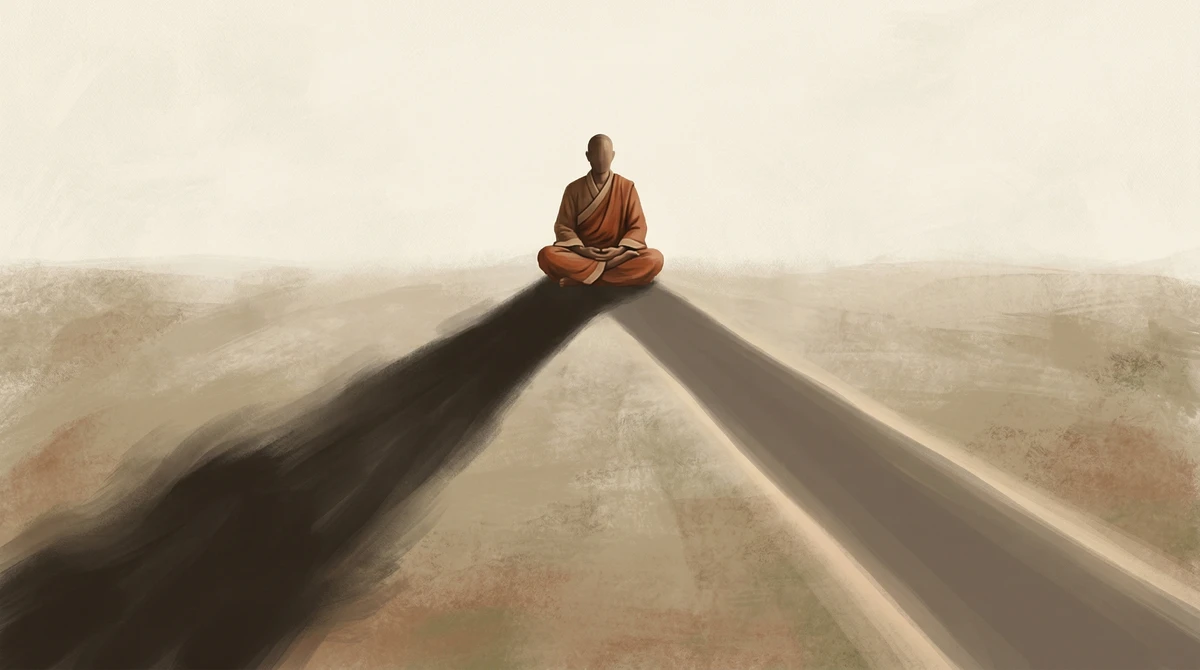
Think of it as a Y-shaped path. Waking consciousness is the stem. As you meditate, you walk down that stem into progressively quieter states. At the fork, one branch leads to unconsciousness (sleep) and the other to heightened awareness (deep meditation). Same entry point, opposite destinations.
The direction depends on what happens to your energy and awareness at the fork. If sensory engagement drops and alertness fades, you fall asleep. If awareness is maintained while the body stays deeply relaxed, you enter meditation’s deeper states.
Your nervous system has thousands of hours of practice going left at that fork (every night of your life), and essentially zero hours going right. So it goes left. Every time. This isn’t a character flaw. It’s a training deficit.
The research bears this out. Elson et al. (1977) compared meditators with a control group doing simple relaxation and found that half the control group fell asleep, while none of the meditators did. The meditators’ EEG signals were “more stable, generally not developing into sleep stage 2 patterns.” But that stability came from practice. Dentico et al. (2018) found that long-term meditators showed waking EEG changes absent in meditation-naive participants, including increases in both low (~8 Hz) and fast (~15 Hz) oscillations. These waking changes correlated with changes in the meditators’ subsequent NREM sleep, suggesting meditation rewires the brain in ways that persist beyond the session itself. Beginner and experienced brains behave differently at the fork. 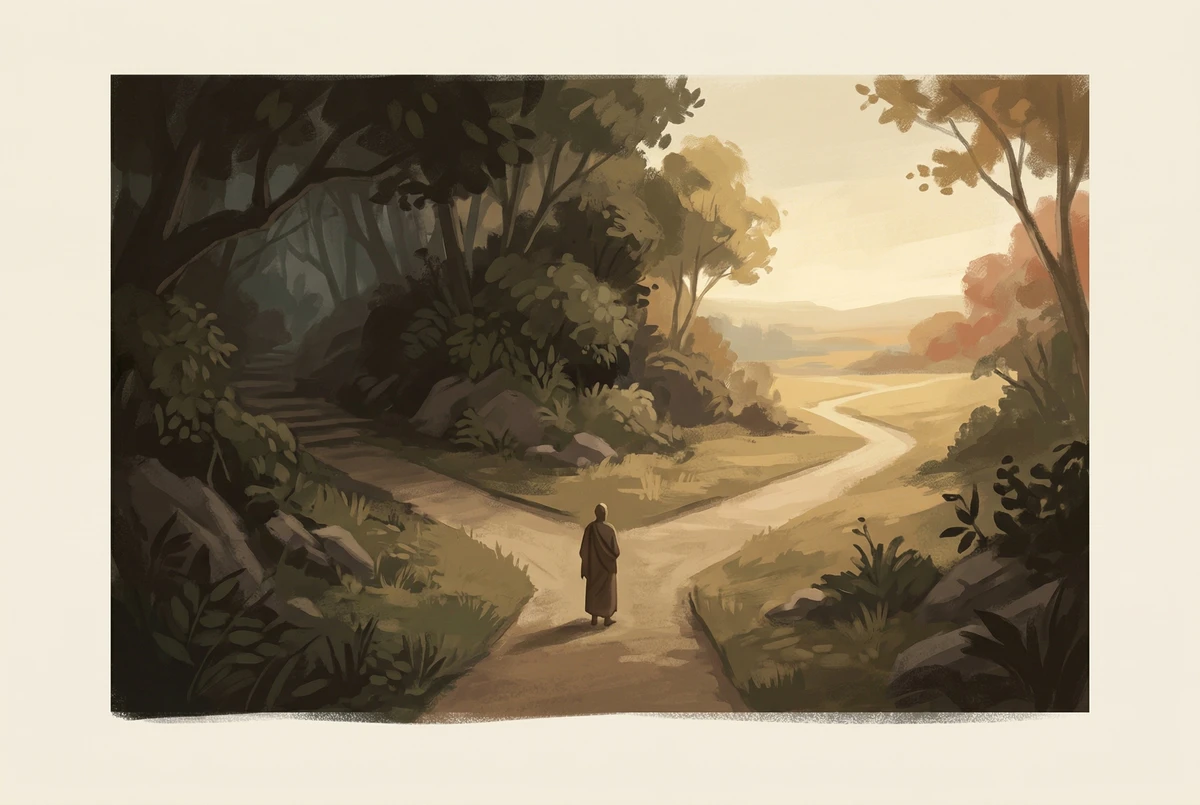
The real reasons you keep falling asleep (and the one everyone gets wrong)
The standard explanations are real but incomplete. Sleep debt, heavy meals, meditating after a long day, a comfortable position: these all contribute. According to 2022 CDC data, 13.5% of American adults feel very tired or exhausted most days, rising to 20.3% among women aged 18-44. If you arrive at meditation already running on a deficit, your body will hijack any rest opportunity it finds.
Parasympathetic activation matters too. Meditation shifts you out of “fight or flight” and into “rest and digest.” A 2022 study by Moszeik, von Oertzen, and Westermann found that 11 minutes of daily Yoga Nidra over 30 days reduced stress and improved well-being in a group of 341 participants. The researchers described Yoga Nidra’s mechanism as activating the parasympathetic nervous system and influencing stress markers like cortisol and skin conductivity. That parasympathetic shift is a feature of meditation, not a bug — it’s why meditation reduces stress. But its side effect is drowsiness.
These factors are real, and every article on this topic covers them.
The deeper problem is structural. Most meditation techniques mimic the onset of sleep by design: eyes closed, body still, reduced sensory input, slowed breathing. You’re giving your brain every sleep cue simultaneously and asking it not to sleep.
For someone who has trained their awareness to stay alert through the theta-wave threshold, this works. For a beginner, it’s like asking someone who has never swum to jump into deep water and not sink. The issue isn’t willpower. It’s that closed-eye, still-body meditation demands a skill (sustained awareness at the threshold) that beginners haven’t built yet.
Falling asleep during meditation is not failure. It means your brain reached the threshold between waking and sleeping. That’s more than most people achieve just sitting in a chair. You went to the fork. You went left instead of right. The goal now is to train the right turn.
How to tell if you actually fell asleep
“Was I sleeping or meditating?” is one of the most common questions meditators ask.
Signs you were sleeping:
- Your head dropped and jerked back up (the “head nod”)
- You were snoring, drooling, or had your mouth hanging open
- You experienced dreams with narrative content (characters, storylines, scenes)
- You lost all awareness of time and felt groggy when you came back
- Someone else saw you sleeping
Signs you were in deep meditation:
- Your head may have tilted forward, but there was no sudden jerk
- No dreams, but a sense of “absence,” like a gap in experience
- Time felt shorter than it actually was
- You felt refreshed, clear, or peaceful afterward, not groggy
- Fewer thoughts upon returning to normal awareness
- Your breathing slowed noticeably or seemed to pause
The Art of Living draws a useful distinction: “alertness in meditation and non-alertness during sleep.” If you emerge feeling dull, you were sleeping. If you emerge feeling clear, you were meditating.
The in-between state is the most confusing. Brief flashes of imagery, micro-sleep episodes lasting seconds, the repeated nodding-and-snapping-back loop. This is hypnagogia, the transitional zone between waking and sleeping — the threshold itself. EEG studies show how common it is: Pagano et al. (1976) found sleep-onset patterns during 40-50% of meditation time, while Hebert and Lehmann (1977) found drowsiness during about 10%. The range tells you this isn’t a rare problem. It’s a defining feature of the practice. Recognizing hypnagogia as a signpost (you’ve arrived at the fork) rather than a failure reframes the experience.
Sleeping during meditation isn’t harmful. If your body needs rest, it will take it. But sleep during meditation isn’t meditation. If you want the specific benefits of meditation (improved attention, emotional regulation, reduced anxiety), you need to stay conscious. Basso et al. (2019) found that 13 minutes of daily meditation improved attention, working memory, and mood after 8 weeks. Those gains required active practice: the control group listened to a podcast for 13 minutes daily and showed no comparable improvements.
The meditation practice designed to keep you awake
The standard advice for staying awake during meditation (“sit up straight,” “meditate in the morning,” “open a window”) treats symptoms. The structural fix is choosing a practice that keeps you on the wakeful side of the threshold by design.
That practice is trataka: steady-gaze meditation, traditionally done with a candle flame.
The neuroscience is straightforward. The reticular activating system (RAS) in your brainstem regulates wakefulness. It coordinates the sleep-wake cycle, attention, and arousal. According to StatPearls, the lateral hypothalamus releases orexin “in response to the light hitting the eyes, which then stimulates arousal and the transition from sleep to waking.” Close your eyes, and you remove this arousal signal. Keep your eyes open and focused on a light source, and the RAS stays active.
This is not a modern workaround. The Hatha Yoga Pradipika, written around the 15th century, lists trataka as one of the six shatkarmas (purification practices). Verse 31 defines it: “Being calm, one should gaze steadily at a small mark, till eyes are filled with tears.” Verse 32 states its benefit: trataka “destroys eye diseases and removes sloth.” The Sanskrit word translated as “sloth” is tandra, which means drowsiness, sleepiness, torpor. The traditional texts prescribe trataka as a remedy for the exact problem this article addresses.
The Gheranda Samhita, a separate text from roughly the 17th century, gives the same instruction: “Gaze steadily without winking at any small object, until tears begin to flow.”
How trataka works in practice:
- Place a candle at eye level, about an arm’s length away, in a dim room
- Gaze at the tip of the flame without blinking. Keep your gaze soft but steady
- When your eyes water (usually after 1-3 minutes), close them
- Hold the afterimage of the flame in your mind’s eye, resting awareness at the point between the eyebrows
- When the afterimage fades, open your eyes and repeat
The alternation between open-eye gazing and closed-eye visualization trains your brain to maintain awareness at the threshold. During the open phase, the RAS keeps you alert. During the closed phase, you practice holding consciousness without the visual anchor. Over time, you build the capacity to stay aware with eyes closed — the skill that closed-eye meditation demands from the start.
Trataka is not unique to the Hatha Yoga tradition. Zen Buddhism’s zazen keeps eyes half-open with a soft downward gaze to prevent drowsiness. Tibetan Dzogchen includes “sky gazing.” Theravada kasina meditation uses external objects as focal points. Multiple contemplative traditions arrived at the same solution independently: keep the visual system engaged.
Giovanni Dienstmann, who has reviewed the primary yogic texts on trataka extensively, explains the connection: 80% of all sensory data processed by the brain comes through vision. The retina is, developmentally, “a piece of the brain that has grown into the eye.” If you can focus your eyes, you can focus your mind. Trataka exploits this direct link between eye stillness and mental stillness.
Other ways to stay awake during meditation
If candle gazing doesn’t suit you, these strategies address the same underlying mechanism.
Walking meditation eliminates the stillness cue entirely. You can’t fall asleep while walking. This is a legitimate meditation practice in both Zen (kinhin) and Theravada (cankama) traditions, not a consolation prize for people who can’t sit still.
Energizing breathwork before sitting. Kapalabhati (rapid abdominal breathing) and bhastrika (bellows breath) raise your energy level before you approach the threshold. A study on kapalabhati’s neurological effects suggested that its high-frequency breathing pattern may “entrain neural activity in the gamma band (30-80 Hz), supporting heightened alertness and executive control.” In the Y-path model, this means you arrive at the fork with more energy, making it easier to go right instead of left.
Shorter sessions. Five minutes of fully awake meditation is more valuable than twenty minutes where you sleep for fifteen. Basso et al. (2019) found meaningful cognitive and emotional benefits from 13 minutes of daily meditation over 8 weeks. Start with a length where you can stay awake the entire session and extend gradually.
The “noting” technique. When drowsiness arises, mentally label it: “drowsy, drowsy, drowsy.” This comes from the vipassana tradition. Labeling requires metacognitive awareness — just enough consciousness to prevent full sleep onset. It works with any meditation technique.
Light movement before sitting. A few minutes of yoga asanas or stretching shifts the body out of pure stillness mode. The goal is relaxed but alert, not relaxed and collapsing.
When to just sleep. If you are severely sleep-deprived, rest. Kaul et al. (2010) found that long-term meditators showed reduced total sleep need and no evidence of sleep debt. But those meditators built their practice over years. If your body is hijacking meditation for sleep, the practical first step is to address the deficit. Meditation will be there when you’ve caught up.
Sources
- Deolindo CS, Ribeiro MW, Aratanha MA. (2020). “A Critical Analysis on Characterizing the Meditation Experience Through the Electroencephalogram.” Frontiers in Systems Neuroscience, 14, 53. DOI: 10.3389/fnsys.2020.00053
- Dentico D, Ferrarelli F, Riedner BA, et al. (2018). “Acute effects of meditation training on the waking and sleeping brain: Is it all about homeostasis?” European Journal of Neuroscience. PMC: PMC6534352
- Moszeik EN, von Oertzen T, Westermann S. (2022). “Effectiveness of a short Yoga Nidra meditation on stress, sleep, and well-being in a large and diverse sample.” Current Psychology, 41, 5272-5286. DOI: 10.1007/s12144-020-01042-2
- Basso JC, McHale A, Ende V, Oberlin DJ, Suzuki WA. (2019). “Brief, daily meditation enhances attention, memory, mood, and emotional regulation in non-experienced meditators.” Behavioural Brain Research, 356, 208-220. PubMed: 30153464
- Mangold SA, Das JM. (2023). “Neuroanatomy, Reticular Activating System.” StatPearls. PMID: 31751025
- Bottoms-McClain L, Ng AE. (2023). “QuickStats: Percentage of Adults Aged ≥18 Years Who Felt Very Tired or Exhausted.” MMWR Morb Mortal Wkly Rep, 72:1248. DOI: 10.15585/mmwr.mm7245a7
- Kaul P, Passafiume J, Sargent RC, O’Hara BF. (2010). “Meditation acutely improves psychomotor vigilance, and may decrease sleep need.” Behavioral and Brain Functions, 6, 47. PMC: PMC2919439
- Pagano RR, Rose RM, Stivers RM, Warrenburg S. (1976). “Sleep during Transcendental Meditation.” Science, 191(4224), 308-310.
- Fenwick PBC, et al. (1977). “Metabolic and EEG changes during Transcendental Meditation.” Biological Psychology, 5(2), 101-118.
- Elson BD, Hauri P, Cunis D. (1977). “Physiological changes in yoga meditation.” Psychophysiology, 14(1), 52-57.
- Hebert R, Lehmann D. (1977). “Theta bursts: an EEG pattern in normal subjects practising the transcendental meditation technique.” Electroencephalography and Clinical Neurophysiology, 42(3), 397-405.
- Swami Swatmarama. (~15th century). Hatha Yoga Pradipika. Translation: Pancham Sinh, 1914. Chapter 2, Verses 22, 31-32.
- Gheranda Samhita. (~17th century). Chapter 1, Shlokas 53-54.
- Study on neurological and autonomic changes during kapalabhati pranayama. PMC: PMC8963645.