How Long Does It Take to Form a Meditation Habit?
Miha Cacic · April 11, 2026 · 7 min read

Most people need roughly six to ten weeks of daily practice before meditation starts to feel automatic. But that number hides the real story. Meditation is unusually difficult to make habitual, and the reason has nothing to do with willpower.
The standard advice tells you it takes 21 days (wrong), gives you a habit-stacking trick, and sends you on your way. What gets left out is that meditation breaks the rules that make other habits work. Understanding why it’s hard is more useful than knowing how many days to count.
The honest answer: two to three months, but it depends on what you mean by “habit”
When people ask “how long does it take?” they’re actually asking three different questions without realizing it:
- How long until I sit down without debating it? This is automaticity, the cue-to-action link. Your brain stops treating meditation as a decision and starts treating it as a default.
- How long until I stop skipping days? This is consistency. You’ve built enough momentum that the routine holds up even on bad days.
- How long until I actually want to do it? This is intrinsic motivation. You meditate because you’d miss it, not because you’d feel guilty.
These happen on different timelines. Based on the habit research and the added complexity of meditation, automaticity likely arrives around weeks six to ten. Consistency tends to develop a few weeks before that, once the routine feels normal. Intrinsic motivation, the thing that makes a habit last, takes longer. Practitioners consistently describe it emerging somewhere between three and six months.
The most-cited study on habit formation comes from University College London, where Phillippa Lally and colleagues tracked 96 people building new daily behaviors over 12 weeks (Lally et al., 2010). The median time to automaticity was 66 days. But the range was enormous: 18 to 254 days, depending on the person and the behavior.
The behaviors in that study were simple things like drinking a bottle of water with lunch, eating a piece of fruit, or going for a 15-minute run. Nothing cognitively demanding. The study also found that more complex behaviors took consistently longer to become automatic. Meditation, which asks you to sit still and redirect your attention over and over, is arguably more demanding than any behavior Lally’s team tested. The 66-day figure is almost certainly too optimistic for most meditators.
And the 21-day number? That came from Maxwell Maltz, a plastic surgeon who noticed in the 1960s that patients took “at least 21 days” to adjust psychologically to their new appearance after surgery. He wrote about it in Psycho-Cybernetics (1960). Self-help authors later stripped the qualifier and turned a rough observation about adjusting to a new nose into a universal law of habit formation. The research literature finds no support for 21 days as a habit formation timeline.
Why meditation is harder to make habitual than other behaviors
Most habit advice treats all behaviors as interchangeable. Drink more water, floss your teeth, meditate for ten minutes: same habit loop, same strategies. But meditation has features that actively resist the way habits normally form.
The reward is invisible. When you go for a run, endorphins flood your system within 20 minutes. When you meditate, the benefits are subtle, delayed, and cumulative. Your brain’s reward prediction system needs something to latch onto, and “slightly less reactive to an annoying email three hours later” doesn’t register the way a runner’s high does.
You’re training yourself to do less. Every other habit involves doing something. Meditation asks you to stop doing. You sit down, your mind races, you bring it back, it races again. At the end, you haven’t produced anything. The brain defaults to favoring action over stillness, and building a taste for the opposite takes time.
Early sessions feel like failure. Mind wandering during meditation isn’t a sign that you’re doing it wrong. It is the practice. Every time you notice your mind has wandered and bring attention back, that’s a repetition, the equivalent of a bicep curl for your attention. But beginners almost universally interpret wandering as “I can’t meditate” or “this isn’t working,” which creates a negative association at the moment the habit most needs a positive one.
There are no visible progress markers. Runners track distance and pace. Weightlifters add plates. Meditators have no external metric. You can’t tell whether today’s session was “better” than yesterday’s in any objective sense. Without progress signals, the motivation loop weakens.
State effects fade; trait effects take months. A single meditation session can produce real, measurable calm. A Northwestern meta-review of 415 clinical trials (2025) found that 83% of single-session interventions, including mindfulness, showed significant psychological benefits. But that post-session calm doesn’t persist. The lasting changes, what researchers call “trait effects” (a calmer baseline, better emotional regulation, improved stress resilience), require months of consistent practice. The gap between state and trait is where most people quit: they’ve tasted the benefit, but it doesn’t stick, so they conclude it’s not working.
What actually happens in the first eight weeks
Week 1: Novelty carries you. Motivation is high. Sessions feel awkward but interesting. Your mind wanders constantly, which is normal. Single sessions do produce measurable psychological benefits (Northwestern, 2025), and you’ll likely feel calmer afterward. But the effect doesn’t carry over to the next morning.
Week 2: Small shifts appear. You notice moments of genuine stillness, even if they last only a few seconds. You might catch yourself being less reactive to something that would normally irritate you. Research on intensive retreat practice shows that default mode network activity can decrease within a single week of concentrated meditation. Daily sessions of ten to twenty minutes don’t pack the same dose as a retreat, so these shifts arrive more gradually, but the same process is underway.
Weeks 3-4: The dead zone. This is where many practitioners quit. Novelty has worn off. Automaticity hasn’t arrived. Sessions feel repetitive. You sit down and think, “I don’t feel any different than I did two weeks ago.” Meanwhile, your brain is doing exactly what it needs to do, but the changes are below the threshold of conscious experience. A 2023 study in JMIR Formative Research found that four weeks of daily ten-minute sessions produced statistically significant improvements in mindfulness scores (Lynn & Basso, 2023), but these improvements show up on validated scales, not in how you feel on a Tuesday morning. The dead zone isn’t a sign that meditation isn’t working. It’s the gap between measurable change and felt change. 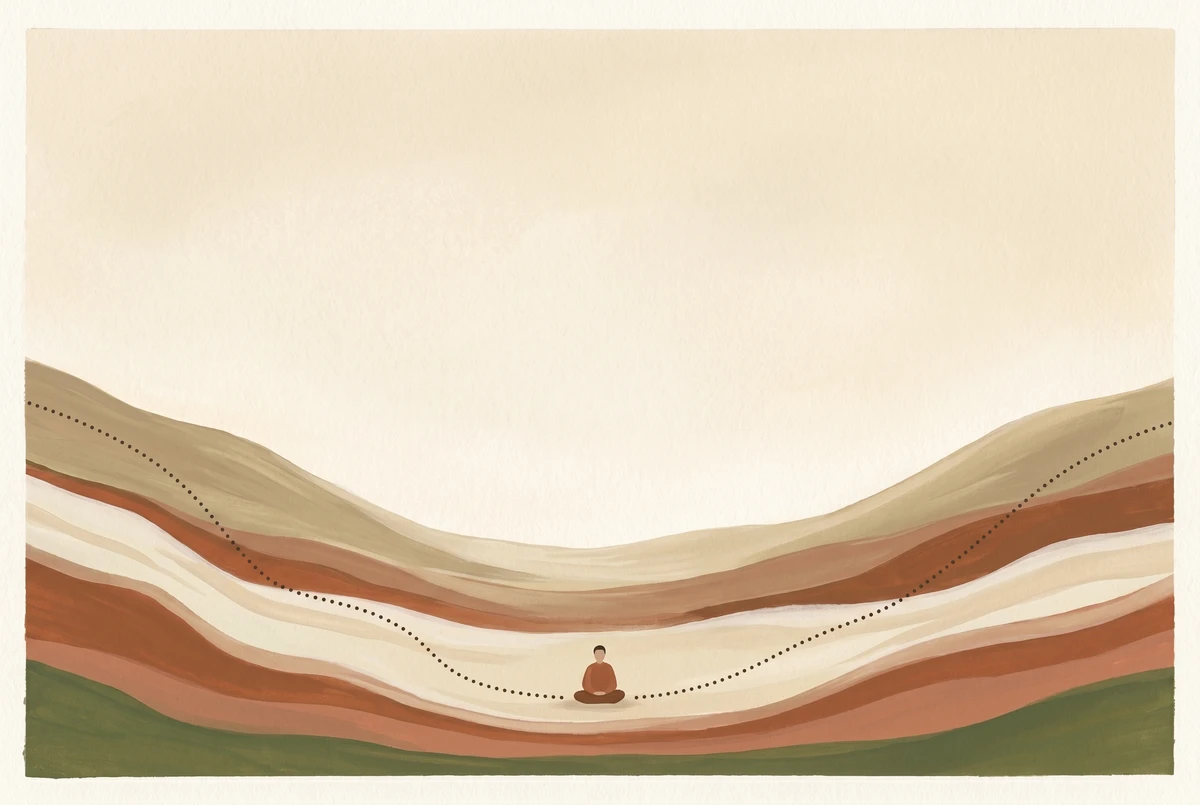
Weeks 5-6: The plateau breaks. If you’ve pushed through the dead zone, two things shift. First, trait-level calm starts emerging. Research on four-week meditation interventions suggests that resting-state calmness (not just the post-session glow) begins improving by the end of the first month. By weeks five and six, this shift consolidates: you feel different on days you haven’t yet meditated, not just in the minutes after you finish. Second, meditation starts requiring less deliberate effort to initiate. You stop debating whether to do it. These are signs that Lally’s habit curve is leveling off toward automaticity.
Weeks 7-8: Automaticity begins. The habit loop starts closing. You sit down without an internal negotiation. Research using fMRI scans shows that after two months of focused attention meditation, connectivity between the Default Mode Network (the mind-wandering network) and the Dorsal Attention Network (the focus network) increases significantly (Zhang et al., 2021). These two networks normally work against each other. Increased connectivity means your brain is getting better at catching when attention drifts and redirecting it, which is the core skill of meditation. 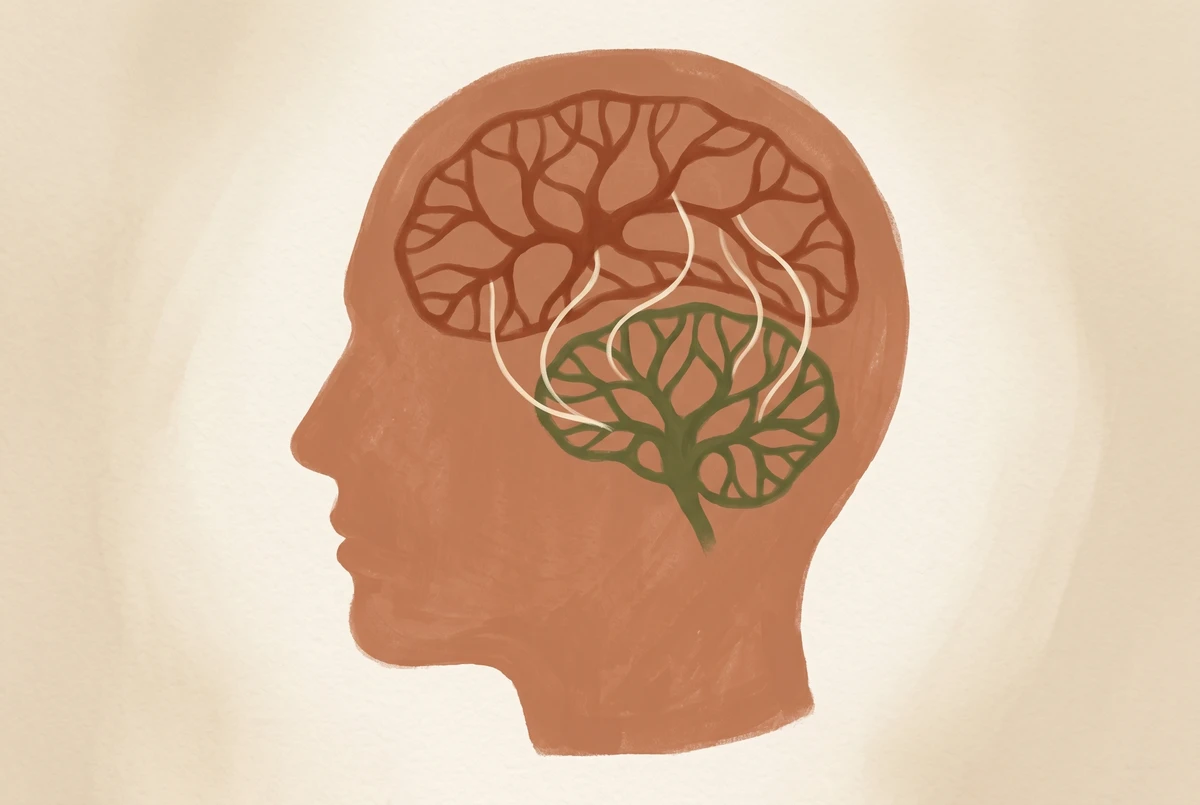
This is also when structural brain changes become measurable. Hölzel and colleagues at Harvard and Massachusetts General Hospital (2011) found that after eight weeks of MBSR (Mindfulness-Based Stress Reduction), participants showed increased gray matter density in the hippocampus (learning and memory) and decreased gray matter in the amygdala (stress and fear response). The study was small (16 meditators vs. 17 controls), but the pattern has held up: a 2024 systematic review of neuroimaging studies found consistent cortical thickening in the prefrontal cortex, insula, and hippocampus across multiple studies of sustained meditation practice.
What makes meditation finally stick (it’s not streaks)
People who meditate for thirty days and people who meditate for thirty years start the same way. The difference isn’t discipline. It’s a shift in motivation that happens somewhere around months two to three for most daily practitioners.
The identity shift. There’s a meaningful difference between “I’m trying to build a meditation habit” and “I’m a meditator.” James Clear describes this in Atomic Habits (2018) as identity-based habit formation: lasting behavior change comes from changing how you see yourself, not from tracking streaks. Clear’s framework isn’t peer-reviewed research, but it aligns with what self-determination theory studies consistently find: intrinsic motivation (doing something because it fits who you are) predicts long-term behavior maintenance far better than external incentives (Yavuz Sercekman et al., 2024).
The moment you miss it. Long-term practitioners describe a turning point that’s hard to manufacture: you skip a day and genuinely feel something is missing. Not guilt about breaking a streak, but an actual absence, like forgetting your morning coffee. When meditation shifts from obligation to felt need, the habit becomes self-sustaining.
Why challenges and streak apps can backfire. A 21-day challenge creates compliance-based motivation. When the challenge ends, the external structure disappears and so does the reason to continue. Streak counters can be worse: they shift the reward from the meditation itself to the number on the screen. You’re no longer meditating to meditate. You’re meditating to keep a streak alive. Self-determination theory calls this a shift from intrinsic to extrinsic motivation, and the research consistently shows extrinsic motivation is more fragile.
The type of meditation matters for habit formation. Focused-attention meditation (following the breath, repeating a mantra, or fixing your gaze on a point like a candle flame) provides a concrete anchor and a clear feedback signal: you’re either attending to the object or you’re not. Open-monitoring meditation (open, choiceless awareness) has no anchor, which can make early sessions feel directionless. Some evidence suggests that starting with focused attention before moving to open monitoring produces better emotion regulation outcomes than open monitoring alone (Zhang et al., 2019). For habit formation, having a tangible focal point gives beginners something to return to, making the experience of “doing it right” more accessible.
How to survive the dead zone (weeks 3-6)
The dead zone isn’t a failure of willpower. It’s a predictable phase where novelty has faded and neurological changes haven’t consolidated. Lally’s habit curve shows this pattern: rapid early gains taper before automaticity arrives.
Redefine success. During weeks three to six, “I sat down and my mind wandered for ten minutes” is a successful session. Expecting calm or clarity at this stage guarantees disappointment. The only metric that matters is: did you sit?
Drop to your minimum dose. If you started at ten or twenty minutes, drop to five. Or three. The goal during the dead zone is protecting the daily cue-response pattern, not session quality or duration. You can always do more once you sit down, but the commitment should be small enough that you never skip. The Lally study found that missing a single day didn’t significantly affect habit formation, but missing multiple consecutive days did. One day off is fine. Two in a row is where the routine starts dissolving.
Stop grading your sessions. The performance mindset is poison during the dead zone. If you finish a session thinking “that was a bad one,” you’re building a negative association with the habit. The session happened. That’s enough.
Track the off-cushion effects. Keep a one-line daily note of anything you noticed outside meditation: a moment of patience you wouldn’t normally have had, a caught breath before reacting, slightly better sleep. This makes the invisible reward visible. Your brain needs evidence that the habit is doing something, and these micro-observations provide it, even when sessions themselves feel flat.
The long game: what changes after six months, one year, and beyond
Once meditation survives the first three months, the trajectory changes.
Six to twelve months. Meditation feels like a natural part of the day, not a task. Stress resilience becomes a baseline trait rather than something that appears only after a session and fades. The structural brain changes documented at eight weeks continue to deepen. A 2024 systematic review of neuroimaging studies found consistent cortical thickening in the prefrontal cortex (attentional control), insula (body awareness), and hippocampus (learning and memory) with sustained practice.
One to two years. Benefits persist even when you miss several days, as long as you maintain some regular practice. Practitioners describe sessions becoming richer and more varied, not just easier. Long-term follow-up data from MBSR participants (Yavuz Sercekman et al., 2024) found that improvements in anxiety, depression, and sleep quality remained statistically significant at one year and three years post-training, particularly for those who maintained any regular practice, even if not daily.
Two years and beyond. Research on long-term meditators by Brefczynski-Lewis, Davidson, and colleagues (2007) found something striking: expert meditators with tens of thousands of practice hours (often monastics or intensive retreat practitioners) showed less brain activation during focused attention tasks than novices. Not more, less. The attentional work became effortless. Novice meditators had to recruit their attention networks heavily. Expert meditators achieved the same or better focus with minimal neural effort. The researchers called it an inverted-U pattern: effort increases with experience up to a point, then drops as the skill becomes second nature. 
This is what a fully formed meditation habit looks like at the neurological level. The thing that once required so much effort, both to do and to remember to do, becomes effortless. The question “how long does it take?” stops making sense. You’re not maintaining a habit anymore. You’re just living the way you live.
Sources
- Lally, P., van Jaarsveld, C. H. M., Potts, H. W. W., & Wardle, J. (2010). “How are habits formed: Modelling habit formation in the real world.” European Journal of Social Psychology, 40(6), 998-1009. DOI: 10.1002/ejsp.674
- Lally, P. & Gardner, B. (2013). “Promoting habit formation.” Health Psychology Review, 7(sup1), S137-S158. PMC3505409.
- Hölzel, B. K., Carmody, J., Vangel, M., Congleton, C., Yerramsetti, S. M., Gard, T., & Lazar, S. W. (2011). “Mindfulness practice leads to increases in regional brain gray matter density.” Psychiatry Research: Neuroimaging, 191(1), 36-43. PMID: 21071182.
- Brefczynski-Lewis, J. A., Lutz, A., Schaefer, H. S., Levinson, D. B., & Davidson, R. J. (2007). “Neural correlates of attentional expertise in long-term meditation practitioners.” Proceedings of the National Academy of Sciences, 104(27), 11483-11488. DOI: 10.1073/pnas.0606552104.
- Zhang, Q., et al. (2021). “Resting-state functional connectivity changes after focused attention meditation training.” NeuroImage, PMC8166909.
- Zhang, Q., et al. (2019). Focused attention then open monitoring meditation sequence study. Referenced in PMC9896358.
- Yavuz Sercekman, A., et al. (2024). “Sustained impact of mindfulness-based stress reduction on anxiety, depression, and sleep quality.” PMC11294918.
- Lynn, S. J., & Basso, M. R. (2023). “Effects of a 4-week daily 10-minute meditation intervention.” JMIR Formative Research, 7, e40135.
- Northwestern University Feinberg School of Medicine (2025). Meta-review of 415 clinical trials on single-session interventions.
- Maltz, M. (1960). Psycho-Cybernetics. Prentice Hall.
- Clear, J. (2018). Atomic Habits. Avery.
- PMC11591838 (2024). Systematic review of neurobiological changes from meditation practice.
- PMC9896358. 4-week meditation baseline calm and focused attention sequence studies.