How to Stay Consistent with Meditation
Miha Cacic · April 11, 2026 · 5 min read

You’ve been consistent before. Maybe for a week, maybe a month. Then you missed a day, went on a trip, or just didn’t feel like it, and the whole thing unraveled. You’re not reading this because you can’t meditate. You’re reading it because you can’t seem to keep meditating.
The fix isn’t a better routine. It’s a different definition of consistency. Instead of optimizing for “never stop,” optimize for “always return.”
Why “never miss a day” is the wrong goal
The streak mentality (meditate every day without exception) sounds like discipline. It’s actually fragile. The longer your streak, the more devastating a single miss feels. Miss day 31 of a 30-day streak and you don’t think “I meditated 30 out of 31 days.” You think “I failed.”
Psychologists call this the abstinence violation effect. Originally described by Marlatt and Gordon (1985) in addiction research, it explains what happens when someone breaks a self-imposed rule: they attribute the lapse to a permanent personal failing (“I’m just not disciplined enough”), feel guilt and shame, and then abandon the whole effort. One slip becomes total collapse, not because the slip mattered, but because of the story they told themselves about it.
This pattern shows up constantly in meditation communities. “I was on a streak and then missed a day and the whole thing fell apart” is one of the most common refrains on r/meditation and Quora threads about consistency. The streak didn’t help these people. It set a trap.
Here’s what the research actually says about missing a day: it barely matters. Lally et al. (2010) tracked 82 people building new daily habits over 12 weeks and found that “missing one opportunity to perform the behaviour did not materially affect the habit formation process.” The habit still formed. The streak was irrelevant to the outcome.
The same study found that habits take an average of 66 days to become automatic, with a range of 18 to 254 days. If your meditation practice doesn’t feel effortless after three weeks, that’s not a sign you’re failing. That’s normal.
Long-term practitioners don’t describe an unbroken daily chain. They describe a practice full of gaps, restarts, and phase changes, one that survived moving, grief, new jobs, and entire seasons of forgetting. That’s not a lower bar. That’s a practice built to last.
What actually breaks your consistency (and what to do about it)
Generic advice (“start small,” “be kind to yourself”) treats consistency as one problem. It’s actually three different problems, each requiring a different response.
When life gets busy
The standard advice is “just do 2 minutes.” That’s correct but incomplete. The real problem isn’t time. You have 2 minutes. The problem is that meditation feels like the lowest-priority item on a packed day because its benefits are invisible. When you’re overwhelmed, you cut what seems least urgent.
Two things help. First, drop duration aggressively. Not to 5 minutes. To 60 seconds. One breath with full attention before opening your laptop. Three conscious breaths at a red light. Thirty seconds of eyes-closed presence between meetings. The point isn’t that 60 seconds produces the same benefit as a full session. Levi et al. (2021) found a dose-response relationship: longer daily sessions produced greater same-day improvements in mindfulness and emotional state. But Lally’s habit research shows that maintaining the daily behavior, even briefly, is what keeps the habit forming. The micro-session preserves the pattern. The longer sessions can return when life allows.
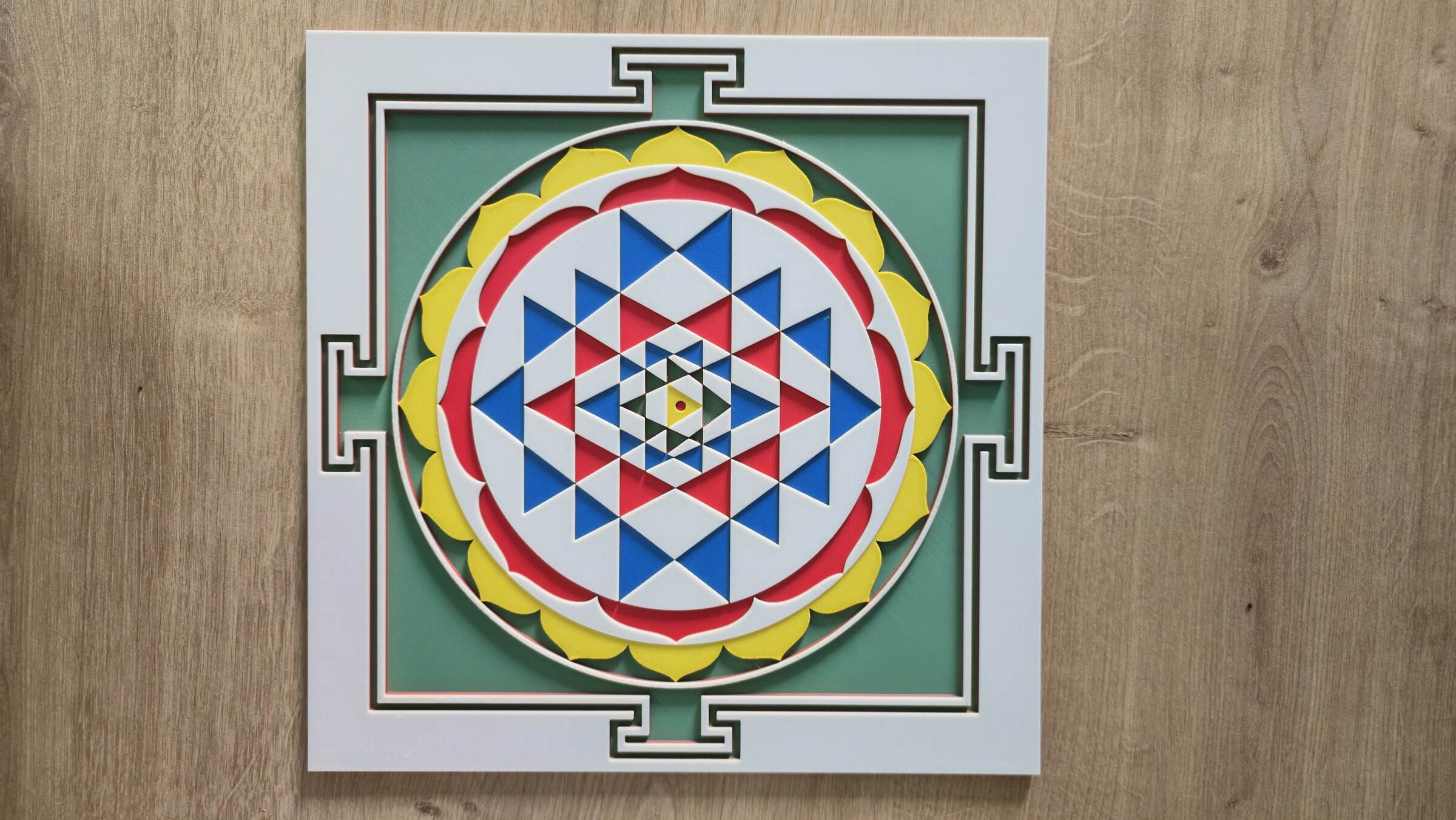
Second, simplify your technique. If your practice requires a specific app, 20 minutes of quiet, and a cushion, it has too many dependencies. The busier you are, the simpler your method should be. A single point of visual focus (a candle, a small image, even a dot on the wall) reduces cognitive load to near zero. You don’t have to figure out how to meditate. You just look.
When you’re traveling
Travel doesn’t just remove free time. It removes the environmental cues that trigger the habit: your meditation spot, your morning routine, the cushion in the corner. The system that makes meditation automatic is gone, and nothing in your new environment reminds you to practice.
The fix is bringing a portable cue. A small card with a visual focal point. A specific breathing pattern you only use for meditation. Something that recreates the trigger in any environment. Pair it to a travel-universal anchor: the moment after sitting down on a plane, the first minute in your hotel room, the gap between waking up and checking your phone.
Give yourself permission to practice differently while traveling. Shorter, simpler, different posture. A 3-minute open-eye meditation on a park bench counts. The traditional practice of trataka (steady gazing at a fixed point, described in the Hatha Yoga Pradipika as a technique for removing “fatigue and sloth”) works precisely because it needs nothing but something to look at. 
Reentry matters more than maintenance. Have a plan for your first session back home, even if it’s just “sit on my cushion for 2 minutes before unpacking.” The first day back is where people lose the thread, not the days away.
When you don’t feel like it
This is the most honest question in meditation: do I push through or honor the resistance?
There are two kinds of “don’t feel like it,” and learning to distinguish them is itself part of the practice.
The first is avoidance. The mind generating reasons not to face itself: not enough time, too tired, I’ll do it tomorrow. Hunt et al. (2020) studied 621 adults and identified four predictable barriers: doubting whether meditation will actually help, doubting whether you’re doing it correctly, struggling to find time, and sensing it conflicts with your social norms. These are the mind’s standard objections, not evidence of a real problem.
The second is genuine depletion. You’re sick, grieving, or running on no sleep. Your body is telling you something real.
Here’s a practical test: sit down for 60 seconds. If after one minute you still feel genuine resistance, stop. Rest is the practice today. But if after 60 seconds you’re fine (and most of the time, you will be), the resistance was just the activation energy barrier. The hard part was sitting down, not sitting.
This matters because early experiences shape whether you continue. A 2020 study found that new meditators who experienced positive emotions during their first few sessions were more likely to maintain the practice. Each time you sit down, discover the resistance was hollow, and finish feeling better than you started, you build the case for the next session.
Jon Kabat-Zinn offers a useful reframe: “The word discipline comes from disciple, someone who is in a position to learn.” Discipline in meditation isn’t forcing yourself through every session regardless of context. It’s showing up with enough curiosity to see what’s actually happening, even if what you discover is that you need rest today.
How to come back after a gap
This is the question nobody answers: what do you actually do when you’ve already stopped? Not yesterday. Three weeks ago. Or three months ago.
The biggest barrier to returning isn’t logistics. It’s the story you tell yourself about what the gap means. “I’m not really a meditator.” “I wasted all that progress.” “I have to start from scratch.” These narratives do more damage than the gap itself. They are the abstinence violation effect playing out in slow motion.
But you’re not starting from scratch. Lazar et al. (2005) at Harvard found that long-term meditators showed measurably greater cortical thickness in brain regions associated with attention and interoception. And research at MIT on habit reactivation (primarily in animal models, though the principle is consistent with human habit research) showed that neural patterns for dormant habits “immediately reformed” when reactivated, rather than needing gradual rebuilding. No study has specifically tracked meditation-related brain changes through a practice gap and back. But the evidence from both structural neuroscience and habit science points the same direction: you’re rekindling something, not building from nothing.
Your first session back should be embarrassingly short. Two minutes, no expectations, no making up for lost time. Don’t analyze why you stopped. That analysis becomes another reason to delay. Sit first. Reflect later.
Pema Chödrön’s core meditation instruction captures why this works. When your mind wanders during meditation, you notice, label the thought “thinking” (without judgment), and return to the breath. That returning is the practice. It’s not a failure to correct. It’s the whole point. Restarting after a gap of days or weeks is the same skill operating at a larger scale: you notice you’ve wandered, and you come back.
Building a practice that survives disruption
If you accept that gaps are inevitable, the question shifts from “how do I never stop?” to “how do I make returning easy?”
Keep it simple. The most resilient practice is one you could do on a park bench with nothing. A visual focus point (a trataka object, a small image, a candle) is more portable than any app and works in any environment.
Don’t tie your practice to a single time slot. Have a preferred time, but also a fallback. “If not morning, then before bed. If not before bed, then 60 seconds right now.” A flexible schedule bends under pressure instead of snapping.
Choose identity over schedule. “I am someone who meditates” is more durable than “I meditate every day at 7am.” The identity survives missed days. The schedule doesn’t. When you think of yourself as a meditator who is currently in a gap (rather than someone who failed at meditation), returning feels natural instead of shameful.
Only 4.7% of meditation app users are still using their app after 30 days (Baumel et al., 2019). The other 95% didn’t lack willpower. They built practices with too many dependencies (the app, the streak counter, the guided voice), and when any single piece failed, the whole thing collapsed.
The practice that lasts isn’t the most optimized one. It’s the one you can return to after you’ve lost it. Build for that.
Sources
- Levi, K., Shoham, A., Amir, I., & Bernstein, A. (2021). “The Daily Dose-Response Hypothesis of Mindfulness Meditation Practice: An Experience Sampling Study.” Psychosomatic Medicine, 83(6), 620–628. DOI: 10.1097/PSY.0000000000000912. PubMed: 34213862.
- Hunt, C.A., Hoffman, M.A., Mohr, J.J., & Williams, A.L. (2020). “Assessing Perceived Barriers to Meditation: the Determinants of Meditation Practice Inventory-Revised (DMPI-R).” Mindfulness, 11(5), 1139–1149. DOI: 10.1007/s12671-020-01308-7. PubMed: 33664878.
- Lally, P., van Jaarsveld, C.H.M., Potts, H.W.W., & Wardle, J. (2010). “How are habits formed: Modelling habit formation in the real world.” European Journal of Social Psychology, 40(6), 998–1009. DOI: 10.1002/ejsp.674.
- Baumel, A., Muench, F., Edan, S., & Kane, J.M. (2019). “Objective User Engagement With Mental Health Apps: Systematic Search and Panel-Based Usage Analysis.” Journal of Medical Internet Research, 21(9), e14567. DOI: 10.2196/14567.
- Lazar, S.W., Kerr, C.E., Wasserman, R.H., Gray, J.R., Greve, D.N., Treadway, M.T., et al. (2005). “Meditation experience is associated with increased cortical thickness.” Neuroreport, 16(17), 1893–1897. PubMed: 16272874.
- Marlatt, G.A. & Gordon, J.R. (1985). Relapse Prevention: Maintenance Strategies in the Treatment of Addictive Behaviors. New York: Guilford Press.
- Graybiel, A.M. et al. (2005). “Brain researchers explain why old habits die hard.” MIT News.
- Swatmarama. Hatha Yoga Pradipika, Chapter II, Verses 31–32.
- Gheranda. Gheranda Samhita, Chapter I.
- Chödrön, P. (2013). How to Meditate: A Practical Guide to Making Friends with Your Mind. Sounds True.
- Kabat-Zinn, J. (2011). Mindfulness for Beginners. Sounds True.