How to Use Mala Beads for Meditation
Miha Cacic · April 11, 2026 · 7 min read
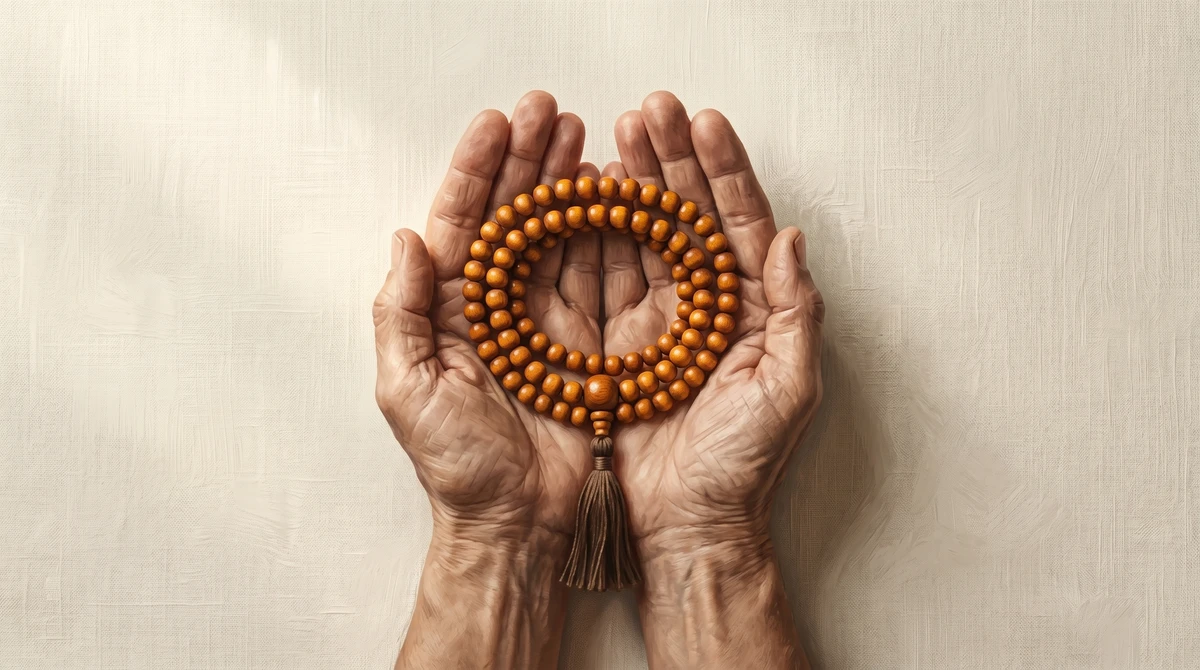
A mala is a string of 108 beads used to count mantra repetitions during meditation. But counting is not the point. The mala works because it gives your hands something to do, your ears something to track, and your mind a physical circuit to follow, occupying the channels that would otherwise fill with distraction. That makes it one of the most practical meditation tools available, especially for people who find sitting still with their eyes closed and ‘watching the breath’ too abstract to sustain.
What is a mala?
A mala is a loop of 108 beads with one larger bead (called the guru bead or meru bead) that marks the starting point. Most malas have a tassel hanging from the guru bead, and many include spacer beads that divide the strand into four sections of 27. Wrist malas (27 beads on elastic) are a shorter version designed for portability. 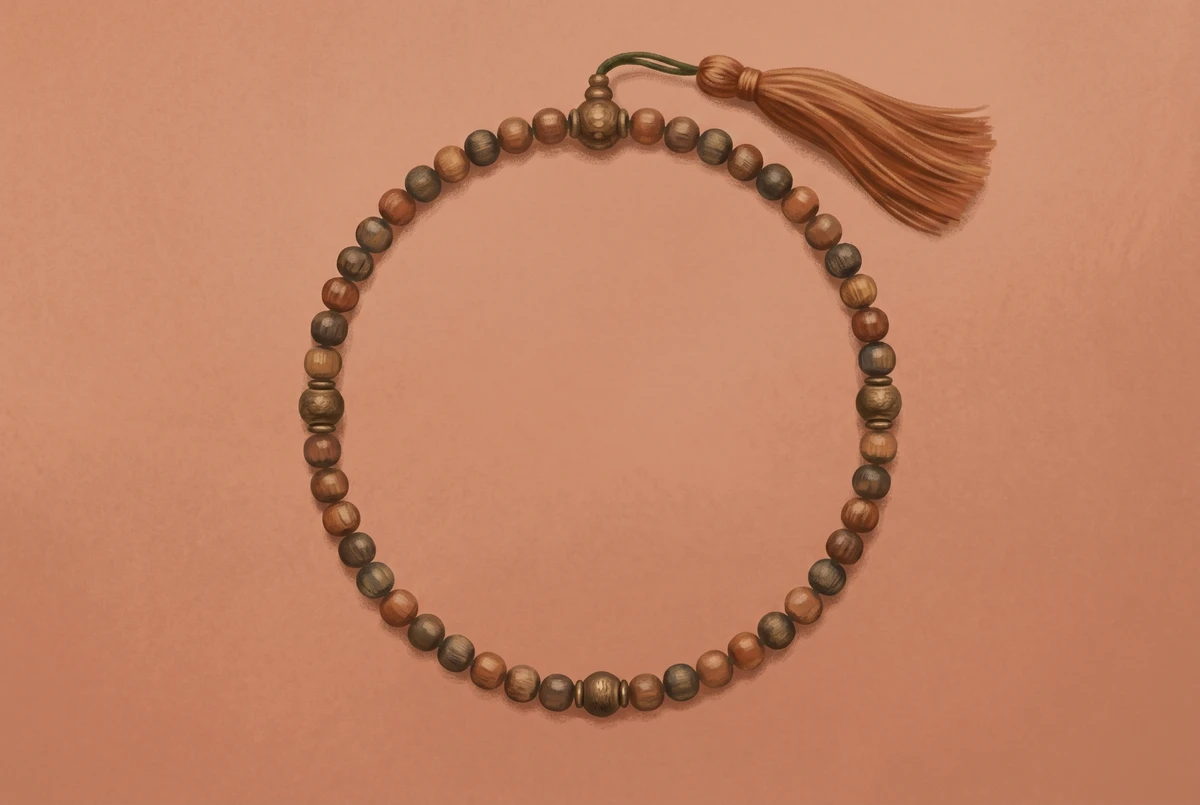
Common materials include rudraksha seeds, sandalwood, tulsi wood, bone (in the Tibetan tradition), gemstones, and simple wood. E-commerce stores will tell you that different gemstones carry different healing properties. The more honest guidance comes from Rolf Sovik, clinical psychologist and former president of the Himalayan Institute: “The material of the mala is far less important than the sincerity and one-pointedness with which you bring the mantra to mind.” A plain wood mala works perfectly fine for any beginner.
Why do malas have 108 beads?
Everyone asks. Nobody has a definitive answer.
There are many claimed explanations: the Muktika Upanishad lists exactly 108 Upanishads. Hindu and Buddhist traditions recognize 108 names of various deities. The ratio between the Sun’s diameter and Earth’s is approximately 109 (close enough to 108 that it gets cited as a cosmic coincidence). 108 is a harshad number, meaning it’s divisible by the sum of its digits (1+0+8=9, and 108÷9=12), which in Sanskrit translates to “joy-giver.”
The honest framing: 108 has been considered sacred across Hindu and Buddhist traditions for millennia, and the specific origin is lost in time. The earliest known textual prescription of 108 beads for mantra counting appears in the Mu Huanzi Jing, a Mahayana Buddhist text from roughly the 4th or 5th century CE, in which the Buddha advises a suffering king to string 108 wooden beads and recite upon each one.
What matters practically: 108 repetitions at a moderate pace takes roughly 15 to 25 minutes, a natural session length. The Himalayan Institute tradition credits only 100 repetitions per round, with the extra 8 beads accounting for the inevitable moments when your mind wanders. Malas also come in 54 and 27 beads for shorter sessions.
Why use a mala for meditation
Most articles say a mala “enhances focus” or “creates calm” and leave it there. That’s the equivalent of saying a bicycle “helps you go places.” The mechanism is more specific.
It fills your attention channels
When you use a mala, you’re simultaneously occupying three cognitive channels: touch (feeling the bead), sound (reciting the mantra, silently or aloud), and sequential tracking (moving through the circuit). Nils Lavie’s load theory of selective attention (2004) offers a framework for why this matters: when perceptual load is high (many channels occupied), less cognitive capacity remains available for processing distractors. Low perceptual load leaves spare capacity, which the mind automatically fills with irrelevant thoughts. 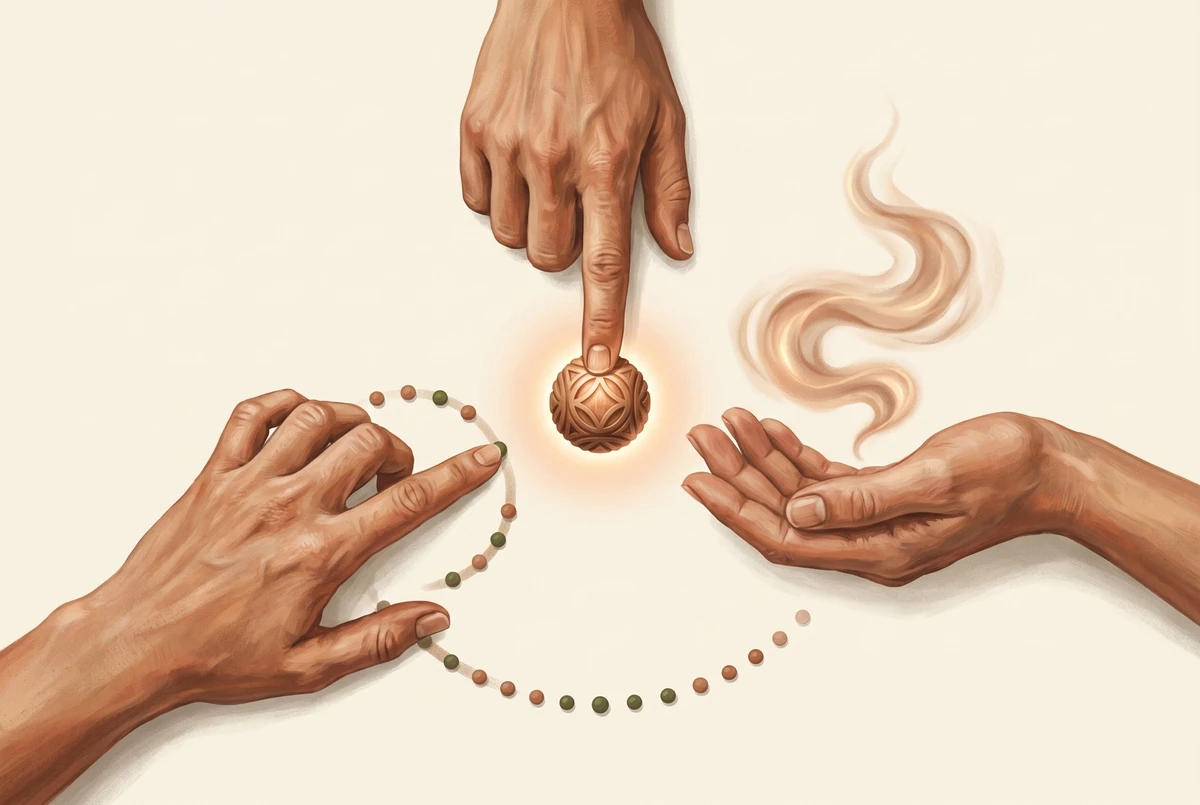
This helps explain why japa meditation (mantra repetition with a mala) is often more accessible than breath-only meditation for beginners. It gives the restless mind more to track, not less, which paradoxically reduces distraction. As one Theravada practitioner put it: “Engaging more of the senses can aid concentration… mala beads can be a way of engaging more senses in practice.”
Each bead is a micro-awakening
Ram Dass described it best: “If you want a psychological analysis of the use of a mala, you could say that it is a ‘kinesthetic cue device.’ Without it, you could be doing the mantra and get lost in doing it mechanically. But if you suddenly feel the bead between your fingers, it wakes you up again.”
You drift into autopilot, then feel the bead under your thumb, and it pulls you back. This happens 108 times per round. Not passive counting, but 108 small returns to awareness.
It replaces a timer
A mala turns meditation from clock-watching into circuit-walking. Instead of opening your eyes to check how long you’ve been sitting, you know the session ends when you return to the guru bead. One practitioner on Dhamma Wheel described the shift: “I like using malas because it shifts the focus from ‘doing time’ to ‘setting aside the time.‘”
What the neuroscience shows
Three findings are worth knowing. First, Berkovich-Ohana et al. (2015) showed in an fMRI study that even simple word repetition (no mala, no training, just silently repeating a word) produced widespread deactivation of the default mode network (the brain circuit associated with mind-wandering and self-referential thought) in 23 non-meditating subjects. Even without a mala or meditation training, repetitive speech quiets the wandering mind at the neural level.
Second, Acevedo, Pospos, and Lavretsky (2016) reviewed 13 studies and found that active meditation practices combining verbal repetition with touch or movement engaged brain areas for “tactile stimulation, sensorimotor integration, and motor function” that mindfulness-only practices did not activate. No study has tested mala use specifically, but the implication is clear: adding a tactile rhythm to mantra recitation recruits neural pathways that silent sitting does not.
Third, Bernardi et al. (2001) found that both rosary prayer and yoga mantra recitation independently slowed breathing to approximately 6 cycles per minute, the same frequency as the body’s endogenous cardiovascular rhythms. This synchronization produced significant increases in baroreflex sensitivity and heart rate variability. The convergence is striking: two unrelated traditions arrived at the same pace, and that pace happens to match a rhythm the body already runs on.
One tool in a family
The mala anchors attention through touch. A trataka candle anchors it through sight. Breath counting anchors it through interoception (sensing the body from within). These are different entry points to the same skill: sustained voluntary attention. For people who find closing their eyes and watching the breath too abstract, the mala offers a concrete, tactile alternative.
How to use a mala: step by step
Choose a mantra (or use your breath)
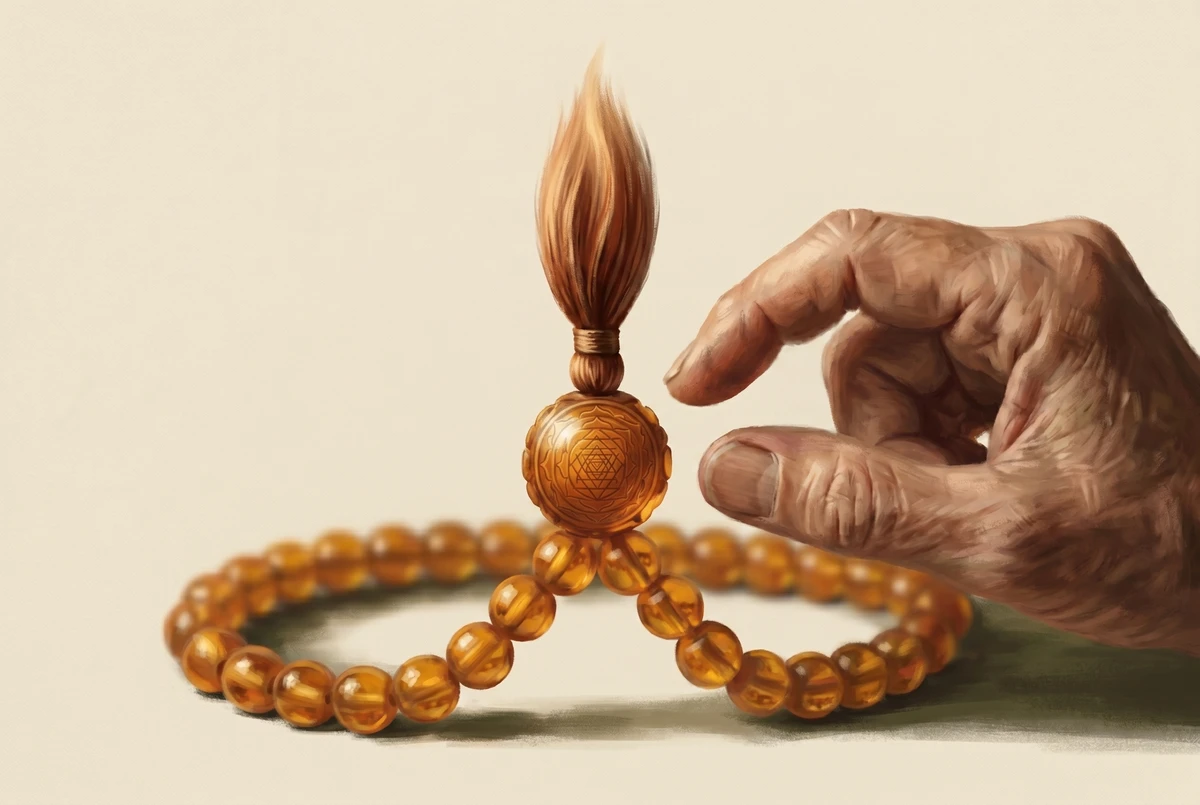
A mantra can be a traditional Sanskrit syllable (Om, Om Mani Padme Hum, Om Namah Shivaya), an English word, or simply your breath. If mantras feel foreign, count one breath cycle per bead instead. The mala works with both.
Hold the mala correctly
Drape the mala over the middle or ring finger of your right hand. Use your thumb to pull each bead toward you. The traditional reason for excluding the index finger: it represents ego (it’s the pointing finger). The practical reason: the thumb-and-middle-finger grip gives better bead control.
Note: the right-hand-only rule comes from Hindu tradition. Tibetans use either hand, and Padmasambhava prescribed different fingers for different types of mantras. If you’re not practicing within a specific tradition, use whatever hand feels natural. 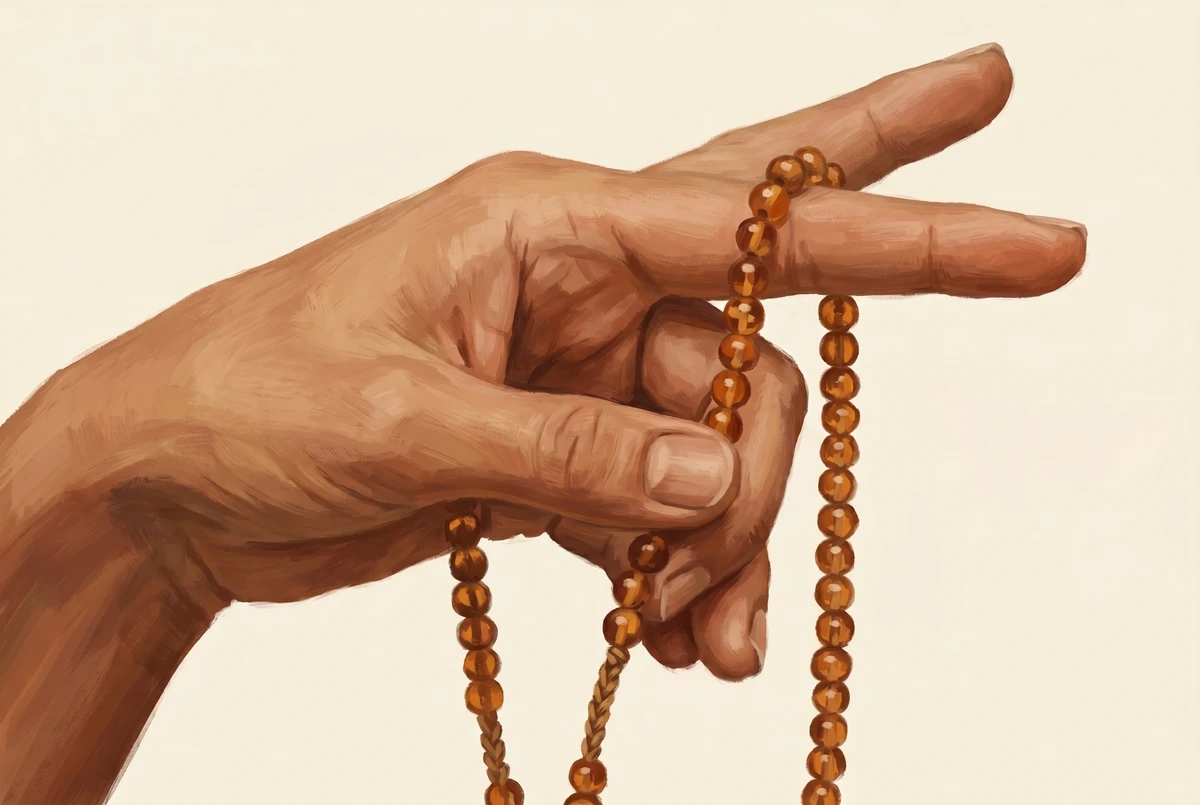
Start at the guru bead, one bead per repetition
Each bead receives one full mantra or one full breath cycle. Don’t rush. The pace should match the natural rhythm of the mantra, not an arbitrary speed. At roughly 6 beads per minute (a pace consistent with Bernardi’s finding of natural mantra rhythm at 6 cycles per minute), one full round takes about 18 minutes.
Don’t cross the guru bead
When you return to the guru bead at the end of a round, pause. Traditionally this is a moment to “bow mentally to the guru.” Practically, it’s a checkpoint: notice how you feel before deciding whether to continue. To start another round, flip the mala and go back the other way.
When you lose your place
You will lose count. Your mind will drift and your thumb will move without awareness. When you notice, return attention to whichever bead you’re on. Don’t restart. Don’t go back. The noticing is the practice.
How long to practice
One round (108 beads) is a natural starting point. Traditional japa prescribes multiple rounds, but for beginners, one round done with attention is worth more than four rounds done on autopilot.
Choosing a mantra for your mala practice
Start simple. “Om” is the most universal mantra: a single syllable, no memorization, usable regardless of tradition. Other accessible options:
- Om Mani Padme Hum (Tibetan compassion mantra, six syllables)
- Om Namah Shivaya (Hindu mantra of transformation, five syllables)
- So Hum (“I am that,” syncs naturally with breath: “So” on inhale, “Hum” on exhale)
Secular alternatives work too. If mantras feel too spiritual, use a word that means something to you: “peace,” “let go,” “I am here.” The mechanism is the same: repetition combined with touch produces focus. Ram Dass described a mantra as “a single wave pattern that gradually overrides all the other ones, until the mantra is the only thought-form left.” The content matters less than the consistency.
Stick with one. The advice across Hindu and yogic traditions is to practice one mantra for at least 40 days before switching. Changing mantras every session is like starting a new groove in a record each time. Consistency lets the association between the mantra and the mental state deepen.
Received vs. chosen. In some traditions, a guru gives you a personal mantra. In modern practice, most people choose their own. Either works. The mantra’s power comes from repetition and intention, not from authority.
The practice progression (what happens over time)
What most practitioners want to know at every stage: “Am I doing this right?”
Stage 1: Clumsy and distracted. The fingers fumble. The beads slip. The mantra competes with racing thoughts. You lose count repeatedly. This is normal, and the physical awkwardness actually helps. Fumbling requires attention, and attention is what you’re training.
Stage 2: The counting becomes automatic. The thumb-and-bead movement smooths out. The mantra begins to carry itself. Your mind still wanders, but you catch it more quickly because the tactile rhythm pulls you back. One practitioner on Dhamma Wheel described using the mala specifically as a warm-up: “I have started using them in conjunction with the breath, to help settle me down before meditation… When I feel more settled then putting down the mala and going into the mental counting.”
Stage 3: The mantra deepens. The mantra stops being a mental recitation and becomes more like a vibration or feeling. Tseng (2022) describes this as the state where “mantra repetition no longer consciously occurs and instead, the mind reaches a near-empty state without thought.” The mala movement becomes so natural it fades from awareness. You may find the mantra continues internally after you set the mala down.
Stage 4: The mala becomes optional. Some practitioners reach a point where they sustain the mantra without the mala. The internal rhythm has been established. The mala is a preference rather than a necessity, like training wheels that served their purpose. Not everyone reaches this stage, and not everyone should aim for it. Many experienced practitioners continue using a mala for decades because it grounds their practice.
In the Burmese Theravada lineage, this progression was explicit. Within Ledi Sayadaw’s tradition, mala practice was used as what one practitioner called “surrogate meditation,” an introductory practice before students moved on to anapanasati (breath awareness). In this lineage, the mala was never the final destination. One practitioner who eventually set the mala aside described the transition: “I decided to have my nose as my mala, and each in-breath and out-breath as the beads.”
Common mistakes (and the rules you can safely ignore)
Rushing through the beads. The most common beginner mistake. If you’re finishing 108 beads in under 10 minutes, you’re racing, not meditating. Each bead should receive a full, unhurried mantra or breath cycle.
Obsessing over hand position. The index-finger prohibition, right-hand-only rule, and specific finger placements come from Hindu cultural tradition. They’re worth respecting if you’re practicing within that tradition. But they’re not universal (Tibetans use any hand; Padmasambhava prescribed different fingers for different mantras), and getting anxious about “doing it wrong” defeats the purpose of a calming practice.
Treating the mala as a fashion accessory. Wearing a mala without using it is like hanging a piano on your wall. As one practitioner on Dhamma Wheel put it: “I’m always surprised at the number of yoga peeps who have malas, and wear them regularly, but who don’t know how to use them.” If wearing it reminds you to practice, good. But the value is in the doing.
Never practicing without it. If you always need the mala to meditate, you may be depending on the tool rather than developing the skill it trains. Occasionally sit without it and see whether your concentration holds. A practitioner on the same forum described becoming attached to the mala itself: “I ended up fidgeting with it more than meditating with it… worrying about where it was or if it was lost… I became attached to it as a piece of flair accentuating my identity as a meditator.”
Rules you can safely ignore as a beginner: You don’t need to “energize” your mala for 40 days before it works. You don’t need specific gemstones for specific intentions. You don’t need to hide it from others or store it in a special pouch. Start simple: wood or seed beads, one mantra, one round.
Caring for your mala
Store it somewhere clean and consistent: a small bowl, a cloth bag, a bedside table. This creates a ritual association between seeing the mala and sitting down to practice.
If the string breaks, restring it. A well-used mala wears out, and that’s a sign you’re actually using it. Knots between beads extend the lifespan and prevent all 108 beads from scattering when the cord goes.
Don’t wrap a full-length mala tightly around your wrist; it stresses the cord. Wrist malas (27 beads on elastic) are designed for wearing. Full malas are not.
A mala accumulates meaning through use, not through ceremony. A well-used plain wood mala is more valuable to your practice than an unused gemstone one.
Sources
- Berkovich-Ohana A, Wilf M, Kahana R, Arieli A, Malach R. (2015). “Repetitive speech elicits widespread deactivation in the human cortex: the ‘Mantra’ effect?” Brain and Behavior, 5(7):e00346. DOI: 10.1002/brb3.346. PMID: 26221571.
- Garrison KA, Zeffiro TA, Scheinost D, Constable RT, Brewer JA. (2015). “Meditation leads to reduced default mode network activity beyond an active task.” Cognitive, Affective, & Behavioral Neuroscience, 15(3):712–720. DOI: 10.3758/s13415-015-0358-3. PMID: 25904238.
- Acevedo BP, Pospos S, Lavretsky H. (2016). “The Neural Mechanisms of Meditative Practices: Novel Approaches for Healthy Aging.” Current Behavioral Neuroscience Reports, 3(4):328–339. DOI: 10.1007/s40473-016-0098-x. PMID: 27909646.
- Bernardi L, Sleight P, Bandinelli G, et al. (2001). “Effect of rosary prayer and yoga mantras on autonomic cardiovascular rhythms: comparative study.” BMJ, 323(7327):1446–1449. PMID: 11751348.
- Tseng AA. (2022). “Scientific Evidence of Health Benefits by Practicing Mantra Meditation: Narrative Review.” International Journal of Yoga, 15(2):89–95. DOI: 10.4103/ijoy.ijoy_53_22. PMID: 36329765.
- Lavie N, Hirst A, de Fockert JW, Viding E. (2004). “Load Theory of Selective Attention and Cognitive Control.” Journal of Experimental Psychology: General, 133(3):339–354. DOI: 10.1037/0096-3445.133.3.339. PMID: 15355143.
- Sovik R. “String of Pearls: How to Use a Mala.” Yoga International / Himalayan Institute.
- Ram Dass. (2014). “How to Use a Mala.” Love Serve Remember Foundation. https://www.ramdass.org/use-mala/
- Ram Dass. “Why Do We Use Mantras?” Love Serve Remember Foundation. https://www.ramdass.org/why-do-we-use-mantras/
- Mu Huanzi Jing (木槵子經). Mahayana Buddhist text, approx. 4th–5th century CE. Translation accessed via Buddho.org.
- Community discussions: Dhamma Wheel Forum (dhammawheel.com) and Dharma Wheel Forum (dharmawheel.net), threads on mala use in Buddhist practice.