Meditation for Creative People: Which Type Actually Works
Miha Cacic · April 11, 2026 · 6 min read

Some creative people try meditation and lose their edge. Ideas stop arriving in the shower. Emotional responses flatten. The productive restlessness that drives their work fades. They’re not imagining it. Certain meditation practices genuinely dampen the mental wandering that generates creative ideas. But the right practice, used at the right time, does the opposite, and there’s a specific reason why.
The wrong meditation can actually kill your creativity
Stefano Bernardi wrote a viral Medium post about how meditation destroyed his creative output. The advice he followed was simple: be mindful during your shower, your commute, falling asleep. The result? “All the moments when I used to race with creative ideas got killed.” He was told to bring awareness to every moment, and it worked. The problem was that those moments of inattention were exactly where his ideas came from.
He’s not alone. On Quora, a user named Toni Shuma described the same thing: “I stopped meditating because I lost my reactions. I used to love the rain and write poetry about it. After meditation, I looked at the rain and felt nothing.”
This isn’t a failure of discipline. It’s a mismatch between practice and goal.
Focused-attention meditation (FA) trains you to concentrate on a single object, like the breath, and return your attention to it every time your mind wanders. That “return” is the whole exercise. For someone whose creative process depends on wandering thoughts, this is actively counterproductive. You’re training your mind to do the opposite of what generates ideas.
A 2012 study at Leiden University by Colzato, Ozturk, and Hommel tested this directly. They had 19 experienced meditators perform both focused-attention and open-monitoring meditation sessions, then measured creative thinking. FA meditation showed no improvement on divergent thinking tasks (the kind that generates multiple ideas) and no improvement on convergent thinking tasks either. It simply didn’t help.
The people quitting meditation to save their creativity aren’t weak-willed. They’re responding accurately to what the practice is doing to their minds.
Why open-monitoring meditation works for creative thinking
The same Leiden study found the opposite effect for open-monitoring meditation (OM). In OM, you sit with awareness and let thoughts arise without latching onto them or pushing them away. You observe the stream without directing it.
After OM sessions, participants scored significantly higher on the Alternate Uses Task, a standard measure of divergent thinking where you list creative uses for common objects. Flexibility (the range of categories explored) jumped with a large effect size (η²p = 0.365), fluency rose from an average of 17.3 uses at baseline to 24.4 after OM, and originality improved comparably (η²p = 0.320). These are not marginal gains (Colzato et al., 2012). 
Why does OM work where FA doesn’t? Each practice does something different to top-down cognitive control. FA strengthens it: you pick a target and hold your attention there, suppressing everything else. OM loosens it: you let thoughts emerge, connect, and dissolve on their own schedule. A 2014 review by Lippelt, Hommel, and Colzato found that OM promotes “quick jumps from one thought to another by reducing the top-down control of cognitive processing.”
The default mode network (DMN) helps explain why this matters. The DMN is the brain network that activates during mind-wandering and daydreaming. In 2024, a team at Baylor College of Medicine published a study in Brain using intracranial electrodes implanted directly in patients’ brains to measure DMN activity during creative tasks. When they stimulated DMN regions with electrical pulses, the originality of participants’ ideas decreased. Not the quantity, specifically the originality. This is causal evidence that the DMN doesn’t merely correlate with creative thinking; it helps produce it (Bartoli et al., 2024). 
The theoretical connection to meditation follows from this: if OM meditation reduces top-down cognitive control (as the behavioral evidence suggests), it should allow the DMN more room to operate. FA meditation, which redirects attention to a single anchor every time the mind drifts, would work against this. The logic is consistent, though a 2025 fMRI study by Zhang and colleagues from the same Leiden group found that the neural pattern was “much clearer for the creativity tasks than meditation.” The specific brain-level overlap between OM and enhanced creativity remains unconfirmed.
The creative cycle: when to sit and when to work
The creative process moves through phases, and meditation helps in some of them while interfering with others.
Before ideation, OM meditation clears residual stress and loosens the grip of whatever you were thinking about before. If you’ve spent the morning answering emails, your mind is in a narrowed, reactive state: filtering, responding, task-switching. A short OM session shifts toward the loose, wandering attention that produces new connections.
During a creative block, OM may help break fixation. When you’re stuck, your brain is often looping through the same set of associations, like a search algorithm trapped in a local minimum. Capurso, Fabbro, and Crescentini (2014) have suggested that OM meditation reduces habitual verbal-conceptual interference, which is part of what keeps you locked in unproductive loops. A few minutes of non-directed observation can release the grip. This is practitioner logic supported by theory, not a tested protocol.
During active flow, don’t meditate. Flow states and OM meditation share one feature: both reduce prefrontal control over thought (Dietrich, 2004). But flow involves active skill engagement with a task, while meditation is deliberately unfocused. Interrupting flow to meditate is like pulling a fish out of the water to give it a swimming lesson.
After completing a piece of work, meditation helps with the emotional aftermath: the self-doubt, the vulnerability of having made something, the fear of judgment. This isn’t about creativity directly, but about sustaining the capacity to keep creating.
Meditation isn’t a daily vitamin you take for general creative health. It’s a tool with specific uses at specific moments. As Arjun Temurnikar put it on Quora, after quitting meditation as a teenager and reintroducing it at ten minutes a day: “Don’t make meditation your mantra. Don’t incorporate it into all facets of your life.”
What trataka offers that other practices don’t
For many creative people, the hardest part of OM meditation is the entry point. “Just sit and observe your thoughts without attachment” is a reasonable instruction for experienced meditators but a baffling one for everyone else. You sit down, close your eyes, and within seconds you’re either chasing a thought or fighting one.
Trataka (candle-gazing meditation) addresses this with a two-phase structure.
Phase one: gazing. You fix your eyes on a point, traditionally a candle flame, without blinking, for two to three minutes. This is pure focused attention. You have something concrete to do. Your eyes are open, your attention is anchored, and surface-level mental chatter settles because you’re engaged in a specific task. The Hatha Yoga Pradipika (Chapter 2, verse 31) lists trataka among the six purification practices, describing it as a technique that “destroys sloth” and clears the mind. A 2014 controlled study by Talwadkar, Jagannathan, and Raghuram found that one month of trataka practice improved attention and cognitive flexibility in elderly subjects compared to a control group (n=60). No equivalent study exists for younger creative practitioners, but the cognitive mechanisms are consistent. 
Phase two: afterimage. When you close your eyes, an afterimage of the flame appears. You don’t force it. You watch it shift, blur, change color, and dissolve. This phase naturally transitions the mind into open-monitoring territory. The afterimage gives your mind something to observe without effort, preventing the blankness or restlessness that trips up beginners in pure OM meditation. You’re watching something unfold that you can’t control, which is the mental posture that the Colzato research associates with divergent thinking.
The shift from phase one to phase two mirrors the shift from FA to OM within a single sitting. You don’t need to choose between focus and openness. Trataka walks you from one to the other.
For visual artists, designers, and anyone whose creative process is image-based, there’s an additional affinity: the afterimage phase trains the capacity to hold and observe mental images. Giovanni Dienstmann describes trataka as “the bridge between the body-oriented practices and the mind-oriented practices of meditation.”
No controlled study has tested trataka’s effect on creative output specifically. The connection rests on two well-supported premises: that OM meditation enhances divergent thinking (Colzato et al., 2012), and that trataka’s afterimage phase produces an OM-like mental state. The logic is sound but the direct evidence isn’t there yet.
What the research says (and what it doesn’t)
The core evidence rests on a small number of studies, and honesty about their limitations matters.
The Colzato et al. (2012) study is the most cited finding in this space: OM meditation enhanced divergent thinking while FA meditation did not. But the sample was 19 experienced meditators who practiced both FA and OM. There was no beginner group. The authors themselves called for future studies with naïve participants. A commentary by Capurso, Fabbro, and Crescentini (2014) echoed this, noting that the biasing effect of OM on cognitive control “could be less evident” in people who haven’t practiced before.
The 2014 review by Lippelt, Hommel, and Colzato confirms the broader pattern but also notes that research across meditation types uses inconsistent methods, samples, and tasks. Their conclusion: “Research on meditation is still in its infancy.”
The causal DMN evidence from Bartoli et al. (2024) is strong but indirect. It proves the DMN plays a causal role in creative originality. It doesn’t prove meditation enhances creativity via the DMN; that’s an inference, though a reasonable one. The Zhang et al. (2025) fMRI study from the same Leiden group found that flexibility conditions activated the DMN, but “did not find significant effects when contrasting the 2 meditation techniques” at the whole-brain level.
On the anecdotal side, David Lynch practiced Transcendental Meditation from 1973 until his death in 2025 and credited it with his creative output. His metaphor from Catching the Big Fish (2006): “If you want to catch little fish, you can stay in the shallow water. But if you want to catch the big fish, you’ve got to go deeper.” TM is a mantra-based practice distinct from OM meditation. Lynch’s experience supports the general idea that a non-forcing meditation style can coexist with (and perhaps enhance) creativity, but it doesn’t directly validate the OM-specific findings from Leiden.
At the Bauhaus school, Johannes Itten practiced meditation as a follower of the Mazdaznan movement and explicitly framed it as the source of his artistic practice and teaching philosophy (Droste, 2002). His commitment to meditation-as-creative-practice was so central that it eventually caused a rift with Walter Gropius. This is a historical data point, not evidence, but it shows that the connection between meditation and visual creativity has been taken seriously by working artists for over a century.
What’s missing from the literature: no study has tested whether brief OM meditation helps creative beginners (not just experienced meditators). No study has tested trataka’s effect on creative output. No study has compared meditation timing (before vs. after creative work). These are the questions creative practitioners actually ask, and science hasn’t caught up yet.
A simple practice for creative people who’ve never meditated
Ten minutes before a creative session, no more.
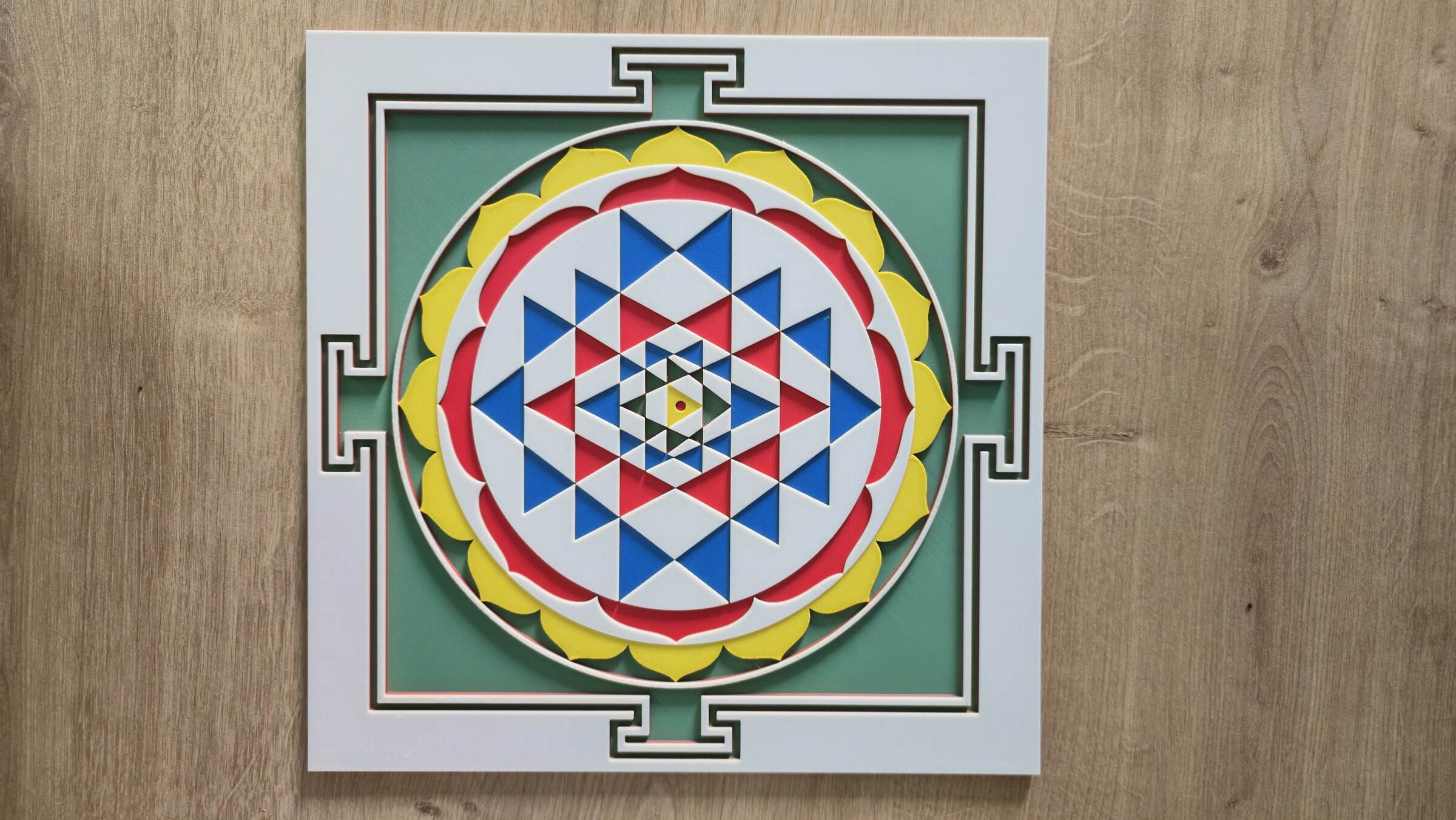
- Light a candle or place a printed geometric pattern (a Sri Yantra works well) at eye level, about two feet away.
- Gaze at the center point without blinking for two to three minutes. When your eyes water, that’s normal.
- Close your eyes. Watch the afterimage. Don’t try to hold it or sharpen it. Just observe as it shifts and fades. Stay here for two to three minutes.
- If the afterimage disappears, sit with whatever you see behind your eyelids. If stray thoughts arise, let them.
- Open your eyes, repeat once if you want, then go directly into your creative work. Don’t check your phone or email first.

Two things this practice is not: it’s not a lifestyle overhaul, and it’s not a daily obligation. Don’t be mindful in the shower. Don’t meditate during your commute. Those are the unstructured moments where your ideas come, and you should protect them fiercely.
Use meditation as a deliberate tool at a deliberate moment, the same way you might use a warm-up sketch before a painting or scales before a performance. The goal isn’t to become a meditator. The goal is to do your best creative work.
Sources
- Colzato, L.S., Ozturk, A., & Hommel, B. (2012). “Meditate to create: the impact of focused-attention and open-monitoring training on convergent and divergent thinking.” Frontiers in Psychology, 3:116. DOI: 10.3389/fpsyg.2012.00116. PMCID: PMC3328799.
- Lippelt, D.P., Hommel, B., & Colzato, L.S. (2014). “Focused attention, open monitoring and loving kindness meditation: effects on attention, conflict monitoring, and creativity – A review.” Frontiers in Psychology, 5:1083. DOI: 10.3389/fpsyg.2014.01083.
- Bartoli, E., et al. (2024). “Default mode network electrophysiological dynamics and causal role in creative thinking.” Brain, 147(10): 3409–3425. DOI: 10.1093/brain/awae199. PMID: 38889248.
- Talwadkar, S., Jagannathan, A., & Raghuram, N. (2014). “Effect of trataka on cognitive functions in the elderly.” International Journal of Yoga, 7(2): 96–103. DOI: 10.4103/0973-6131.133872. PMID: 25035618.
- Zhang, W., Sjoerds, Z., Mourits, R., & Hommel, B. (2025). “Neural correlates of metacontrol persistence and flexibility induced by creativity and meditation.” Cerebral Cortex. PMID: 41082374.
- Capurso, V., Fabbro, F., & Crescentini, C. (2014). “Mindful creativity: the influence of mindfulness meditation on creative thinking.” Frontiers in Psychology, 4:1020. DOI: 10.3389/fpsyg.2013.01020. PMCID: PMC3887545.
- Dietrich, A. (2004). “The cognitive neuroscience of creativity.” Psychonomic Bulletin & Review, 11(6): 1011–1026.
- Lynch, D. (2006). Catching the Big Fish: Meditation, Consciousness, and Creativity. Tarcher/Penguin.
- Droste, M. (2002). Bauhaus: 1919–1933. Taschen. ISBN: 3-8228-2105-5.
- Hatha Yoga Pradipika, Chapter 2, verse 31.