Meditation for People Who Overthink
Miha Cacic · April 11, 2026 · 6 min read

You’ve been told to “just observe your thoughts.” But you’re already observing them. That’s the entire problem. Overthinking isn’t a failure to be mindful. It’s a loop: the same worry, the same replay, the same rehearsal, cycling through your mind because it hasn’t found resolution. The meditation that helps isn’t the kind that asks you to watch the loop. It’s the kind that breaks it.
Overthinking isn’t “too many thoughts,” it’s the same thought on repeat
The word psychologists use is rumination. Susan Nolen-Hoeksema, who spent her career studying it, defined rumination as a passive, repetitive focus on the causes, consequences, and symptoms of distress. Not active problem-solving. The mind returns to the same material because it’s trying to “solve” something that can’t be solved by thinking alone. Each pass feels like progress but produces no new information.
This is different from ordinary mind-wandering, where your attention jumps between topics. Mind-wandering drifts. Rumination circles. And it’s different from worry, which rehearses future threats. Rumination replays past events. In her later work with Wisco and Lyubomirsky (“Rethinking Rumination,” 2008), Nolen-Hoeksema established that rumination predicts the onset and maintenance of depression, anxiety disorders, binge eating, and alcohol misuse. It’s not just an annoying habit. It’s a clinical risk factor. 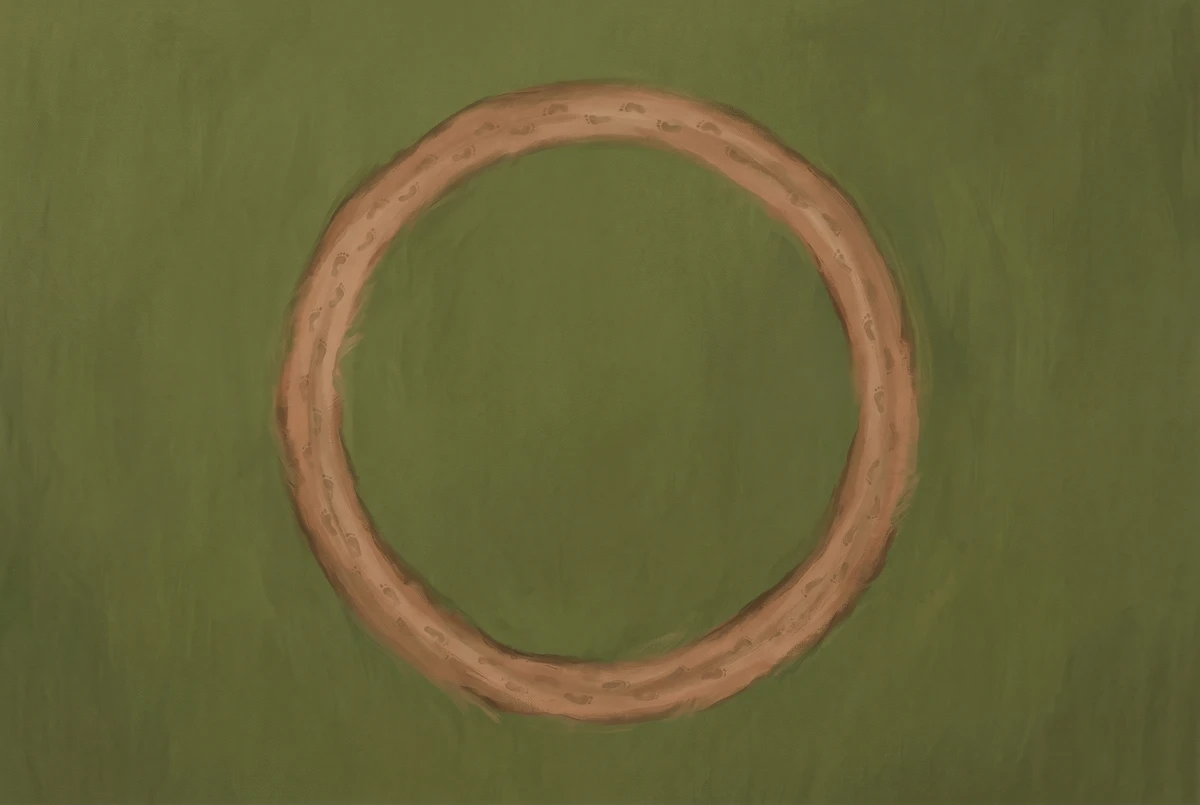
Why does the loop keep running? Because it feels productive. Ruminators report that thinking things through is useful, that they’re being responsible, preparing, analyzing, preventing. Stopping feels like letting your guard down. As one Quora user put it: “A thought which remains unsolved results in overthinking.” The mind won’t let go because it hasn’t reached resolution, and it can’t reach resolution because rumination doesn’t generate solutions. It just replays the problem.
There’s a subtler mechanism at work too. Nolen-Hoeksema’s research found that ruminators are not engaging in emotional processing. They’re avoiding it. Thinking about a feeling is less threatening than feeling the feeling. The cognitive loop substitutes for the emotional experience. Interoception research points in the same direction: people with low interoceptive awareness (the ability to sense internal body signals like heartbeat, gut sensations, and muscle tension) tend to ruminate more. When you’re disconnected from physical sensation, the mind fills the gap with narrative. Füstös and colleagues (2012) found that higher interoceptive accuracy predicts better emotional regulation, suggesting that when you can feel emotions directly, the mind has less reason to loop. One Quora user discovered this on their own: “I have noticed that many thoughts come from inside the body, so what I do is focus on the body and I learned to release the tension and energy that is there. Surprisingly, the same thoughts never come back again if you find their root.”
Why “just observe your thoughts” backfires for overthinkers
The standard meditation instruction is: observe your thoughts without judgment, and they’ll pass. This works for random, drifting thoughts. It doesn’t work for rumination, because rumination is already a form of observation. The overthinker is hyper-aware of every thought, turning it over, examining it from every angle, unable to let it pass. Asking them to observe more carefully deepens the loop rather than interrupting it.
Adrian Wells, who developed Metacognitive Therapy, draws a crucial distinction here. There’s a difference between noticing “I’m having a thought” (healthy metacognition) and noticing “I’m having a thought about having a thought about whether I’ll ever stop having this thought” (metacognitive rumination). Standard mindfulness instructions don’t distinguish these. Overthinkers naturally drift toward the second. Wells calls it the difference between metacognitive mode (observing thoughts as mental events) and object mode (engaging with thought content as real and requiring response). The instruction “observe your thoughts” sounds like metacognitive mode. For a ruminator, it often triggers object mode with extra steps. 
Then there’s the quiet. When you close your eyes and remove external stimulation, you remove everything competing with the rumination loop. The default mode network (DMN), a brain network associated with self-referential thinking, gets free rein. Brewer and colleagues at Yale showed via fMRI that experienced meditators (averaging over 10,000 hours of practice) show reduced DMN activity during meditation, while novices show typical DMN activation. The novice’s brain, left without external input, does what it does best: it thinks about itself. For someone whose DMN is already hyperactive (as rumination research consistently shows), this amplifies the problem.
Fujino and colleagues confirmed this at the neural level. In experienced open-monitoring meditators, the hippocampus and parahippocampal gyrus (memory-replay regions) showed reduced activation during practice. In novices attempting the same practice, these regions activated. The beginners’ brains were reaching for memories to observe, pulling up the same material that feeds rumination. Open monitoring eventually works, but the training pathway goes through a stage where it makes the problem worse.
This isn’t speculation. Lindahl and Britton’s 2017 study in PLOS ONE documented meditation-related adverse effects across 60 experienced Western Buddhist practitioners. Among the cognitive challenges they catalogued: “rumination and repetitive thoughts” appeared explicitly as a meditation-related adverse effect. Practitioners with prior anxiety or ruminative tendencies were disproportionately represented among those reporting difficulties. As one Quora user and longtime Buddhist put it: “It is normal to overthink… meditation can help or hinder. If you tend to overthink, it will most likely manifest itself in the meditation practice, leading to more frustration.”
This doesn’t mean meditation is wrong for you. It means the entry point matters.
The meditation that actually works: give your mind a job it can do
Meditation research classifies practices into two broad categories. Lutz, Slagter, Dunne, and Davidson formalized the distinction in 2008: open monitoring (OM), where you observe whatever arises without selective focus, and focused attention (FA), where you concentrate on a single object, notice when you’ve drifted, and return.
For overthinkers, FA is the better entry point. OM asks the mind to do nothing in particular, which is exactly what the overthinking mind can’t do. FA gives it a job: stay with this object. When you wander, come back. The skill it trains is precisely the one ruminators lack: voluntary disengagement from a thought loop. Querstret and Cropley’s systematic review (2013) found that interventions targeting attentional redirection (FA-type) consistently outperformed insight-oriented approaches (OM-type) in reducing rumination in the short term.
Most FA instructions start with the breath. Focus on your breathing. The problem for overthinkers is that the breath is subtle, internal, and offers no feedback. You can’t tell if you’re “doing it right.” For an analytical mind, this ambiguity creates more material to ruminate about. (“Am I breathing correctly? Am I observing enough? Why can’t I feel it?“)
A visual object solves this. Your eyes are either focused on it or they’re not. There’s no room for interpretive overthinking. And vision recruits an enormous amount of brain real estate. As MIT neuroscientist Mriganka Sur noted, roughly half the human brain is devoted, directly or indirectly, to visual processing. When you engage this system with a steady gaze on a fixed point, you occupy the cognitive resources that the rumination loop needs to sustain itself. 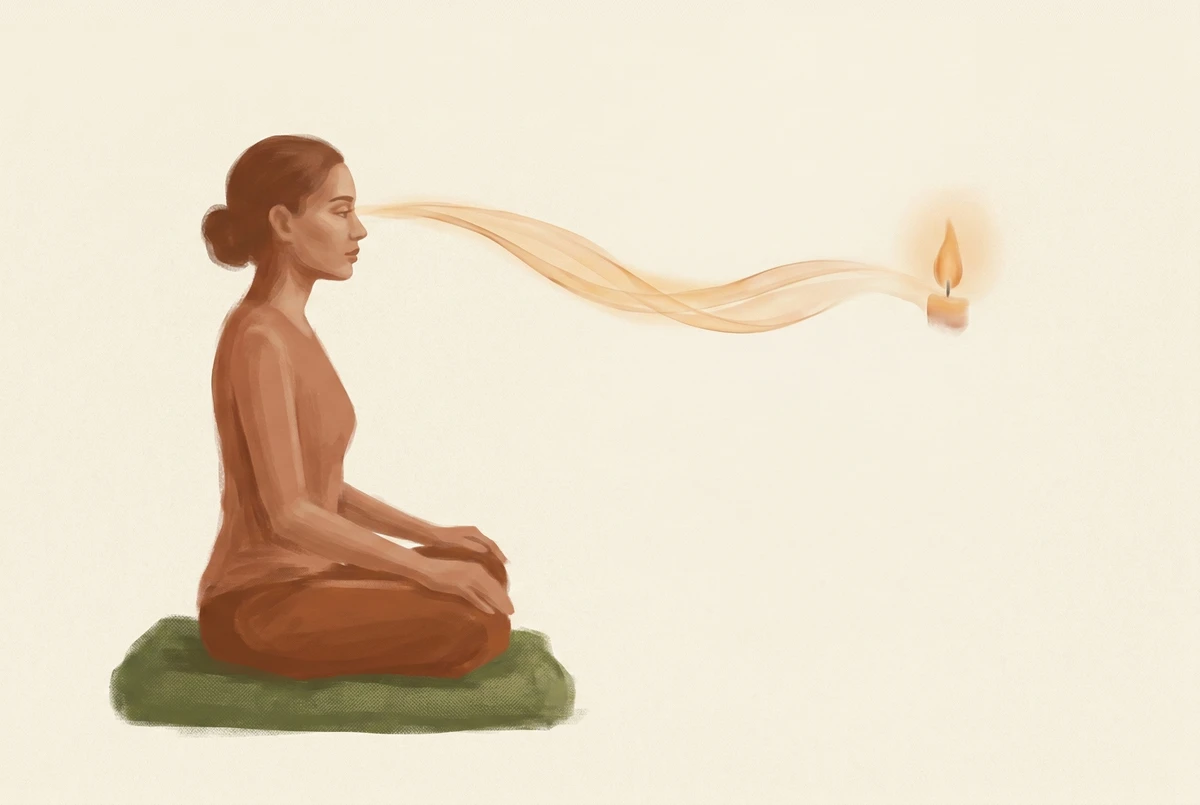
This principle has an old name: trataka. The Hatha Yoga Pradipika, a 15th-century yoga manual, describes it plainly: “Being calm, one should gaze steadily at a small mark, till eyes are filled with tears.” It’s one of the six shatkarmas (purification practices), and it’s the physical implementation of dharana (concentration), the sixth limb of Patanjali’s Yoga Sutras.
Modern research backs up the mechanism. Swathi, Bhat, and Saoji (2021) tested 43 adults in a repeated-measures crossover design comparing trataka (15 minutes of gazing at a fixed point) against supine rest and puzzle-solving. On the Corsi-Block Tapping Task (a measure of visuospatial working memory), trataka produced significantly better scores than both controls (p < 0.001 for forward span). Raghavendra and Singh (2016) found that a single 10-minute trataka session significantly improved Stroop test performance (p < 0.001), measuring the ability to suppress automatic responses and select intentional ones. Neither study measured rumination directly. But both target the skill ruminators lack: top-down attentional control, the ability to disengage from a response you didn’t choose.
Some practitioners find that complex visual objects (a geometric pattern like the Sri Yantra, with its interlocking triangles and nested structure) provide richer engagement than a simple dot or flame. This is a practitioner observation, not a research finding, but the logic tracks: a more visually complex anchor recruits more of the visual system, leaving less room for the rumination loop to reassert itself.
How to start (a practice for the overthinking mind)
Start with three minutes, not ten. The standard “start with 10 minutes” advice creates a 10-minute arena for rumination. Three minutes is short enough that the overthinking mind doesn’t panic, but long enough to practice the skill of visual focus. Extend the duration only when three minutes feels easy.
Use a physical object, not your breath. A candle flame, a dot drawn on paper, or a Sri Yantra image. Place it at eye level, about arm’s length away. Gaze steadily without straining. When you notice you’ve drifted into a thought loop, the correction is simple: look at the object again. No ambiguity, no judgment, no “was I observing correctly?” 
The blink test. In trataka, you hold a steady gaze without blinking for as long as comfortable. Don’t force it or strain. When tears come (and they will), close your eyes. This gives you concrete biofeedback: you can measure your focus improving session by session by how long you hold the gaze before blinking. For the overthinker who needs evidence of progress, this is more useful than any app streak.
The afterimage phase. When you close your eyes after gazing, a luminous afterimage of the object appears. Hold your attention on it. This trains the same focused attention skill, but internally, a bridge toward eyes-closed practice. Overthinkers often find this easier than starting with eyes closed because they’ve already settled their mind during the gazing phase. When the afterimage fades, open your eyes and resume gazing.
When the loop restarts. It will. The thought loop will reassert itself, probably within 20 seconds at first. That’s fine. The practice isn’t “never think.” It’s “notice the loop, return to the object.” Each return is one repetition of the attention muscle. Brewer’s fMRI research found that experienced meditators have stronger connectivity between the posterior cingulate cortex (the DMN hub) and the dorsal anterior cingulate cortex (the “oops, I wandered” detector). This connectivity likely develops through exactly this kind of practice: noticing the loop and choosing to return. With consistent practice, the gap between loops grows longer.
When meditation isn’t enough (and what to do about it)
Chronic, uncontrollable overthinking can be a symptom of generalized anxiety disorder, OCD, depression, or PTSD. If overthinking significantly disrupts your sleep, prevents decisions, or causes physical symptoms, meditation alone may not be sufficient.
For clinical overthinking, meditation works best alongside professional support. Cognitive Behavioral Therapy (CBT) and Adrian Wells’ Metacognitive Therapy (MCT) specifically target rumination patterns. MCT, for example, teaches a technique called “postponed worry”: when you notice a rumination loop, you schedule it for a specific time later (“I’ll think about this at 6pm”). This demonstrates to the mind that the loop is controllable, challenging the belief that it isn’t. In controlled trials, MCT has shown large effect sizes for reducing ruminative thinking, likely because it targets the metacognitive beliefs that keep the loop running rather than the thought content itself.
If meditation practice consistently increases your distress, rumination, or emotional flooding, that’s useful information, not a failure. Lindahl and Britton’s research suggests that practitioners with prior anxiety or ruminative tendencies may benefit from building emotional regulation skills (often through therapy) alongside their meditation practice, rather than relying on silent sitting alone.
Many experienced meditators also see therapists. These are different tools for different aspects of the same problem. The mind that overthinks is not broken. It’s a powerful engine that needs steering, not suppression.
Sources
- Nolen-Hoeksema, S. (1991). “Responses to depression and their effects on the duration of depressive episodes.” Journal of Abnormal Psychology, 100(4), 569–582. https://doi.org/10.1037/0021-843X.100.4.569
- Nolen-Hoeksema, S., Wisco, B. E., & Lyubomirsky, S. (2008). “Rethinking Rumination.” Perspectives on Psychological Science, 3(5), 400–424. https://doi.org/10.1111/j.1745-6924.2008.00088.x
- Füstös, J., Gramann, K., Herbert, B. M., & Pollatos, O. (2012). “On the embodiment of emotion regulation: Interoceptive awareness facilitates reappraisal.” Social Cognitive and Affective Neuroscience, 8(8), 911–917. https://doi.org/10.1093/scan/nss089
- Wells, A., & Matthews, G. (1996). “Modelling cognition in emotional disorder: The S-REF model.” Behaviour Research and Therapy, 34(11–12), 881–888. https://doi.org/10.1016/S0005-7967(96)00050-2
- Brewer, J. A., Worhunsky, P. D., Gray, J. R., Tang, Y.-Y., Weber, J., & Kober, H. (2011). “Meditation experience is associated with differences in default mode network activity and connectivity.” PNAS, 108(50), 20254–20259. https://doi.org/10.1073/pnas.1112029108
- Fujino, M., Ueda, Y., Mizuhara, H., Saiki, J., & Nomura, M. (2018). “Open monitoring meditation reduces the involvement of brain regions related to memory function.” Scientific Reports, 8, 9968. https://doi.org/10.1038/s41598-018-28274-4
- Lindahl, J. R., Fisher, N. E., Cooper, D. J., Rosen, R. K., & Britton, W. B. (2017). “The varieties of contemplative experience: A mixed-methods study of meditation-related challenges in Western Buddhists.” PLOS ONE, 12(5), e0176239. https://doi.org/10.1371/journal.pone.0176239
- Lutz, A., Slagter, H. A., Dunne, J. D., & Davidson, R. J. (2008). “Attention regulation and monitoring in meditation.” Trends in Cognitive Sciences, 12(4), 163–169. https://doi.org/10.1016/j.tics.2008.01.005
- Querstret, D., & Cropley, M. (2013). “Assessing treatments used to reduce rumination and/or worry: A systematic review.” Clinical Psychology Review, 33(8), 996–1009. https://doi.org/10.1016/j.cpr.2013.08.004
- Swathi, P. S., Bhat, R., & Saoji, A. A. (2021). “Effect of Trataka (Yogic Visual Concentration) on the Performance in the Corsi-Block Tapping Task: A Repeated Measures Study.” Frontiers in Psychology, 12, 638510. https://doi.org/10.3389/fpsyg.2021.638510
- Raghavendra, B. R., & Singh, P. (2016). “Immediate effect of yogic visual concentration on cognitive performance.” Journal of Traditional and Complementary Medicine, 6(1), 34–36. https://doi.org/10.1016/j.jtcme.2014.11.030
- Hagen, B. I., et al. (2017). “Metacognitive therapy for depression in adults: A waiting list randomized controlled trial with six months follow-up.” Frontiers in Psychology, 8, 31. https://doi.org/10.3389/fpsyg.2017.00031
- Sur, M. (1996). “How the Brain Processes Visual Information.” MIT News, April 17, 1996. https://news.mit.edu/1996/visualprocessing
- Swami Swatmarama (~15th century CE). Hatha Yoga Pradipika, Chapter II, verses 31–32. Trans. Srisa Chandra Vasu. https://sacred-texts.com/hin/hyp/hyp04.htm
- Patanjali. Yoga Sutras, Book III, verses 1–3.