Meditation for Programmers: The Open-Eye Method
Miha Cacic · April 11, 2026 · 5 min read

Programmers already do the hardest part of meditation every working day: sustaining focused visual attention. When you’re deep in a debugging session, eyes on code, tracing state through functions, tuning out everything around you, you’re performing a feat of concentration that most meditators spend years trying to develop.
The problem isn’t that you can’t focus. It’s that nearly every meditation guide tells you to close your eyes, watch your breath, and let thoughts pass. For a brain trained on sustained visual attention, that’s like telling a pianist to practice by thinking about music without touching a keyboard.
Why most meditation advice doesn’t work for programmers
Programming is visual pattern recognition. You read syntax highlighting, scan indentation levels, spot misplaced brackets, compare diffs side by side. An fMRI study by Ikutani et al. (2021) found that expert programmers develop dedicated cortical representations for source code, with brain regions for stimulus-driven attention control showing the strongest correlation with programming expertise. Your brain has rewired itself around visual attention. 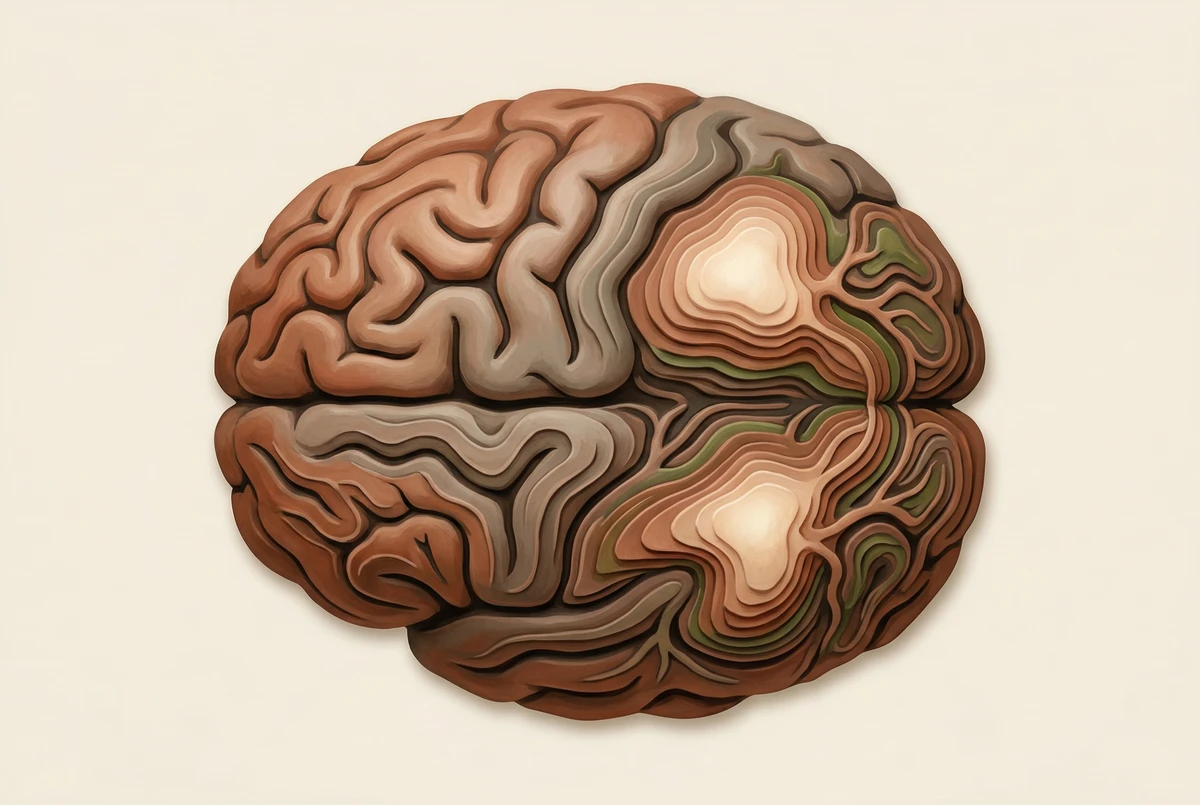
Standard mindfulness meditation asks you to shut down this entire channel. Close your eyes. Focus on your breath. When a thought arises, observe it without engaging.
That last instruction is the exact opposite of what programming trains you to do. Programming rewards you for engaging with every problem that arises, not watching it float by. And when you close your eyes and remove all visual input, your visual processing system doesn’t go quiet. It fills the void with mental imagery: the bug you’re stuck on, tomorrow’s sprint planning, that pull request you haven’t reviewed.
This is why programmers so often report that their minds race during meditation. It’s not a personal failing. It’s a mismatch between the technique and the cognitive profile. You’re asking the most active part of your brain to sit idle while offering it nothing to work with. 
What programmers actually need from a meditation practice
Every meditation article for developers lists the same benefits: focus, stress reduction, creativity, flow. Here’s what matters for someone who holds program state in their head for a living:
Sustained single-task attention. Debugging requires maintaining a mental model of state across dozens of lines. A meditation practice should train this capacity directly, not as a side effect of watching your breath.
Faster context-switching recovery. Gloria Mark’s research shows it takes approximately 25 minutes to return to a deep work task after an interruption. Slack messages, standups, and PR reviews constantly shatter deep focus. The useful practice is one that rebuilds concentration in minutes, not one that needs 20 minutes of runway before it starts working.
Relief from screen fatigue. After 8+ hours of fixed-distance screen gaze, a practice should give your eyes purposeful exercise at a different focal distance, not more darkness behind closed lids.
Easier access to flow. Csikszentmihalyi identified sustained concentration on the present moment as a core component of flow. A practice should train that concentration directly, so flow becomes something you can prime rather than something you wait for.
Open-eye meditation: the technique that fits how you already think
There’s a category of meditation that every top Google result for “meditation for programmers” ignores: open-eye visual concentration.
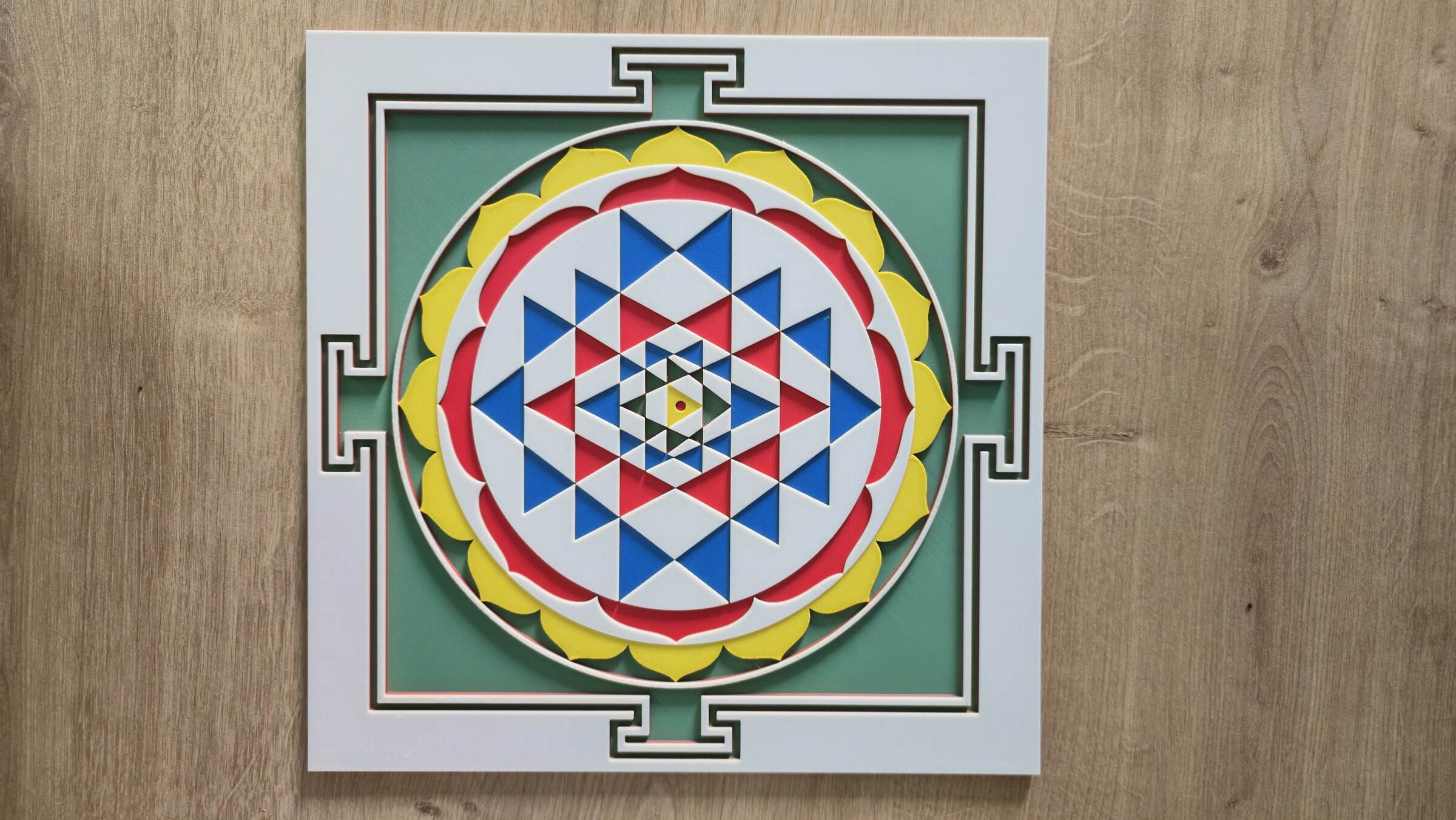
In the yogic tradition, this technique is called trataka. The Hatha Yoga Pradipika, a 15th-century text, describes it: “Being calm, one should gaze steadily at a small mark, till eyes are filled with tears.” You fix your eyes on a single visible point (a candle flame, a dot, a geometric pattern) and hold your gaze steady. That’s it.
What makes trataka different from breath meditation is the feedback loop. When your attention wanders during breath-focused practice, you might not notice for minutes. The breath keeps going whether you’re paying attention or not. But with a visual anchor, the moment your mind drifts, you see it: your eyes shift, the object blurs, your gaze goes soft. The visual target gives you an immediate, external signal that you’ve lost focus. For programmers trained to respond to visual feedback (a red underline, a failing test indicator, a syntax highlight out of place), this is a natural attentional language.
This isn’t just philosophical preference. Different meditation techniques train different cognitive subsystems. Jha, Krompinger, and Baime (2007) found that even within breath-based mindfulness, an 8-week MBSR course improved attentional orienting (selecting and directing attention to relevant stimuli), while a month-long intensive retreat improved alerting (sustained vigilance and readiness). If two variations of the same modality produce different cognitive outcomes, the type of meditation you choose matters.
The most directly relevant study comes from Swathi, Bhat, and Saoji (2021), who measured trataka’s effect on the Corsi Block-Tapping Task, a standard neuropsychological test of visuospatial working memory. Participants trained for two weeks (six days per week), with each session consisting of 10 minutes of preparatory eye exercises followed by 10 minutes of candle-flame gazing. After training, their forward Corsi Span improved from 5.5 to 6.1 (p < 0.001, Cohen’s d = 0.642), and their total visuospatial working memory score rose from 44.26 to 56.95 (p < 0.001, d = 0.743). A control group that performed the same eye exercises without the focused-gaze component showed no comparable improvement.
What does visuospatial working memory have to do with programming? The Corsi task measures your ability to hold and recall spatial sequences. When you read a function and track which variables reference which values across multiple lines, you’re performing something structurally similar: holding spatial-positional information in mind while processing sequences. No study has directly tested whether trataka improves code reading. But both tasks rely on overlapping fronto-parietal attention networks, and the cognitive capacity they share makes the connection plausible, not speculative.
A caveat on the evidence: this was a single study of 41 young adults (predominantly women, mean age 23), not programmers. The effect sizes were medium, and the study measured performance after a two-week training period rather than long-term cognitive change. Treat it as promising evidence for a mechanism, not proof that trataka will make you a better programmer.
Open-eye meditation has credibility outside the yogic tradition too. In Zen Buddhism, practitioners meditate with eyes half-open, gazing at a point on the wall or floor. The instruction is deliberate: open eyes prevent drowsiness and maintain contact with present reality. The idea that “real” meditation requires closed eyes is a modern Western assumption, not a universal principle.
There’s a practical benefit as well: trataka directly counteracts screen fatigue by exercising your eyes at a different focal distance than your monitor. A study by Shathirapathiy and Mooventhan (2020) found that 10 days of trataka (45 minutes per session) significantly improved sleep quality in people with insomnia, reducing severity scores from clinically moderate to subthreshold levels. The sessions were longer and the participants different from the desk-based practice described below, but the direction is consistent: focused gazing at a physical object appears to relieve eye strain rather than add to it.
One distinction worth making: staring at your screen is not trataka. “Gazing blankly at the screen for hours is not equivalent to Trataka and rather has an equal and opposite effect.” Screen work is reactive visual processing: moving text, competing elements, blue-spectrum light, notifications pulling your eyes. Trataka is voluntary, sustained concentration on a single stable point. Same eyes, different attentional mode.
How to start: a 5-minute practice for your desk
No app required. No subscription. This protocol is adapted from the Swathi et al. study (which used longer sessions with a candle at 2 meters), scaled down for a first practice at your desk: 
Pick a visual anchor. A small printed dot or geometric pattern on a card, propped at eye level at arm’s length. A candle works too. The object should be small, bounded, and stationary.
Set a timer for 5 minutes. Use a terminal command, a desk clock, or a watch. Not your phone (notifications defeat the purpose).
Gaze steadily at the center point. Blink naturally. Don’t strain or suppress blinking. Your eyes may water slightly; every classical text on the practice mentions this as normal.
When your mind wanders, return. You’ll notice because your eyes will have shifted or your gaze will have gone soft. Bringing attention back is the exercise. The wandering is not failure any more than lowering the bar is failure in a bench press.
Close your eyes for 30 seconds at the end. Notice whether you can see an afterimage of the object. This transition from external to internal focus is a traditional part of the practice and a natural cooldown for your visual system.
Build to 10-15 minutes over weeks. The Swathi et al. study used 10-minute gazing periods within 20-minute sessions, practiced daily for two weeks. Five minutes daily will do more than 20 minutes twice a week.
When to practice: Before a deep coding session (to prime sustained focus), or after a frustrating debugging block (to reset your attentional state). Don’t interrupt productive flow to meditate. If you’re already in the zone, stay there.
How to make it stick: Sullivan and Huberty (2023) tracked 3,275 meditation app subscribers and found that people who meditated after an existing daily routine had a 39-57% lower risk of abandoning their practice compared to those who relied on reminders or willpower. After your morning coffee, before standup, after lunch: pick one and attach the practice to it. Research shows 21-54% of subscribers abandon meditation apps within 10-15 months, and less than 4% of paying subscribers use them daily. The routine anchor is what separates the consistent few from the rest. 
Sources
- Swathi PS, Bhat R, Saoji AA. (2021). “Effect of Trataka (Yogic Visual Concentration) on the Performance in the Corsi-Block Tapping Task: A Repeated Measures Study.” Frontiers in Psychology, 12:773049. doi: 10.3389/fpsyg.2021.773049. PMC8718544.
- Sullivan M, Huberty J, Chung Y, Stecher C. (2023). “Mindfulness Meditation App Abandonment During the COVID-19 Pandemic: An Observational Study.” Mindfulness, 1-18. doi: 10.1007/s12671-023-02125-4. PMC10158687.
- Jha AP, Krompinger J, Baime MJ. (2007). “Mindfulness training modifies subsystems of attention.” Cognitive, Affective, & Behavioral Neuroscience, 7(2):109-119. doi: 10.3758/CABN.7.2.109. PMID: 17672382.
- Ikutani Y, et al. (2021). “Expert Programmers Have Fine-Tuned Cortical Representations of Source Code.” eNeuro, 8(1). PMC7877476. PMID: 33318072.
- Shathirapathiy G, Mooventhan A. (2020). “Effect of trataka (yogic gazing) on insomnia severity and quality of sleep in people with insomnia.” Complementary Therapies in Clinical Practice, 41:101239. doi: 10.1016/j.ctcp.2020.101239. PMID: 33036930.
- Mark G. (2023). Attention Span: A Groundbreaking Way to Restore Balance, Happiness and Productivity. Hanover Square Press.
- Svātmārāma. (15th century). Hatha Yoga Pradipika, Chapter 2, Verses 31-32. Translation: Pancham Sinh (Sacred Texts archive).