How to Set Up a Meditation Space at Home
Miha Cacic · April 11, 2026 · 7 min read
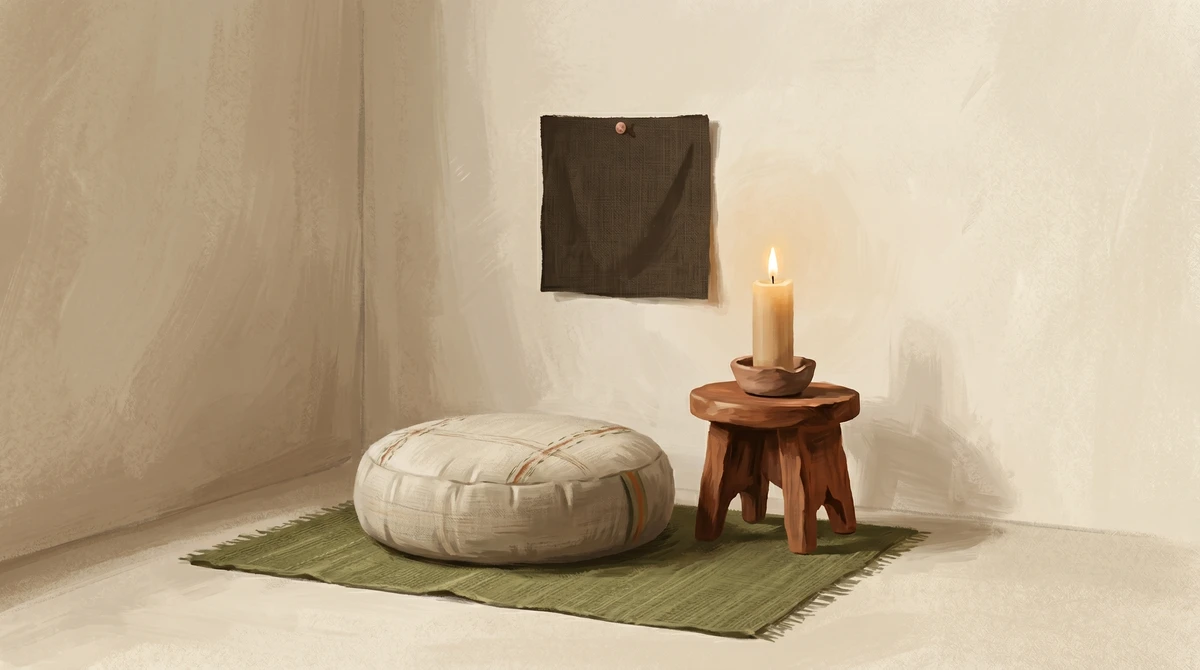
You need a spot where you can sit undisturbed for 10 to 30 minutes under the right conditions for your specific practice. Not a room. Not an altar. Not a curated corner with crystals and a singing bowl. The requirements depend entirely on what kind of meditation you do, and most guides skip that part because they assume everyone sits with closed eyes following the breath.
A breath meditator needs quiet and comfort. A trataka practitioner needs controlled lighting, a stable flame at a precise distance, and zero air movement. A yantra meditator needs consistent light that renders colors accurately and a focal point mounted at exact eye height. These are different setups, and getting the wrong one means your space actively works against you.
Why a dedicated space matters (and what it actually does)
The standard advice is that a dedicated space “builds consistency.” That’s true, but it skips the mechanism, which matters when your space isn’t working and you need to know why.
The strongest explanation comes from habit formation research. Wood and Neal (2007) found that habits form through repeated behavior in stable contexts, and that once formed, the physical environment itself triggers the behavior, independent of conscious intention. Your meditation spot becomes a cue. The decision to meditate gets outsourced to the environment, which is more reliable than willpower.
This connects to context-dependent memory, the finding that we recall information better in the environment where we learned it. Godden and Baddeley (1975) demonstrated this with divers who remembered word lists better underwater when they’d learned them underwater. A 2021 replication by Murre did not reproduce the original large effect, and the broader literature suggests context-dependent memory is real but modest (Cohen’s d ≈ 0.25). The practical suggestion still stands: a consistent space likely primes the mental state you’re reaching for, though less dramatically than the diver study implied.
Lally et al. (2010) at UCL tracked 96 university students building new daily habits and found it took an average of 66 days to reach automaticity, with a range of 18 to 254 days. The practical takeaway: a space you’ve meditated in 100 times works differently than a fresh spot, not for mystical reasons, but because the neural associations have had time to compound. And missing a single day didn’t materially affect the process.
There’s a practical layer too. When your cushion is already in position and your candle is on its shelf, you remove the small decisions that create friction. You don’t have to choose where to sit, find your supplies, or clear a spot. These micro-decisions feel trivial, but they add up to enough resistance to skip a session.
You don’t need a dedicated space to start meditating. But there is strong theoretical reason to believe you need one to keep meditating. No study has directly tested whether a dedicated physical space improves long-term meditation adherence (Cearns and Clark, 2023, noted this as an open research question after analyzing 280,000 meditation sessions), but the habit formation literature strongly predicts it would.
What your practice needs from a space
This is where most guides fail. They give a single set of instructions as though all meditation is the same. As Bhikkhu Vimala put it on Quora, “Your meditation space should accommodate the meditative technique you are practicing.” Here’s what that means concretely. 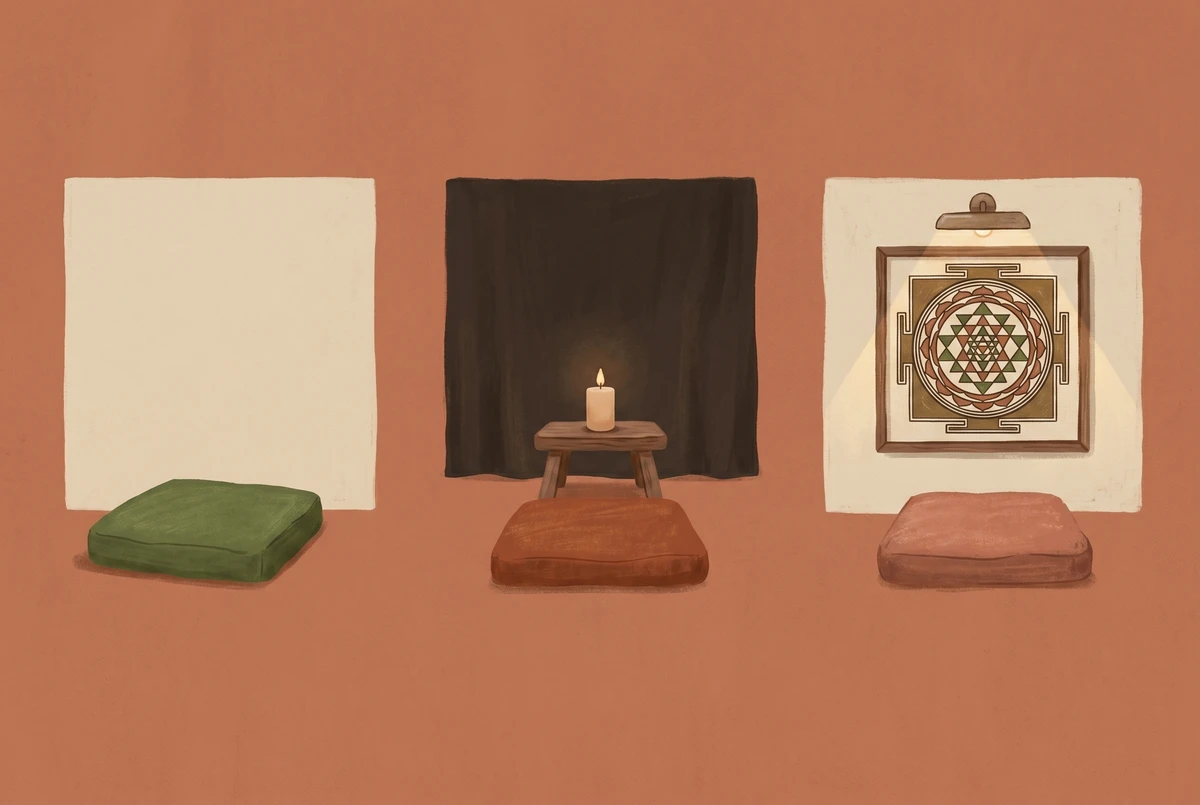
Breath and mindfulness meditation needs quiet above all. External sound is the primary distraction when your eyes are closed. You need comfortable temperature, low visual stimulation (though you won’t see it), and any seating that supports an upright posture. Lighting barely matters.
Trataka (candle gazing) is more demanding. The Hatha Yoga Pradipika (2.31) defines the practice as gazing steadily at a small mark until tears flow, and the Gheranda Samhita (1.53-54) describes gazing at a “subtle object” without blinking. Neither text specifies environmental conditions, but modern yoga traditions, particularly the Bihar School of Yoga, have codified requirements that make functional sense:
- Dim or dark room. Ambient light competes with the flame for visual attention.
- No air drafts whatsoever. Candle flames are remarkably sensitive to air movement: air speeds as low as 0.5 m/s can cause visible flicker. That means window gaps, AC vents, ceiling fans, and even walking nearby. A flickering flame forces constant involuntary micro-adjustments through the accommodation reflex, the ciliary muscle contracting repeatedly to maintain focus on a shifting target. This directly undermines the “locked gaze” state that trataka is designed to develop.
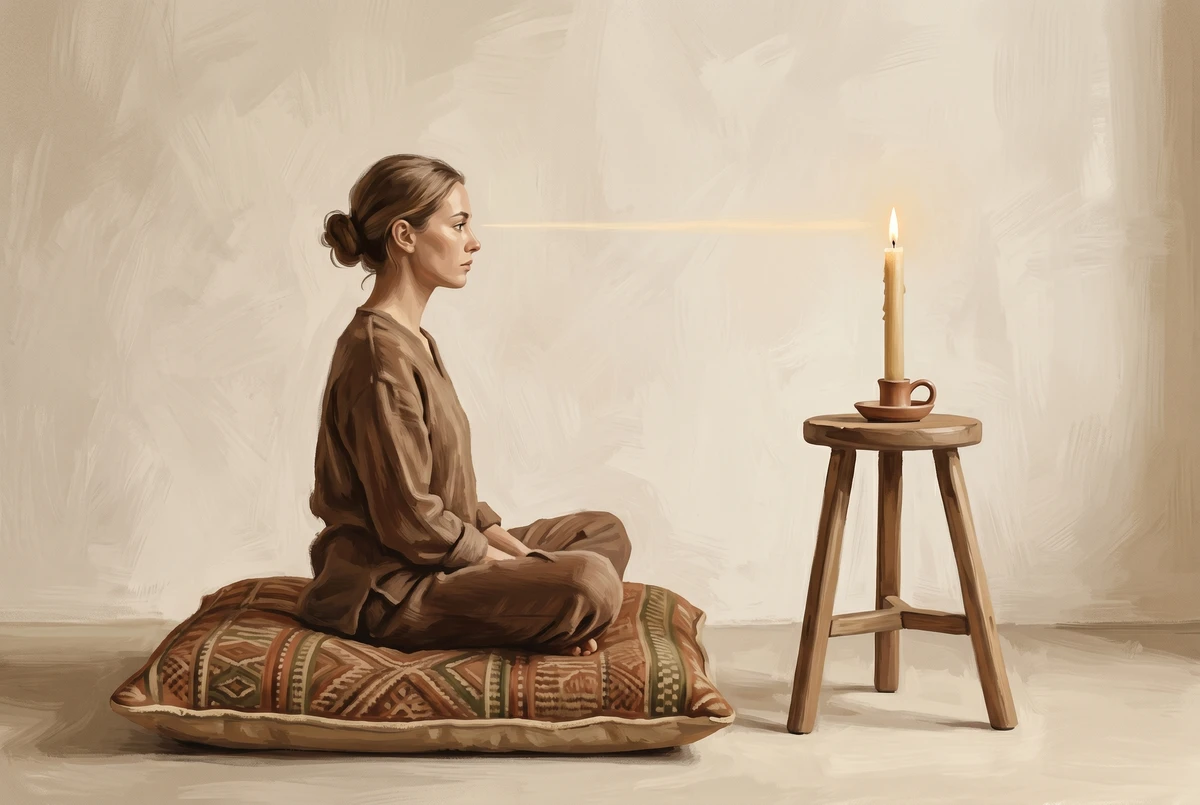
- Focal point at seated eye level. The standard distance is arm’s length to 1.5 meters, a convention from modern yoga teaching (not ancient texts) that works because the flame fills enough of the visual field for concentrated focus.
- Minimal peripheral clutter. Your gaze should have nowhere else to land.
- Fire safety. Fire-safe surface under the candle, nothing flammable above or behind it.
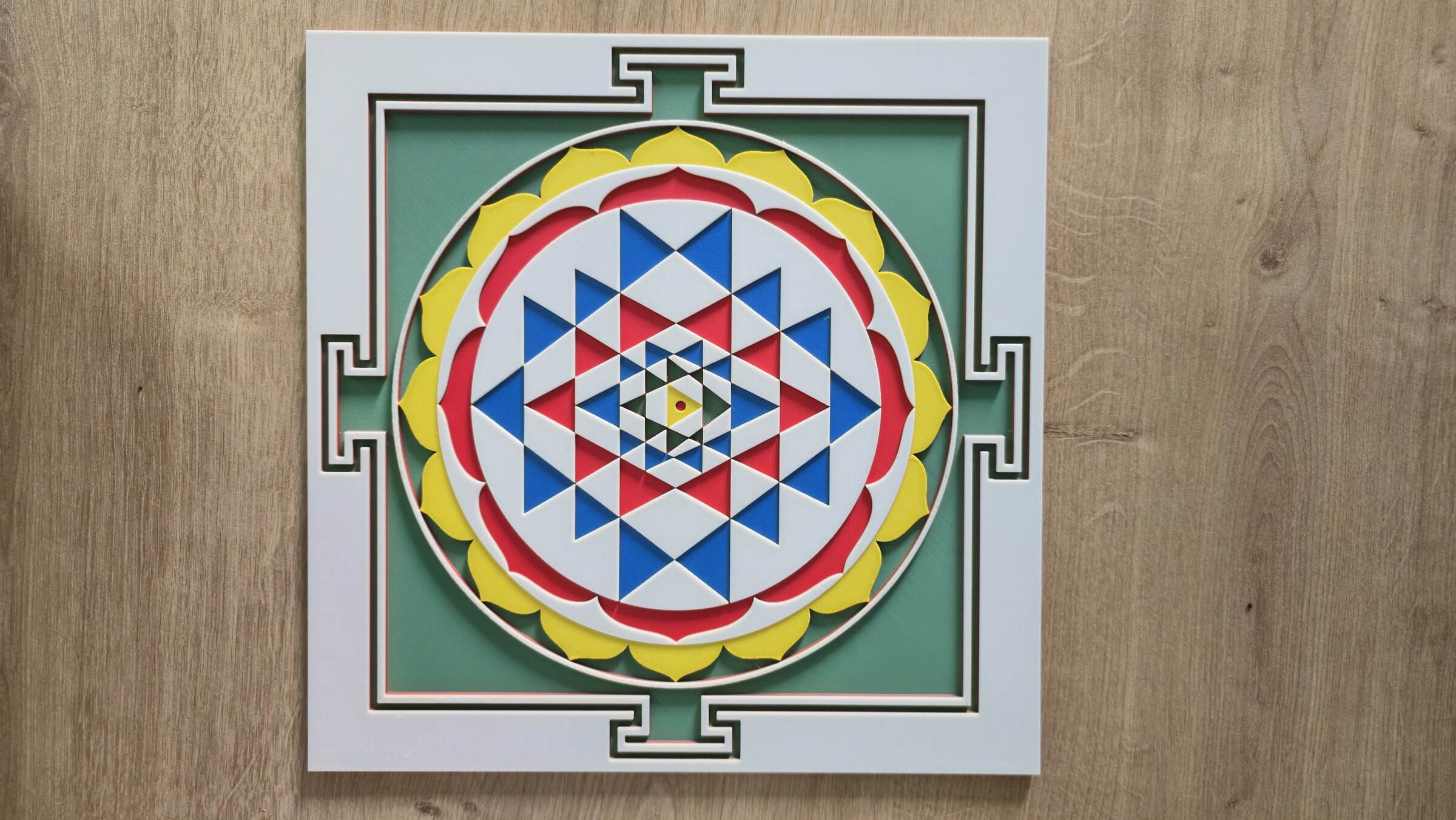
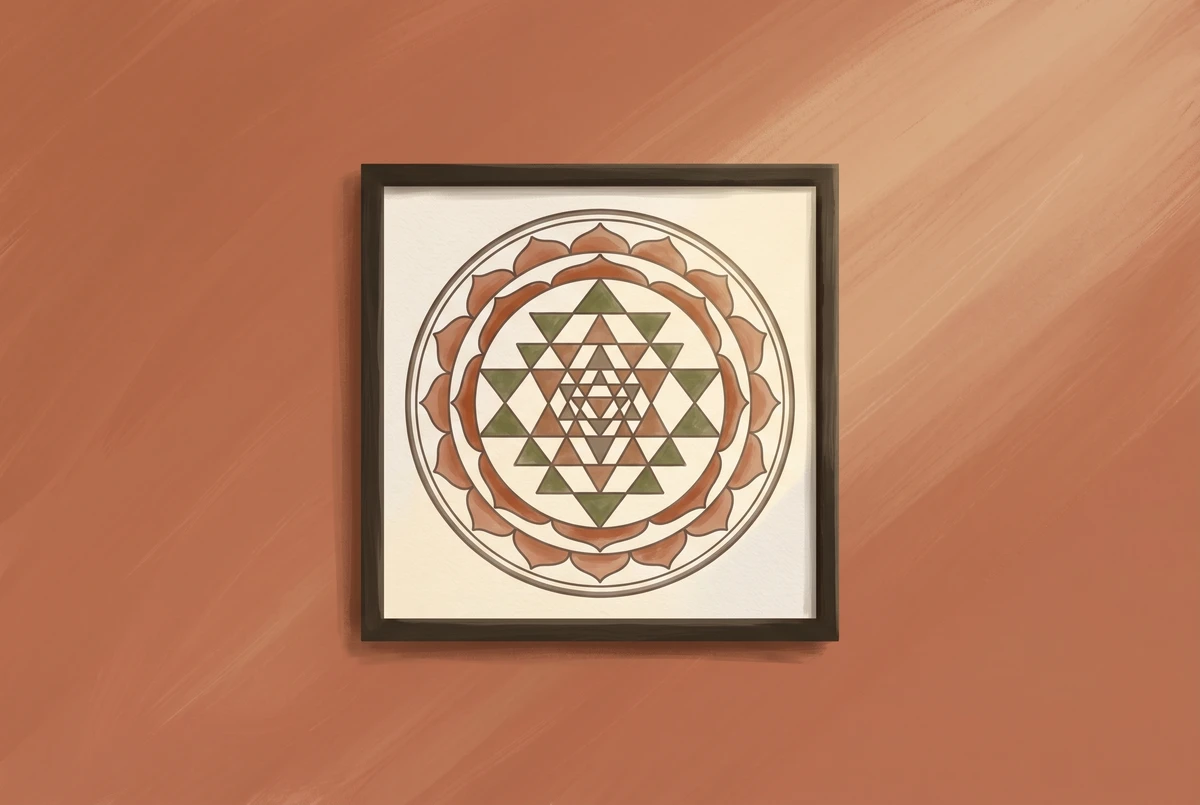
Sri Yantra and yantra meditation needs moderate, consistent lighting (enough to see the yantra clearly but not glaring), with the bindu (central point) at seated eye level. For close practice, Urban Sannyasin recommends the yantra fill most of your visual field, including peripheral vision, which means 1 to 2 feet for a handheld yantra. Wall-mounted yantras work at 3 to 4 feet if they’re 12 inches or larger. A solid wall behind the yantra prevents background movement from competing for attention.
On lighting for yantras: Vastu Mandir’s placement guide recommends neutral daylight (5000-6000K) for the most accurate color rendering, while warm bulbs (2700-3000K) are more comfortable for long sessions. The key factor is Color Rendering Index (CRI), not color temperature alone: a bulb with CRI 90+ in any warm-to-neutral range will render yantra colors accurately. Choose based on what keeps you seated longer.
Guided and app-based meditation mostly needs your phone or speaker positioned within earshot but out of reach (so you’re not tempted to check it), and a Bluetooth connection if your phone stays across the room.
Walking meditation requires roughly 10 feet of clear path, enough for about 10 slow steps and a turn. Floor surface affects the practice: in walking meditation the sensation of each step is the object of focus, so try both hard floor and carpet to see which helps you concentrate. These are practical estimates, not research-derived numbers.
The point: before buying anything, identify your practice and what it physically requires. Then evaluate your space against those requirements.
How to choose your spot (a practical test)
“Find a quiet corner” is advice that sounds helpful but isn’t. Most people’s quiet corners are next to windows (drafts), face doors (visual interruptions), or have lighting that changes throughout the day. Here’s how to actually test a spot.
The five-minute audit:
- Sit there at your planned practice time. Close your eyes. What do you hear? Fridge hum, traffic patterns, HVAC cycling, a roommate’s alarm? The ambient soundscape at 6 AM is different from 9 PM.
- Open your eyes and look at where your focal point would be. What’s behind it? A cluttered bookshelf? A window with movement? A blank wall is ideal.
- Hold a lighter flame still for 30 seconds. Does it flicker? If yes, you have a draft. Track the source: window seal, door gap, air vent, gap under a baseboard.
- Check the light. Is there glare from a window hitting your eye line? Does artificial light cast shadows where your focal object would sit? Will this change as the sun moves?
- Walk the route to the spot. If you have to cross a high-traffic area (past a partner watching TV, through the kitchen during dinner prep), that friction will reduce how often you show up.

What disqualifies a spot for trataka:
- Directly beneath or near an HVAC vent
- Facing a window, even closed (light shifts across the session)
- Near a door that others use (air movement plus visual disruption)
- Anywhere you can’t eliminate drafts completely
What makes a spot work well:
- A corner (two walls block drafts from two directions)
- Away from windows but accessible enough to reach safely in dim light
- Somewhere you can leave your setup in place, or at least semi-permanently. If you rebuild every session, you’ll eventually stop.
Essential setup by practice type
This isn’t a shopping list. It’s the minimum functional setup to sit down and practice.
For any meditation (baseline):
- Seating that places your hips above your knees. A firm couch cushion on the floor works. A folded blanket works. A chair works.
- A timer with a gentle tone. Phone on airplane mode is fine.
- About 3 by 3 feet of clear floor space.
Additional for trataka (candle gazing):
- A stable surface at your exact seated eye height for the candle. Measure this: sit on your cushion, note your eye height from the floor, then find or build a surface at that height. A stack of books under a ceramic plate is a legitimate solution.
- A windbreak plan: close the window, close the door, turn off any fan or AC for the duration.
- A dark backdrop behind the flame. A piece of dark cloth pinned to the wall behind the candle reduces visual noise.
- Eye wash cup or clean water nearby. Tears are a normal part of the practice (the texts describe this explicitly), and you’ll want to rinse afterward.
- A fire-safe surface: ceramic plate, stone tile, or similar under the candle.
- A note on eye safety: a candle flame at arm’s length produces luminance far below phototoxicity thresholds. The real risk is dry eyes from suppressed blinking, which causes temporary discomfort, not permanent damage. If you have glaucoma, consult your eye doctor before practicing. Epileptics should avoid candle flame specifically due to flickering light sensitivity.
Additional for yantra meditation:
- Wall mount, shelf, or stand that places the bindu at your seated eye height.
- A consistent light source angled from above or 45 degrees to the side, not head-on (to avoid glare on the yantra surface). CRI 90+ for accurate color rendering.
- Size matched to distance: a 6 to 8 inch yantra works well at 1.5 feet; 12 inches or larger for 3 to 4 feet.
- Clean wall with no competing visual information. No gallery wall arrangement. Isolate the yantra.
Small spaces and shared spaces
You don’t need a spare room. Three by three feet of floor space is enough for seated meditation with a focal point. If you can sit facing a wall, you have a meditation space.
A room divider or curtain creates psychological separation without construction. A closet with the door open provides three walls of visual isolation and natural draft protection, a practical solution mentioned by multiple practitioners. A bathroom can work too: the lock guarantees privacy, and three walls plus a door give you enclosure. Just turn the fan off during practice. 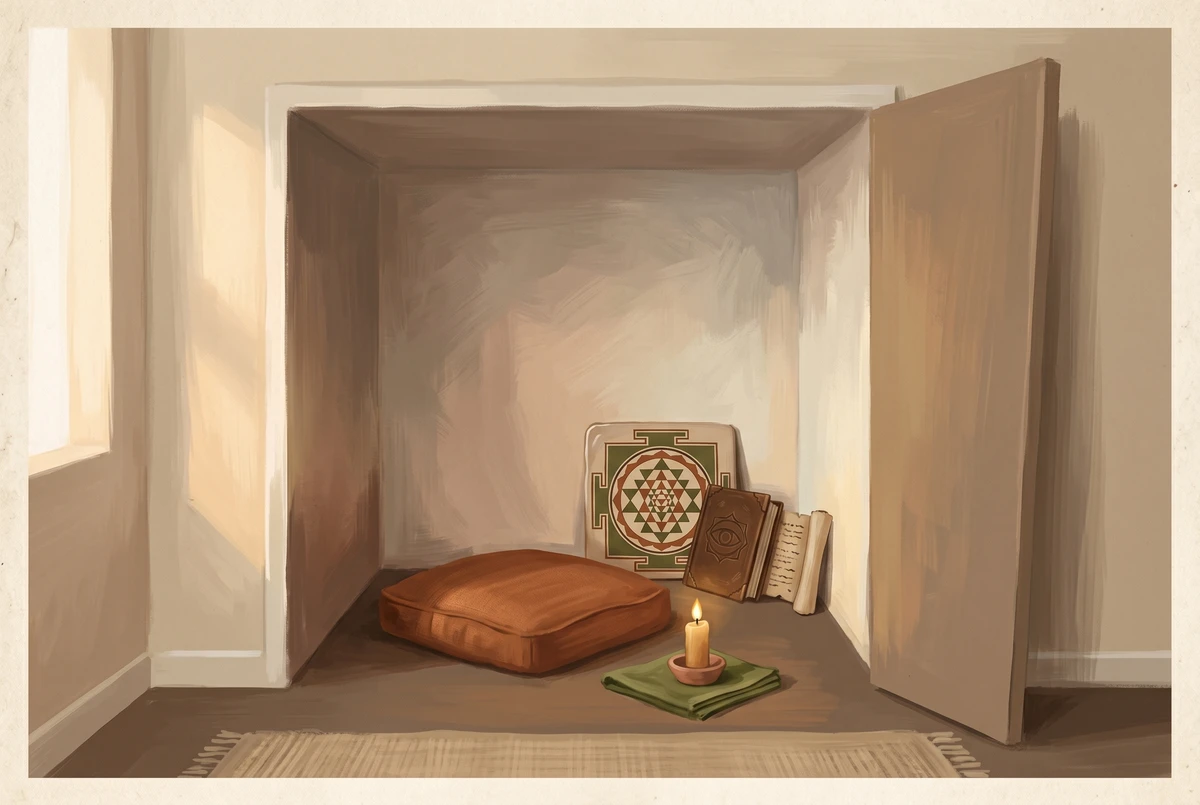
If you share a space:
Negotiate a time, not a territory. “I meditate from 6:30 to 6:50 AM” is easier for a roommate to accommodate than “this corner is mine at all times.” If your practice is visual (trataka, yantra), you need visual isolation more than auditory isolation, so headphones aren’t enough. A folding screen (four-panel, available for around $40) blocks peripheral distractions and creates a temporary enclosure.
For maximum portability: cushion, small yantra or candle, lighter, and a dark cloth backdrop. This kit sets up anywhere in about 60 seconds.
If you can’t control lighting:
Practice at dawn or after sunset for natural darkness. A sleep mask pushed up on the forehead creates a visor that blocks overhead light. For candle gazing in a lit room, even a simple cardboard viewing tunnel (think elementary school diorama) creates a dark field around the flame. Not elegant, but functional.
Perfectionism about the space is a procrastination strategy. A slightly drafty corner where you actually sit every day beats a Pinterest-ready meditation room you never use.
What you don’t need
You don’t need incense. Scent is atmosphere, not function.
You don’t need a singing bowl, crystals, or an altar, unless your specific practice uses them as focal objects.
You don’t need to face East. Vastu Shastra recommends it, and the tradition has real rationale (morning sunlight, solar alignment). But it’s a preference, not a requirement. Facing whichever direction gives you a blank wall and no drafts matters more.
You don’t need to buy anything before your first session. Sit on a folded towel, face a wall, and begin. Every item you think you need before starting is one more reason to delay starting.
Making your space work harder over time
After your first two weeks, keep a one-line note of what distracted you each session. “Draft from window.” “Flame too low.” “Glare at 7 AM.” This log tells you what to fix. It’s more useful than any blog post with generic tips, because it’s specific to your body, your space, and your practice.
Common patterns: people who start candle gazing discover drafts are their biggest problem only after beginning. Yantra practitioners typically adjust height and distance two or three times in the first month as they find what fits their body proportions. Both are normal.
Revisit your setup with the seasons. A spot that faces west may get afternoon glare in summer. Dropping temperatures may shorten your sessions unless you add a layer. A setup that works in October often needs adjustments in April.
After 30 to 60 sessions in the same spot, you’ll likely notice you settle into concentration faster. This is habit formation compounding over time: the associations between the place and the mental state deepen with repetition. Don’t relocate your space unless you have to.
Sources
- Godden, D. R., & Baddeley, A. D. (1975). “Context-dependent memory in two natural environments: On land and underwater.” British Journal of Psychology, 66(3), 325–331. DOI: 10.1111/j.2044-8295.1975.tb01468.x
- Murre, J. M. J. (2021). “The Godden and Baddeley (1975) experiment on context-dependent memory on land and underwater: a replication.” Royal Society Open Science, 8(11), 200724. DOI: 10.1098/rsos.200724. PMID: 34760281.
- Wood, W., & Neal, D. T. (2007). “A new look at habits and the habit–goal interface.” Psychological Review, 114(4), 843–863. DOI: 10.1037/0033-295X.114.4.843
- Lally, P., van Jaarsveld, C. H. M., Potts, H. W. W., & Wardle, J. (2010). “How are habits formed: Modelling habit formation in the real world.” European Journal of Social Psychology, 40(6), 998–1009. DOI: 10.1002/ejsp.674
- Cearns, M., & Clark, S. R. (2023). “The Effects of Dose, Practice Habits, and Objects of Focus on Digital Meditation Effectiveness and Adherence.” Journal of Medical Internet Research, 25, e43358. DOI: 10.2196/43358
- Hatha Yoga Pradipika, Chapter 2, Verses 31–32. Pancham Sinh translation (1914). Via sacred-texts.com.
- Gheranda Samhita, Chapter 1, Verses 53–54. Cited via pranawakening.com.