Is Trataka Safe for Your Eyes?
Miha Cacic · April 8, 2026 · 5 min read
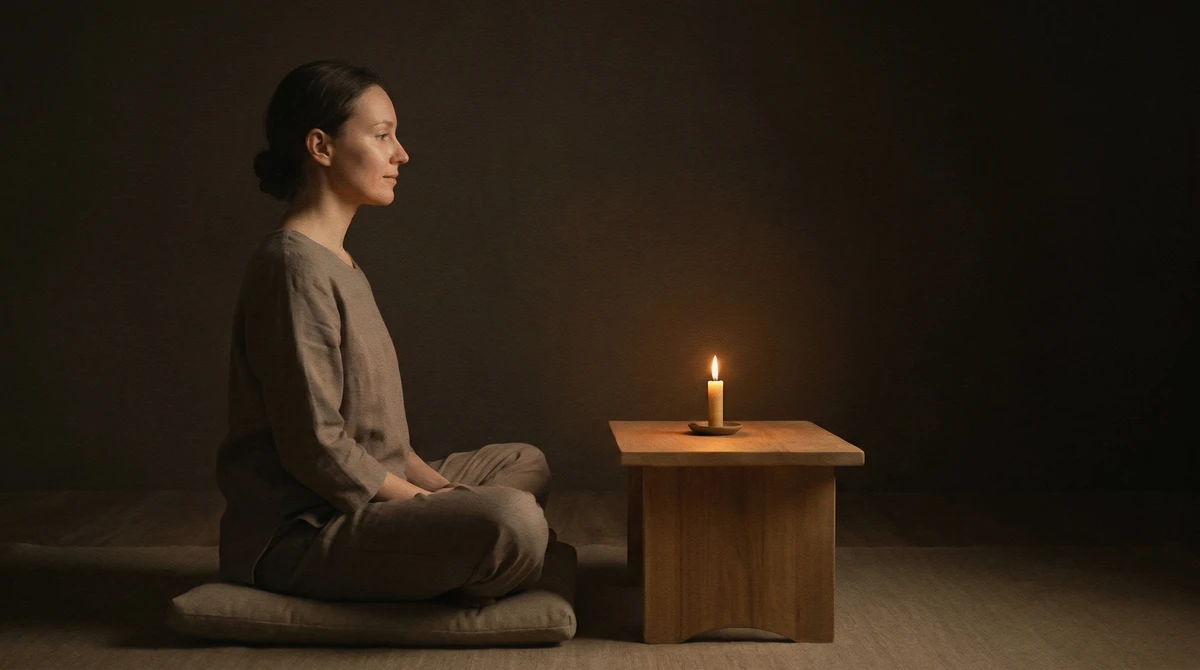
Yes. Trataka, the yogic gazing practice, is safe for your eyes. A candle is physically too dim to cause retinal damage, and every clinical study that has tracked eye health during trataka found zero adverse effects. The real risks are strain-related: dry eyes from suppressing blinks, tension headaches from forcing your gaze. Both are avoidable with basic technique.
But search for “is trataka safe” and you’ll find vague warnings about retinal damage, lists of scary side effects, and rules about mandatory breaks that nobody can source. Most of this comes from confusing two completely different things: light damage and eye strain.
The short answer
Across every published study on trataka, no researcher has reported ocular harm. Gopinathan et al. (2012) followed 34 patients with refractive errors through three weeks of daily trataka and found no deterioration in any objective eye measurement. Tiwari et al. (2018) found the same in a separate eight-week study. Talwadkar et al. (2015) described the practice as “feasible, safe” with no adverse effects in elderly subjects. A 2021 narrative review covering 37 studies on yogic cleansing practices found no evidence that trataka improved or worsened eye conditions.
Can a candle flame actually damage your retina?
No. And understanding why puts most trataka fears to rest.
Retinal damage from light, called photic retinopathy, requires intense short-wavelength (blue or UV) light at high luminance. The foundational research by Ham et al. (1976) in Nature showed that the retina is most vulnerable at 441 nm (deep blue), and that a visible lesion requires roughly 30 J/cm² of blue-light retinal dose. The sun, at about 1.6 billion candelas per square meter, can deliver this dose in under a minute of direct gazing.
A candle flame produces approximately 1 candela. Its color temperature sits around 1,800K, which means its light is almost entirely red and orange with negligible blue-light content. For comparison, a typical phone screen operates at roughly 6,500K with significant blue spectral output. Neither will damage your retina under normal use, but the candle produces a fraction of the blue light you absorb from screens every day.
The ICNIRP guidelines on optical radiation safety classify any light source below 10,000 cd/m² as “not hazardous.” A candle at arm’s length falls far below that threshold. Radiometric measurement isn’t even required at these intensities.
So what about the “retinal impression” that yogic teachers sometimes warn about? That’s a normal afterimage: when you stare at any light source, photopigments in your retinal cones temporarily bleach, producing a complementary-color ghost image when you close your eyes. It fades within seconds to minutes and happens every time you glance at a lamp or window. It’s a sign your visual system is working normally, not evidence of injury.
What the clinical research actually shows
The pattern across studies is consistent: trataka doesn’t cure eye conditions, but it doesn’t damage eyes either.
Gopinathan et al. (2012) ran the most detailed eye-specific trial. They randomized 66 patients with refractive errors into two groups: 34 practiced daily trataka, 32 did Bates-method eye exercises, both for three weeks. In the trataka group, over half reported mild to moderate improvement in symptoms like headaches, eye watering, and fatigue. Objectively, dioptric power, retinoscopic readings, and keratometric measurements didn’t change. The researchers called it “encouraging” that a relaxation technique could improve quality of vision without changing the underlying optics.
Talwadkar et al. (2014) randomized 60 elderly participants into a trataka group (n=36) and a control group (n=24) for 26 days. No worsening of eyesight. Within seven days, the trataka group reported reduced eyestrain.
On intraocular pressure (IOP), the evidence is surprising. A 2021 randomized controlled trial assigned 60 patients with type 2 diabetes and open-angle glaucoma to either daily 55-minute trataka sessions (n=30) or medication alone (n=30) for one month. The trataka group showed a statistically significant decrease in IOP, along with lower blood pressure, heart rate, and fasting blood glucose. The control group showed no changes.
These findings align with a mechanism Sankalp et al. (2018) had proposed from AIIMS New Delhi: trataka’s cycle of focused gazing and relaxation exercises the ciliary muscles, increasing aqueous humor outflow and reducing eye pressure.
Why your eyes water (and why that’s fine)
Tearing during trataka is the expected response, not a warning sign.
When you fixate on a small object and reduce your blink rate, your tear film thins and the cornea begins to dry. Your body responds with reflex tearing to restore moisture. As Gopinathan et al. (2012) explained: reduced blinking leads to “non replacement of tear film, which leads to blurring of vision,” and the “reflex irritation of conjunctiva” triggers tears.
The Hatha Yoga Pradipika (2:31) describes exactly this: “Being calm, one should gaze steadily at a small mark, till eyes are filled with tears.” The Gheranda Samhita says the same: “Gaze steadily without winking at any small object, until tears begin to flow.” Tearing is the designed endpoint of each round.
If your eyes remain irritated or water during everyday activities outside of practice, shorten your sessions. Blink more freely during practice. Palm your eyes afterward (rub your hands together, cup them gently over closed eyes). Splash cool water on your face when you finish.
Can trataka cause headaches?
Headaches from trataka almost always come from one of two causes.
Muscular tension. Forcing your eyes wide open and suppressing blinks strains the muscles around the eyes (the orbicularis oculi and frontalis). That tension radiates into a headache. The fix: soften your gaze. Trataka is focused attention, not a staring contest. Blink when you need to. If your forehead is tight, you’re trying too hard.
Overdoing duration. On YogaForums, one practitioner documented doing 30 to 40 minutes daily for 2.5 months and developing persistent headaches and speech difficulties. Another user who’d practiced daily for a year at 20 minutes reported zero problems. The difference was duration.
Traditional systems understood this. Yoga in Daily Life, the system of Paramhans Swami Maheshwarananda, recommends starting at 10 to 15 seconds and building to one minute of gazing after a full year of gradual progression. The practice was always paired with palming, eye washing, and closed-eye visualization precisely because those counterbalance the strain of sustained fixation.
If you’re getting headaches, start shorter. One to two minutes of gazing is enough for a beginner. Build gradually over weeks.
Is trataka safe for children?
Yoga in Daily Life explicitly recommends trataka for school children, citing benefits for concentration and bedwetting.
For kids, keep sessions short (five minutes total, including closed-eye visualization). Use a black dot on white paper instead of a candle: it trains the same attention skills with no fire risk and no light-related concerns. Stick to the gentler meditation version where blinking happens naturally, rather than the traditional “gaze until tears” kriya.
When trataka is genuinely not safe
A candle won’t hurt healthy eyes, but certain conditions deserve caution.
Glaucoma (uncontrolled). The clinical evidence suggests trataka may lower intraocular pressure, but the theoretical concern about transient IOP elevation during sustained fixation is valid for people with uncontrolled or severe glaucoma. Talk to your ophthalmologist first.
High myopia. Severely myopic eyes have thinner, more stretched retinas. A candle won’t damage them, but forceful straining during practice carries higher risk in already-vulnerable tissue. Practice gently and keep sessions short.
Epilepsy or seizure disorders. A flickering candle flame is a photic stimulus. While it flickers at much lower frequency than a clinical strobe, the precaution is medically sound for anyone with photosensitive epilepsy. Use a dot or other non-flickering object instead.
Psychosis or schizophrenia. Yoga in Daily Life cautions against trataka for those with schizophrenia or hallucinations. Sustained gazing practices may not be appropriate for people in acute psychotic states.
Recent eye surgery or active eye infection. Wait until your doctor clears you for sustained visual tasks.
Sun trataka. This is the one form that can cause retinal damage. The sun’s luminance is billions of times greater than a candle’s. Talwadkar et al. (2015) warned explicitly: “sun trataka if not done properly can damage the retina.” If you practice sun gazing at all, limit it to the first or last few minutes of sunrise or sunset, and approach with extreme caution.
How to practice without straining your eyes
- Start small. One to two minutes of gazing per round. Build to five or ten minutes over weeks, not days.
- Position the object at eye level, arm’s length away. Looking up or down adds neck strain.
- Blink naturally. “As little as possible” does not mean “never.” When tears come or eyes tire, that’s the end of the round.
- Close your eyes and visualize. After each gazing round, close your eyes and hold the afterimage. This is internal trataka, and it’s half the practice.
- Palm afterward. Rub your hands together until warm, then cup them gently over your closed eyes for 30 seconds.
- Wash your eyes with cool water after the session.
- If using a candle: practice in a dark, draft-free room so the flame stays steady. A flickering flame is harder to fixate on and more likely to cause strain.
- If you’re worried about the candle: use a black dot on white paper. Same meditation benefits, zero light-related concerns.
You may have seen advice to take a two-week break from candle trataka every two months. This recommendation traces back to a single blog post by Giovanni Dienstmann, who attributed it to unnamed “Yogis” concerned about “permanent retinal impressions.” It appears in neither the Hatha Yoga Pradipika nor the Gheranda Samhita. The concern conflates normal afterimages with tissue damage. There’s no clinical basis for mandatory breaks, but swapping between a candle and a non-flame object periodically is reasonable for variety.
Sources
- Gopinathan G, Dhiman KS, Manjusha R. (2012). “A clinical study to evaluate the efficacy of Trataka Yoga Kriya and eye exercises in the management of Timira.” Ayu, 33(4):543-546. PMCID: PMC3665208.
- Talwadkar S, Jagannathan A, Raghuram N. (2014). “Effect of trataka on cognitive functions in the elderly.” Int J Yoga, 7:96-103. PMCID: PMC4097909.
- Talwadkar S, Jagannathan A, Nagarathna R. (2015). “Response to ‘trataka and cognitive function.‘” Int J Yoga, 8(1):83. PMCID: PMC4278143.
- Tiwari KK, Shaik R, Aparna B, Brundavanam R. (2018). “A comparative study on the effects of vintage nonpharmacological techniques in reducing myopia.” Int J Yoga, 11(1):72-76. PMCID: PMC5769202.
- Sankalp, Dada T, Yadav RK, Faiq MA. (2018). “Effect of Yoga-Based Ocular Exercises in Lowering of Intraocular Pressure in Glaucoma Patients.” Int J Yoga, 11(3):239-241. PMCID: PMC6134736.
- Swathi PS, Bhat R, Saoji AA. (2021). “Health and therapeutic benefits of Shatkarma: A narrative review of scientific studies.” J Ayurveda Integr Med, 12(2):206-212. PMCID: PMC8039332.
- “Effect of Jyoti-Trataka on intraocular pressure, autonomic control, and blood glucose in diabetic patients with high-tension primary open-angle glaucoma.” (2021). J Complement Integr Med. PubMed: 34303323.
- Ham WT Jr, Mueller HA, Sliney DH. (1976). “Retinal sensitivity to damage from short wavelength light.” Nature, 260:153-155.
- ICNIRP. (2013). “Guidelines on Limits of Exposure to Incoherent Visible and Infrared Radiation.” Health Physics, 105(1):74-96.
- Hatha Yoga Pradipika, Chapter 2, Verses 31-32. Translation by Pancham Sinh (1914).
- Gheranda Samhita, Chapter 1, Verse 53. As referenced in Sankalp et al. (2018).