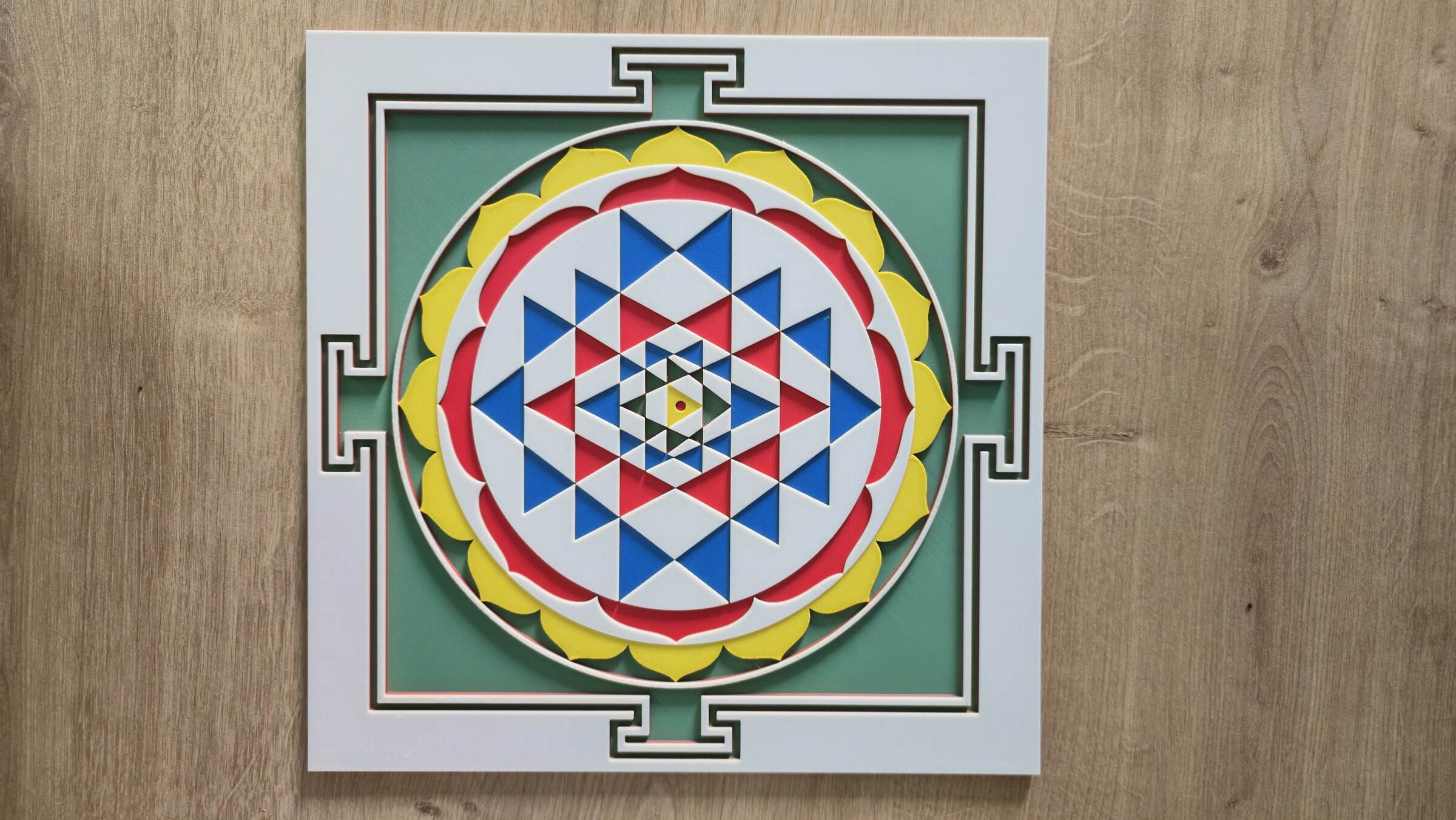
Sri Yantra Colors and Their Meaning
Miha Cacic · April 8, 2026 · 6 min read
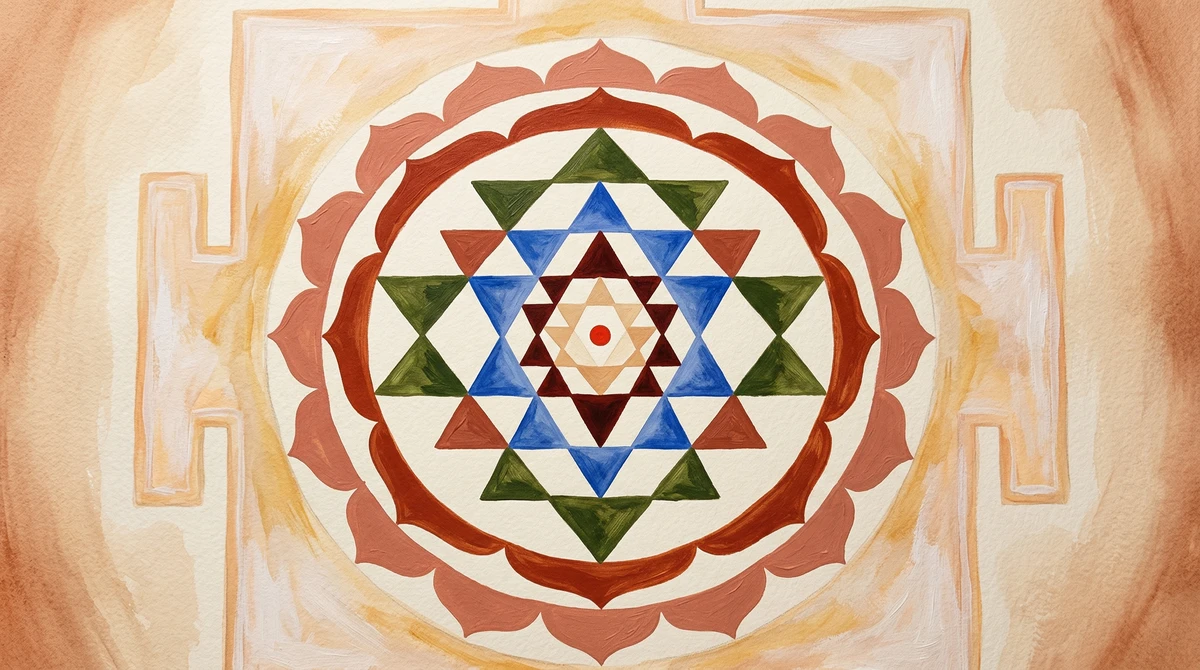
Sri Yantra colors are not decorative. Traditional tantric texts prescribe specific colors for each region of the yantra, and each one encodes information about the energy and stage of consciousness that layer represents. As the Wikipedia article on yantras puts it: “Aesthetics and artistry are meaningless in a yantra if they are not based on the symbolism of the colors and geometric shapes.”
Why Sri Yantra colors matter
The Sri Yantra is read as a map of consciousness, moving from the outermost square inward to the central point (bindu). Each concentric layer represents a progressively subtler state of awareness, and the prescribed color for each layer serves as a visual marker of that state. Colors tell the practitioner what kind of energy they’re engaging with at each stage.
Trataka (yogic gazing meditation) is one of the most common practices involving the Sri Yantra. A 2016 study by Raghavendra and Singh found that trataka significantly improved selective attention and cognitive flexibility in 30 male volunteers, with a 26% improvement on color-word tasks compared to 10% in the control group. A follow-up study in 2021 with 41 volunteers confirmed trataka improves working memory and spatial attention. Neither study used the Sri Yantra specifically (they tested trataka as a general gazing technique), but practitioners reason that distinct colors for each layer help anchor attention during the inward progression through the yantra’s concentric rings.
You’ll sometimes hear that “any color works.” That’s half true. A monochrome Sri Yantra still holds its geometric meaning, and a black-on-white version is perfectly valid for meditation. But traditional colors add a dimension of encoded information that a monochrome version lacks, the same way a topographic map with color-coded elevation bands communicates more than a black-and-white contour map.
The three guna colors: white, red, and black
The most fundamental color system in yantra tradition maps to the three gunas (qualities of nature) from Samkhya philosophy:
- White = sattva (purity, clarity, consciousness)
- Red = rajas (activity, passion, creative energy)
- Black = tamas (inertia, dissolution, the unmanifest)
These three colors appear throughout Hindu sacred art and aren’t specific to the Sri Yantra. But they explain why red dominates the Sri Yantra in particular.
The goddess the Sri Yantra represents, Lalita Tripura Sundari, is called “The Red Goddess” in both Sanskrit tradition and Western tantric scholarship. The opening verse of the Lalita Sahasranama describes her as “Sinduraruna-vigraham,” meaning “she whose form is vermilion-red like sindura.” The Soundarya Lahari (attributed to Adi Shankaracharya) calls her “Aruṇā, the Crimson-coloured Goddess, like the light of morning’s rising sun.”
Red signals rajas, the active and creative principle. The Sri Yantra is not a symbol of withdrawal or stillness; it represents consciousness in the act of creating. That creative energy is why red predominates.
The three guna colors also map onto the goddess’s three forms: white for Saraswati (knowledge), red for Lakshmi (abundance and creative power), and black for Kali (dissolution). As one traditional description states: “Her form is red, white and the mixture of the two.”
The bhupura colors: what the three border lines mean
The outermost part of the Sri Yantra is the bhupura, the square enclosure with four T-shaped gates. Look closely and you’ll see it’s made of three nested lines, each a different color according to traditional descriptions:
- Outer line: white
- Middle line: orange-red, “like the rising sun”
- Inner line: yellow, “like the colour of butter”
These three lines represent the three lokas (realms of experience) and mark the transition from gross to subtle as you move inward.
The bhupura as a whole is the first of the nine enclosures (Trailokya Mohana Chakra, “the wheel that enchants the three worlds”). It corresponds to the Muladhara chakra and, in the body-mapping system of the Bhavanopanishad, to the feet, knees, and thighs. This is the ground level: the gate through which the practitioner enters.
Colors of the nine enclosures (avaranas)
The heart of Sri Yantra color symbolism lies in the nine concentric enclosures, each with its own deity, energy center, gemstone, and prescribed color. The most complete color reference comes from S.P. Tata’s compilation on Astrojyoti, who studied “several tantrik scriptures, mantra mahodadhi and also the writings of Sri Amritananda” to assemble the list. These colors are corroborated by Prof. S.K. Ramachandra Rao’s The Tantra of Sri Chakra (1953) and the Devipuram tradition’s teachings.
One important note: the Sri Vidya tradition maps these nine enclosures to nine energy centers in the body, not the seven chakras most Westerners know. The familiar seven (Muladhara through Sahasrara) are extended by two additional centers above the Ajna: the Manasa-chakra and the Soma-chakra. 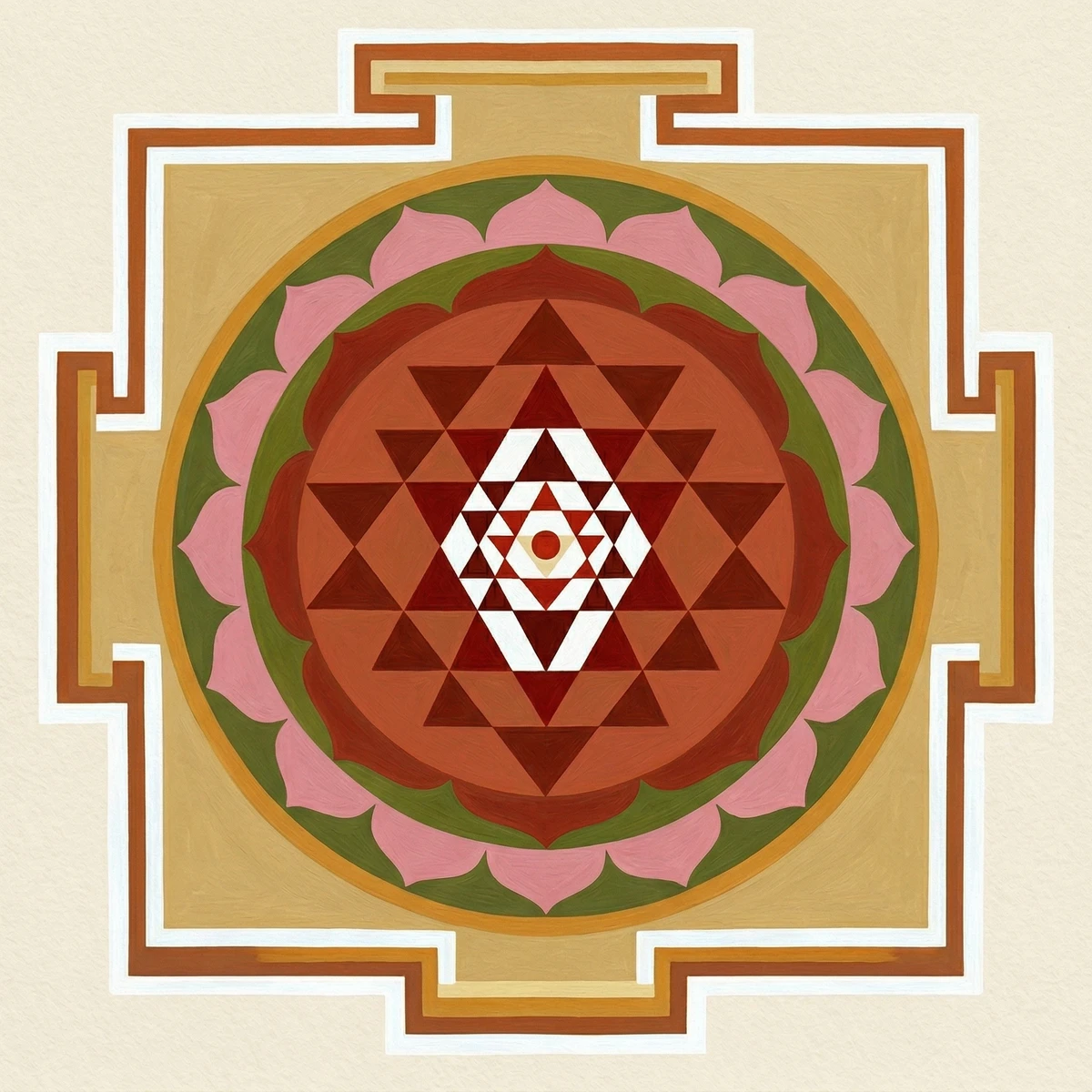
Here is each enclosure, from outermost to innermost.
The outer square (bhupura): white, orange-red, and yellow
Trailokya Mohana Chakra (“wheel that enchants the three worlds”). Three colored border lines as described above. This is the waking state, the most material level of experience. The associated gem is topaz. Corresponds to the Muladhara (root) energy center.
Sri Amritananda Natha of Devipuram describes this as “the earth level, where srishti is completely manifested and separateness is felt.” You begin here, experiencing the world as separate objects and forms.
The sixteen-petal lotus: pink
Sarva Asha Paripuraka (“fulfiller of all desires”). The sixteen petals represent the sixteen vowels of Sanskrit and the sixteen phases of the moon. This enclosure is associated with the Svadhisthana chakra and the sapphire gemstone.
The color is pink, like a lotus flower, though this is the least consistently documented color across sources. The Astrojyoti reference shows it as pink in the traditional rendering, but the textual sources focus more on the layer’s symbolic function than its hue.
The eight-petal lotus: red
Sarva Samkshobhana (“the agitator of all”). Red, specifically the color of bandhuka flowers (Pentapetes phoenicea), a vivid scarlet-red bloom used frequently in tantric descriptions. Connected to the Manipura (solar plexus) chakra and the navel region. The associated gem is cat’s eye.
The fourteen triangles: green
Sarva Saubhagya Dayaka (“bestower of all prosperity”). Green, described as the color of glowworms. This is the first ring of interlocking triangles and corresponds to the Anahata (heart) chakra and the abdominal region. The associated gem is coral.
Among the Sri Yantra’s predominantly red and warm-toned palette, this green layer stands out, marking the transition from the outer lotus enclosures to the more concentrated triangle formations.
The outer ten triangles: red
Sarvartha Sadhaka (“accomplisher of all purposes”). Red, like japakusuma flowers (Hibiscus rosa-sinensis, the common red hibiscus used in Hindu worship). Connected to the Vishuddha (throat) chakra and the neck. The associated gem is pearl.
The inner ten triangles: blue
Sarva Rakshakara (“protector of all”). Blue. This enclosure corresponds to the Ajna (third-eye) chakra. The associated gem is emerald. The traditional sources note that “the deities here have the lustre of 1000 rising suns,” suggesting the blue is luminous, not dark.
The eight triangles: red
Sarva Rogahara (“remover of all disease”). Red, like dadini (pomegranate) flowers, a deep red. This layer corresponds to the Manasa-chakra, one of the two energy centers above the Ajna that are specific to Sri Vidya tradition. The eight speech goddesses (Vag Devatas) traditionally reside here, governing fundamental polarities of existence: cold and heat, joy and sorrow. The associated gem is diamond.
The innermost triangle: white
Sarva Siddhi Prada (“bestower of all attainments”). White, representing pure sattva, pure consciousness. This is the primary downward-pointing triangle that surrounds the bindu. It corresponds to the Soma-chakra (the second additional center above Ajna) and the crown of the head. The associated gem is gomaya.
Within this triangle reside three forms of the goddess: Kameshwari (white, like the moon), Vajreshwari (red, like sunrise), and Bhagamalini (mixed). White dominates because at this stage, creative activity (rajas) has settled into pure awareness (sattva).
The bindu (central point): red
Sarvananda Maya (“supremely blissful”). Red, like sindoor (vermilion powder). This dimensionless center point is the Sri Yantra reduced to its essence: the goddess Lalita Tripura Sundari herself. The associated gem is ruby, and the corresponding energy center is the Sahasra Padma (the thousand-petaled lotus at the Brahmarandra, the opening at the crown).
As Sreenivasarao writes: “It is this point, coloured red, which really is the Sri Chakra. Every other detail is an expansion or a manifestation of its aspects.”
Why the Sri Yantra is predominantly red
Now you can see the pattern. The bindu is red. The goddess is “The Red Goddess.” Three of the nine enclosures are red-toned. The innermost triangle is white (sattva), but it holds within it a red point: consciousness-as-creative-energy.
This red identity extends beyond symbolism into physical worship. Kumkum (vermilion powder, traditionally made from turmeric and slaked lime) is the central offering in Sri Yantra puja. The bindu is marked with vermilion, and the entire yantra may be anointed with it. The opening dhyana verse of the Lalita Sahasranama describes the goddess as “Sinduraruna-vigraham” — “she whose form is vermilion-red.”
Red represents shakti, the dynamic creative energy that gives rise to the manifest world. The Sri Yantra isn’t a map of stillness or transcendence alone. It maps the entire arc from pure awareness (the white innermost triangle) to fully manifest creation (the outer square), with creative energy (red) as the driving force.
What about rainbow and multi-colored Sri Yantras?
If you search for Sri Yantras online, you’ll find rainbow-colored versions everywhere: red at the base, cycling through orange, yellow, green, blue, indigo, and violet toward the center. These follow the modern seven-chakra color system, not the traditional tantric color scheme.
The distinction matters. The Sri Yantra’s traditional coloring uses nine prescribed colors based on tantric texts, mapped to nine energy centers. The rainbow version uses seven colors from a system that was popularized in the 20th century, largely through Western yoga. These are separate frameworks applied to the same geometry.
A rainbow Sri Yantra isn’t “wrong” in some absolute sense. The geometric form still carries its structural meaning. But if you’re interested in the traditional symbolism, the rainbow scheme doesn’t reflect what the tantric sources describe. The most widely cited traditional color reference in Western contexts is Harish Johari’s rendering in Tools for Tantra (1986), where Johari, a tantric scholar and artist, reconstructed the colors from ancient sources.
Which color Sri Yantra should you use for meditation?
This depends on your practice.
For trataka (gazing meditation): High contrast works best. A traditional red-and-gold Sri Yantra on a neutral background gives your eyes a clear focal point. The research on trataka used simple visual targets; what matters most is visual clarity, not color complexity.
For beginners: A monochrome black-on-white Sri Yantra emphasizes the geometric form without the distraction of learning color symbolism at the same time. Start with the structure, add color later.
For deeper practice: A traditionally colored version (following the avarana color scheme described above) lets you meditate on each layer’s specific meaning as your attention moves inward. This is closest to how the yantra functions within Sri Vidya sadhana, where each enclosure is addressed individually with its own mantra and visualization.
On material: Copper and gold are traditional for three-dimensional Meru (pyramid-shaped) Sri Yantras. But the material question is separate from color. A Sri Yantra printed on paper or displayed on a screen is still valid for meditation. What matters is the accuracy of the geometry and your quality of attention.
Sources
S.P. Tata. “Sri Yantra with correct colours and design.” Astrojyoti.com, September 30, 2009. https://www.astrojyoti.com/sriyantracolours.htm
Sreenivasarao. “Sri Muthuswami Dikshitar and Sri Vidya (6 of 8).” Sreenivasarao’s blogs, September 14, 2012. Referencing Prof. S.K. Ramachandra Rao, The Tantra of Sri Chakra (1953). https://sreenivasaraos.com/2012/09/14/sri-muthuswami-dikshitar-and-sri-vidya-6-0f-8/
Sri Amritananda Natha Saraswati. “Meaning and symbolism of Nava Avarana of Shri Cakra.” Posted by Vira Chandra, April 8, 2016. http://amritananda-natha-saraswati.blogspot.com/2016/04/meaning-and-symbolism-of-nava-avarana.html
Johari, Harish. Tools for Tantra. Rochester, VT: Destiny Books / Inner Traditions, 1986. ISBN 0892810556.
Mahavidya Sadhana Centre. “The Significance of the Sri Yantra in Srividya Sadhana.” Mahaavidya.org, February 6, 2024. https://mahaavidya.org/the-significance-of-the-sri-yantra-in-srividya-sadhana/
Raghavendra BR, Singh P. “Immediate effect of yogic visual concentration on cognitive performance.” J Tradit Complement Med. 2016;6(1):34-36. PMC4738033.
Raghavendra BR, et al. “Effect of Trataka (Yogic Visual Concentration) on the Performance in the Corsi-Block Tapping Task: A Repeated Measures Study.” Front Psychol. 2021;12:773049. doi:10.3389/fpsyg.2021.773049.
Wikipedia contributors. “Yantra.” Wikipedia, The Free Encyclopedia. https://en.wikipedia.org/wiki/Yantra
Wikipedia contributors. “Lalita Sahasranama.” Wikipedia, The Free Encyclopedia. https://en.wikipedia.org/wiki/Lalita_Sahasranama