Transcendental Meditation vs Concentration Meditation
Miha Cacic · April 11, 2026 · 7 min read

Transcendental Meditation says it isn’t concentration meditation, and brain scans support this. TM produces alpha waves associated with relaxed wakefulness, while concentration techniques produce beta and gamma waves associated with focused effort (Travis & Shear, 2010). But the line between them is blurrier than the TM organization admits. The major concentration traditions describe a progression from effortful focus to effortless absorption. TM formalizes that endpoint from the first session. Understanding what actually differs, what overlaps, and what each costs matters for choosing between them.
What concentration meditation actually is
Concentration meditation gets a bad reputation in TM-friendly literature, where it’s reduced to “straining to focus.” The actual practice is more nuanced.
The Sanskrit term is dharana: holding the mind steady on a single object. In Patanjali’s Yoga Sutras (compiled over 1,500 years ago), dharana is the sixth of eight limbs of yoga. It isn’t the destination. It matures into dhyana (absorbed, uninterrupted attention), which matures into samadhi (complete absorption where the boundary between meditator and object dissolves). These three stages form a continuum called samyama (Bryant & Patanjali, 2009, pp. 301-303). 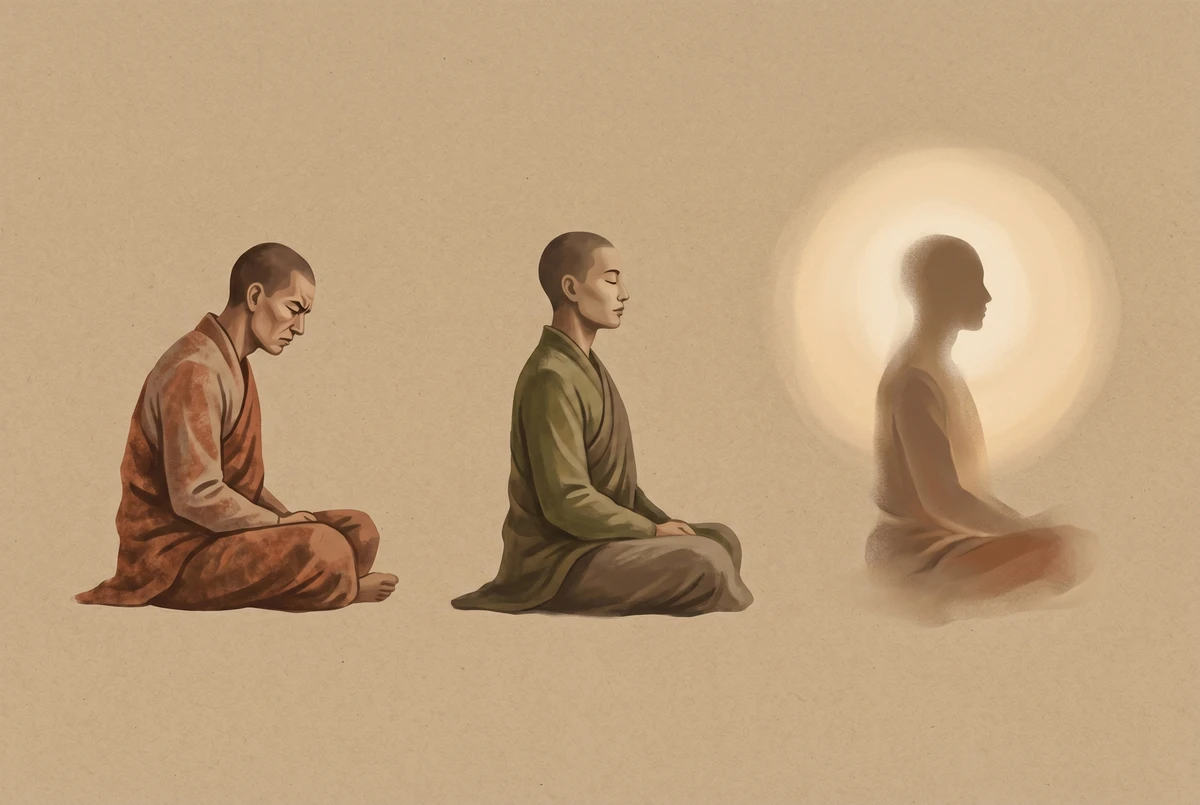
The progression matters because advanced concentration meditators describe their state as effortless. In Buddhist jhana practice, the first absorption still involves directed thought. By the fourth jhana, effort has dropped away entirely. The meditator rests in equanimous stillness. This resembles what TM calls “transcending.”
The forms vary: breath focus (anapanasati), mantra repetition, candle gazing (trataka), kasina disc practice, yantra meditation, visualization. Each uses a different sensory channel to anchor attention. In the Pali tradition, samadhi means “collected mind” or “mental composure,” not a forced, narrow state.
So concentration meditation isn’t gritting your teeth and holding on. It’s a graduated path that begins with deliberate attention and, with practice, can arrive at the absorbed stillness that TM promises from session one. The two traditions describe a similar destination; the starting point differs.
What Transcendental Meditation actually is
TM is a mantra-based technique taught through a standardized four-day course. You receive a personal mantra (a Sanskrit syllable), sit with eyes closed for 20 minutes twice daily, and silently repeat it. The key instruction: when you notice you’ve drifted from the mantra, return to it gently. Don’t force it. The TM organization uses the word “favor”: you favor the mantra, the way you’d guide a wandering puppy back, without scolding.
Founded by Maharishi Mahesh Yogi in the 1950s and drawn from the Vedic Shankaracharya lineage, TM was popularized in the West through celebrity practitioners. The claimed mechanism: the mantra acts as a vehicle that lets the mind settle inward naturally, through quieter levels of thought, until you “transcend” thought altogether and rest in pure awareness. Maharishi described meditation as experiencing a thought in “more subtle states until its subtlest state is experienced and transcended” (Maharishi Mahesh Yogi, 1963).
TM is trademarked. You can only learn it from a certified teacher. The current standard fee is $980 in the US, with income-based sliding scale available. This cost is relevant context, not a criticism: it shapes who can access the practice and fuels legitimate questions about whether the proprietary framing reflects the technique’s nature or its marketing.
The three-category framework
The conversation about TM versus other meditation is dominated by a single paper. In 2010, neuroscientist Fred Travis and philosopher Jonathan Shear proposed three categories to classify meditation based on EEG signatures:
- Focused Attention (concentration): Zen, trataka, kasina, breath focus. Brain signature: beta and gamma waves (20-50 Hz). Requires sustained voluntary effort.
- Open Monitoring (mindfulness): Vipassana, choiceless awareness. Brain signature: frontal theta (5-8 Hz). Requires non-reactive observation.
- Automatic Self-Transcending: TM and some Qi Gong. Brain signature: alpha-1 waves (7-9 Hz). Neither effort nor monitoring; the practice “transcends its own activity.”
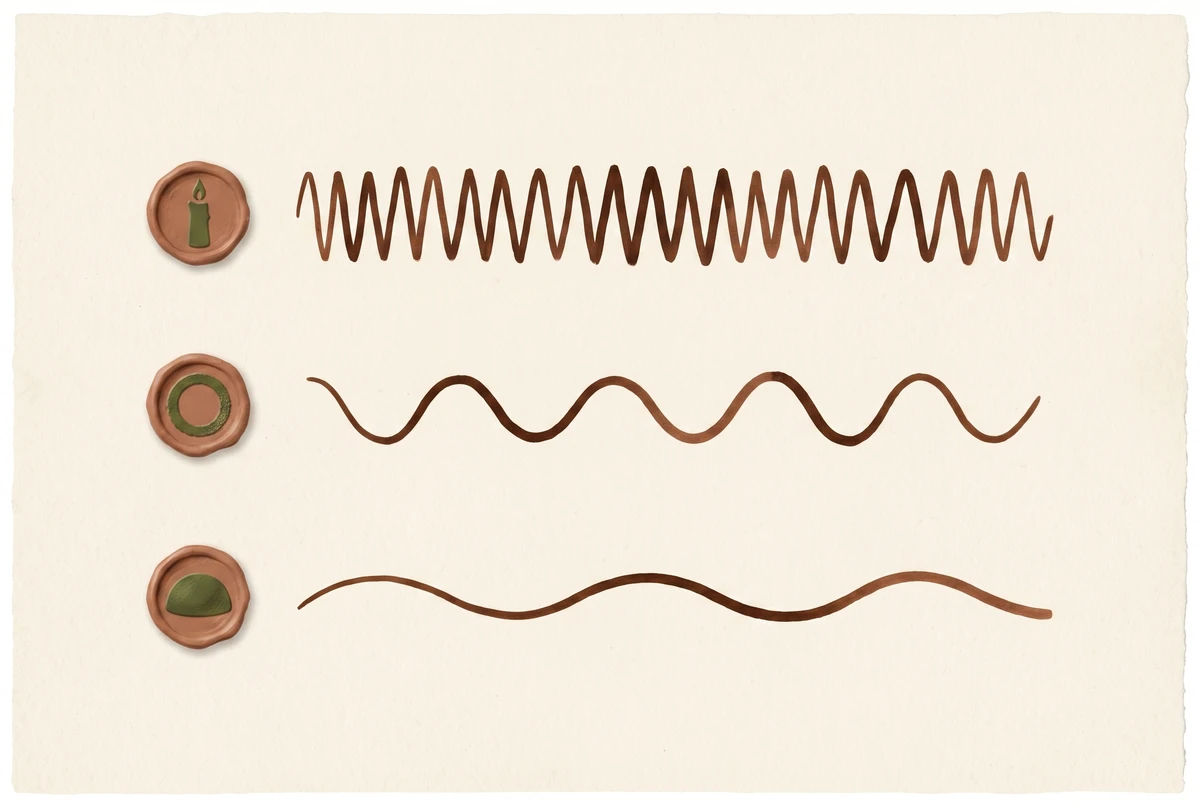
This framework is genuinely useful. Different meditation styles do produce different measurable brain states. But the source matters: Fred Travis is faculty at Maharishi International University (the TM-founded institution in Fairfield, Iowa). Jonathan Shear is a former professor at the same university and co-authored the most-cited anxiety meta-analysis favoring TM (Eppley, Abrams & Shear, 1989). The same researcher is the intellectual backbone of both key studies underpinning TM’s claim to a separate category.
This doesn’t invalidate the research. But it’s important context that TM-affiliated websites never mention.
The Travis and Shear paper is a theoretical review that assigns EEG bands based on previously reported brain patterns. It isn’t a direct head-to-head EEG experiment comparing all three categories in the same lab under the same conditions.
What “effortless” actually means
In concentration meditation, the typical instruction is: “Focus on X. When your mind wanders, bring it back to X.” There’s an active, deliberate return.
In TM, the instruction is: “Think the mantra. When you notice you’ve drifted, easily return to it.” The word “easily” does significant work. You’re told not to concentrate on the mantra but to hold it lightly, let it become faint, let it dissolve.
The practical difference: in concentration, your relationship to the object is “I am holding onto this.” In TM, the relationship is “I am letting this carry me.” Same mantra, different grip. 
This distinction is real and measurable. The EEG data shows it. But here’s what TM-affiliated articles consistently omit: in the major concentration traditions, the progression from beginner to advanced involves exactly this shift from effortful holding to effortless absorption.
The jhana states in Buddhist practice describe a deepening of concentration where effort falls away and the mind naturally rests in its object. Trataka practitioners report the same arc: you start by deliberately gazing at the flame, and as practice deepens, the gazing becomes effortless and the mind enters an absorbed state.
So the honest answer: TM teaches you to start where advanced concentrators end up. It skips the effortful stage. Whether that’s better depends on what you value: quick access to a relaxed state, or the gradual building of attentional skill that the effortful stage provides.
The research, honestly
TM has a large research base. The Orme-Johnson and Barnes 2014 meta-analysis identified over 600 TM research papers and found 16 randomized controlled trials on trait anxiety among 1,295 participants. The effect sizes were meaningful: TM outperformed active alternative treatments (d = -0.50) and waitlist controls (d = -0.62), with stronger effects for people with high anxiety (d = -0.74 to -1.2).
The earlier Eppley, Abrams and Shear (1989) meta-analysis found that TM had a significantly larger effect size on reducing trait anxiety than other relaxation techniques, and that meditation involving concentration had a significantly smaller effect. This finding is often exaggerated in TM literature to claim concentration meditation is “less effective than placebo,” but the original abstract does not make that claim.
A small but striking study by Alexander et al. (1989) followed 73 elderly nursing home residents (mean age 81) randomly assigned to TM, mindfulness training, relaxation, or no treatment. After three years, all TM participants were alive, compared to 87.5% in the mindfulness group and lower rates in the other groups. The lead author was from Maharishi International University. The sample was small, and the study hasn’t been replicated, but it’s frequently cited.
The 2007 AHRQ systematic review, a comprehensive government-funded independent assessment from the University of Alberta, reviewed 813 meditation studies and concluded: “Firm conclusions on the effects of meditation practices in healthcare cannot be drawn based on the available evidence.” The review characterized most studies as “predominantly poor-quality.”
A 2012 independent meta-analysis by Sedlmeier et al., published in Psychological Bulletin, reviewed 163 studies and found TM showed “overall comparable effects to other meditation techniques in improving psychological variables.” This directly challenges the narrative that TM is categorically superior.
The honest picture: TM is well-researched, and many studies show real benefits, particularly for anxiety and blood pressure. But the strongest claims of TM superiority come from TM-affiliated researchers, and independent reviews find more modest and comparable results across meditation techniques.
Where trataka fits in this debate
Trataka (fixed-point gazing at a candle flame, yantra, or other object) is one of the six shatkarmas, the classical purification practices described in the 15th-century Hatha Yoga Pradipika (Muktibodhananda, 1999). By Travis and Shear’s classification, it belongs squarely in the “focused attention” category. But that classification is based on surface instruction, not what happens as practice deepens.
A 2021 study by Swathi, Bhat, and Saoji tested trataka’s effect on working memory using the Corsi-Block Tapping Task. After two weeks of practice, 41 participants showed significant improvement in visuospatial working memory: forward Corsi span increased from 5.5 to 6.1 (Cohen’s d = 0.642, p < 0.001), and trataka outperformed eye exercises alone. This is a medium-to-large effect size. The data doesn’t support the implication that “focused attention” practices are a lesser category. Different categories, different strengths. 
The trataka progression also mirrors TM’s central claim about effortlessness:
Beginner stage: You deliberately hold your gaze on the flame or yantra. Your eyes water, your mind wanders, you bring attention back. This is effortful concentration (dharana).
Intermediate stage: The gaze softens. You stop trying to look and simply rest your eyes on the object. The mind settles without being forced. Effort decreases naturally.
Advanced stage: The eyes are steady without effort. The object may dissolve or transform. The mind enters an absorbed state (dhyana) that is, experientially, what TM describes as “transcending.”
So trataka starts where TM says you shouldn’t start (effortful focus) and arrives where TM says you should end up (effortless transcendence). This suggests the two approaches are different entry points to overlapping territory, not fundamentally different kinds of meditation.
No study has directly compared the EEG signatures of advanced trataka practitioners in deep absorption with TM’s alpha-1 pattern. The convergence is experientially reported and theoretically consistent with Patanjali’s dharana-to-samadhi framework, but it remains a hypothesis, not an established finding.
If you practice trataka or any concentration technique and find yourself frustrated by how much effort it takes, know that this phase is temporary and purposeful. The effortlessness develops. It just takes longer to arrive at than TM’s first-session approach.
The cost question
For $980, you get four days of in-person instruction, a personal mantra, and lifetime access to follow-up sessions, group meditations, and teacher check-ins at any TM center. Income-based rates and payment plans are available.
What you’re paying for is the standardized teaching system and in-person correction. Ron Whitaker, who practiced TM for 20 years before switching to Self-Inquiry meditation, put it well: “I don’t think the benefit is in the secret mantra but in the precise and clear teaching technique and method.” This pragmatic view separates the delivery system from the technique’s inherent properties. Both can have value.
What you’re not paying for is the basic instruction “silently repeat a mantra without concentrating on it.” This principle exists across multiple traditions. Vedic Meditation teachers (a parallel lineage trained in the same Maharishi tradition, including teachers like Thom Knoles) teach an essentially identical technique at varying price points, typically $500 to $1,500. Free mantra meditation instructions are widely available in books and online.
Regarding the mantras themselves: multiple independent scholars (sociologist Roy Wallis, religious scholar J. Gordon Melton) have documented that TM mantras are assigned based on age and gender from a set of about 16 syllables. The TM organization describes them as “meaningless sounds” chosen for suitability by trained teachers. Former TM teacher Lola Williamson identifies them as bija (seed) mantras from the Tantric tradition.
Whether $980 is worth it depends on how much you value structured, in-person instruction versus self-directed learning. Many practitioners find the investment worthwhile, and the standardized format means you can’t really do it wrong. But if cost is a barrier, concentration practices offer a proven, free path to deep meditative states. The destination overlaps significantly. The route and starting experience differ.
Which practice suits what goals
For immediate stress relief with a low learning curve: TM delivers relaxation quickly. The structured instruction removes guesswork, and many beginners report a qualitatively different experience from their first session.
For building focused attention that transfers to daily life: Concentration meditation (trataka, breath focus, mantra focus) actively trains the capacity for sustained attention in ways that carry over to work, study, and daily tasks. TM’s effortless approach may not build the same attentional muscle.
If breath-based meditation doesn’t work for you: Trataka and other visual concentration practices offer a concrete external object. Many people find it easier to hold their gaze on a flame than to follow the breath.
For the deepest traditional framework: Concentration meditation’s dharana-dhyana-samadhi progression is embedded in a system over 1,500 years old that integrates ethical practice, physical yoga, and philosophy.
If budget matters: Concentration techniques are free. TM requires a significant financial commitment.
If community and teacher support matter: TM’s global network of centers and lifetime follow-up is unmatched in its infrastructure. Concentration meditation communities exist but are less formalized.
These aren’t mutually exclusive. Many experienced meditators use both approaches at different times, and the best practice often changes depending on what you need on a given day.
Sources
- Travis, F. & Shear, J. (2010). “Focused attention, open monitoring and automatic self-transcending: Categories to organize meditations from Vedic, Buddhist and Chinese traditions.” Consciousness and Cognition, 19(4), 1110-1118. PMID: 20167507.
- Eppley, K.R., Abrams, A.I. & Shear, J. (1989). “Differential effects of relaxation techniques on trait anxiety: a meta-analysis.” Journal of Clinical Psychology, 45(6), 957-974. PMID: 2693491.
- Orme-Johnson, D.W. & Barnes, V.A. (2014). “Effects of the transcendental meditation technique on trait anxiety: a meta-analysis of randomized controlled trials.” Journal of Alternative and Complementary Medicine, 20(5), 330-341. PMID: 24107199.
- Alexander, C.N., Langer, E.J., Newman, R.I., Chandler, H.M. & Davies, J.L. (1989). “Transcendental meditation, mindfulness, and longevity: An experimental study with the elderly.” Journal of Personality and Social Psychology, 57(6), 950-964. PMID: 2693686.
- Swathi, P.S., Bhat, R. & Saoji, A.A. (2021). “Effect of Trataka (Yogic Visual Concentration) on the Performance in the Corsi-Block Tapping Task: A Repeated Measures Study.” Frontiers in Psychology, 12:773049. PMCID: PMC8718544.
- Ospina, M.B., Bond, K., Karkhaneh, M., et al. (2007). Meditation Practices for Health: State of the Research. Evidence Reports/Technology Assessments, No. 155. AHRQ, Rockville, MD.
- Sedlmeier, P., Eberth, J., Schwarz, M., et al. (2012). “The psychological effects of meditation: A meta-analysis.” Psychological Bulletin, 138(6), 1139-1171.
- Bryant, E.F. & Patanjali (2009). The Yoga Sutras of Patanjali. North Point Press.
- Muktibodhananda, S. (1999). Hatha Yoga Pradipika (commentary). Bihar School of Yoga.
- Maharishi Mahesh Yogi (1963). The Science of Being and Art of Living.