What Does Meditation Actually Feel Like?
Miha Cacic · April 11, 2026 · 7 min read
Meditation feels like sitting with yourself while your mind does everything it can to be somewhere else, and then, sometimes, like the whole room goes quiet inside your head. The first few minutes are almost always noisy and restless. What happens after that follows a recognizable pattern, and understanding that pattern is what turns “am I doing this right?” into a non-question.
The first few minutes: mental noise and restlessness
Within seconds of closing your eyes, your mind generates a to-do list, replays a conversation from yesterday, or produces a random fragment of a song you haven’t heard in years. This isn’t failure. It’s the default mode network, the brain’s self-referential processing center, doing what it always does when you stop feeding it external tasks (Brewer et al., 2011). 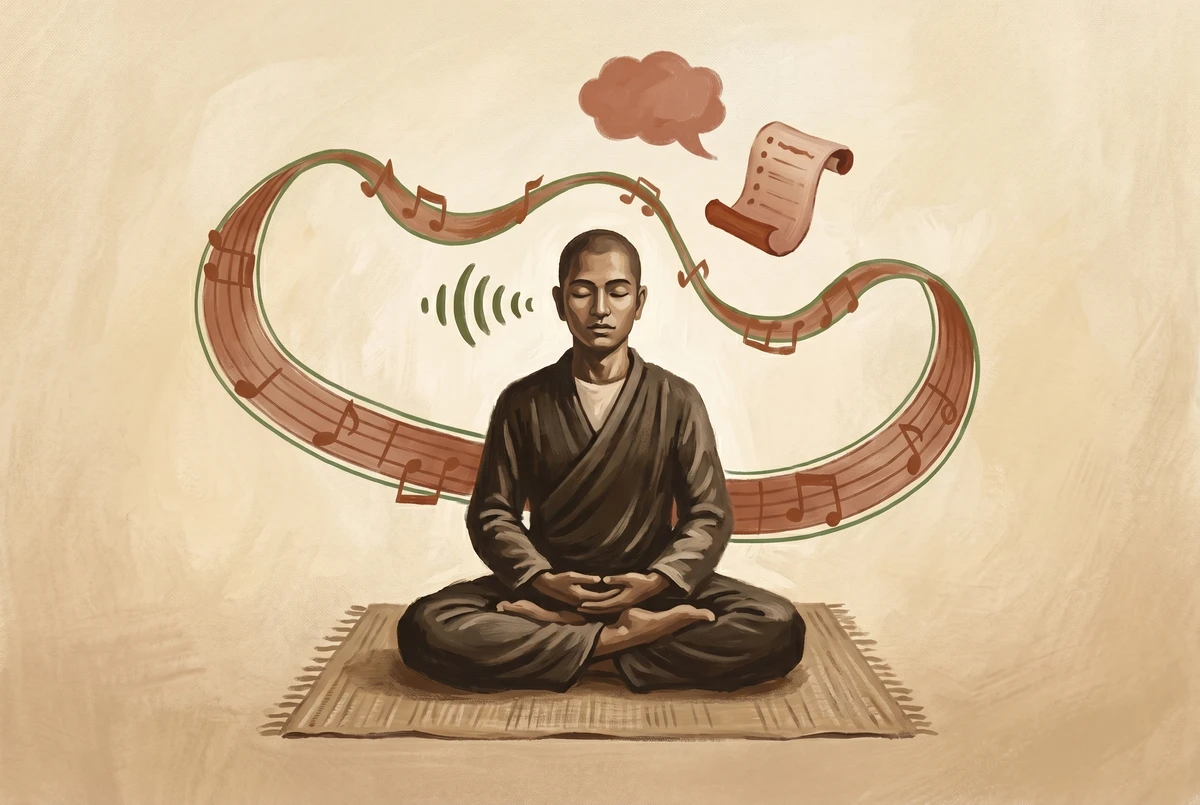
Your body protests too. An itch appears on your nose. Your knee aches. Your jaw is clenched and you didn’t notice until now. Stillness makes these sensations unavoidable. You’re feeling tension you were carrying all along, now unmissable because there’s nothing else to attend to.
Then comes the voice: “This is pointless.” “You’re failing at this.” Nearly every meditator hears some version of this within the first two or three minutes. It’s the number one experience people want validated in meditation forums. The Visuddhimagga, a 5th-century Buddhist text and the most systematic traditional account of meditation phenomenology, describes five “hindrances” that arise at the start of practice: sensual desire, ill will, sloth-and-torpor, restlessness-and-worry, and doubt. That “this is pointless” voice is doubt. The to-do list is restlessness. The body discomfort is attachment to physical comfort. These aren’t signs of failure. They’re what the tradition has expected for 1,500 years.
This phase is not something to push through. It is the practice. Each time your mind wanders and you notice it wandered, that’s one repetition. The cycle of drifting and returning is what builds attentional control, the same way lifting a weight and lowering it builds muscle. There is no version of meditation where this phase doesn’t happen.
The settling: when something shifts
Somewhere between minutes 5 and 15 (the timing varies by person and day), the quality of experience changes. Experienced meditators recognize this shift instantly. Beginners are waiting for it without knowing it exists.
The body settles first. Shoulders drop. Jaw unclenches. Breath deepens and slows on its own, without you forcing it. This is the parasympathetic nervous system engaging. In the 1970s, Harvard cardiologist Herbert Benson documented what he called the “relaxation response”: a measurable shift from sympathetic to parasympathetic dominance, including reduced heart rate, lower blood pressure, decreased respiratory rate, and lower cortisol (Benson et al., 1974; Benson, 1975).
Thoughts change character. Instead of urgent, narrative-driven sentences (“I need to email Sarah”), they become more diffuse and image-like. Associations instead of arguments. Fragments instead of stories.
Time starts to warp. Five minutes might feel like two, or like fifteen. A 2011 study at Yale found that the medial prefrontal cortex and posterior cingulate cortex (the two main nodes of the default mode network, responsible for self-referential thinking) were deactivated in experienced meditators across all meditation types tested (Brewer et al., 2011). When the part of your brain that narrates your experience goes quiet, time loses its scaffolding.
Not every session reaches this phase. Some days, the restless chatter lasts the entire 20 minutes. This has nothing to do with skill. It reflects your nervous system state that day: how much sleep you got, how much stress you’re carrying, whether you just drank coffee. Experienced meditators treat these sessions as routine, not failures.
The body sensations nobody warns you about
At some point during a session, your body does things nobody told you about. These experiences alarm beginners, but they’re well-documented. A 2017 study at Brown University catalogued 59 meditation-related experiences across seven domains (cognitive, perceptual, affective, somatic, conative, sense of self, and social), based on interviews with more than 60 Buddhist practitioners and 30 teachers (Lindahl et al., 2017). Physical sensations were among the most commonly reported.
Tingling and vibrations. Most commonly felt in the hands, feet, face, or crown of the head. The likely mechanism: as the nervous system downshifts, chronically tense muscles release and blood flow redistributes. A physiological event, not a spiritual one.
Body heaviness or lightness. Feeling like you’re sinking into the floor or floating above it. Your body’s proprioceptors (the sensors that tell the brain where you are in space) interpret the slight drop in muscle tension as heaviness. Lightness appears to come from reduced proprioceptive input as the brain attends less precisely to the body’s position.
Involuntary twitches and jerks. Similar to the hypnic jerk you get when falling asleep: the body releasing stored tension as the central nervous system transitions states. More common in the first few months of practice and during stressful periods.
Temperature changes. Warmth spreading through the body comes from vasodilation as muscles relax. Sudden chills reflect nervous system recalibration.
Emotional releases. Tears, sudden sadness, anger, or a wave of grief that seems to come from nowhere. One plausible mechanism: when the prefrontal cortex quiets during meditation, it loosens its usual suppression of inconvenient emotions, allowing stored material to surface. Lindahl et al. (2017) found that these releases ranged from mildly uncomfortable to intensely distressing, depending on the practitioner’s history, the specific practice, and available support. They typically pass on their own if you don’t fight them, though for people with trauma history, certain practices can be genuinely destabilizing. Working with a qualified teacher matters in those cases.
In the Chinese qigong tradition, there’s a classical list called the ”Eight Touches” (Ba Chu): moving, itching, cool, warm, light, heavy, harsh, and slippery, describing the normal sensations of deep meditation. Different traditions, different vocabulary, same phenomenology. 
What deeper meditation actually feels like
Past the settling phase, some sessions go further. These are the states that beginners wonder about and experienced meditators know better than to chase.
The hallmark is a felt sense that there’s nowhere to go and nothing to do. Not lethargy. A quiet completeness, as if this moment is enough and you couldn’t add anything to improve it.
Self-referential thinking drops away. You stop monitoring yourself. You forget that you’re meditating. The distinction between the observer and what’s being observed starts to blur. This maps to what brain imaging shows: reduced activity in the default mode network, the brain’s “me” center (Brewer et al., 2011). A 2015 study confirmed that this reduction is specific to meditation, not just any cognitive task (Brewer et al., 2015). 
Time distortion becomes extreme. Twenty minutes feels like five. You can’t account for where the time went because you weren’t narrating it to yourself. Experienced meditators report that breathing becomes barely perceptible. A sudden deep breath may jolt you when the body needs more oxygen.
The brain wave data matches the felt experience. A comprehensive review of EEG meditation research found “an overall slowing subsequent to meditation, with theta and alpha activation related to proficiency of practice” (Cahn & Polich, 2006). In concrete terms: your brain shifts from fast beta waves (13-30 Hz, normal waking consciousness) to alpha waves (8-13 Hz, relaxed awareness) to theta waves (4-8 Hz, deep meditative states). A later systematic review confirmed these patterns for mindfulness specifically (Lomas et al., 2015). Beginners tend to stay in beta for most of a session. Experienced meditators reach alpha and theta more consistently, which partly explains why early sessions feel like nothing is happening.
Patanjali’s Yoga Sutras, written roughly 2,000 years ago, describe this same progression in three stages: dharana (fixed concentration), dhyana (unbroken flow of attention), and samadhi (absorption where the observer dissolves into the observed). The Visuddhimagga maps it differently through four jhanas: from initial focused attention with physical rapture (tingling, warmth, lightness), through the quieting of internal dialogue, to pure equanimity where the breath becomes almost imperceptible. Different frameworks, same phenomenological arc.
These states are unreliable. They come and go. Chasing them actively prevents them. The experienced meditator’s relationship to depth is appreciation without attachment, because clinging to pleasant experiences is itself a form of the restlessness you sat down to observe.
How different meditation techniques feel different
Most accounts of “what meditation feels like” describe breath meditation by default, as if “meditation” were one monolithic experience. It’s not. Different techniques produce distinctly different phenomenology, and if you’ve only tried one, you haven’t sampled the full range.
Breath meditation feels internal, spacious, and sometimes frustratingly vague. The anchor is subtle: the faint sensation of air at the nostrils or the gentle rise of the belly. When it works, it feels like dissolving inward. When it doesn’t, it feels like staring at a blank wall inside your own head.
Mantra meditation feels rhythmic and vibratory. The repetition creates a sonic anchor that the mind can grip more easily than breath. Practitioners report a buzzing or humming sensation that extends beyond the sound itself into the body. The rhythm gives the restless mind something concrete to hold onto.
Body scan feels like a traveling warm spotlight. Attention moves systematically through the body, and each region seems to “light up” as you focus on it. Deeply relaxing and good for grounding, but it rarely produces the expansive “vastness” states. It stays embodied.
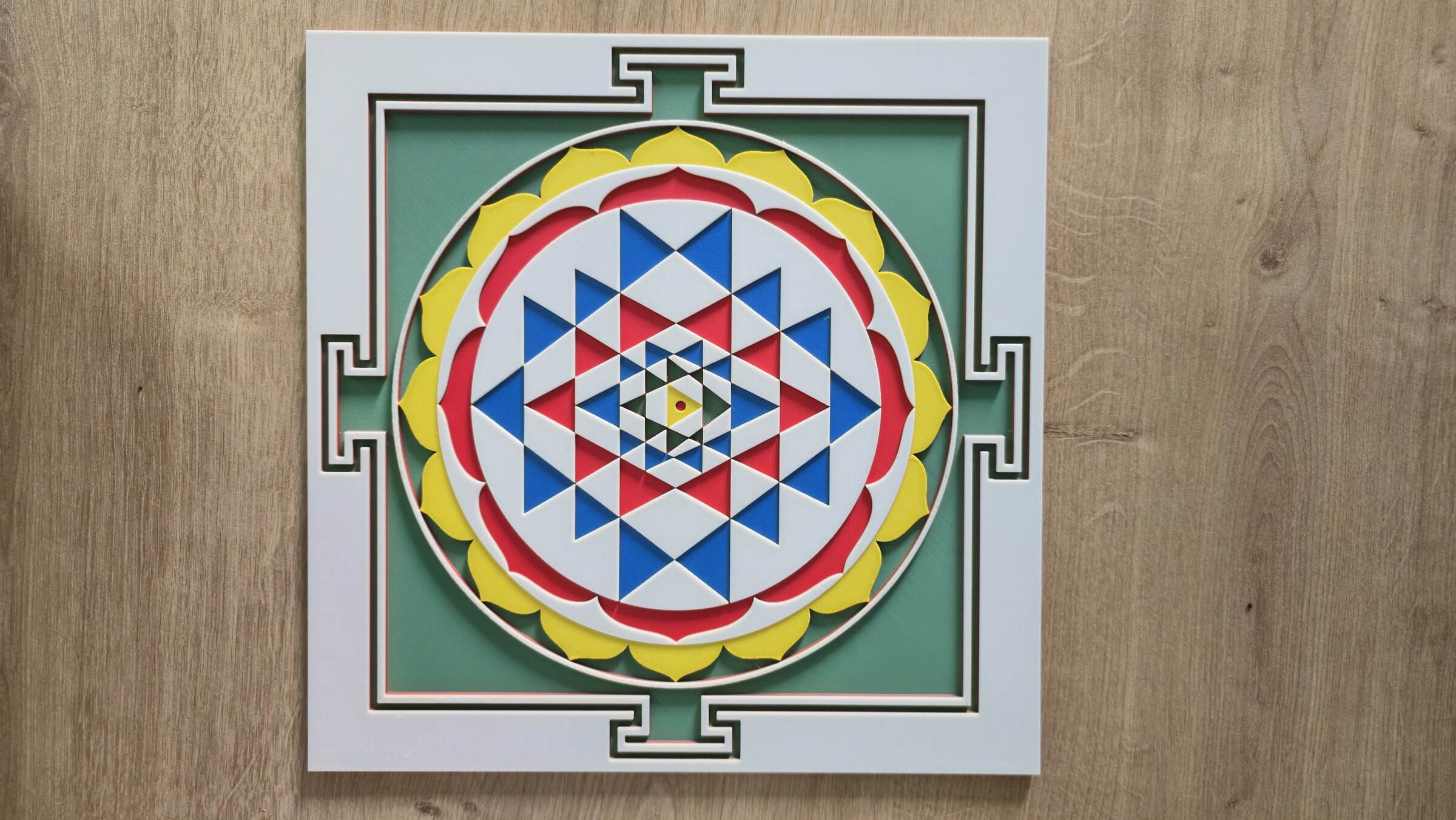
Gazing meditation (trataka) feels visually vivid and externally anchored. Because the eyes are open and locked on an object (a candle flame, a point, or a geometric form like a Sri Yantra), the experience has a concreteness that breath meditation lacks. The Hatha Yoga Pradipika, a 15th-century Sanskrit text, defines it simply: “Being calm, one should gaze steadily at a small mark, till eyes are filled with tears. This is called Trataka by acharyas” (Chapter II, verses 31-32). What the text doesn’t describe, but practitioners consistently report, is the visual phenomenology: the visual field narrows, peripheral vision dims, and the object may appear to glow, pulse, or shift colors. When you close your eyes after gazing, you see an afterimage that becomes an internal anchor. This transition from external to internal focus is unique to trataka and creates a built-in progression that other techniques lack.
This distinction matters. If someone has tried breath meditation and found it boring or impossible, they haven’t experienced “meditation.” They’ve experienced one technique. Gazing meditation feels completely different and is often more accessible for visual thinkers and restless minds.
Why some sessions feel like nothing happened
“Nothing happened” usually means “nothing dramatic happened.” The absence of vivid calm or striking sensations doesn’t mean the session was wasted. Your nervous system still downregulated. Your attention still practiced returning. Your body still released micro-tensions you weren’t aware of.
Flat sessions are often doing the most work. Just as a gym session where you “just showed up” still maintains baseline fitness, a meditation session where you spent 15 minutes wrestling with your thoughts still trained the returning-attention reflex.
There’s also a perceptual explanation. EEG research shows that the brain wave shift from beta to alpha and theta correlates with practice proficiency (Cahn & Polich, 2006). Beginners spend more time in beta, which is normal waking consciousness. If your brain stayed in beta for most of the session, the session will feel indistinguishable from just sitting there with your eyes closed, even though the repeated act of noticing distraction and returning attention was still training the skill.
Many experienced meditators report that session quality doesn’t predict post-session quality. Some of the clearest after-meditation states (the calm and groundedness that lasts for hours) follow the most boring, restless sessions. The processing happened on the cushion. The results showed up later.
The “nothing happened” feeling decreases over months. As your perceptual sensitivity increases, you notice subtler shifts you previously missed: a slight softening in the chest, a brief moment of genuine stillness, the quality of silence between thoughts. The experience didn’t change. Your awareness of it did.
What meditation feels like after months of practice
The restless opening phase shortens. What took 10 to 15 minutes of mental chatter to settle through in month one may take 2 or 3 minutes by month six. The mind learns the routine and drops in faster, consistent with the EEG finding that alpha and theta activation correlates with proficiency of practice (Cahn & Polich, 2006).
You start noticing the effects outside the session more than during it. The real payoff isn’t what happens on the cushion. It’s catching yourself mid-reaction in a conversation, noticing tension in your shoulders at your desk and releasing it, or realizing you’ve been calm for an hour without trying.
The meditative state starts to appear unbidden. Experienced meditators describe moments of spontaneous clarity while brushing their teeth or walking to the car, where the spacious awareness from formal practice shows up on its own. Brain imaging offers a possible explanation: experienced meditators develop stronger connectivity between the default mode network and self-monitoring regions (Brewer et al., 2011), meaning the brain doesn’t just suppress wandering during meditation, it integrates the monitoring habit into everyday cognition.
The relationship with difficult sessions changes most of all. Beginners dread restless sessions. Experienced meditators shrug at them. The emotional charge around “good” and “bad” sessions dissolves because you’ve seen enough of both to know they’re weather, not climate.
Sources
- Brewer JA, Worhunsky PD, Gray JR, Tang YY, Weber J, Kober H. (2011). “Meditation experience is associated with differences in default mode network activity and connectivity.” Proceedings of the National Academy of Sciences, 108(50): 20254-20259. PMC3250176.
- Brewer JA, et al. (2015). “Meditation leads to reduced default mode network activity beyond an active task.” NeuroImage. PubMed: 25904238.
- Lindahl JR, Fisher NE, Cooper DJ, Rosen RK, Britton WB. (2017). “The varieties of contemplative experience: A mixed-methods study of meditation-related challenges in Western Buddhists.” PLOS ONE, 12(5): e0176239.
- Cahn BR, Polich J. (2006). “Meditation states and traits: EEG, ERP, and neuroimaging studies.” Psychological Bulletin, 132(2): 180-211. PubMed: 16536641.
- Lomas T, Ivtzan I, Fu CHY. (2015). “A systematic review of the neurophysiology of mindfulness on EEG oscillations.” Neuroscience & Biobehavioral Reviews, 57: 401-410. PubMed: 26441373.
- Benson H, Rosner BA, Marzetta BR, Klemchuk HM. (1974). “Decreased blood pressure in pharmacologically treated hypertensive patients who regularly elicited the relaxation response.” Lancet: 289-291. PubMed: 4130474.
- Benson H. (1975). The Relaxation Response. William Morrow.
- Buddhaghosa. (~5th century CE). Visuddhimagga (The Path of Purification). Translated by Bhikkhu Ñāṇamoli. Buddhist Publication Society.
- Patanjali. (~2nd century BCE-4th century CE). Yoga Sutras. Translated by Swami Satchidananda. Integral Yoga Publications, 1990.
- Svatmarama. (~15th century CE). Hatha Yoga Pradipika. Translated by Pancham Sinh, 1914. Sacred Texts Archive.
- Yang, Jwing-Ming. “Common Sensations Experienced in Still Meditation.” YMAA Publication Center.