What Is a Sadhana? Meaning, Structure, and How to Start
Miha Cacic · April 11, 2026 · 5 min read

A sadhana is a structured spiritual practice: a deliberate sequence of techniques, repeated daily, designed to transform the practitioner over time. The internet will tell you sadhana just means “daily spiritual practice.” That’s technically correct, but it misses the point. Having a morning meditation habit isn’t automatically a sadhana. What makes it a sadhana is the architecture: each session follows a sequence (open, prepare, practice, integrate, close), and each session builds on the last.
What sadhana means in Sanskrit
The Sanskrit root sadh means “to come or lead straight to the aim; to accomplish, succeed, effect, finish” (Cappeller Sanskrit-English Dictionary; corroborated by Monier-Williams). Sadhana is the instrumental noun form, meaning literally “the means by which the accomplishing is done.” Not the goal. Not the practitioner. The instrument.
This becomes clearer through a classical triad described by Swami Tejomayananda of the Chinmaya Mission: the sadhaka (practitioner) uses a sadhana (practice) to reach the sadhya (goal). The word carries intentionality that “daily practice” does not. A sadhana is directed effort toward a specific transformation, not open-ended sitting. 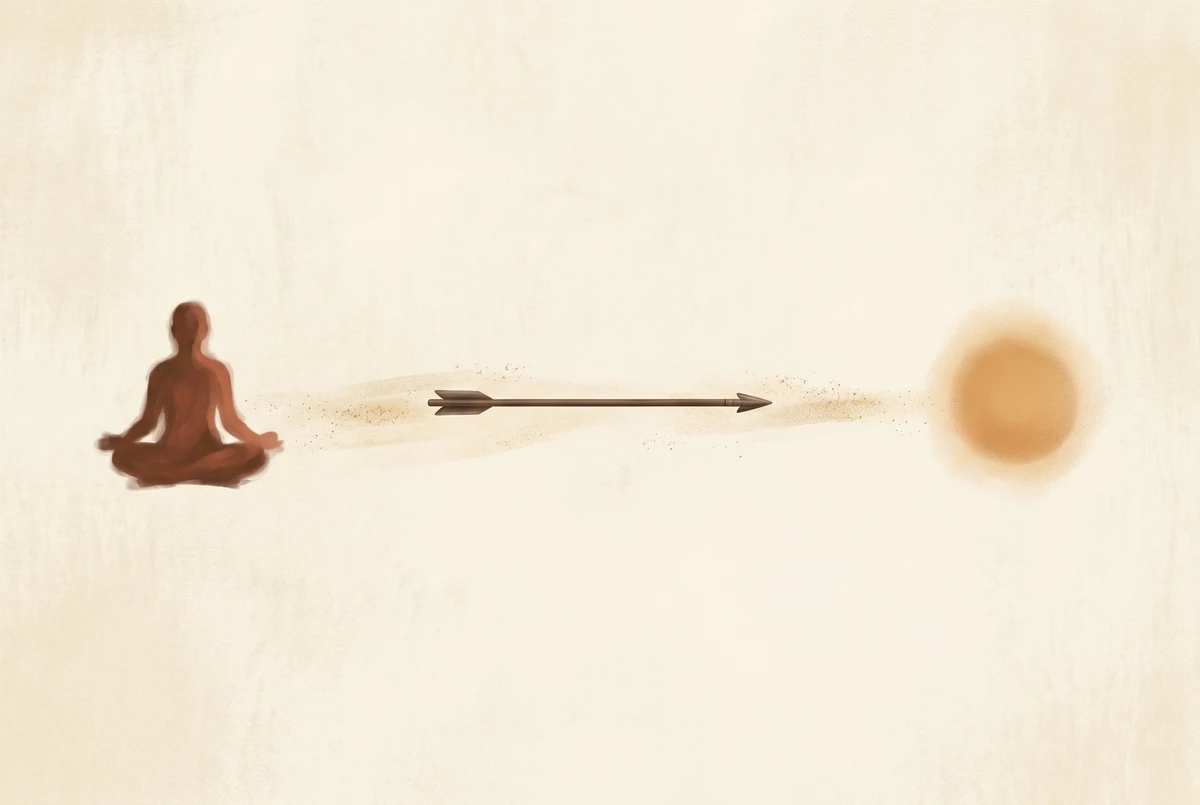
Different traditions use the term in distinct but overlapping ways. In Hindu tantra, a sadhana is often a specific ritual-meditative liturgy centered on a deity. In Vajrayana Buddhism, it’s a structured visualization text, as catalogued in the Sadhanamala, a collection of approximately 312 such texts spanning the 5th through 11th centuries CE. In the Kundalini yoga tradition, it refers to the morning practice sequence. In common modern usage, it’s been broadened to mean any consistent spiritual discipline.
What all of these share: structured, directed, cumulative practice.
How sadhana differs from meditation
This is the most common question people ask about sadhana, and the answer is straightforward. Meditation is a single technique: focusing on the breath, observing thoughts, gazing at a flame. Sadhana is the container that holds one or more techniques in a deliberate sequence.
Meditation is an ingredient; sadhana is the recipe. A sadhana session might include settling the body, clearing the breath with pranayama, performing the core meditation, sitting in silence to integrate the effects, and formally closing. Each element prepares the ground for the next, just as you prepare ingredients before cooking rather than throwing everything into the pan at once.
This is why traditions prescribe specific orders. The Yoga Sutras of Patanjali, whose second chapter is literally titled “Sadhana Pada” (the chapter on practice), lays out the eight limbs of yoga as a sequential progression: ethical restraints, personal observances, posture, breath control, sense withdrawal, concentration, meditation, and finally absorption. Each limb prepares for the next. You don’t jump to deep meditation without first settling the body and breath.
If your daily practice is just sitting down and meditating, adding a deliberate opening and closing transforms it into a sadhana structure. That can be as simple as three conscious breaths on each side.
The structure of a sadhana session
A common architecture appears across traditions, regardless of the specific practices used.
Opening. Physical settling (posture, space), energetic clearing (a few deliberate breaths), and mental intention. In the Kundalini yoga tradition, this means tuning in with the Adi Mantra. In a simple trataka sadhana, it’s lighting the candle, sitting, and taking three deep breaths. The opening marks a boundary: you are leaving daily activity and entering the practice container.
Purification. Techniques that clear physical tension and mental noise so the core practice can go deeper. This might be asana, pranayama, or preliminary chanting. In the Hatha Yoga Pradipika, the shatkarmas (six purification practices, including trataka) serve exactly this function: preparatory actions that clear the ground before deeper work. 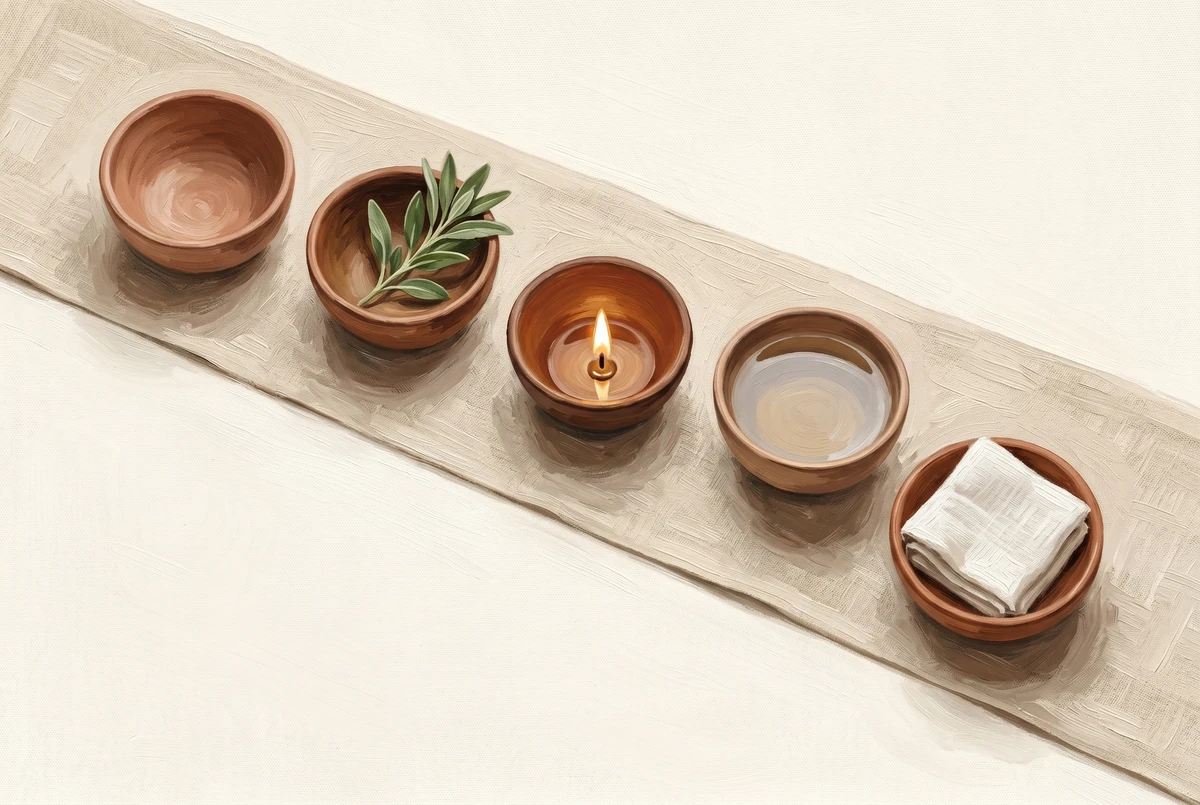
Core practice. The main technique: sustained meditation, visualization, mantra repetition, or gazing practice. This is what most people think of as “the whole thing,” but it works better when prepared for.
Integration. Stillness after the core practice. Let the effects settle. This is the part most people skip, and it’s where much of the transformation actually registers. In trataka, this means sitting with closed eyes after the final gazing round, observing whatever arises. In the Vajrayana Buddhist tradition, this stage involves dissolving the visualization back into emptiness and resting in the natural state.
Closing. A formal ending: a mantra, a dedication, or simply three conscious breaths. You don’t drift out of practice; you close the container. This marks the transition back to daily activity.
This structure can be 15 minutes or 3 hours. What matters is that each element is present, even briefly. Swami Sivananda described sadhana as “spiritual movement consciously systematized,” and the emphasis falls on systematized. A wandering, improvised meditation session can be beneficial, but it is not what the tradition means by sadhana.
What happens after 40 days of sadhana
A single session is the unit, but the arc across days and weeks is where transformation happens.
The most widely cited framework comes from the Kundalini yoga tradition as taught by Yogi Bhajan, and it works in stages: 40 days breaks an old pattern. 90 days establishes the new pattern as default behavior. 120 days integrates the pattern into identity. 1,000 days produces mastery. This framework is a modern teaching, not something found in classical texts like the Yoga Sutras or the Hatha Yoga Pradipika. Treat it as a practical guideline rather than ancient scripture.
The number 40, however, does appear across multiple traditions as a marker of committed duration. Jesus spent 40 days in the desert. Lent lasts 40 days. Moses spent 40 days on Mount Sinai. In Islamic tradition, the arba’in (literally “forty”) marks a 40-day mourning period, and Sufi seclusion practices traditionally run for 40 days. In Hindi, the word chalisa (meaning “forty”) names devotional compositions of exactly 40 verses, like the Hanuman Chalisa. Whether this reflects something about human adaptation or the independent spread of a culturally compelling number is an open question. In practical terms, 40 days is long enough to move past initial resistance and short enough to commit to without open-ended dread.
Modern research offers a different number. A 2010 study by Phillippa Lally and colleagues at University College London found that the average time to form an automatic habit was 66 days, with a range of 18 to 254 days depending on the person and the behavior (Lally et al., 2010). The commonly cited “21 days to form a habit” (derived from Maxwell Maltz’s 1960 book Psycho-Cybernetics) has no empirical support. The 66-day average falls closer to the yogic 90-day marker than the 40-day one. The study measured everyday behaviors like eating fruit and exercising, not spiritual practices, but the general direction aligns: 40 days is a start, not a finish.
What happens if you miss a day? Traditions vary. Some (particularly in Kundalini yoga) say restart the count. Others say acknowledge the break and continue. The honest answer is that a broken chain of 38 days still built 38 days of practice. Be straightforward about the break, but don’t throw away the progress.
A sadhana is not a resolution or a goal. You don’t “achieve” a sadhana and move on. You do it because the daily repetition is the transformative mechanism, not a means to some finish line. As Swami Sivananda put it: “Just as the body needs food every day, the mind and soul need sadhana.”
Sadhana examples across traditions
The architecture shows up in very different forms.
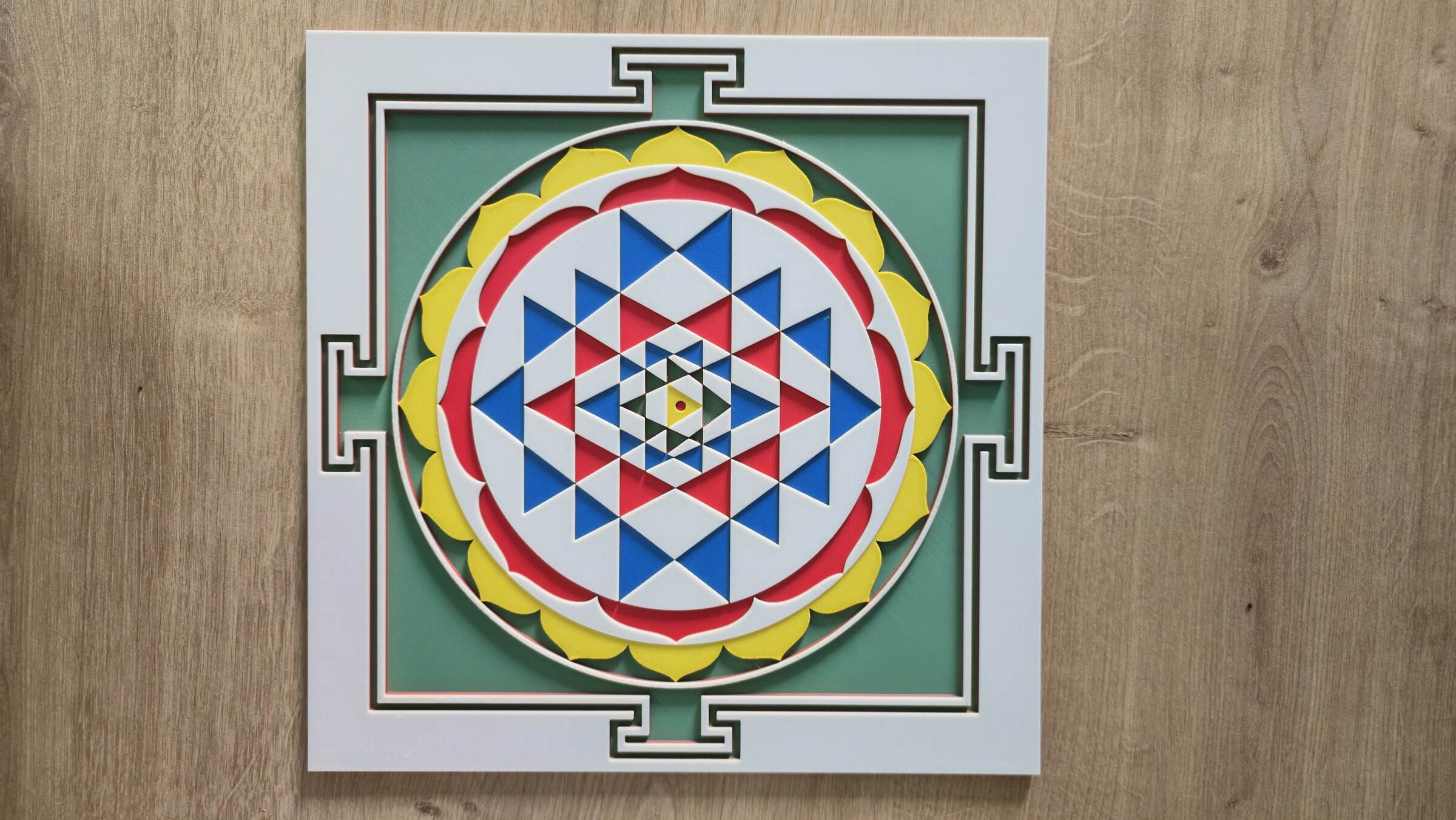
Trataka sadhana (Hindu/yogic). A gazing-based practice. Open with pranayama. Gaze at a candle flame or a Sri Yantra until the eyes water, as the Hatha Yoga Pradipika instructs: “Being calm, one should gaze steadily at a small mark, till eyes are filled with tears.” Close the eyes to observe the after-image. Rest in stillness. The open-close eye cycle creates a natural rhythm of effort and integration, making trataka one of the simplest and most structurally complete sadhana forms. The Sri Vidya tradition uses trataka on the central point of the Sri Yantra as a complete sadhana for developing dharana shakti (power of concentration), noting that the object of gazing shapes the outcome: “Whatever you focus, the same will be activated within yourself.”
Kundalini yoga sadhana (3HO tradition). The full Aquarian Sadhana runs approximately 2.5 hours in the amrit vela (pre-dawn hours, roughly 3 to 6 AM): recitation of Japji Sahib (Guru Nanak’s morning prayer), a Kundalini yoga kriya (asana and pranayama sequence), deep relaxation, then 62 minutes of chanting seven specific mantras. Highly structured, often communal.
Vajrayana Buddhist sadhana. A written liturgical text prescribing a precise visualization sequence: take refuge and generate bodhicitta, dissolve ordinary appearance into emptiness, generate yourself as the deity, recite mantras, make offerings, dissolve the visualization back into emptiness, rest in the natural state, and dedicate the merit. The Sadhanamala preserves hundreds of such texts, each following this same architecture. This form requires initiation and transmission from a teacher.
Bhakti sadhana (devotional Hinduism). Daily puja (ritual worship), japa (mantra repetition with mala beads, typically 108 repetitions), devotional singing (kirtan), and scriptural reading. The structure centers on cultivating a personal relationship with the divine through repetition and devotion, moving from external ritual to internal absorption.
The practices differ, but the architecture is consistent: open, prepare, practice, integrate, close. The technique is what you put inside the structure.
How to start your own sadhana
Pick one core practice. Don’t assemble a complex multi-part session on day one. Choose one technique you want to deepen: trataka, breath-focused meditation, mantra repetition, or any practice you already do inconsistently. Swami Sivananda’s advice is blunt: “Do not mix up many Sadhanas. Select one form of Sadhana and stick to it with leech-like tenacity.” 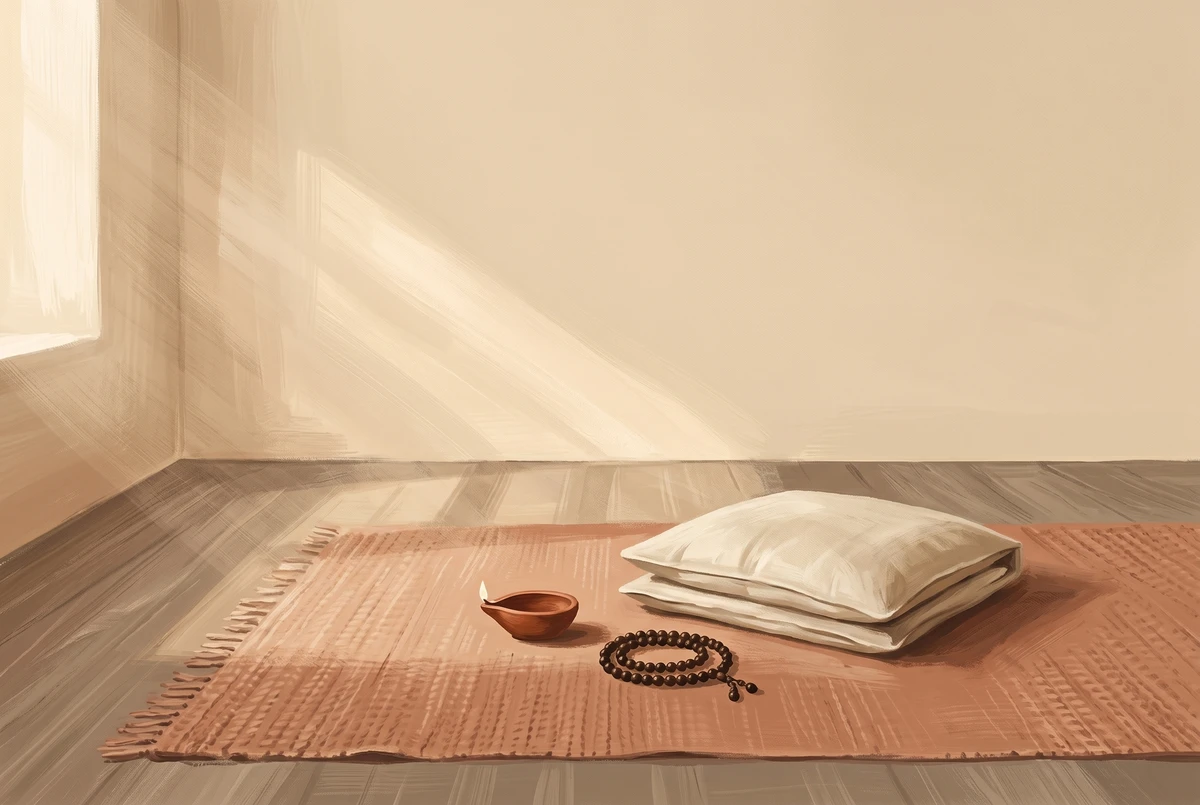
Add a simple opening and closing. Three conscious breaths to open. Three conscious breaths to close. You now have a sadhana structure instead of just a meditation session.
Set the container: same time, same place, same duration. Morning is traditional because the mind is quieter before the day’s inputs arrive, but evening works. Start with a duration you can sustain every day without heroic effort: 10 to 15 minutes is enough.
Commit to a number of days. Forty is the traditional minimum, long enough to move past initial resistance and to notice cumulative effects that a single session cannot produce.
Treat the structure as non-negotiable, the duration as flexible. On a hard day, do a five-minute version: three breaths, two minutes of practice, three breaths to close. The structure matters more than the length.
One more thing from Swami Tejomayananda: “Even our mundane activities can become sadhana when done with the right attitude.” The criterion is not what you do but whether it’s directed, with intention, toward the sadhya. A sadhana does not require a meditation cushion. It requires a structure and a direction.
Sources
- Cappeller, C. A Sanskrit-English Dictionary. Cited via wisdomlib.org.
- Lally, P., van Jaarsveld, C.H.M., Potts, H.W.W., & Wardle, J. (2010). “How are habits formed: Modelling habit formation in the real world.” European Journal of Social Psychology, 40(6), 998–1009. DOI: 10.1002/ejsp.674.
- Monier-Williams, M. A Sanskrit-English Dictionary. Cited via wisdomlib.org.
- Patanjali. Yoga Sutras, Sadhana Pada (Book II). Charles Johnston translation via sacred-texts.com.
- Sadhanamala. (c. 5th–11th centuries CE). Collection of approximately 312 Vajrayana sadhana texts. Referenced via wisdomlib.org.
- Sri Vidya Sadhana. “Trataka to Deepen Our Dharana Shakti.” srividyasadhana.com.
- Svatmarama. Hatha Yoga Pradipika, Chapter 2. Pancham Sinh translation (1914) via sacred-texts.com.
- Swami Sivananda. “Sadhana.” Divine Life Society. dlshq.org.
- Swami Sivananda. “Sadhana as the Main Purpose of Life.” sivanandaonline.org.
- Swami Tejomayananda. “Sadhana: Means to Spiritual Perfection.” Integral Yoga Magazine. integralyogamagazine.org.