What Is Drishti in Yoga? The Focused Gaze Explained
Miha Cacic · April 9, 2026 · 6 min read
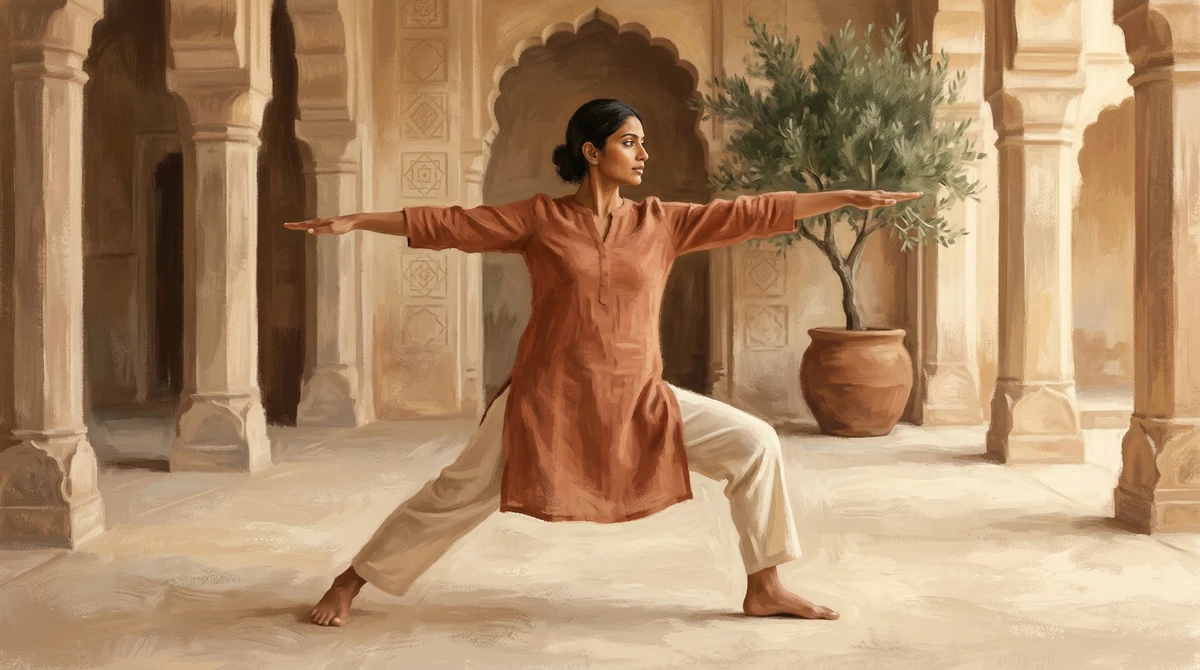
Drishti is a Sanskrit term meaning “focused gaze,” a technique where you direct your eyes to a specific point during yoga practice. Most teachers introduce it as a balance aid: look at a spot on the wall and you’ll stop wobbling in tree pose. That’s true, but it’s the shallowest version of what drishti actually is. In the yogic tradition, drishti is a concentration training tool that uses a simple biological fact: your eyes and your mind are coupled, and learning to still one stills the other.
What drishti means (and what it doesn’t)
The word drishti (dṛṣṭi) translates literally as “sight,” “gaze,” or “point of focus,” but it carries a broader meaning too: vision, perspective, a way of seeing. In yoga practice, drishti refers both to the specific focal point for your eyes and to the quality of focused attention that develops from using it over time.
There are two categories. Bahya drishti is an external gaze, where your eyes rest on a physical point like your fingertips, the tip of your nose, or a spot on the wall. Antara drishti is an internal gaze, where the eyes are closed and attention is directed inward, often toward the space between the eyebrows. David Life explained the distinction well in Yoga Journal: practitioners should use external gazing points during asana and more active practices, and shift to the internal gaze for contemplation and meditation.
One persistent misconception: drishti is not staring. It’s a relaxed, steady gaze, more like looking through a point than locking onto it. Straining your eyes creates tension, which defeats the purpose.
Another common misunderstanding is that drishti comes from Patanjali’s Yoga Sutras. It doesn’t. The Sutras define dharana (concentration) as holding the mind on an inner state, not a visual gaze, and never mention drishti at all. The earliest clear reference appears in the Bhagavad Gita (VI.13), where Krishna instructs Arjuna to “hold one’s body and head erect in a straight line and stare steadily at the tip of the nose.”
The 9 drishtis in Ashtanga yoga
Ashtanga Vinyasa Yoga, the system developed by Pattabhi Jois, assigns a specific drishti to every inhale and exhale of every pose and transition. There are nine gazing points:
- Nasagrai (tip of the nose) — Chaturanga, Upward Dog
- Bhrumadhya (between the eyebrows) — meditation, Fish Pose
- Nabhicakre (navel) — Downward Dog
- Hastagrai (fingertips) — Triangle Pose
- Padayoragrai (toes) — Seated Forward Bend
- Angushthamadhyam (thumbs) — Warrior I, first movement of Sun Salutation
- Parshva right (far right) — twists
- Parshva left (far left) — twists
- Urdhva (upward) — Warrior I variations, Half Moon
In Jois’s framework, drishti isn’t optional or secondary. It’s one of three core elements of tristhana (“three places of action or attention”), alongside ujjayi breath and bandhas (energy locks). These three together are what turn asana from exercise into moving meditation.
Not every yoga tradition uses the full nine-point system. Iyengar Yoga instructs gaze direction for certain poses (B.K.S. Iyengar wrote that “the eyes play a predominant part in the practice of asanas” in Light on Pranayama) but doesn’t formalize it the way Ashtanga does. Sivananda Yoga uses only two drishtis (nose tip and third eye), primarily for trataka (candle-gazing meditation) rather than during asana practice.
The nine-point system also isn’t as ancient as it might seem. The earliest known text assigning gazes to specific asanas is the Joga Pradipika from 1737, which uses two drishtis (nose tip and between the eyebrows) across all 84 asanas. This predates Krishnamacharya by roughly two centuries, according to Mallinson and Singleton’s Roots of Yoga (2017). The full nine-point system was formalized by Krishnamacharya and his student Pattabhi Jois in the 20th century.
Why drishti works: the eye-mind connection
Most yoga writing asserts that fixing your gaze steadies the mind and treats the claim as self-evident. It’s not. There’s a specific mechanism at work.
Your eyes are never still. Even when you try to fix your gaze on a single point, your eyes make tiny involuntary movements called microsaccades, roughly once or twice per second. Neuroscientists Susana Martinez-Conde and Stephen Macknik have spent decades studying these movements, and their research shows that microsaccades are directly coupled to attention. Engbert and Kliegl (2003) demonstrated that microsaccade direction tracks where covert attention is being allocated.
The reverse is also true. When you voluntarily fix your gaze, you reduce the frequency and modulate the direction of microsaccades, which reduces the constant tug on your attention. The coupling runs both ways: a wandering gaze both reflects and reinforces a wandering mind. This is the mechanism behind drishti. By stilling the eyes, you reduce the involuntary eye movements that pull attention from point to point.
The scale of this effect makes sense when you consider how much of the brain is devoted to vision. Approximately a third of the cerebral cortex processes visual information, according to neuroscience research (some estimates go higher, above 50%, when including indirect visual processing pathways). When you hold a steady gaze, you reduce the volume of visual change competing for attentional resources.
There’s also a direct connection to physical balance. The vestibulo-ocular reflex (VOR) stabilizes your gaze during head movement by rotating the eyes in the opposite direction. When you fix your gaze on a point, the VOR has a stable reference, which helps the three systems responsible for balance (visual, vestibular, and proprioceptive) work together. This is why drishti improves balance in standing poses. But the mental effect (reduced distraction, deeper body awareness) is the more consequential benefit.
EMDR therapy, a clinical treatment for trauma, may illustrate this eye-mind coupling from the other direction. EMDR deliberately uses bilateral eye movements to modulate emotional processing of traumatic memories: eye movement to change mental states, where drishti uses eye stillness to create mental stillness. The parallel is suggestive, not proven. The specific mechanisms of EMDR are still debated, and some analyses question whether the bilateral eye movements are the active ingredient in the treatment (Landin-Romero et al., 2018).
One small study has tested drishti directly. Madankumar and Kalpanadevi (2019) had 30 young adults practice nasikagra drishti (nose-tip gazing) over three days and measured their selective attention using a letter cancellation task. Attention scores improved significantly both immediately after practice and after the three-day period, with the cumulative benefit being larger. The study is limited (small sample, no control group), but it’s the only published research testing a specific drishti technique on measured cognitive performance.
David Frawley put the yogic understanding concisely in Inner Tantric Yoga: “Fixing the gaze…not only concentrates the mind but draws our energy inward along with it, extending the action of pratyahara” (the yogic internalization of the senses). This is what connects drishti to the deeper limbs of yoga: pratyahara (sense withdrawal) and dharana (concentration). You’re not just looking at a spot. You’re training the ability to choose where attention goes.
How to practice drishti
Start simple. Add drishti to easy, stable poses before attempting it in challenging ones. Get your alignment right, establish your breath, then layer in the gaze. Trying to hold a specific gazing point while struggling to balance in half moon is too many things at once.
Keep the gaze soft. Lara Land, an Ashtanga teacher at Land Yoga in Harlem, describes it well: “It’s not a strenuous, intense sort of staring, but rather a soft gaze where your eyes are resting gently on one spot.” Think of it as letting your eyes settle rather than forcing them to focus.
Resist closing your eyes. In difficult poses, the urge to shut your eyes is strong. Land identifies this as a form of avoidance: “It’s that urge to turn away from a challenging experience… But instead of running away from the moment, what if you maintain your gaze and simply sit with the discomfort?” Keeping the eyes open and directed trains you to stay present under difficulty.
Modify when needed. If the prescribed drishti creates strain (looking at your toes in a forward bend when tight hamstrings force your neck into compression, for example), use a closer, more natural gaze point. Work toward the prescribed one over time. Land’s advice for poses where the gaze must shift sideways: “Once you feel stable in the pose while looking forward, move your gaze just one foot to the side… the idea is to go to the edge of your comfort zone.”
Move the eyes slowly between drishtis. Shifting gaze abruptly between poses disrupts the steadiness you’re building. Deliberate, gradual transitions preserve it.
When no specific drishti is given, gaze in the direction of the stretch. Jennifer Allen Logosso of Yoga International explains the logic: “By gazing in the direction of the stretch, your body will naturally move in that direction.” The gaze leads the body.
Expect it to take time. A survey by the Yoganatomy research project found that only 39% of practitioners with 4 to 10 years of experience could maintain drishti most of the time, compared to 61% of those with 20+ years. This is a self-reported survey, not a controlled study, but it matches what most practitioners experience: drishti feels secondary and optional for years before it becomes central to practice.
Drishti beyond the mat
Drishti in asana is an entry-level version of a skill that goes much deeper. The same principle (directing and holding attention through the eyes) powers trataka meditation, but at greater intensity and duration. In trataka, you sustain your gaze on a single object, typically a candle flame, for minutes at a time. Where asana drishti asks for seconds of focus per pose, trataka asks for unbroken concentration.
The progression extends further: from asana drishti (seconds of focus, moving between points) to trataka (minutes of sustained gaze on a single object) to antara drishti (internal visualization with eyes closed, no external object at all). Each stage demands more of the same skill: holding attention where you place it.
Krishnamacharya understood drishti as something to practice throughout the day, not only during formal yoga. A.G. Mohan recounts in Krishnamacharya: His Life and Teachings that Krishnamacharya habitually kept his eyes downcast whether sitting or walking, understanding that “as our gaze wanders, our mind follows.” This wasn’t absent-mindedness. It was a continuous, deliberate practice of pratyahara (sense withdrawal) applied to ordinary life.
Krishnamacharya also connected gazing practice to the concept of mudra, a way of sealing and directing attention and energy. In Yoga Makaranda, he wrote that practicing mudras properly can lead to “one-pointedness of the gaze and of the mind.” He used the term “gazing place” rather than “drishti” for the technique in asana, reserving “divya drishti” for something far larger: divine sight or understanding.
David Life captured the concentration angle in Yoga Journal: “Constant application of drishti develops ekagraha, single-pointed focus. When you restrict your visual focus to one point, your attention isn’t dragged from object to object.”
That’s the real function of drishti. It’s not about where you look. It’s about rehearsing the choice to direct your attention rather than letting it be pulled. Every time you hold your gaze steady in Downward Dog, you’re practicing the same skill you’ll need for sitting meditation, for focused work, for any moment that requires sustained attention in a world built to scatter it.
Sources
- Martinez-Conde, S., Macknik, S.L., & Hubel, D.H. (2004). “The role of fixational eye movements in visual perception.” Nature Reviews Neuroscience, 5(3), 229–240. DOI: 10.1038/nrn1348. PubMed: 14976519.
- Martinez-Conde, S., Macknik, S.L., Troncoso, X.G., & Hubel, D.H. (2009). “Microsaccades: a neurophysiological analysis.” Trends in Neurosciences, 32(9), 463–475. DOI: 10.1016/j.tins.2009.05.006. PubMed: 19716186.
- Martinez-Conde, S., Otero-Millan, J., & Macknik, S.L. (2013). “The impact of microsaccades on vision: towards a unified theory of saccadic function.” Nature Reviews Neuroscience, 14, 83–96. DOI: 10.1038/nrn3405.
- Engbert, R. & Kliegl, R. (2003). “Microsaccades uncover the orientation of covert attention.” Vision Research, 43(9), 1035–1045. DOI: 10.1016/S0042-6989(03)00084-1. PubMed: 12676246.
- Madankumar, S. & Kalpanadevi, M. (2019). “Nasikagra Drishti to enhance the selective attention on performance of six-letter cancelation task by young adults.” Saudi Journal of Sports Medicine, 19(1), 17–20. DOI: 10.4103/sjsm.sjsm_7_19.
- Landin-Romero, R., et al. (2018). “How Does Eye Movement Desensitization and Reprocessing Therapy Work? A Systematic Review on Suggested Mechanisms of Action.” Frontiers in Psychology, 9, 1395. DOI: 10.3389/fpsyg.2018.01395.
- Frawley, David. (2008). Inner Tantric Yoga: Working with the Universal Shakti. Lotus Press. ISBN: 978-0-940676-50-3.
- Mohan, A.G. (2010). Krishnamacharya: His Life and Teachings. Shambhala Publications. ISBN: 978-1-59030-800-4.
- Jois, K. Pattabhi. (2010). Yoga Mala: The Seminal Treatise and Guide from the Living Master of Ashtanga Yoga. Macmillan. ISBN: 978-0-86547-751-3.
- Mallinson, James & Singleton, Mark. (2017). Roots of Yoga. Penguin Classics.
- Iyengar, B.K.S. (1981). Light on Pranayama. Crossroad Publishing.
- Life, David. (2007). “See More Clearly by Practicing Drishti.” Yoga Journal.
- Hayes, Marianne. (2018). “4 Ways to Improve Your Drishti.” Yoga Journal.
- Logosso, Jennifer Allen. “How to Practice Drishti.” Yoga International.
- Yoganatomy. “Drishti: Gazing Practice Bridges the External and Internal.” yoganatomy.com.