Yantra Meditation in the Tantric Tradition
Miha Cacic · April 11, 2026 · 7 min read
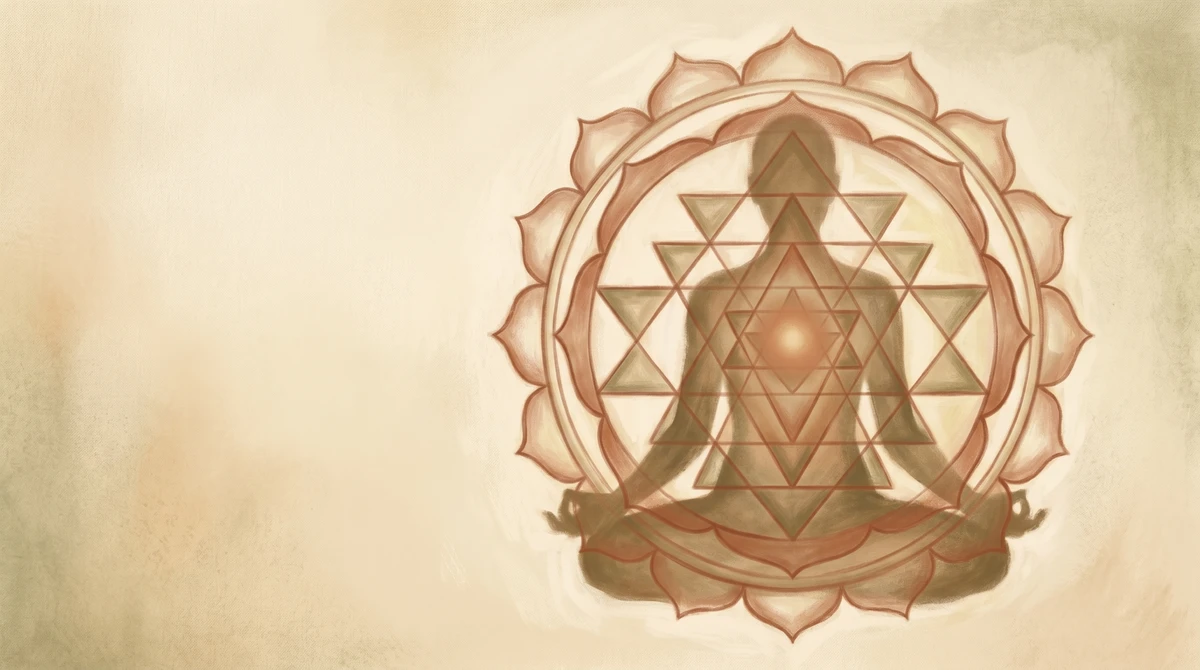
Yantra meditation shows up in most meditation guides as a gazing exercise: place a geometric diagram at eye level, stare at the center, close your eyes and hold the afterimage. That describes trataka, a legitimate concentration technique listed among the six shatkarmas in the Hatha Yoga Pradipika. But in the tantric tradition, yantra meditation is something more specific: a progressive technology for dissolving the boundary between the practitioner and the divine, using geometric form as the medium. The gazing is step one.
What a yantra actually is in tantra (and what it is not)
The word “yantra” comes from the Sanskrit root yam (to hold, to sustain) and the suffix tra (instrument). The Kularnava Tantra defines it directly: “Because it restrains suffering due to desires, anger and karma, it is called Yantra.” This isn’t metaphor. In tantric philosophy, a yantra is not a symbol of a deity. It is the deity’s energetic body rendered in geometric form.
This distinction matters for practice. When you treat a yantra as a pretty concentration aid (a mandala poster from a bookshop, a screensaver), you’re using it the way you’d use a candle flame or a black dot on a wall. Functional for building focus, but missing the point. Tantra treats the yantra as a living structure: the specific arrangement of triangles, circles, and lotus petals creates a precise energetic architecture that holds the deity’s presence.
Geometric precision matters in ways it wouldn’t for a simple focal point. An incorrectly drawn yantra doesn’t lose aesthetic appeal; it loses the geometric relationships that define the energetic structure. A fire altar built to the wrong proportions can’t carry the sacrifice. A yantra drawn with sloppy angles can’t hold what it’s designed to hold.
Sacred geometry as spiritual technology: from fire altars to yantras
The idea that geometric form has functional power (not decorative or symbolic value alone) predates yantras by centuries. The Sulba Sutras, Vedic texts dating to roughly 800–500 BCE, give detailed geometric instructions for constructing sacrificial fire altars. The Baudhayana Sulba Sutra, the oldest in the collection, specifies precise proportions for square, rectangular, circular, and trapezoidal altar designs. The rules are exacting because the ritual’s efficacy depended on spatial precision. A correctly proportioned altar worked. An incorrect one didn’t. 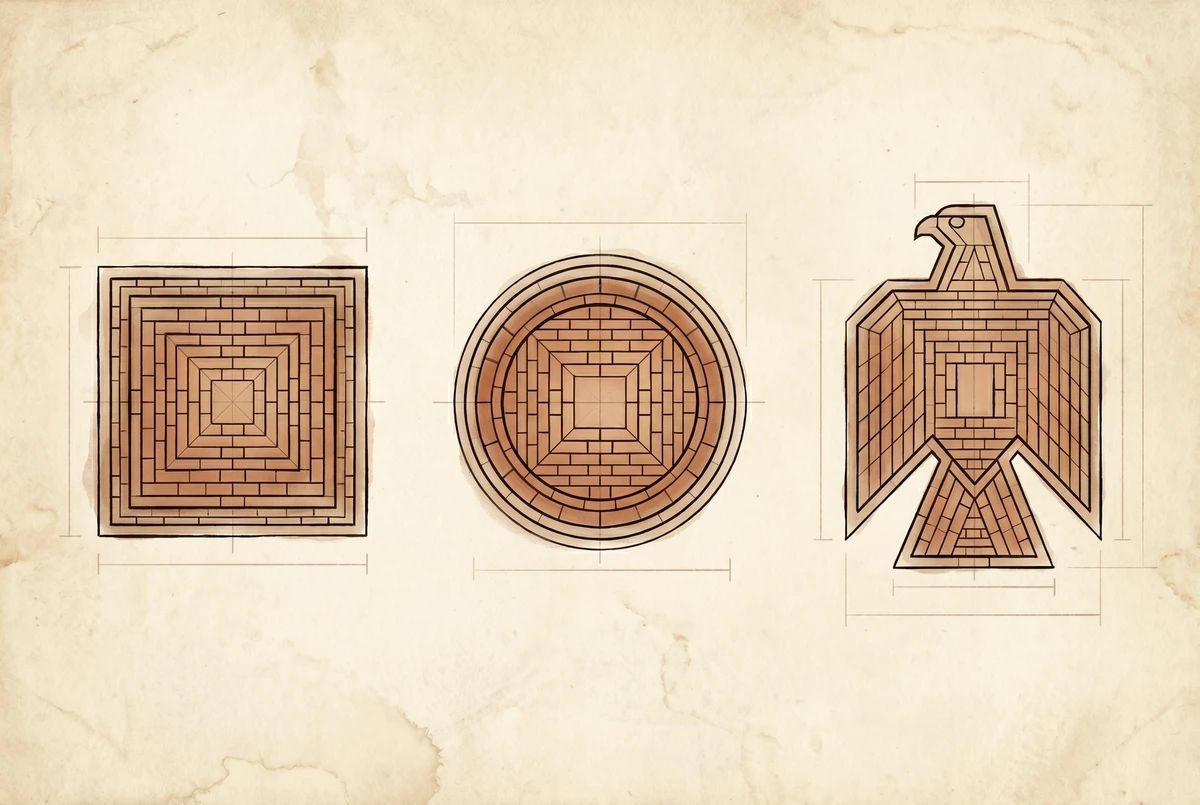
The Indus Valley Civilization (c. 3300–1900 BCE) shows earlier evidence of standardized sacred geometry: the mature Harappan sites of Mohenjo-daro and Harappa (c. 2600 BCE) contain standardized brick ratios, circular and square altar remains, and consistent measurement systems that suggest geometry was already serving ritual purposes.
Buddhist mandalas function as cosmographic diagrams for deity visualization, palace layouts that the practitioner mentally enters and traverses. Hindu temple ground plans follow the Vastu Purusha Mandala, encoding cosmic proportions into built space. Jain yantras serve protective and devotional functions through geometric form. The principle that specific spatial forms create specific conditions for consciousness crosses cultural boundaries.
What tantra did was compress this principle into something portable and reproducible. A fire altar requires land, materials, and priests. A temple requires architecture. A yantra achieves the same functional geometry on a copper plate or a piece of paper: an entire cosmology in a diagram you can hold in your hands.
The anatomy of a yantra: how geometry encodes consciousness
Each element of a yantra encodes a specific energetic relationship.
Bindu (the central point): The seed of undifferentiated consciousness, the point before manifestation. Not a dot, but the origin from which everything in the yantra (and, symbolically, in creation) radiates outward.
Trikona (triangles): Upward-pointing triangles represent Shiva, consciousness, fire. Downward-pointing triangles represent Shakti, energy, water. Their interlocking represents creation through the union of these two principles. The number, size, and arrangement of triangles varies between yantras and determines which cosmic principle the yantra embodies.
Circles: Cyclical energy fields that contain and circulate the forces generated by the triangles.
Lotus petals: Stages of unfolding manifestation. Different petal counts (8, 16, etc.) correspond to different levels of creative expression.
Bhupura (the square enclosure with gates): The boundary between mundane and sacred space. The four gates at the cardinal points mark the threshold the practitioner’s attention crosses when entering the yantra. 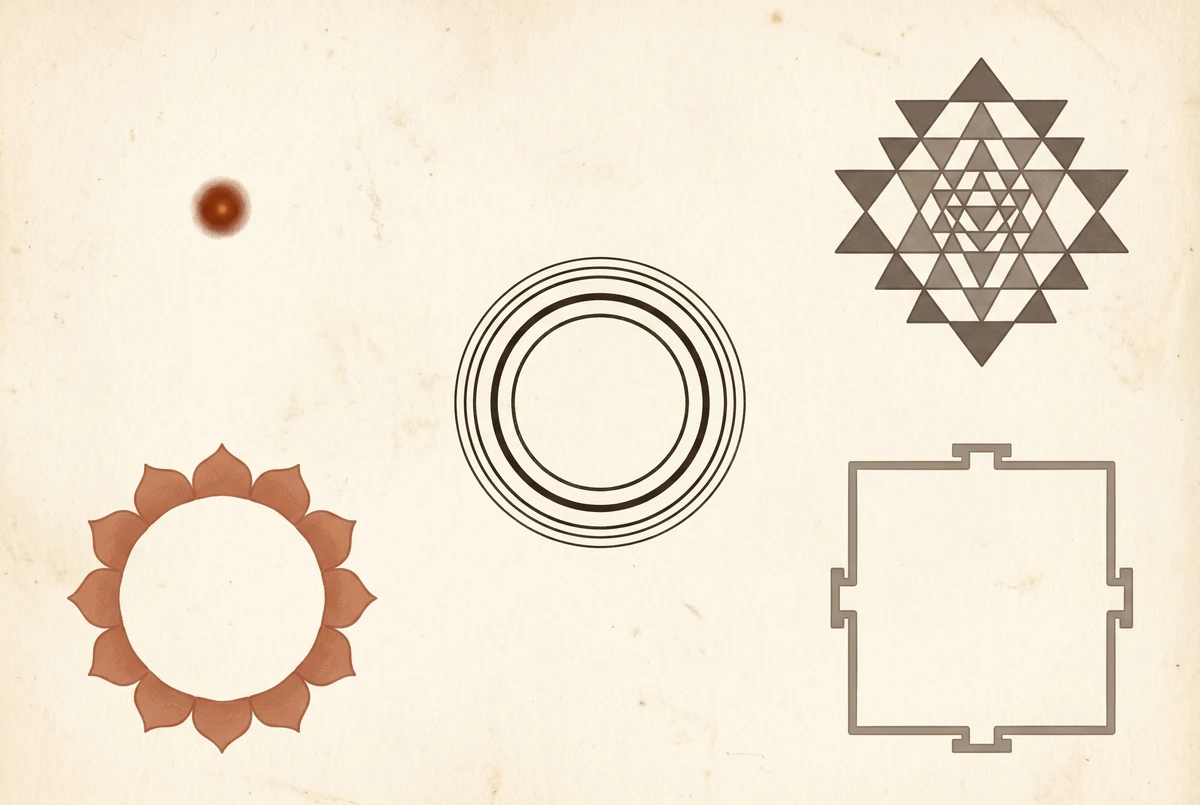
The yantra reads in two directions. From outside in (bhupura to bindu) traces the path of dissolution: from the material world back to the source. This is the meditation direction. From inside out (bindu to bhupura) traces the path of manifestation: from undifferentiated consciousness into the multiplicity of creation.
Why tantra pairs mantra with yantra
Most articles about yantra meditation mention that mantras and yantras “go together” or that combining them is “more powerful.” They rarely explain the mechanism, and the mechanism is the whole point.
Tantric philosophy understands reality as vibration (a principle articulated in the Spanda Karikas of 9th-century Kashmir Shaivism). Every cosmic principle has both a sonic form and a visual form. Mantra is the sonic form. Yantra is the visual form. They aren’t two different things combined for extra effect. They’re the same reality perceived through different senses. 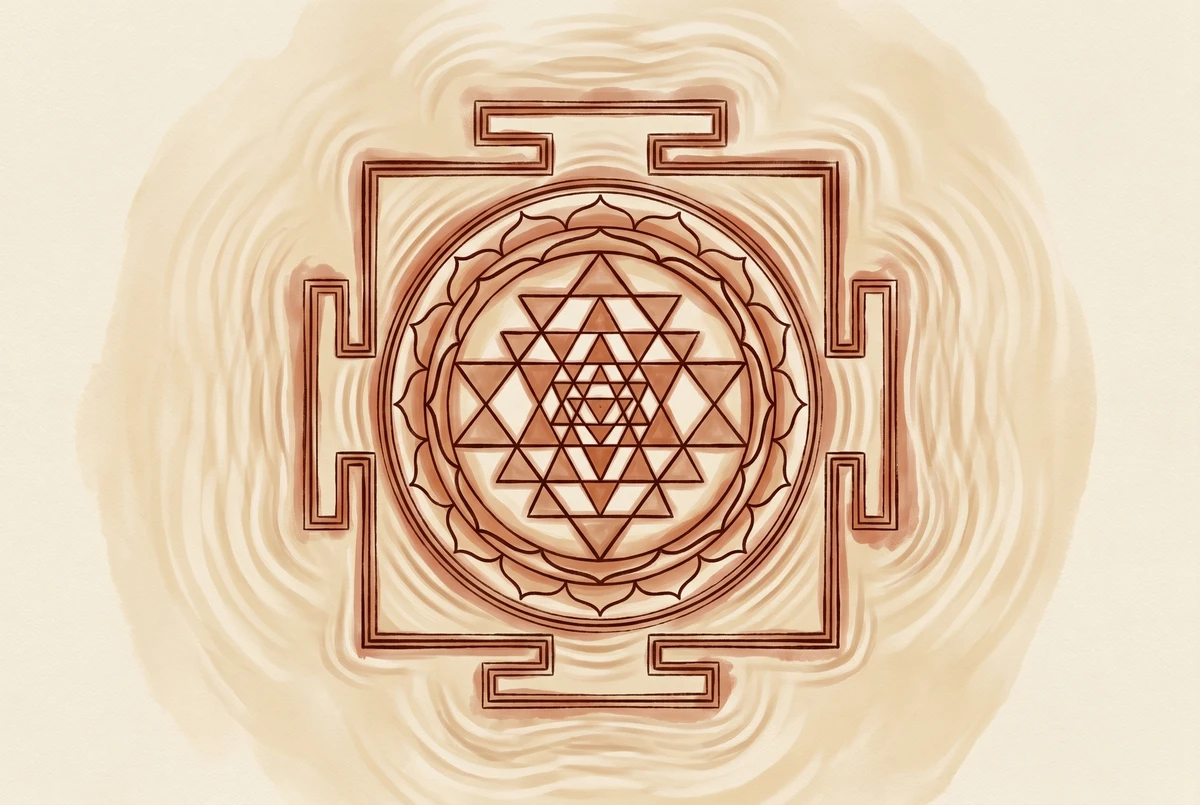
Hence the traditional teaching: “yantra plus mantra equals tantra.” The combination isn’t additive. It’s stereoscopic: the practitioner’s consciousness engages the same principle through both hearing and seeing simultaneously, creating a depth of resonance that neither channel achieves alone.
The practical implication is concrete. Gazing at a yantra without its corresponding mantra is like reading sheet music silently. You can study the structure, trace the melody with your eyes, and learn something real about the composition. But the full experience requires the sound. When a practitioner pairs a yantra’s visual geometry with its corresponding mantra syllables, each geometric layer activates as a vibratory field rather than a static image.
The first verse of the Saundarya Lahari (attributed to Adi Shankara, 8th–9th century CE) states this interdependence at the cosmic level: “United with Shakti, Shiva is endowed with power to create; or otherwise, he is incapable of even a movement.” The mantra-yantra pairing recreates this union in practice: sound (Shakti) animates form (Shiva), and form gives sound a structure to inhabit.
The stages of tantric yantra meditation
This is where tantric practice diverges most sharply from the “gaze at the center” instructions found in popular guides. Tantra teaches yantra meditation as a staged progression, each phase building on the previous one.
Stage 1: External gazing (bahir trataka)
The practitioner gazes at the physical yantra, tracing attention from the outer bhupura inward through each geometric layer to the central bindu. The gaze is steady, soft, and sustained (the Hatha Yoga Pradipika describes trataka as “gazing steadily at a small mark until tears flow”).
This develops dharana (concentration) and begins to imprint the yantra’s geometric pattern on the practitioner’s visual memory. It’s training, and it produces measurable effects: meditation research documents that sustained meditative focus produces increased alpha wave amplitude and regularity, markers of relaxed alertness (Balaji, Varne & Ali, 2012).
Stage 2: Internal visualization (antar trataka)
After sustained external practice, the practitioner closes their eyes and reconstructs the yantra internally. Early on, this relies on the visual afterimage from gazing. With practice, it develops into a stable mental construction that the practitioner can hold and explore without the external diagram.
This shift from external to internal marks the transition from concentration (dharana) to meditation proper (dhyana). The practitioner is no longer looking at the yantra. They’re inhabiting it.
Stage 3: Mantra-yantra integration
The practitioner pairs the yantra’s corresponding mantra with the internal visualization. Each geometric layer is activated by its associated mantra syllable. The silent mental image becomes a vibratory field: the practitioner sees the form and hears the sound simultaneously, creating the resonance described above.
This is where the practice stops being a concentration exercise and becomes distinctly tantric. The form is alive.
Stage 4: Nyasa and embodiment
Through nyasa (“placing”), the practitioner maps the yantra onto their own physical and subtle body. This ritual involves touching specific body parts while reciting corresponding mantras, consecrating the body as a living yantra.
The bindu corresponds to sahasrara (the crown). The interlocking triangles map onto specific chakras. The outer enclosures correspond to the peripheral body. The practitioner’s body becomes the yantra’s geometry. 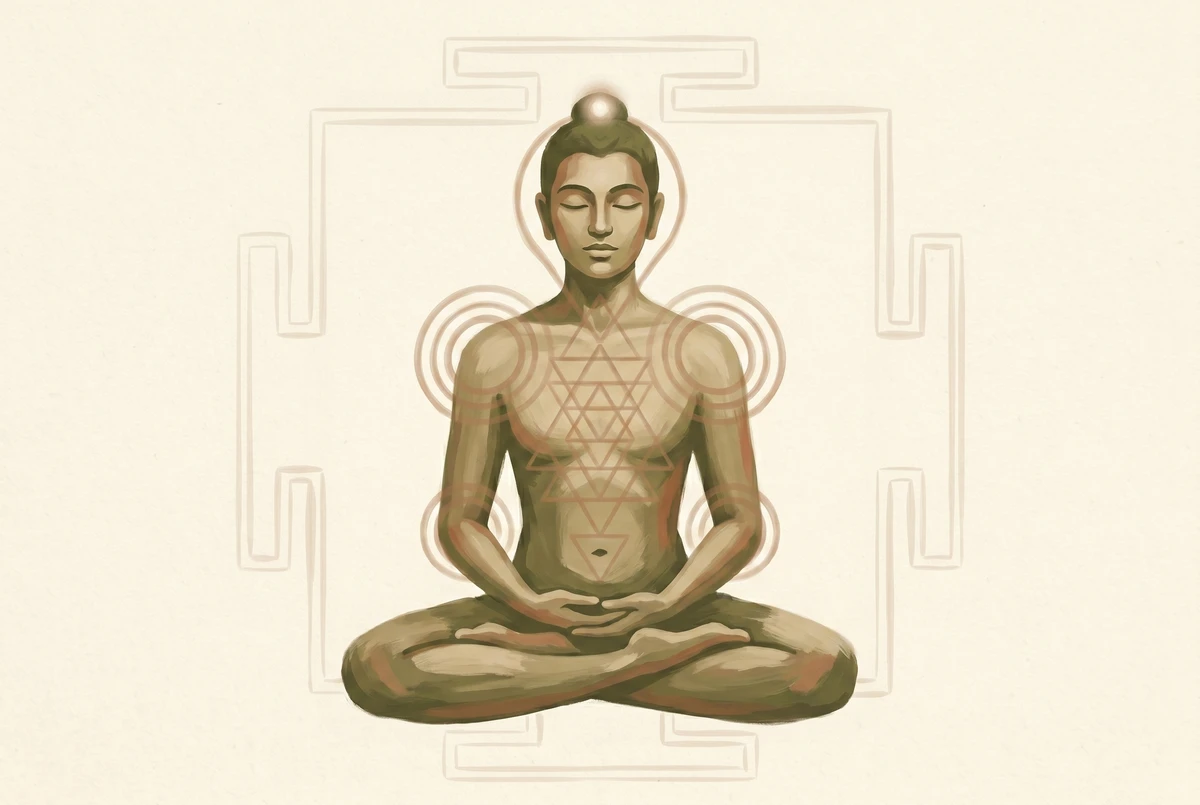
This stage transforms the practice from something the practitioner does to something the practitioner is. The yantra is no longer external (Stage 1), no longer a mental image (Stage 2), no longer an animated internal field (Stage 3). It is the practitioner’s own body, experienced as sacred architecture.
Stage 5: Deity identification (laya)
The final stage dissolves the remaining distinction between practitioner, yantra, and deity. The geometric meditation culminates in direct recognition: the cosmic architecture depicted in the yantra is identical to the architecture of one’s own consciousness.
This is laya (absorption). The tantric practitioner doesn’t concentrate on a diagram or visualize a geometric form. They progressively discover that the diagram’s structure is their own structure, and that the deity whose energetic body the yantra maps is not separate from the consciousness doing the mapping.
The Sri Yantra: tantra’s supreme diagram
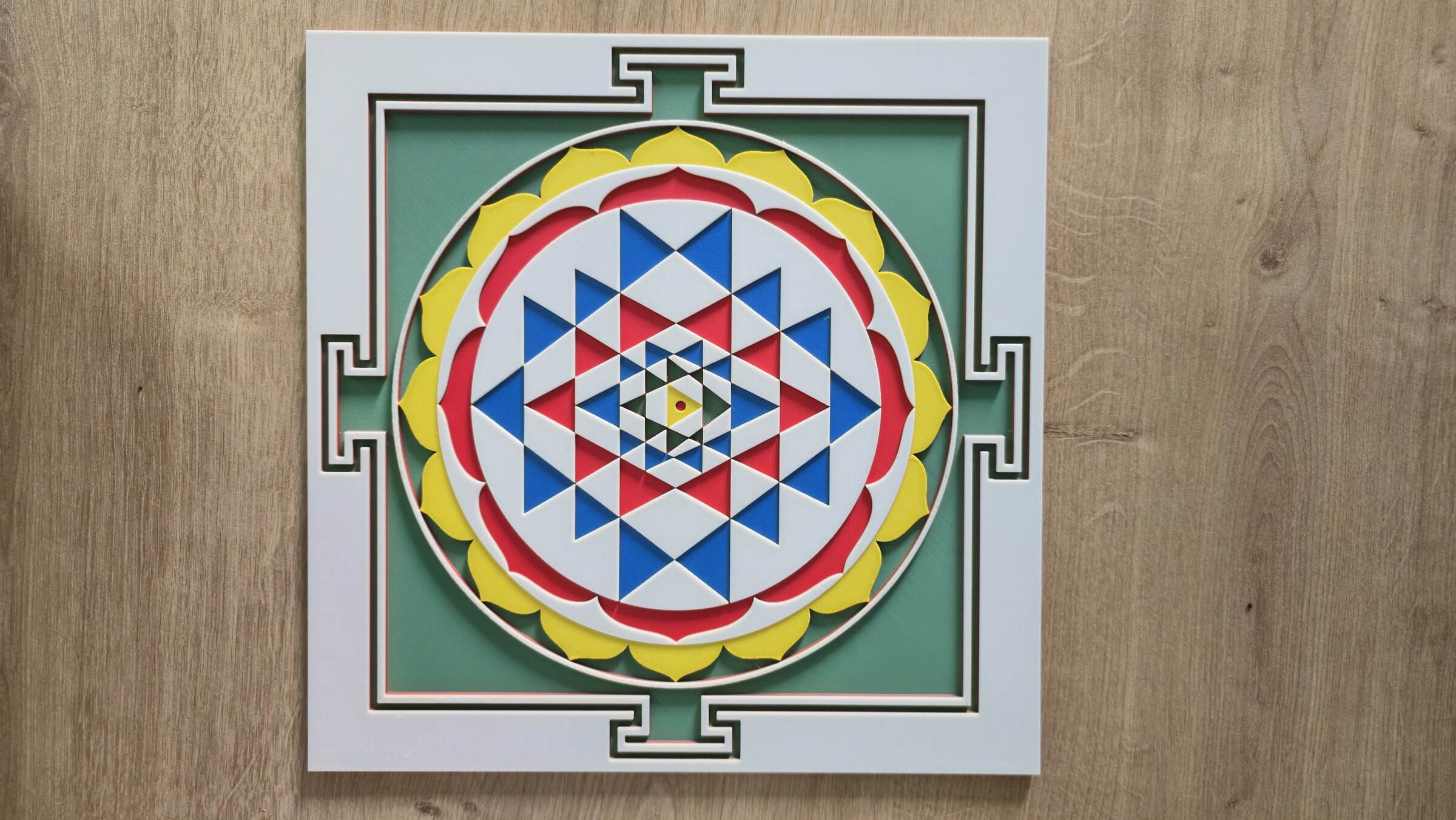
Among the many yantras in tantric practice, the Sri Yantra (also called Sri Chakra) stands as the most complex and comprehensive. It consists of nine interlocking triangles (four pointing upward representing Shiva, five pointing downward representing Shakti) that create 43 smaller triangles arranged in five concentric levels. Surrounding these are two rings of lotus petals (16 and 8), three circles, and the outer bhupura.
The Sri Yantra maps the entire process of cosmic manifestation and dissolution into a single diagram. Its nine enclosures (navavaranas) form a graduated meditation path:
The outermost enclosure, the bhupura (“earth city”), marks the boundary between mundane and sacred space. Moving inward, the 16-petal lotus (Sarva Aasa Paripuraka, “Fulfiller of all desires”) and 8-petal lotus (Sarva Sankshobahana, “Agitator of all”) represent the first stages of turning attention from the external world. The rings of 14, 10, 10, and 8 triangles that follow (each named for a specific spiritual function, from “Giver of all auspiciousness” to “Remover of all diseases”) represent progressively subtler levels of consciousness. The central triangle (Sarva Siddhiprada, “Bestower of all perfections”) leads to the bindu itself: Sarva Anandamaya, “Full of all bliss.”
The Sri Yantra belongs to the Sri Vidya tradition, a Shakta tantric lineage centered on the worship of Lalita Tripurasundari. The Saundarya Lahari, one of the tradition’s foundational texts, presents the Sri Yantra as the visual body of the goddess. The navavarana puja (worship through the nine enclosures) maps each layer to specific mantras, deities, and spiritual attainments.
Some practitioners work with the Maha Meru, a three-dimensional projection of the Sri Yantra where the flat diagram rises into a pyramid form with the bindu at its apex. Traditionally cast in metal (brass, copper, or panchadhatu alloy), the Maha Meru represents the full spatial manifestation of the cosmology that the flat yantra encodes in two dimensions. 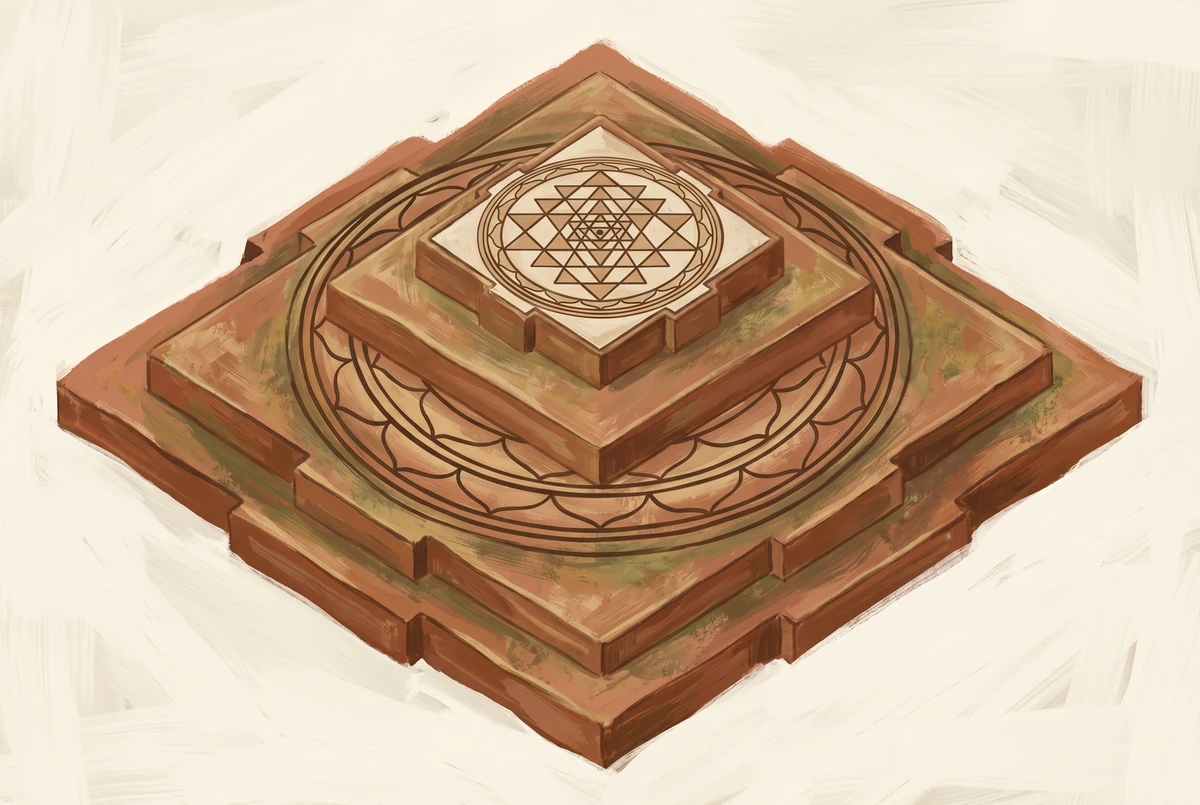
Mathematician and Vedic scholar Subhash Kak has argued that a geometric description in the Svetasvatara Upanishad (c. 400–200 BCE) prefigures the Sri Yantra’s structure, though this remains a minority scholarly position. The Sri Yantra as a named, codified diagram is most firmly associated with the Sri Vidya tantric tradition and its textual lineage.
Do you need initiation? The role of the guru
The honest answer: it depends on how deep you want to go.
Stage 1 (external gazing) is accessible to anyone. Trataka on a yantra is a legitimate concentration practice that requires no initiation, no specific mantra, and no guru. You can practice it with a printed or digital Sri Yantra and get real benefits: improved concentration, reduced mental chatter, the calm alertness that comes from sustained visual focus.
The deeper stages are a different matter. In the Sri Vidya tradition, specific mantras (particularly the Panchadashi and Shodashi mantras) are transmitted only through diksha (initiation) from a qualified guru. Nyasa sequences, visualization details, and the specific ways each enclosure of the Sri Yantra maps to mantra syllables belong to a living oral tradition. The guru doesn’t hand over instructions. In tantric understanding, the guru transmits shakti (energy) that activates the practice at a level that self-study cannot replicate.
This isn’t gatekeeping for its own sake. The progressive stages involve increasingly subtle internal work, and a practitioner without guidance can develop incorrect patterns that are hard to unlearn. The guru provides course correction that no book can offer.
On printed versus consecrated yantras: geometric accuracy matters more than material. A precisely drawn yantra on paper is more functional than an ornate metal yantra with incorrect proportions. That said, ritual consecration (prana pratishtha, “establishing the life breath”) adds a dimension that an unconsecrated yantra doesn’t carry. If you’re practicing basic trataka, a well-drawn print works fine. If you’re engaging in full tantric sadhana, a properly consecrated yantra becomes part of the practice’s integrity.
Common misconceptions about yantra meditation
“A yantra is just a visual aid for concentration.” It can be used this way, and it works for building focus. But in tantra, a yantra is the deity’s energetic body in geometric form, not a concentration prop. Treating it only as a focal point is like using a piano as a table: functional, but missing the instrument’s purpose.
“Any geometric pattern is a yantra.” Precision is non-negotiable. Each yantra’s proportions, angles, and element counts encode specific energetic relationships. A carelessly drawn yantra doesn’t look wrong; the geometric relationships that define its function are broken. This is why traditional yantra construction follows exact mathematical specifications.
“Yantra meditation is passive gazing.” The tantric approach involves five progressive stages, from external gazing through internal visualization, mantra integration, bodily mapping, and absorption. Calling it “gazing” describes only the first stage of a practice that restructures the practitioner’s relationship to their own consciousness.
“You need an expensive metal yantra.” The yantra’s function depends on geometric accuracy, not material cost. A precisely drawn yantra on paper serves basic practice well. Metal yantras (particularly those cast in copper or panchadhatu alloy) are traditional for altar worship and long-term sadhana, but price doesn’t determine efficacy. An expensive yantra with inaccurate geometry is less functional than a carefully drawn free one.
“Yantras are exclusively Hindu.” Yantra-like geometric meditation tools appear across traditions. Buddhist mandalas serve a parallel function (cosmographic diagrams for progressive visualization and deity identification). Jain yantras exist as protective and devotional diagrams. The tantric yantra tradition is the most systematized approach to geometric meditation, but the underlying principle crosses cultural boundaries.
Sources
- Kularnava Tantra. Trans. Arthur Avalon (Sir John Woodroffe). Motilal Banarsidass Publishers.
- Svātmārāma. (15th century). Hatha Yoga Pradipika.
- Adi Shankara (attrib.). (8th–9th century CE). Saundarya Lahari. English translations: W. Norman Brown, Harvard Oriental Series vol. 43, 1958; Mani Rao, HarperCollins, 2022.
- Spanda Karikas. (9th century CE). Kashmir Shaivism.
- Baudhayana Sulba Sutra. (c. 800–500 BCE).
- Balaji, P.A., Varne, S.R., & Ali, S.S. (2012). “Physiological Effects of Yogic Practices and Transcendental Meditation in Health and Disease.” North American Journal of Medical Sciences, 4(10): 442–448. PMC3482773.
- Kak, Subhash. “Sri Yantra geometry in the Śvetāśvatara Upanishad.” Brahmavidya (journal of the Adyar Library).