Hindu Meditation Techniques: A Complete Guide
Miha Cacic · April 11, 2026 · 9 min read
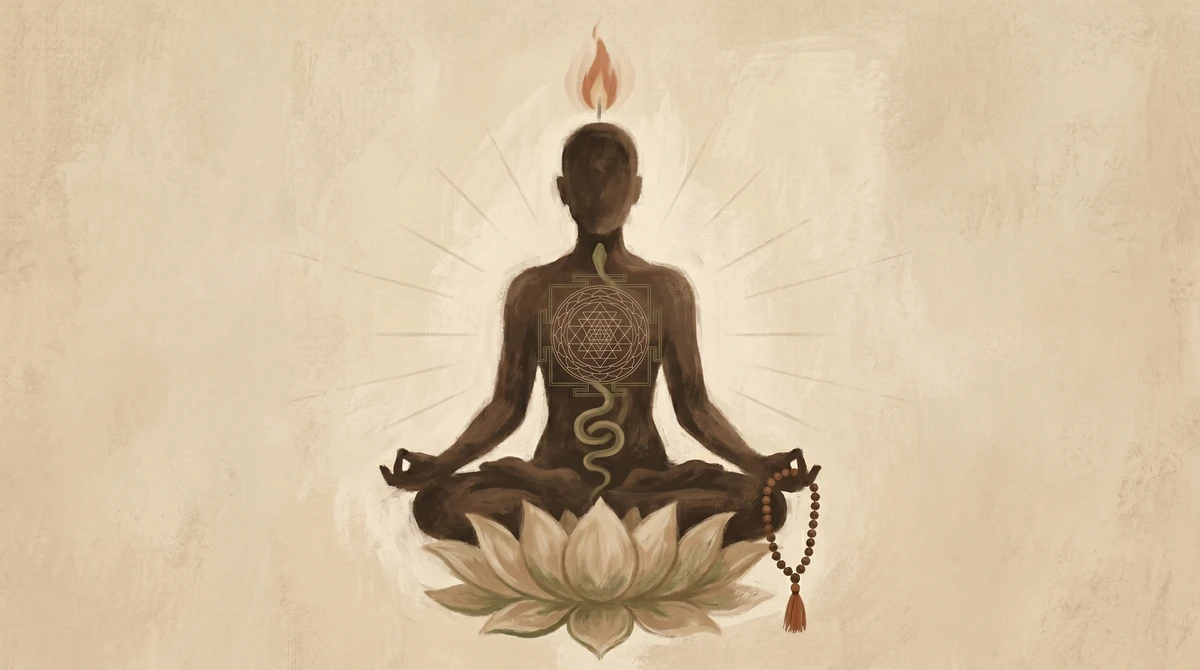
Hindu meditation is not one technique. It is an interconnected system of practices developed across more than three millennia, spanning the Vedas, Upanishads, Yoga Sutras, Bhagavad Gita, and Tantric texts. These practices range from breath control and mantra repetition to fixed-gaze concentration and formless self-inquiry, and they follow a deliberate progression from physical preparation to mental stillness to spiritual absorption. The reason so many techniques exist is not that ancient practitioners couldn’t agree on one. Different methods suit different temperaments and serve different stages of the path. Understanding the system matters more than memorizing the list.
The system behind the techniques
Most articles present Hindu meditation as a buffet: pick a technique, here’s how to do it. But the techniques were never meant to stand alone. They fit into a framework, and the clearest version of that framework comes from Patanjali’s Yoga Sutras (compiled approximately 4th century CE).
Patanjali describes eight limbs (ashtanga) of yoga. These are not eight separate practices you choose between. They are a sequential progression:
- Yama (ethical restraints) and Niyama (personal observances) establish the behavioral foundation.
- Asana (posture) and Pranayama (breath control) prepare the body and nervous system.
- Pratyahara (sense withdrawal) turns attention inward, away from external stimuli.
- Dharana (concentration) fixes the mind on a single point.
- Dhyana (meditation) is sustained, effortless attention on that point.
- Samadhi (absorption) is the dissolution of the boundary between the meditator and the object of meditation.
Most “Hindu meditation techniques” that people search for map to the inner limbs: pranayama, pratyahara, dharana, and dhyana. And here is the distinction that changes how you practice all of them:
What most people call “meditation” is actually dharana (concentration). Patanjali defines dharana as “the fixing of the mind in one place” (Yoga Sutra 3.1). In dharana, you are aware of the object but your attention still gets pulled away; you notice and bring it back. True dhyana arises only when that concentration becomes uninterrupted, when awareness flows toward the object without effort. The classical commentaries compare this to oil poured in a continuous stream (a metaphor from Vyasa’s Yogabhashya on Sutra 3.2). As the commentator Shankara noted, in dharana “awareness of the object is still interrupted,” while in dhyana, all interruption ceases.
This is not a semantic distinction. It means that when you sit down with a mantra or a candle flame and your mind wanders repeatedly, you are not failing at meditation. You are doing concentration practice (dharana), the necessary prerequisite. Meditation (dhyana) is what happens when that concentration matures.
The four yogic paths (and why they matter for choosing a technique)
Hindu philosophy doesn’t just offer techniques. It offers a framework for matching techniques to people. The Bhagavad Gita presents this through four primary yogic paths, each suited to a different temperament (a principle the tradition calls adhikara, or spiritual readiness): 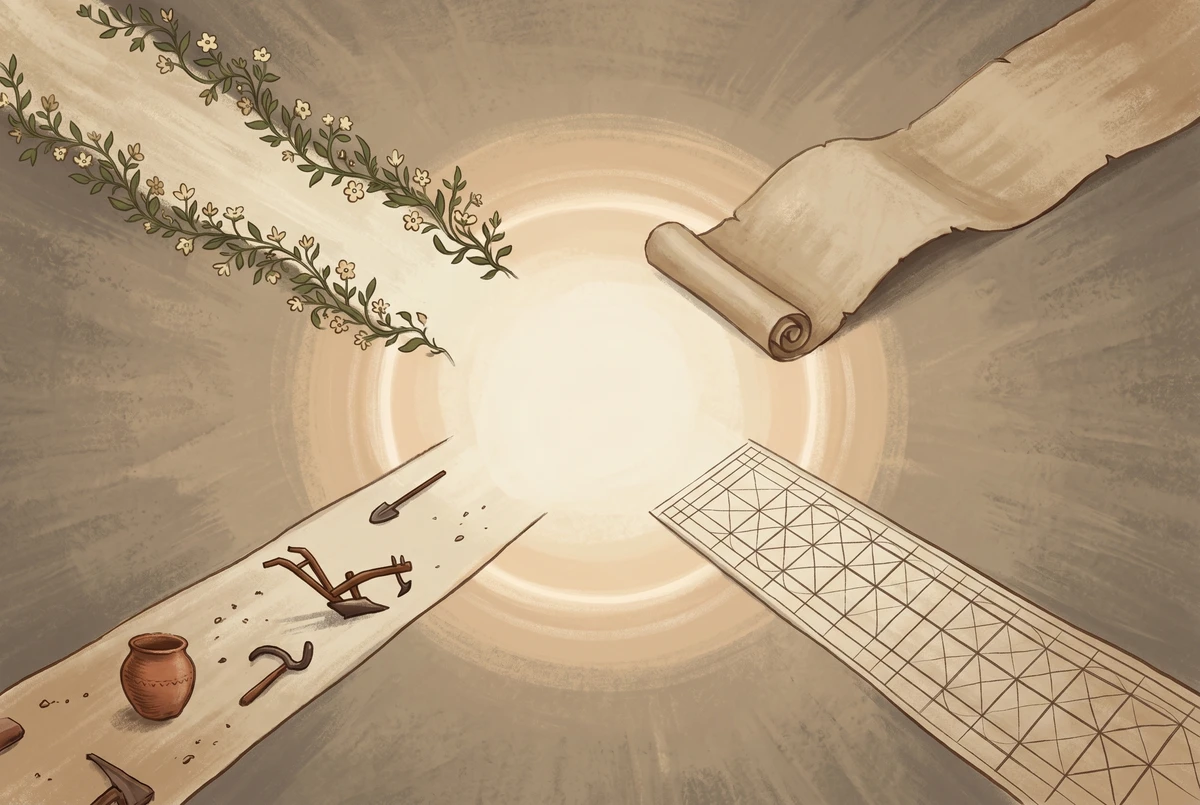
Bhakti Yoga (the path of devotion) is for those who are emotionally oriented. Techniques include deity visualization, kirtan (call-and-response chanting), and devotional mantra repetition. Krishna endorses this path in the Gita (6.47), declaring the one who meditates with love and devotion to be the most devoted of all yogis.
Jnana Yoga (the path of knowledge) is for the intellectually oriented. The primary technique is self-inquiry (atma vichara), the practice of tracing thoughts back to their source by asking “Who am I?” This path draws from the Upanishadic teaching of “neti neti” (not this, not this), systematically negating everything that is not the Self.
Raja Yoga (the royal path) is for the disciplined and systematic. This is Patanjali’s eight-limb progression: pranayama, dharana, dhyana, samadhi, practiced in sequence with rigor.
Karma Yoga (the path of action) is for the practically oriented. This is not a seated meditation technique but a meditative approach to daily activity: performing action without attachment to results.
The answer to “which technique should I start with?” is not “try mantra meditation because it’s easy.” It is “what is your natural orientation?” Most practitioners blend elements from multiple paths. The paths are dominant orientations, not exclusive categories.
Mantra meditation (Japa)
Japa is the most accessible Hindu meditation technique and the most commonly recommended starting point. The practice is simple: silently or audibly repeat a sacred syllable, word, or phrase to anchor your attention.
The key mantras, each rooted in a specific text:
Om is treated in the Mandukya Upanishad as the primordial sound encoding all states of consciousness. The syllable’s three phonetic components (A-U-M) represent the waking state, the dreaming state, and deep sleep. The silence after the sound represents turiya, the “fourth” state: pure awareness beyond the other three. Repeating Om in japa is not just repeating a sound. It is working with a symbol that maps the entire spectrum of consciousness.
Gayatri Mantra originates in Rig Veda 3.62.10, a prayer for illumination of the intellect. It remains one of the most widely chanted mantras in Hindu practice.
Om Namah Shivaya is the five-syllable Shaiva mantra of devotion to Shiva.
So Hum (“I am That”) follows the natural rhythm of the breath: “So” on the inhale, “Hum” on the exhale.
Practitioners traditionally use a mala (a string of 108 beads) to count repetitions. The number 108 carries multiple layers of significance in Hindu tradition: 27 nakshatras (lunar mansions) multiplied by 4 phases each, or 54 Sanskrit letters multiplied by their dual Shiva/Shakti aspects. No single authoritative explanation exists; the number has remained consistent across centuries regardless of which interpretation is preferred. 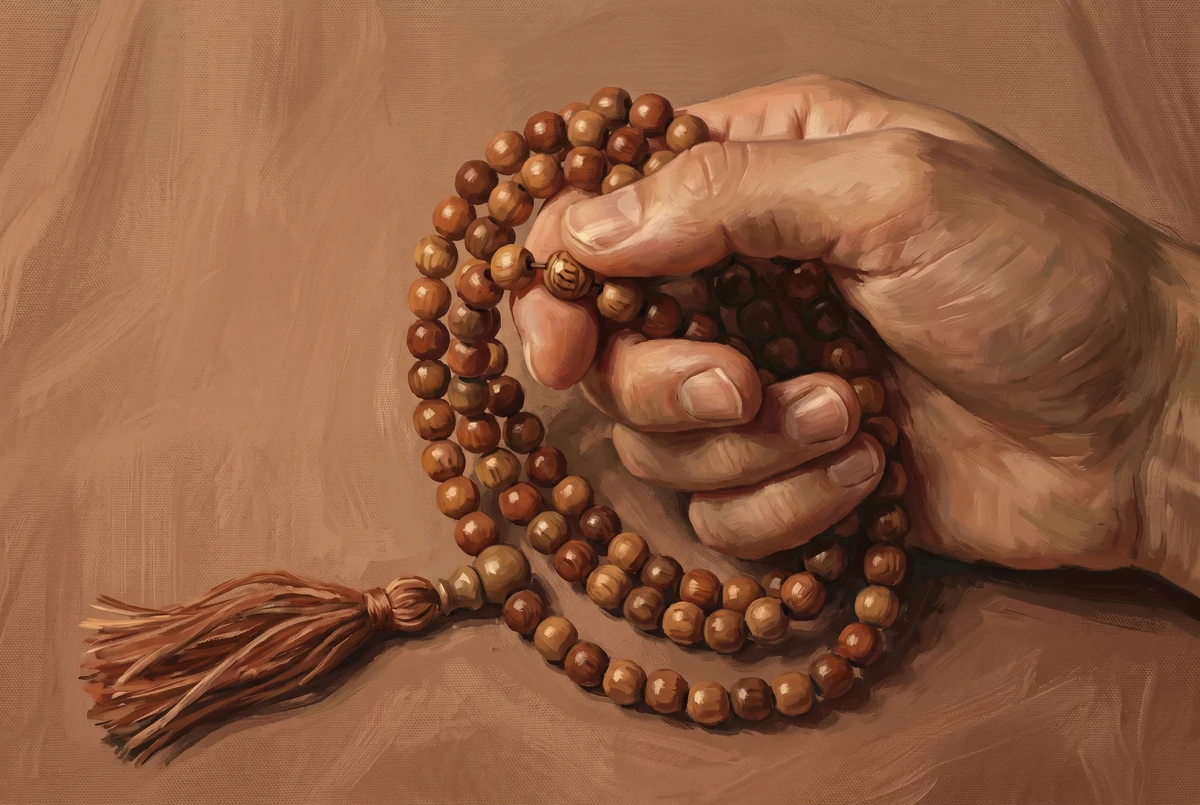
Where japa sits in the system: it is a dharana practice. The mantra gives the wandering mind a tether. When repetition becomes automatic and awareness rests in the space between repetitions, that is the transition from concentration to meditation.
One note on Transcendental Meditation: TM is a branded, commercialized form of mantra meditation introduced publicly by Maharishi Mahesh Yogi in 1955. The underlying technique (silent mantra repetition) is ancient and freely available in the Hindu tradition. Herbert Benson’s research at Harvard Medical School in the 1970s demonstrated that silent mantra repetition triggers what he called “the relaxation response”: decreased metabolic rate, reduced oxygen consumption, lowered heart rate, and, over time, significantly reduced blood pressure in hypertensive subjects (Benson and Klipper, 1975). These physiological effects are not specific to TM. They are a feature of the practice itself.
Pranayama (breath-based practices)
Pranayama is technically limb four of the eight-limb path, preparation for meditation rather than meditation itself. But it appears on every list of Hindu meditation techniques because the breath-awareness component naturally concentrates the mind. The Hatha Yoga Pradipika states this directly: “As long as the breath is restrained in the body, the mind is calm” (HYP 4:29).
The traditional framework holds that prana (vital energy, carried by the breath) and chitta (mind-stuff) are linked: regulate one and the other follows. Modern research on pranayama’s autonomic effects lends some support to this model.
The major techniques:
Nadi Shodhana (alternate nostril breathing) involves breathing through one nostril at a time in a structured pattern. The traditional framework describes this as balancing the ida and pingala nadis (left and right energy channels). In physiological terms, a 2016 review by Nivethitha and colleagues found that Nadi Shodhana improves heart rate variability, balances sympathetic and parasympathetic nervous system activity, and reduces blood pressure in hypertensive subjects. 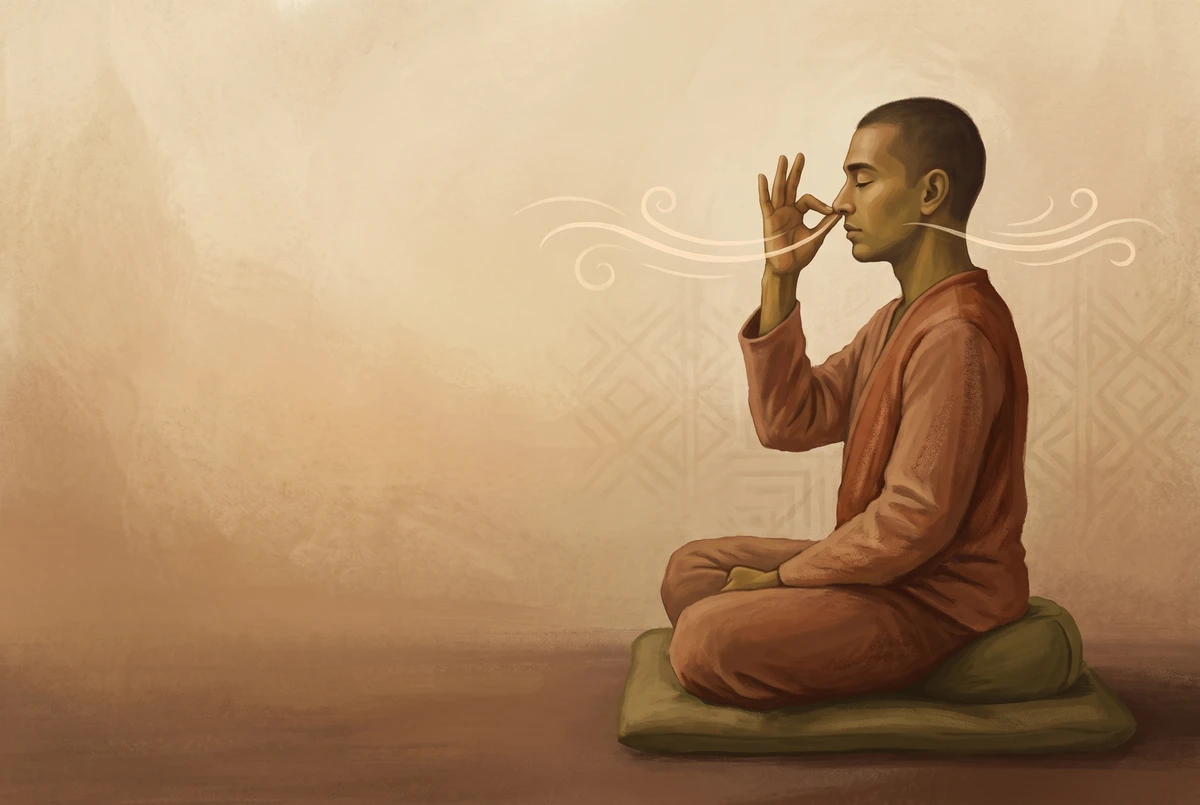
Bhramari (bee breath) is a humming exhalation: you close the ears and produce a low humming sound on the exhale. The internal vibration is thought to stimulate vagal branches in the pharynx and larynx, activating the parasympathetic nervous system. Research finds it produces immediate calming, useful for anxiety, insomnia, and as preparation before seated concentration practice (Nivethitha et al., 2016).
Kapalabhati (“skull-shining breath”) uses rapid, forceful exhalations followed by passive inhalations. Unlike the other two techniques, kapalabhati activates the sympathetic nervous system. It is energizing rather than calming, used for mental clarity rather than relaxation.
Pranayama is one of the best-studied areas of yoga research precisely because its effects on the autonomic nervous system are measurable and replicable.
Trataka (fixed-gaze concentration)
Trataka occupies a unique position in the system. It is classified as a shatkarma (purification practice) in the Hatha Yoga Pradipika (HYP 2:31-32), listed alongside practices like nasal cleansing (neti) and abdominal churning (nauli). But it is the only shatkarma that works directly on the mind, making it a bridge between physical purification and mental concentration.
The practice: gaze steadily at a fixed point (traditionally a candle flame, but also a yantra, a black dot, or a deity image) until the eyes water. Then close the eyes and hold the afterimage internally. The external phase (bahir trataka) develops the capacity for steady attention. The internal phase (antar trataka) carries that steadiness inward, toward meditation.
The Gheranda Samhita (17th century CE) confirms this dual classification, listing trataka both as purification and as preparation for dharana.
Research supports the concentration claim. A 2014 randomized controlled trial by Talwadkar and colleagues (n=60) found that one month of trataka practice significantly improved working memory, processing speed, and executive function in elderly participants. A 2016 study by Raghavendra and Singh measured immediate cognitive improvements following yogic visual concentration practice.
For readers who practice candle gazing and wonder whether it counts as “meditation”: it is formally a dharana (concentration) technique. Whether it becomes meditation depends on what happens after concentration stabilizes. That progression from external gaze to internal focus to effortless absorption is the classical trajectory the texts describe.
Chakra and Kundalini meditation
These practices share the same subtle-body framework. The model describes a central energy channel (sushumna nadi) running along the spine, with seven major chakras (energy centers) from the base of the spine (muladhara) to the crown of the head (sahasrara). Kundalini is described as dormant energy coiled at the base. Through pranayama, bandhas (muscular locks), mudras, and visualization, this energy is said to rise through the chakras, producing different experiential effects at each level. 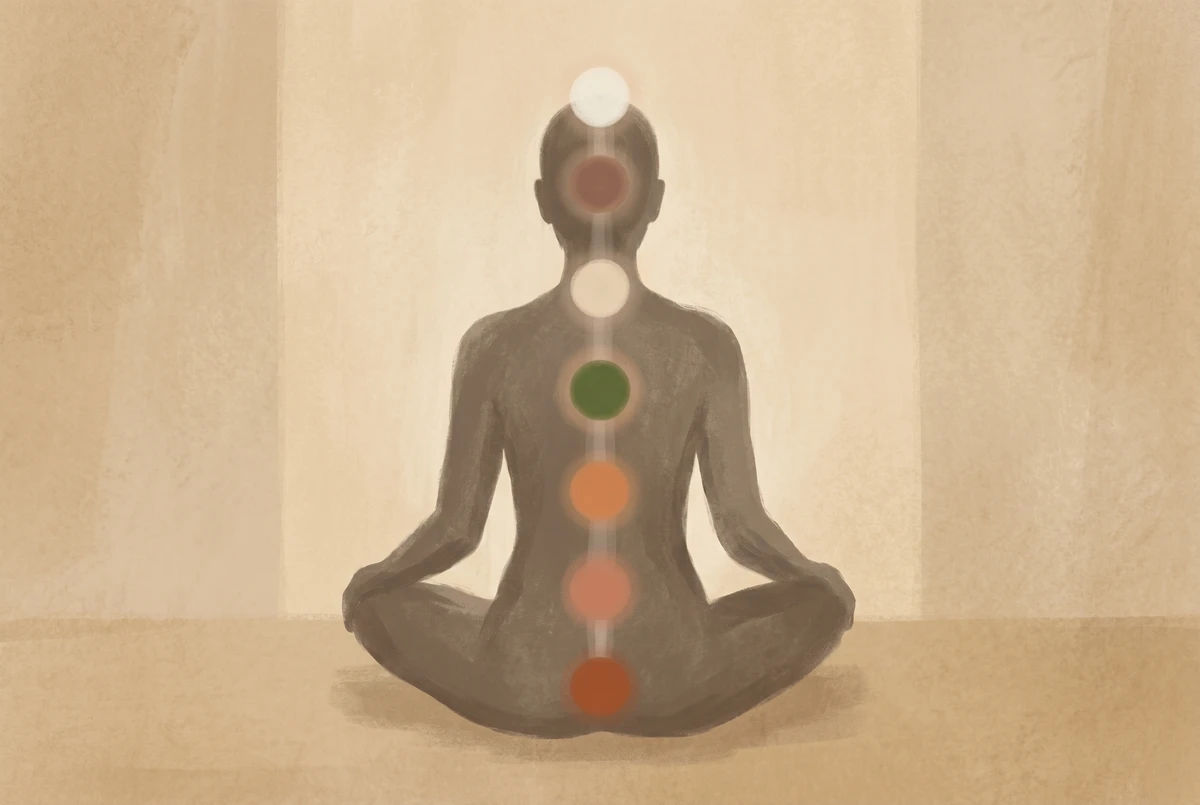
The practical distinction matters. Chakra meditation (visualizing and focusing awareness on individual energy centers) is accessible and widely practiced. You sit quietly, bring attention to the location of a specific chakra, and observe what arises. This is a dharana practice, and it carries no particular risk.
Kundalini awakening is a different matter. Deliberate activation of kundalini energy through intensive pranayama and visualization is an advanced practice. Traditional hatha yoga texts warn that uncontrolled energy movement can produce distressing physical and psychological symptoms. Basic chakra awareness meditation is safe for self-practice. Deliberate kundalini activation techniques should be learned under the guidance of a qualified teacher.
Self-inquiry (Atma Vichara)
Self-inquiry is the jnana yoga approach to meditation, and it works nothing like the other techniques in this article. There is no object to concentrate on, no mantra, no breath focus. Instead, you turn attention toward the sense of “I” itself, asking “Who am I?” and tracing every thought back to its source.
Ramana Maharshi (1879-1950) made this method famous in the modern era. He left home at age sixteen after a spontaneous experience in which he confronted the question of death and identity, and settled at Arunachala in southern India, where he spent the rest of his life teaching primarily through silence. When he did speak, his core instruction was always the same: inquire into the nature of the “I”-thought.
The method has deep roots in Advaita Vedanta, particularly the Upanishadic practice of “neti neti” (not this, not this): systematically negating everything that is not the Self until only pure awareness remains. Ramana did not invent self-inquiry; he distilled a contemplative tradition into its most direct form.
Where this sits in the system: self-inquiry bypasses the preparatory stages and goes directly to the goal. It requires a mind already somewhat settled. Ramana himself acknowledged this, recommending that practitioners start with breath awareness or silent repetition of “I” as a mantra before attempting pure self-inquiry.
Bhakti meditation (devotional practices)
The Bhagavad Gita describes the mechanism behind bhakti meditation: the mind takes on the qualities of whatever it contemplates. Meditating on a form that embodies divine qualities purifies the mind by association.
The primary bhakti techniques:
Deity visualization (roopdhyan) is meditating on the form of a chosen deity, holding the image in the mind’s eye with love and attention. Krishna instructs Arjuna to do exactly this in the Gita (6.47): fix the mind on the divine form. And in Gita 12.5, Krishna acknowledges that meditating on the formless Brahman is “very hard for embodied beings to reach,” which is why the personal, visual form is offered as a more accessible path.
Kirtan (call-and-response chanting) uses communal singing to focus the mind and evoke devotional feeling.
Puja (ritual worship) functions as meditative practice when performed with full attention. The physical actions of offering flowers, lighting incense, and ringing bells anchor awareness in the present, similar to how a mantra anchors the mind.
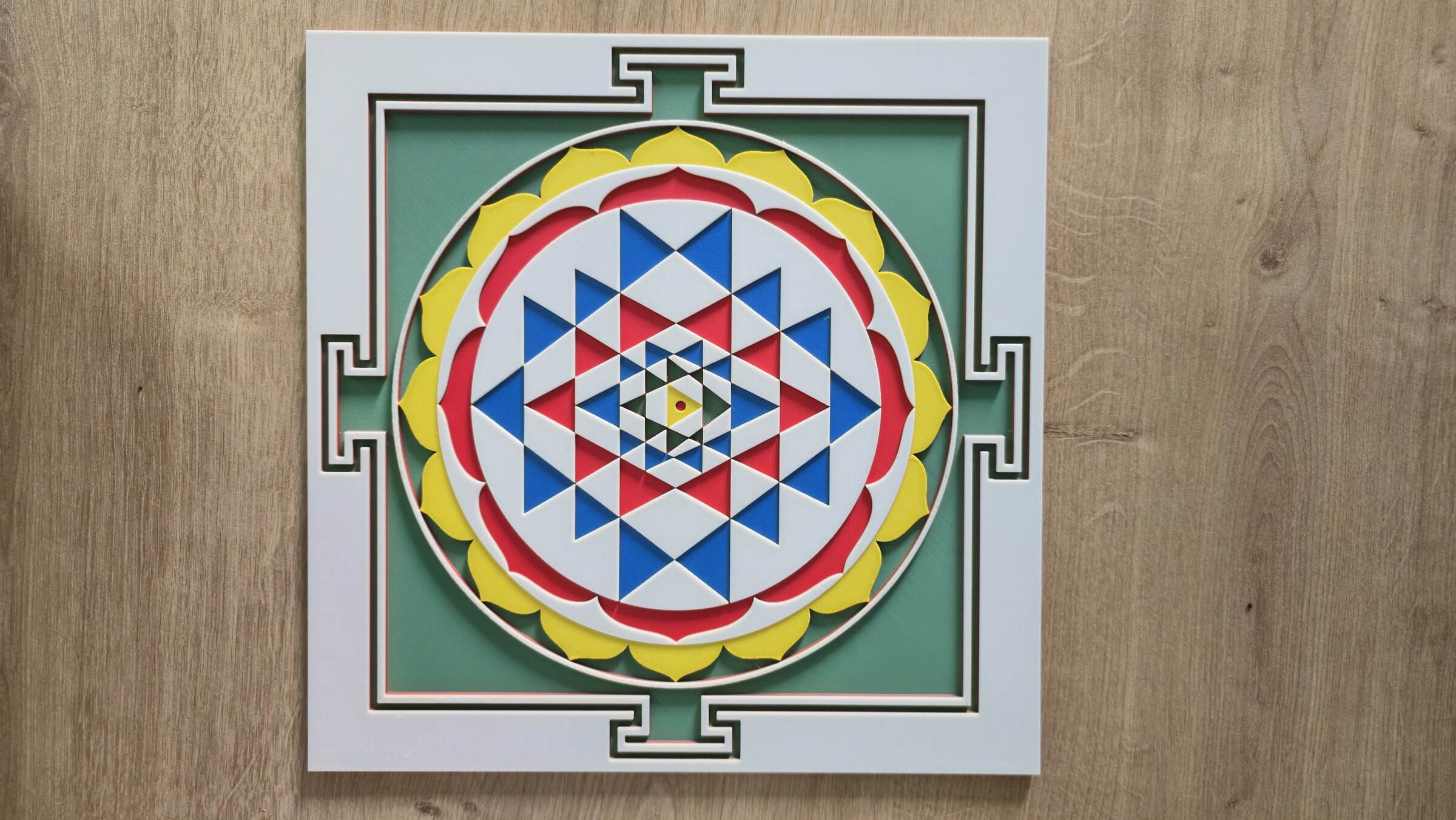
For those drawn to visual meditation objects, the Tantric tradition offers yantras: geometric diagrams representing specific aspects of the divine. The Sri Yantra, for example, represents the goddess Lalita Tripurasundari. Yantra meditation sits at the intersection of raja yoga (fixed-gaze concentration, trataka) and bhakti yoga (contemplation of the divine form), combining visual focus with devotional intent.
Yoga Nidra (yogic sleep)
Yoga Nidra is guided systematic relaxation while maintaining conscious awareness. The body sleeps; the mind stays awake.
The modern form was developed by Swami Satyananda Saraswati, founder of the Bihar School of Yoga (established 1964), who drew on the Tantric nyasa tradition (the ritual practice of sequentially placing awareness on different body parts). His 1976 book Yoga Nidra codified the technique into a structured protocol that could be taught and replicated.
Where it sits in the system: pratyahara, the fifth limb (sense withdrawal). The body scan systematically withdraws awareness from external stimuli, turning attention inward. This makes it a preparatory practice, not meditation proper, but a highly effective on-ramp.
Yoga Nidra is worth knowing about because it represents a different entry point than the other techniques here. You lie down rather than sit upright. You follow guidance rather than directing your own attention. For people who find seated concentration practices too intense, or who need to address chronic tension and sleep disruption before attempting more demanding techniques, Yoga Nidra offers a way in.
How Hindu meditation differs from Buddhist meditation
The core difference between these traditions is the goal, not the technique.
Hindu meditation (especially in the Yoga Sutra and Vedantic traditions) aims at union: realizing the identity of the individual self (atman) with the universal Self (Brahman). Buddhist meditation aims at insight: seeing the impermanent, non-self nature of all phenomena (anatta).
This produces different emphases in practice. Hindu meditation tends toward absorption: one-pointed concentration leading to samadhi, where the subject-object distinction dissolves into unity. Buddhist meditation (particularly vipassana) tends toward observation: clear, moment-to-moment seeing of phenomena as they arise and pass.
In practice, the techniques overlap substantially. Both traditions use breath awareness, mantra, visualization, and concentration. The frameworks and purposes diverge.
Rami Sivan, a Hindu priest and scholar, offers a useful observation: “Although meditation is the foundation of Hindu spiritual practice, it has been totally neglected and there are very few acharyas and gurus that actually focus on teaching this practice. The Buddhists have preserved the technique and actively propagate it.” Buddhism has been more effective at packaging meditation into teachable curricula (vipassana retreats, mindfulness programs). Hindu traditions preserved the theoretical framework but often neglected systematic practical teaching for ordinary practitioners.
A note on Vipassana specifically: as practiced today in the Goenka and Mahasi Sayadaw lineages, vipassana is a Buddhist technique rooted in the Pali texts. Hindu texts contain observation-based practices, and early Buddhism adapted older Brahmanical meditation methods (the Buddha’s own teachers, Alara Kalama and Uddaka Ramaputta, were Brahmanical meditators). The cross-tradition borrowing runs in both directions. But the term “vipassana” and its specific methodology belong to the Buddhist tradition.
How to choose a technique
Rather than “try them all and see what works,” here is guidance rooted in the yogic framework itself:
If your mind races and you need an anchor: Start with mantra meditation (japa) or trataka. Both give the mind a specific point to return to when it wanders. The mantra is auditory; trataka is visual. Choose based on which sense feels more natural to you.
If you are anxious or physically stressed: Start with pranayama, specifically Nadi Shodhana (alternate nostril breathing). Regulate the nervous system first. Trying to concentrate a stressed mind is like trying to read in a moving car.
If you are devotional by nature: Deity visualization (roopdhyan) or kirtan. These practices engage emotion directly, which is an advantage if your mind responds more to feeling than to discipline.
If you are intellectual and skeptical: Self-inquiry (atma vichara). But do some concentration practice first, because self-inquiry requires a mind that can stay with a question rather than immediately chasing new thoughts. Ramana Maharshi himself recommended this sequence.
If seated meditation feels impossible right now: Yoga Nidra. It works lying down, it’s guided, and it addresses the nervous system tension that makes seated practice difficult. Use it as an on-ramp, not a permanent substitute.
For everyone: The classical recommendation, consistent across the Yoga Sutras and the Hatha Yoga Pradipika, is to start with pranayama plus a simple dharana practice (mantra or trataka), establish daily consistency, and let the practice deepen naturally from concentration into meditation. The principle of abhyasa (sustained, devoted practice) from Yoga Sutra 1.14 argues against switching techniques constantly. Depth with one practice beats sampling many.
One last thing. The Vijnana Bhairava Tantra, a 7th-8th century Tantric text, describes approximately 112 distinct meditation techniques in 163 compressed verses. It covers breath awareness, body-center concentration, mantra, visualization, and non-dual awareness practices. If you exhaust the techniques above and want to go deeper, the scholarly translation by Jaideva Singh (1979) is the standard starting point. The text itself acknowledges the adhikara principle: no single technique works for everyone, and the practitioner’s temperament determines the most suitable method.
Sources
- Benson, H. & Klipper, M.Z. (1975). The Relaxation Response. William Morrow / HarperCollins.
- Nivethitha, L., Mooventhan, A. & Manjunath, N.K. (2016). “Effects of Various Prāṇāyāma on Cardiovascular and Autonomic Variables.” Ancient Science of Life. PMID 28446827, PMC5382821.
- Raghavendra, B.R. & Singh, P. (2016). “Immediate effect of yogic visual concentration on cognitive performance.” Journal of Traditional and Complementary Medicine, 6(1): 34-36. PMID 26870677.
- Singh, J. (1979). Vijnanabhairava or Divine Consciousness: A Treasury of 112 Types of Yoga. Motilal Banarsidass.
- Svātmārāma. Hatha Yoga Pradipika (15th century CE). Verses referenced: HYP 2:31-32 (trataka), HYP 4:29 (prana-mind link).
- Talwadkar, S.B., Jagannathan, A. & Raghuram, N. (2014). “Comparative assessment of concentration in trataka and non-trataka practitioners.” International Journal of Yoga, 7(2): 131-137. PMC4097909.
- Vyasa. Yogabhashya (c. 4th-5th century CE). Commentary on Yoga Sutra 3.2 (dhyana as continuous flow).
- Bhagavad Gita, Chapter 6 (Dhyana Yoga) and Chapter 12. Verses referenced: 6.19, 6.34-35, 6.47, 12.5.
- Gheranda Samhita (17th century CE). Chapter 1 (shatkarma classification).
- Mandukya Upanishad (c. 1st-2nd century CE). Om and the four states of consciousness.
- Yoga Sutras of Patanjali (c. 4th century CE). Verses referenced: YS 1.2 (definition of yoga), YS 1.14 (abhyasa), YS 3.1 (dharana), YS 3.2 (dhyana), YS 3.3 (samadhi).
- Satyananda Saraswati, Swami (1976). Yoga Nidra. Bihar School of Yoga.