History of Meditation: A 5,000-Year Pattern
Miha Cacic · April 11, 2026 · 7 min read
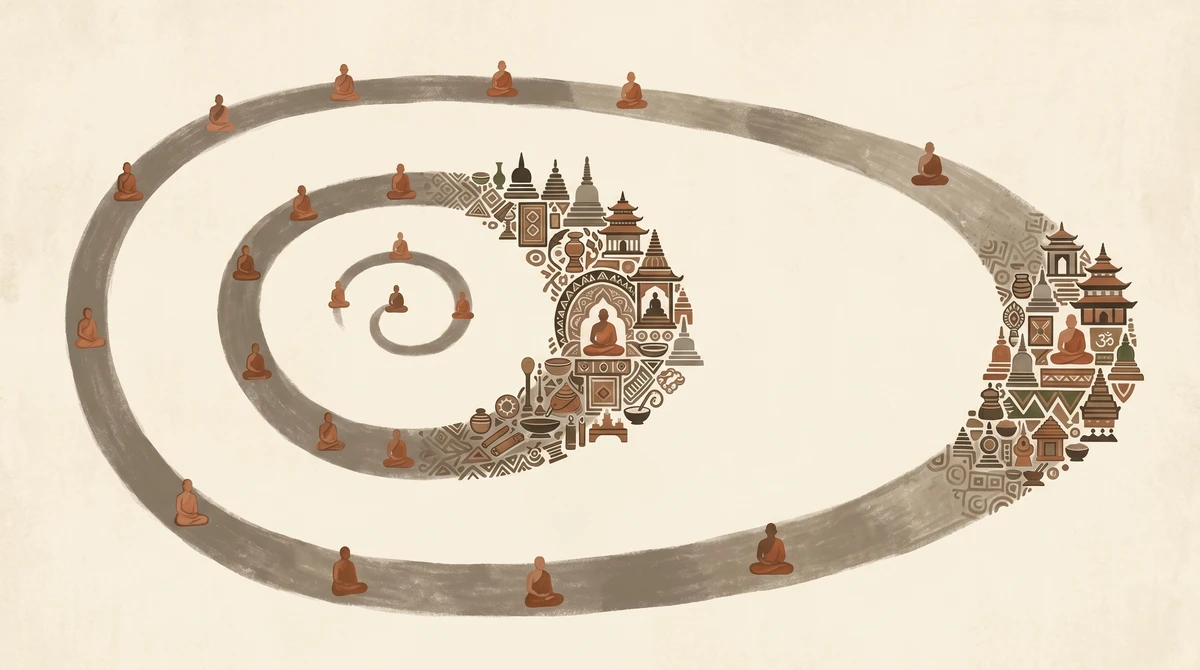
Meditation is at least 5,000 years old, and probably much older. But its history is not a straight line from ancient India to a smartphone app. It follows a repeating pattern: someone strips away complexity to make the practice more direct, that simplified version becomes an institution loaded with new complexity, and the next reformer strips it away again. The Buddha did it to Vedic ritualism. Zen did it to Buddhist scholasticism. Jon Kabat-Zinn did it to Zen. This pattern reframes the “traditional vs. modern” debate as the latest turn of a wheel that has been spinning for millennia.
The oldest evidence: fire, caves, and the first meditators
Nobody invented meditation. Like cooking or language, it emerged independently across cultures, which suggests it is a basic human capacity rather than any one tradition’s creation.
How far back does it go? That depends on what you count. Matt Rossano, an evolutionary psychologist at Southeastern Louisiana University, argued in a 2007 Cambridge Archaeological Journal paper that group meditation around campfires may have helped make us human. His hypothesis: firelight flickering in a dark setting demands sustained attentional focus, and groups of early humans practicing this together created conditions for ritual attention training that, over generations, may have strengthened working memory and favored gene mutations for enhanced cognition. Critics including Richard Klein at Stanford and Frederick Coolidge at the University of Colorado questioned whether the archaeological record can support such specific cognitive claims. The hypothesis remains speculative, but it raises a genuine possibility: deliberate attention training may predate agriculture. 
If you want something more concrete, the earliest visual evidence comes from the Indus Valley civilization. Wall art dating to roughly 5,000 to 3,500 BCE appears to depict figures in meditative postures, though interpreting ancient art is inherently uncertain. And since oral traditions preceded written records by centuries, the actual beginning is unknowable.
The simplest meditation techniques (gazing at a fixed point, repeating a sound, watching the breath) show up across cultures that had no known contact with each other. This points to meditation as something humans naturally arrive at, not something exported from a single source.
Vedic roots and the first formal systems (roughly 3,000 to 500 BCE)
The shift from loose contemplative practice to a formal system happened in India. The Vedas, composed around 1500 BCE in written form but transmitted orally for centuries before that, contain the first known meditation instructions. The rishis (seer-sages) reportedly heard cosmic hymns during deep meditation and passed them through generations of teachers, mouth to ear.
The Upanishads, the philosophical texts that followed (the oldest, the Brihadaranyaka and Chandogya, date to around the 7th to 6th century BCE), went further. They described dhyana, concentrated meditative focus on Brahman or Atman, and gave specific techniques. The Kaushitaki Upanishad 3.2 instructs: “With mind, meditate on me as being prana.” These were not vague suggestions. They were practice instructions embedded in a philosophical framework.
The codification continued. The Yoga Sutras of Patanjali (roughly 400 to 100 BCE) organized meditation into an eight-limbed system, with the final three limbs forming a progression: dharana (concentration), dhyana (sustained meditation), and samadhi (absorption). The Bhagavad Gita, Chapter 6, framed meditation as a spiritual duty, with Krishna giving Arjuna specific instructions on posture, diet, and mental focus.
What began as intuitive contemplation had become an elaborate system with written texts, priestly gatekeepers, and prescribed rituals. The practice gained structure, but it also gained barriers.
The great reformers of the Axial Age (6th to 5th century BCE)
Then came the simplifiers. In a period historians call the Axial Age, multiple reformers across disconnected cultures cut through inherited complexity.
The most famous was the Buddha (roughly 563 to 483 BCE, traditional dating). He trained under Vedic yogis, mastered their techniques, found them insufficient, and built his own approach. What he stripped away is as important as what he kept. Gone was Vedic ritualism, priestly hierarchy, and metaphysical speculation about the nature of Brahman. In their place: direct observation. The Satipatthana Sutta, his foundational mindfulness text, lays out four objects of attention (body, feelings, mind, and mental formations) and says, in effect: watch what is actually happening.
His contemporary Mahavira took a parallel path. Jain meditation (samayika) emphasized equanimity and radical self-purification, traditionally practiced in daily 48-minute sessions. Different philosophy, same impulse: strip the practice back to its essential mechanics.
In China, a similar pattern played out. The Neiye (“Inward Training”), dating to the 4th century BCE and the oldest extant Chinese meditation text, described breath techniques and the cultivation of vital force without the ritual apparatus of Chinese court religion. Zhuangzi, writing around the same period, described zuowang (“sitting forgetting”), the dissolution of the self into the natural flow of the universe. In one passage, the student Yan Hui describes zuowang as “dropping off the body and mind, detaching from both understanding and practice, joining the Great Thoroughfare.” Even Confucius, his teacher in the story, concedes this is superior. 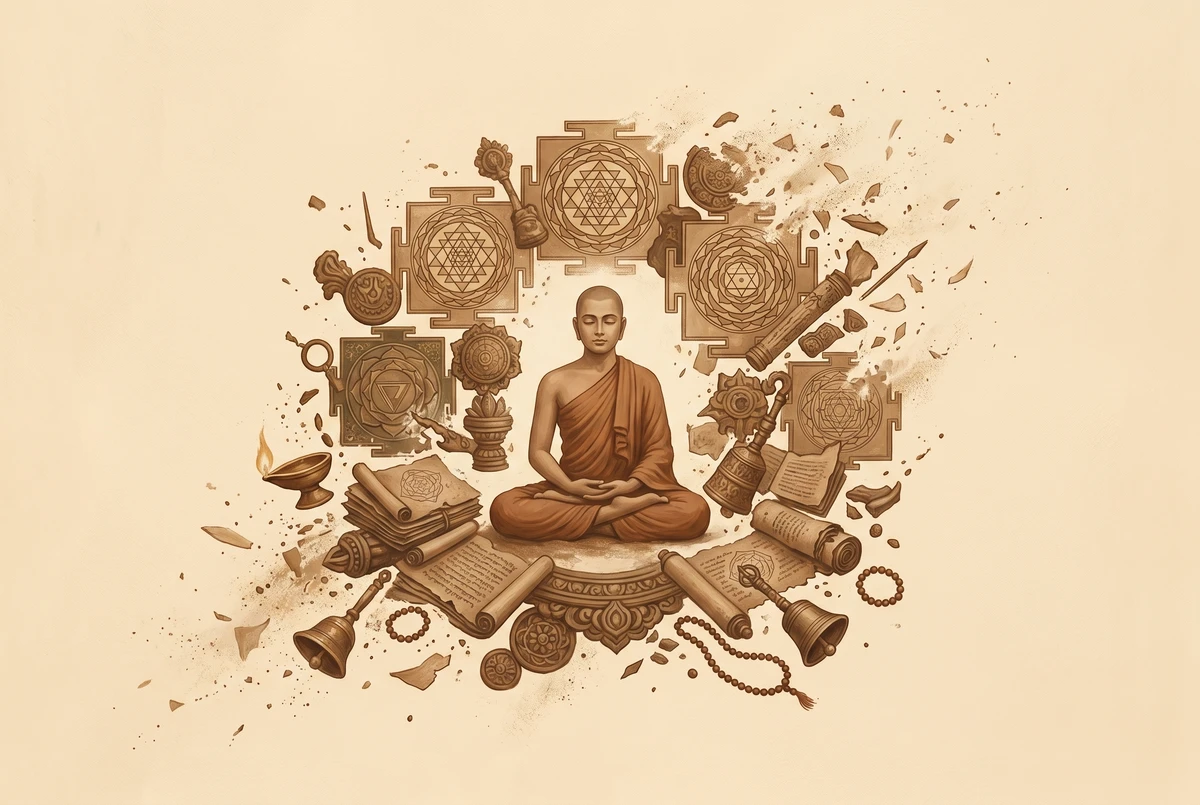
Each reformer began with an inherited tradition that had accumulated layers of institutional complexity, and each one cut back to direct experience.
Meditation travels the world
As Buddhism traveled the Silk Road from India through Central Asia to China, Korea, Japan, and Southeast Asia, the practice changed shape in every culture it entered. But contact was not the only driver. Cultures with no direct connection to India arrived at strikingly similar practices through entirely different doors.
Greek philosophers developed contemplative traditions influenced in part by contact with Indian thought via Alexander the Great’s campaigns around 327 BCE. Plotinus (3rd century CE) developed henosis, a meditative practice of union with the One, which later influenced Jewish, Christian, and Islamic mysticism.
Jewish meditation has its own lineage. The Torah describes Isaac going out “lasuach” in the field, which the rabbi and physicist Aryeh Kaplan (1985) identified as a meditative practice. Kabbalistic visualization and hitbodedut (meditative self-seclusion) developed as distinct contemplative traditions within Judaism.
Christianity built sophisticated meditation systems without borrowing from the East. The Desert Fathers in 3rd-century Egypt practiced hesychia (inner stillness). Eastern Orthodox monks on Mount Athos developed hesychasm, using the Jesus Prayer (“Lord Jesus Christ, Son of God, have mercy on me, a sinner”) as a mantra-like repetition coordinated with breathing. In the 16th century, Teresa of Avila and Ignatius of Loyola created detailed contemplative frameworks within the Catholic tradition.
Sufi meditation (muraqabah) drew on both Abrahamic monotheism and influences from Indian and Neoplatonist sources. Practices like dhikr (rhythmic repetition of divine names) and sama (meditative listening, including the whirling meditation of Rumi’s tradition) use the same core mechanics: breath focus, repetition, concentrated attention. 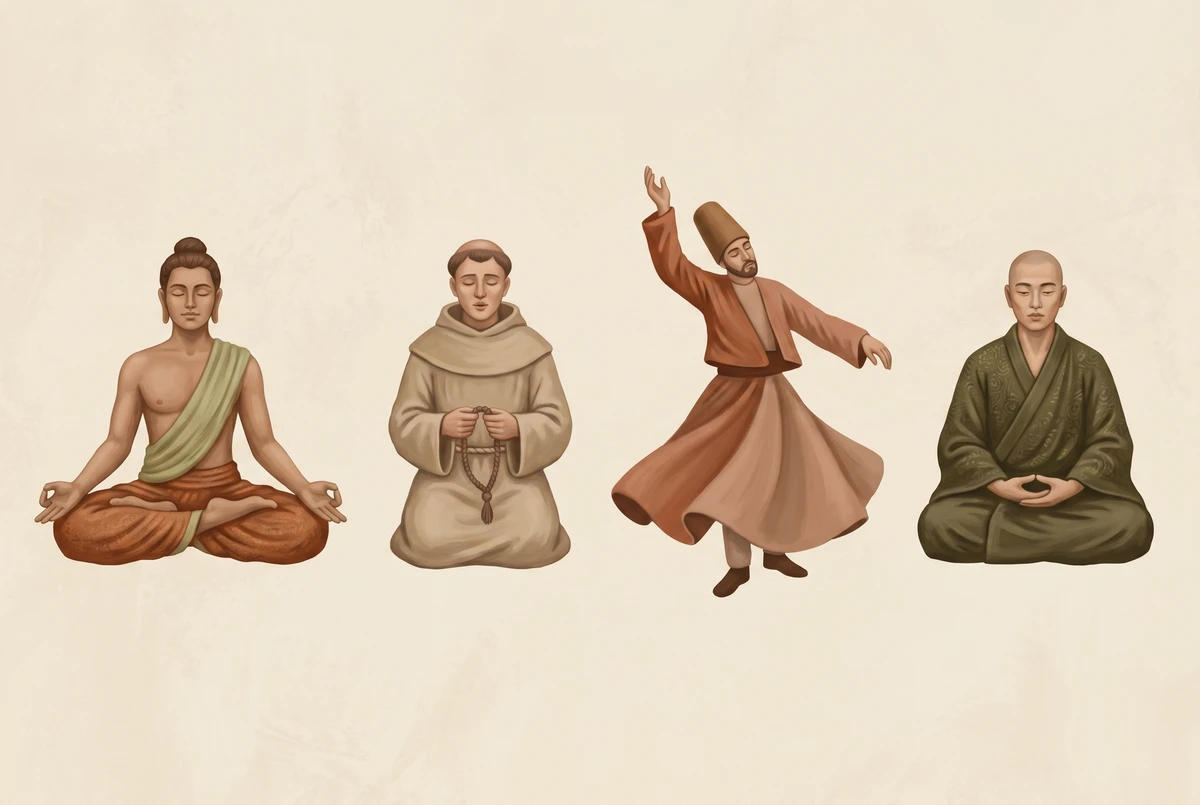
What stands out across these traditions is convergence on a handful of techniques. Breath-focused attention appears as pranayama (Hindu/Buddhist), counted breathing (Zen), the Jesus Prayer (hesychasm), and zikr (Sufi). Mantra repetition shows up as sacred syllables (Vedic), nembutsu (Pure Land Buddhism), dhikr (Sufi), and the rosary (Catholic). Body awareness takes the form of yoga asana, walking meditation (Buddhist), and tai chi (Taoist). Some of this convergence reflects cultural transmission along trade and conquest routes. But these techniques also emerge in traditions with no known contact, which suggests the human nervous system responds to similar inputs in similar ways regardless of the theology wrapped around them.
The monastic centuries: when meditation required a lifetime
For most of recorded history, serious meditation meant leaving ordinary life. Buddhist monasteries in Asia developed elaborate training systems with years of progressive instruction, specialized lineages, and strict hierarchy. Tibetan Buddhism created what may be the most complex meditation systems ever devised: visualization practices, deity yoga, and tantric methods that required decades of dedicated study. Christian contemplative orders (Benedictines, Trappists, Carmelites) treated meditation as a full-time vocation.
The reform-and-institutionalize pattern kept turning even within these monastic walls. Zen is the clearest example. When Bodhidharma brought meditation from India to China in the 5th or 6th century CE, the essence was radical simplicity: “A special transmission outside scriptures, not founded on words and letters, pointing directly at the human mind, seeing into one’s nature and attaining Buddhahood.” Just sit. Pay attention.
But Zen itself accumulated complexity. Koan study became a formal system. Teacher certification (dharma transmission) developed its own politics. Monastic codes grew elaborate. When Dogen returned from China around 1227 and wrote Fukanzazengi (his zazen instructions), he was pushing back toward simplicity. The reformer’s work is never done.
Meanwhile, something quieter happened in Burma that would shape meditation’s future. In the mid-20th century, lay teachers like U Ba Khin began teaching vipassana meditation outside monastic settings. His student S.N. Goenka, a businessman with no monastic training, would later carry this approach worldwide. The seed was planted: deep meditation practice did not require monastic commitment.
From monasteries to mainstream
The most dramatic turn took roughly 150 years, and it started in the West.
Before anyone in the West was meditating, they were reading about it. European philosophers like Schopenhauer and American Transcendentalists like Emerson and Thoreau admired Eastern contemplative traditions through translated texts but remained spectators. That changed on September 11, 1893, when Swami Vivekananda addressed the Parliament of World’s Religions in Chicago. He opened with “Sisters and Brothers of America!” and received a two-minute standing ovation from an audience of 7,000. The New York Herald called him “undoubtedly the greatest figure in the Parliament of Religions.” This was the first large-scale introduction of Hindu philosophy, yoga, and meditation to the American public. Over the following decades, teachers like Paramahansa Yogananda established organizations in the West, but meditation remained niche.
The 1960s changed everything. The Beatles traveled to Rishikesh, India in February 1968 to study Transcendental Meditation with Maharishi Mahesh Yogi. They stayed for weeks (Ringo lasted about ten days; Lennon and Harrison stayed until April 12). TM enrollment surged. Maharishi appeared on major U.S. talk shows. Meditation entered mainstream conversation.
Around the same time, scientists started paying attention. Herbert Benson at Harvard Medical School, reportedly working late at night to avoid institutional resistance, studied Transcendental Meditation practitioners with Robert Keith Wallace. Their findings, published in Scientific American in 1972, showed that meditators experienced reduced oxygen consumption, lower heart rate, decreased breathing rate, and increased alpha wave production. Benson coined the term “relaxation response” to describe meditation’s physiological effects as the mirror image of the stress response.
In 1971, Swami Rama demonstrated something more startling at the Menninger Foundation in Topeka, Kansas. Under laboratory conditions, he increased his heart rate to 300 beats per minute, causing ventricular pumping to stop for 17 seconds while he remained conscious. He created a 5°C (9°F) temperature differential between two spots on the same palm, at will. He produced alpha, theta, and then delta brain waves while staying fully awake and responsive. These feats had been considered physiologically impossible. They were documented by Elmer and Alyce Green and published in their 1977 book “Beyond Biofeedback.”
Then came the pivotal simplification. In 1979, Jon Kabat-Zinn, a molecular biologist who had studied Zen under Korean Zen Master Seungsahn and practiced vipassana and yoga, founded the Stress Reduction Clinic at the University of Massachusetts Medical Center. His patients were chronic pain sufferers referred by physicians who had run out of options.
Kabat-Zinn deliberately stripped Buddhist framing from the practice. He later described his intent: to take “the heart of something as meaningful, as sacred if you will, as Buddha-dharma and bring it into the world in a way that doesn’t dilute, profane or distort it, but at the same time is not locked into a culturally and tradition-bound framework that would make it absolutely impenetrable to the vast majority of people.”
What he kept: attention training, body awareness, non-reactivity. What he removed: Buddhist ethics (sila), liberation as a goal, community (sangha) structure, any mention of Buddhism. The program, originally called the Stress Reduction and Relaxation Program, became Mindfulness-Based Stress Reduction (MBSR) and the template for secular meditation worldwide.
Traditional vs. modern: a tension that has always existed
The debate over whether secular mindfulness is “real” meditation generates real frustration on both sides. Traditional practitioners argue that stripping meditation from its ethical and spiritual context changes what the practice is and what it can do. Miguel Farias and Catherine Wikholm wrote in The Conversation (2015) that “Buddhist meditation was designed not to make us happier, but to radically change our sense of self and perception of the world.” Clark Strand, a former Zen monk, put the critique more sharply: “Once you remove them from the spiritual context, goals default to those of the culture.”
The secular side has its own argument: accessibility matters. According to National Health Interview Survey data, U.S. adult meditation practice more than doubled from 7.5% in 2002 to 17.3% in 2022, surpassing yoga as the most commonly practiced complementary health approach. That growth happened because the barrier to entry dropped.
Jenny Wilks’s 2014 analysis for the Barre Center for Buddhist Studies mapped the trade-off. Traditional practice includes an ethical framework (sila), a community of practice (sangha), depth practices like jhanas and extended retreats, teacher-student transmission, and a liberatory goal. Secular practice offers clinical accessibility, scientific credibility, no religious requirement, and immediate applicability. They serve different purposes.
And secular mindfulness is already developing its own institutional complexity. MBSR teacher certification now takes years and costs thousands of dollars. Proprietary meditation apps compete for market share. Corporate wellness contracts are a growing industry. The simplified version is institutionalizing. If the pattern holds, the next reformer is already out there somewhere.
Where does this leave you? For stress relief, a guided app works. For the kind of transformation the original traditions describe, depth practices still require depth commitment. The 5,000-year pattern suggests that both paths will keep existing, in tension, for as long as humans meditate.
Sources
- Rossano, M. J. (2007). “Did Meditating Make Us Human?” Cambridge Archaeological Journal, 17(1), 47–58.
- Wallace, R. K. & Benson, H. (1972). “The Physiology of Meditation.” Scientific American, 226(2), 84–90.
- Green, E. & Green, A. (1977). Beyond Biofeedback. Delacorte Press.
- Farias, M. & Wikholm, C. (2015). “Mindfulness Has Lost Its Buddhist Roots, and It May Not Be Doing You Good.” The Conversation. https://theconversation.com/mindfulness-has-lost-its-buddhist-roots-and-it-may-not-be-doing-you-good-42526
- Wilks, J. (2014). “Secular Mindfulness: Potential and Pitfalls.” Barre Center for Buddhist Studies. https://www.buddhistinquiry.org/article/secular-mindfulness-potential-pitfalls/
- National Center for Complementary and Integrative Health (NCCIH). “Meditation: In Depth.” https://www.nccih.nih.gov/health/meditation-in-depth
- Kaplan, A. (1985). Jewish Meditation: A Practical Guide. Schocken Books.
- Kabat-Zinn, J. (1990). Full Catastrophe Living: Using the Wisdom of Your Body and Mind to Face Stress, Pain, and Illness. Delacorte Press.